Restoration Contractor Software. Built by construction pros with honest pricing.
The call comes at 2 AM. A pipe burst, there's standing water, and the homeowner needs you there now. Projul gives restoration contractors a single platform to manage emergency mitigation, document everything for insurance, track moisture readings, and coordinate the rebuild - all before the adjuster shows up. Rated 9.8 on G2 by contractors who don't have time for clunky software.
- Dispatch crews to emergency mitigation calls and document conditions on arrival
- Log moisture readings, photos, and containment setups for insurance documentation
- Coordinate remediation, rebuild, and specialty trades on one project timeline
- Generate detailed job records that hold up when the insurance adjuster pushes back
- Track equipment deployment - dehumidifiers, air movers, monitoring devices - per job
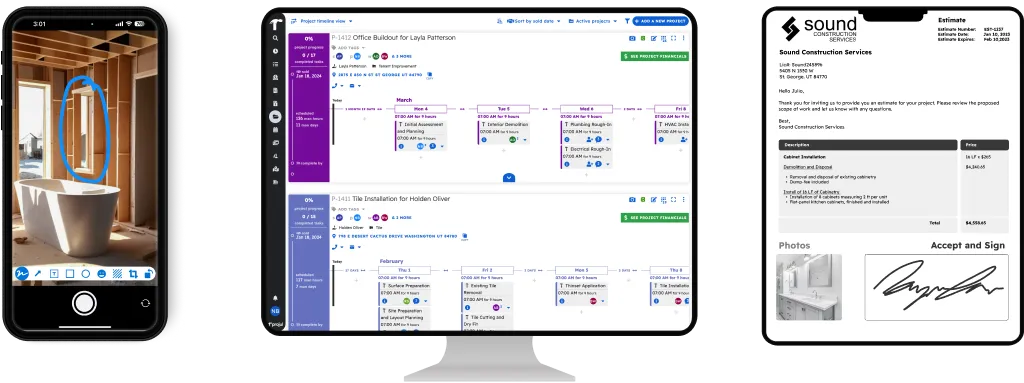
What Is Restoration Contractor Software?
Restoration contractor software is a project management platform that helps restoration companies manage emergency response, insurance documentation, moisture monitoring, equipment tracking, and multi-phase rebuild coordination. Projul gives restoration contractors one place to run mitigation and rebuild operations so nothing gets lost between the emergency call and the final invoice.
Projul’s restoration contractor software helps restoration companies manage emergency response, insurance documentation, and multi-phase rebuild coordination from one platform built by construction professionals who understand urgent timelines. Projul offers flat-rate pricing with no per-user fees for construction companies of all sizes.
Restoration work is unlike any other trade. You do not get to plan your week on Monday morning. The phone rings at 2 AM with a flooded basement. A fire destroys a kitchen on a Saturday afternoon. A slow roof leak creates a mold problem that nobody noticed for six months. You respond, you mitigate, you document, you rebuild, and you fight with insurance to get paid.
Restoration contractor software like Projul exists to bring order to that chaos. It keeps your emergency dispatch organized, your insurance documentation bulletproof, and your rebuild coordination tight. Over 5,000 contractors trust Projul to keep their operations running.
Manage Emergency Mitigation and Rebuild From One Platform
The call comes at 2 AM. A pipe burst, there is standing water, and the homeowner needs you there now. By the time your crew arrives, the clock is already ticking on secondary damage. Every hour of standing water means more damage to subfloors, drywall, and cabinets. Every hour without documentation means weaker insurance claims.
Projul gives restoration contractors a single platform to manage emergency mitigation, document everything for insurance, track moisture readings, and coordinate the rebuild. All before the adjuster shows up. Rated 9.8 on G2 by contractors who do not have time for clunky software.
Your restoration contractor software should match the urgency of your work. When a crew gets dispatched, they need job details on their phone in seconds, not after someone in the office logs into a computer and emails them a work order.
Emergency Response Dispatching
Speed matters in restoration. The faster you arrive, the less secondary damage occurs, and the stronger your relationship with the homeowner and the insurance company. TPA programs grade you on response time. Homeowners remember who showed up fast and who did not.
Projul’s scheduling and notification system lets you assign emergency mitigation calls to available crews at any hour. The dispatched crew sees the job details, client contact info, and site address on their phone immediately. They start documenting conditions before they finish setting up containment.
After-Hours Dispatch Workflow
When a call comes in at 2 AM, your on-call coordinator creates the project in Projul, assigns the available crew, and the notification goes out instantly. The crew sees the address, the loss type (water, fire, mold, storm), and any special instructions. By the time they arrive on site, the project record is already started. They begin logging photos and moisture readings from minute one.
Restoration contractor software that handles after-hours dispatch without friction means faster response times, better documentation, and stronger TPA compliance scores.
Insurance Claim Management
Insurance work is where restoration contractors make or lose their money. A well-documented claim gets paid in full. A poorly documented claim gets cut, delayed, or denied. The difference is your project record.
Projul creates a timestamped project record that holds up to adjuster scrutiny. Every photo, moisture reading, material used, and labor hour is logged against the project with dates and times. When an insurance company questions your scope or pricing, you have a documented chain of evidence from first response through final remediation.
Working With Xactimate Estimates
Most insurance carriers price restoration work using Xactimate line item pricing. Your Xactimate estimate defines what insurance will pay. Your actual costs determine whether you make money on the job. These are two different numbers, and you need to track both.
Projul does not directly import Xactimate files, but you can attach Xactimate estimates and supplements to any project record as reference documents. Your Projul estimate then serves as your internal job costing tool to track actual costs against the approved claim amount. This gives you two views: what insurance approved and what the job actually costs you.
Over 5,000 contractors use Projul to keep those numbers straight. Restoration contractor software that separates insurance pricing from actual job costing protects your margins and gives you data to negotiate supplements when the scope changes.
Supplements and Scope Changes
Every restoration job involves scope changes. You open a wall to dry the cavity and find mold behind the drywall. The adjuster approved drying, not mold remediation. Now you need a supplement. Without documentation of when and how you discovered the additional damage, the supplement gets denied.
Projul timestamps every entry on the project record. When your crew opens the wall, they photograph the mold, note the discovery in the project, and your office writes the supplement with supporting evidence. Your restoration contractor software creates the paper trail that gets supplements approved.
Water Damage Workflows
Water damage is the most common restoration call. Pipe bursts, appliance failures, roof leaks, and storm flooding all create water intrusion that needs immediate mitigation. The workflow follows a predictable pattern: extract standing water, set up drying equipment, monitor moisture levels, remove damaged materials, and rebuild.
Projul manages this workflow as a series of connected tasks on the project timeline. Each step has documentation requirements, and your crew captures them from the field.
Extraction and Setup
Your crew arrives, documents initial conditions with timestamped photos, extracts standing water, and sets up containment and drying equipment. Projul logs the arrival time (automatically through geofencing), the photos, and the equipment deployed. The project record starts building the insurance documentation from the first minute on site.
Drying and Monitoring
Water damage drying typically takes three to five days depending on the materials affected and the severity. Your crew monitors moisture levels daily and adjusts equipment placement as needed. Projul tracks each moisture reading with the date, location in the structure, and the reading value. This creates the moisture mapping that insurance companies and IICRC standards require.
Fire Damage Workflows
Fire restoration combines structural assessment, smoke and soot cleanup, odor removal, and rebuild. The scope is often larger and longer than water damage, and the insurance documentation requirements are more complex.
Projul manages fire damage projects with the same phase-based approach. Mitigation (board-up, tarping, debris removal) flows into remediation (cleaning, deodorizing, content handling) which flows into rebuild (structural repair, finishes, fixtures). Each phase has its own budget, crew assignments, and inspection requirements.
Your restoration contractor software tracks all three phases on one project record. The adjuster sees a clean timeline from emergency response through completion. Your office sees the costs by phase so you know where the margin is.
Mold Damage Workflows
Mold remediation carries additional complexity because of health risks, containment requirements, and post-remediation verification testing. IICRC S520 standards define the protocols, and your documentation needs to prove you followed them.
Projul helps mold remediation contractors document containment setup, HEPA filtration, removal of affected materials, and post-remediation clearance testing. Photographs of containment barriers, negative air pressure readings, and clearance test results all go on the project record.
Post-Remediation Verification
Most mold remediation protocols require a third-party industrial hygienist to verify that the remediation was successful. Projul lets you schedule the verification testing as a project task and attach the clearance report to the job record. Your restoration contractor software maintains the complete chain of documentation from initial assessment through clearance.
Moisture Monitoring and Documentation
Moisture monitoring is the backbone of water damage restoration. Without documented moisture readings, you cannot prove that the structure dried to acceptable levels. Insurance companies require this documentation. IICRC S500 standards require it. And your professional reputation depends on it.
Projul lets you log moisture readings as project notes or checklist items with location tags, dates, and values throughout the drying process. Track readings from initial assessment through clearance testing all in one project file.
Creating a Moisture Map in Projul
Log readings by room and by material (subfloor, drywall, framing, concrete). Record the reading location, the date, and the value. Over the course of the drying process, these readings create a moisture map that shows progressive drying. Insurance adjusters and IICRC-certified restorers both reference this data when evaluating your work.
Restoration contractor software that makes moisture documentation simple means your crews actually do it. If the documentation process is complicated, it gets skipped. Projul makes it fast so your field crews log readings as part of their daily routine.
Contents Inventory and Pack-Out
Many restoration jobs involve contents handling. Furniture, clothing, electronics, and personal items need to be documented, packed, cleaned, stored, and returned. A missing item or a damaged piece becomes a dispute between you, the homeowner, and the insurance company.
Projul lets you create contents inventory lists on the project record with photos, descriptions, and condition notes. Document each item before pack-out. Note the condition on arrival at your warehouse. Document the condition after cleaning and before pack-back. This inventory process protects you against claims of loss or damage.
For large losses with hundreds of content items, this documentation is the difference between a smooth job and a nightmare of disputed claims. Your restoration contractor software should make contents tracking fast enough that your crew does it consistently.
Mitigation vs. Rebuild Phases
Restoration projects have two distinct phases: mitigation (stopping the damage and drying the structure) and rebuild (repairing what was damaged). These phases often involve different crews, different subcontractors, different budgets, and sometimes different insurance claim numbers.
Projul manages mitigation and rebuild as connected phases within the same project. When your mitigation crew clears the structure, the rebuild phase activates with its own schedule, sub assignments, and budget. Drywall, paint, flooring, and specialty trades get sequenced properly. Your project manager sees both phases on one screen instead of juggling separate tracking systems.
Rebuild Coordination
The rebuild phase of a restoration project is essentially a construction project. You coordinate drywall, paint, flooring, cabinets, plumbing, and electrical. Your restoration contractor software handles this exactly the way construction management software would, because it is construction management. Schedule subs, track costs against the approved insurance scope, and invoice for completed work.
Projul gives restoration contractors the rebuild management tools they need without requiring a separate platform. One project, two phases, one record.
IICRC Compliance
IICRC standards (S500 for water damage, S520 for mold, S540 for trauma scene) define the industry protocols for restoration work. Following these standards is not optional if you want to maintain your IICRC certification and satisfy TPA program requirements.
Projul helps you document IICRC compliance on every project. Build checklists based on the applicable standard. Log the required documentation at each step. Store the complete record on the project file.
When an auditor reviews your work for TPA compliance or when a homeowner’s attorney questions your methods, your project record shows that you followed established protocols. Restoration contractor software with built-in compliance documentation is not a nice-to-have. It is how you protect your company.
TPA Program Management
Third-Party Administrator programs (ServPro, ATI, Contractor Connection, etc.) are major lead sources for restoration contractors. These programs come with strict requirements for response times, documentation formats, pricing guidelines, and customer satisfaction scores.
Projul helps you track TPA program requirements per project. Log your response times so you can prove compliance during program audits. Track customer satisfaction follow-ups as project tasks. When a TPA requires specific documentation within their timeline, your restoration contractor software makes sure your team delivers it.
Response Time Tracking
Most TPA programs require on-site response within one to four hours of the initial call. Projul’s geofencing automatically logs when your crew arrives on site. Compare that arrival time against the initial call timestamp and you have documented proof of your response time. This data feeds directly into your TPA compliance reporting.
If your restoration company also handles waterproofing projects, our free waterproofing estimate templates provide ready-made bid formats for basement and foundation waterproofing jobs.
Equipment Tracking Across Multiple Jobs
Restoration contractors deploy expensive equipment: dehumidifiers, air movers, air scrubbers, hydroxyl generators, moisture meters, and thermal imaging cameras. Keeping track of which equipment is at which job, when it was deployed, and when it needs to come back is a logistics challenge.
Projul tracks equipment as resources tied to specific jobs. See which dehumidifiers are deployed where and when they are due for pickup. When you need to move air movers from a completed dry-out to a new loss, you know exactly which units are available without calling every crew in the field.
Equipment rental charges on restoration jobs add up fast. Documenting deployment and pickup dates in your restoration contractor software supports your billing when the adjuster questions why six dehumidifiers ran for five days.
Your Mitigation Crews Document Everything From the Field
When your crew arrives at a flooded basement at 3 AM, they need to start documenting immediately. Projul’s native mobile app lets them upload moisture readings, damage photos, and equipment logs right from the site. Geofencing tracks arrival times automatically, which matters when the insurance adjuster wants to see how fast you responded.
Everything syncs to the project record in real time so your office has the full picture before the sun comes up. Your restoration contractor software needs to work at 3 AM on a wet phone in a dark basement. Projul’s mobile app was designed for exactly that situation. G2 users rate it 9.8 for ease of use.
Job Costing: Insurance Approved vs. Actual Cost
The biggest financial risk in restoration is the gap between what insurance approves and what the job actually costs you. If your actual labor and material costs exceed the approved amount, you lose money. If your costs are well below the approved amount, you are profitable.
Projul tracks both numbers on every project. Your Xactimate estimate represents the insurance side. Your Projul job costing tracks the actual side. Compare them in real time so you know whether a project is profitable before you finish it, not after.
Restoration contractors using Projul report a 32% increase in profitability because they capture every billable item, document properly for supplements, and keep rebuild timelines from dragging out. That margin improvement comes from better data, not harder work.
Insurance Claim Documentation That Gets You Paid
The number one reason restoration contractors lose money on insurance jobs is weak documentation. An adjuster walks the site, disagrees with your scope, and your only proof is a few photos on someone’s phone and a handwritten note about what got torn out. That is not enough to win a dispute, and it is definitely not enough to get a supplement approved.
Projul builds your insurance claim documentation automatically as your crew works. Every photo gets a timestamp and ties to the project. Every moisture reading logs with a date and location. Every material your crew installs or removes gets tracked in the project record. When the adjuster asks why you removed cabinets that looked fine from the outside, you pull up the photo showing 40% moisture content behind the kick plate, dated two hours after arrival.
The real cost of bad documentation hits you on supplements. Say your crew opens up a wall during water mitigation and finds mold behind the drywall. The original scope covered drying only. You need a supplement for mold remediation, which could be $8,000 to $15,000 depending on the affected area. Without a timestamped photo of the discovery, a moisture reading showing elevated levels in the cavity, and a note in the project record documenting when and how you found it, the insurance company denies the supplement. You either eat the cost or leave the mold for someone else.
Restoration contractors running five to ten insurance jobs per month can lose $20,000 or more per year on denied supplements alone. That money does not disappear because the work was not done. It disappears because the paperwork was not there. Projul fixes that by making documentation part of the workflow, not an afterthought your crew has to remember at the end of a 14-hour day.
Build your documentation habit around three checkpoints per job: arrival condition photos with moisture readings, mid-project discovery documentation for any scope changes, and completion photos with final readings. Projul’s mobile app makes each checkpoint take less than five minutes. That small investment protects thousands of dollars on every claim.
Emergency Response Scheduling for 24/7 Operations
Restoration is not a 9-to-5 business. Pipes burst at midnight. Storms hit on weekends. A fire can happen at any hour. Your ability to respond fast determines whether you win the job, satisfy TPA response time requirements, and limit secondary damage that eats into your margin.
The problem most restoration companies face is not willingness to respond. It is coordination. Your on-call tech gets the call at 2 AM, but does not know which crew members are available. The office is closed. The dispatcher is asleep. By the time everyone figures out who is going where, an hour has passed and the homeowner is standing in six inches of water wondering if they called the right company.
Projul’s scheduling system solves this by giving your on-call coordinator visibility into crew availability at any hour. Create the project from your phone, assign the available crew, and the notification goes out instantly. Your crew sees the address, loss type, homeowner contact info, and any special instructions before they leave the house. Response time drops from 90 minutes to 30 minutes, and that speed difference matters to both the homeowner and the TPA program scoring your performance.
For companies running multiple crews across a metro area, emergency scheduling gets more complex. You might have three calls come in during the same storm. Projul shows you which crews are already deployed and which are available. Assign the closest available crew to each call instead of sending your best team across town while a closer crew sits idle. That kind of dispatch intelligence saves drive time, fuel, and most importantly, response time.
Track your average response times in Projul over 30, 60, and 90 day windows. TPA programs audit these numbers. Insurance carriers use them to decide whether to keep you on their preferred vendor list. A restoration company that can document consistent sub-60-minute response times wins more program work than one that guesses at their numbers. Your restoration contractor software should give you this data without anyone building a spreadsheet.
Set up your on-call rotation in Projul’s schedule so everyone knows their nights and weekends in advance. When the call comes in, there is no confusion about who responds. The on-call coordinator assigns the project, the crew gets notified, and the clock starts. That is how professional restoration companies operate, and it is exactly what Projul was built for.
Mold Remediation Tracking and Compliance
Mold jobs carry more risk than a standard water loss. Health concerns, containment requirements, and post-remediation testing add layers of complexity that can turn a $5,000 job into a $25,000 problem if you do not manage it properly. IICRC S520 lays out the protocols, but following the protocol is only half the battle. Documenting that you followed it is the other half.
Projul helps you track every step of a mold remediation project from initial assessment through clearance testing. Start with the assessment: log the affected area, take photos of visible growth, record moisture readings in surrounding materials, and note the suspected source. This initial documentation sets the scope for your remediation plan and gives the insurance adjuster a clear picture of what you are dealing with.
During remediation, your crew needs to document containment setup, negative air pressure readings, HEPA filtration placement, and removal of affected materials. Projul’s checklist feature lets you build a mold remediation protocol checklist that your foreman follows on every job. Check off each step as it is completed, attach photos of containment barriers and equipment placement, and log the date and time. When an auditor or an attorney reviews your work two years from now, that checklist tells the full story.
The clearance testing phase is where many contractors drop the ball. A third-party industrial hygienist tests the air quality and surface samples after remediation. If the results come back clean, the job is done. If not, you go back to work. Projul lets you schedule the clearance test as a project task with a reminder, attach the lab results to the project record, and document the final condition of the space.
Mold remediation projects averaging $8,000 to $20,000 carry real financial exposure if something goes wrong. A homeowner who gets sick, an insurance company that claims you did not follow protocol, or a property manager who sues over recurring mold can all point to your documentation. With Projul, that documentation is thorough, timestamped, and stored in one place. Without it, you are defending your work from memory, and memory does not hold up in court.
For restoration contractors who handle both water damage and mold work, Projul connects these projects naturally. A water loss that leads to mold discovery becomes a two-phase project: water mitigation followed by mold remediation. Both phases share the same project record, so the full history from first response through mold clearance lives in one file. That continuity matters when the insurance company reviews the claim.
Water Damage Assessment Workflows That Protect Your Scope
The first 30 minutes on a water damage call set the tone for the entire project. What you document during that initial assessment determines your scope, your pricing, and your ability to defend both when the adjuster pushes back. Rush through it, and you leave money on the table. Skip a room, and you discover the damage three days later when the scope is already approved and the supplement process starts from scratch.
Projul gives your lead technician a structured assessment workflow that covers every room and every material. Start at the point of loss and work outward. In each affected area, log the moisture reading for every material type: drywall, baseboards, subfloor, carpet pad, concrete, and framing. Take photos of visible damage, water lines, and affected contents. Note the category of water (clean, gray, or black) because it changes your remediation approach and your pricing.
A thorough initial assessment on a residential water loss takes 45 minutes to an hour. That time investment pays for itself many times over. A crew that rushes through a 15-minute walk and misses the wet subfloor in the adjacent bathroom will need a supplement to cover the additional drying and demolition. Supplements take days or weeks to approve, and some never get approved at all. The assessment time you skip on the front end costs you far more on the back end.
Build your assessment checklist in Projul with room-by-room sections. Each section prompts for moisture readings at floor level and four feet high (because water wicks up drywall), photo documentation, material identification, and notes on affected contents. Your technician works through the checklist on their phone, and by the time they finish, the project record contains a complete damage assessment that supports your full scope.
For larger losses like whole-house floods or commercial water damage, the assessment might take half a day and involve multiple technicians. Projul handles this by letting multiple team members contribute to the same project record simultaneously. One tech documents the first floor while another handles the second floor. Everything lands in the same project file with timestamps showing who documented what and when.
Your assessment documentation also serves as the foundation for your Xactimate estimate. Every line item in the scope ties back to a room and a material that your technician documented during the walk-through. When the adjuster compares your scope to their own inspection notes, the detail in your assessment either supports your numbers or leaves gaps they can cut. A thorough assessment with room-by-room moisture readings, photo evidence of affected materials, and clear notes on the water category and source gives your estimator everything they need to build a defensible scope. It also reduces the back-and-forth with the adjuster because the answers to their questions are already in the record.
For commercial water losses in offices, retail spaces, or multi-unit buildings, the assessment scope multiplies. You might be documenting 20 or 30 rooms across multiple floors, with different material types and different levels of damage in each area. Projul handles large-scale assessments by letting your team work through the building systematically, logging each area as they go. The project record grows room by room until you have a complete picture of the loss that supports your scope, your pricing, and your timeline.
Train your crews to treat the initial assessment as the most important 45 minutes of the entire job. The mitigation work, the drying, the rebuild, all of it depends on what you documented at the start. Projul’s reporting tools let you pull assessment data across multiple projects to see patterns: which types of losses generate the most supplements, which rooms get missed most often, and which technicians produce the most thorough documentation. Use that data to train your team and tighten your process.
Coordinating Multi-Trade Rebuild Teams After Mitigation
Once mitigation and drying are complete, the rebuild phase begins. This is where restoration projects start looking like standard construction, and where many restoration contractors struggle with coordination. You need drywall crews, painters, flooring installers, cabinet guys, plumbers, and electricians all sequenced correctly. Miss the order and your painter shows up before drywall mud is dry, or your flooring crew arrives before the cabinets are set.
The challenge is that rebuild timelines on restoration jobs are compressed compared to new construction. The homeowner has been displaced for weeks. The insurance company wants the job closed. The adjuster approved a scope with a specific timeline, and going over that timeline means fighting for additional living expenses coverage. You do not have the luxury of a relaxed schedule.
Projul’s scheduling board sequences every sub on the rebuild so trades show up in the right order. Your drywall crew finishes and the texture is dry before painters arrive. Cabinets go in before countertop templating. Flooring goes in after paint but before base trim. Each sub sees their assigned dates and scope. When one trade runs behind, downstream subs get notified automatically so nobody wastes a trip.
For restoration companies that self-perform some rebuild work and sub out the rest, Projul handles both. Your in-house drywall and paint crews get scheduled alongside your subcontracted flooring and cabinet installers. Track labor costs for your crews and sub invoices for your contractors, all against the approved insurance scope. Your job costing shows the rebuild margin separate from the mitigation margin so you know where you made or lost money.
The rebuild phase is also where change orders are most common. The homeowner wants to upgrade from laminate to hardwood while the floors are out. The adjuster approved standard grade cabinets but the homeowner wants shaker style. Every upgrade needs a change order documenting the cost difference between what insurance covers and what the homeowner pays out of pocket. Projul tracks these change orders with e-signatures so the homeowner approves before the work starts. No disputes at the end about who agreed to what.
A well-managed rebuild phase is what separates restoration contractors who get referrals from those who get complaints. When the homeowner moves back into a house that looks better than before the loss, finished on time and within the approved scope, they tell their insurance agent, their neighbors, and their friends. That reputation is built one project at a time, and your restoration contractor software is the tool that makes consistent delivery possible.
Honest Pricing for Restoration Contractors
Projul starts at $4,788 per year for your entire restoration company. No per-user fees. Your project managers, mitigation techs, estimators, office staff, and rebuild crews all get full access without inflating the bill.
Most restoration contractor software charges per user. Between your on-call technicians, project managers, estimators, office staff, and subcontractors, that per-user model adds up fast. Projul’s flat rate means adding your night crew to the platform costs the same as adding nobody.
Over 5,000 contractors use Projul to manage their operations, and restoration contractors consistently report saving 2+ hours daily on admin work. G2 users rate Projul 9.8 for ease of use and 9.8 for quality of support.