Window & Door Installation Software. Built by construction pros with honest pricing.
One wrong rough opening measurement and you eat the cost of a custom unit. Projul keeps your field measurements, custom orders, lead times, and install schedules tied together so expensive mistakes stay rare. Over 5,000 contractors rely on Projul to protect their margins on every job.
- Attach rough opening dimensions, jamb extension specs, and photos to each job record
- Track lead times on custom casement, double-hung, and mulled unit orders
- Schedule installs around client availability with shared calendar views
- Document U-factor, low-E glass specs, and energy code compliance per project
- Handle damage claims with timestamped before-and-after photos from the field
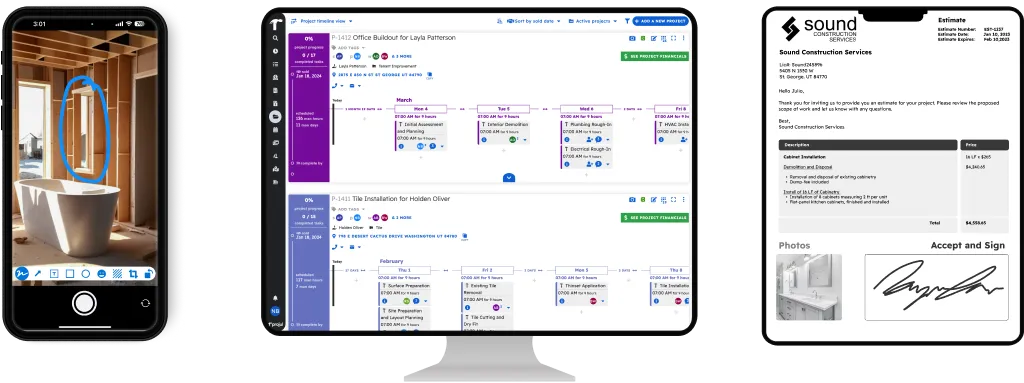
What Is Window and Door Installation Software?
Window and door installation software is a project management platform built for contractors who measure, order, and install windows and doors. It connects field measurements, custom unit orders, lead time tracking, crew scheduling, and invoicing so nothing gets lost between the tape measure and the finished install.
Projul’s window and door installation software helps installers connect field measurements, custom unit orders, and lead time tracking in one platform built by construction professionals who understand precision installation workflows. Projul offers flat-rate pricing with no per-user fees for construction companies of all sizes.
If you run a window and door installation company, you already know that the margin for error is razor thin. One wrong rough opening measurement means you eat the cost of a custom unit. One missed lead time means your crew shows up with nothing to install. One undocumented damage claim means you pay for a scratch you did not cause.
Window and door installation software like Projul exists to keep every detail tied to the job record so your office and your field crews work from the same information. No more ordering from a text message. No more guessing when units will arrive. No more scrambling for energy code paperwork the morning of inspection.
Protect Your Margins on Every Custom Order
One wrong rough opening measurement and you eat the cost of a custom unit. That is the reality of running a window and door installation business. A single mis-order on a large casement window can cost you $800 or more, and the manufacturer is not taking it back.
Projul keeps your field measurements, custom orders, lead times, and install schedules tied together so expensive mistakes stay rare. Over 5,000 contractors rely on Projul to protect their margins on every job. Window and door installation software should prevent problems, not just track them after the damage is done.
Most ordering mistakes happen because the field measurement lives in one place and the order form lives in another. Your installer texts a measurement to the office. The office writes it down, maybe transposes a digit, and places the order. Three weeks later, the wrong size shows up on the truck. With Projul, the measurement, the photo, and the specs all live on the job record. Your office orders from the same data your installer captured on site.
Tie Field Measurements to Every Job Record
Projul ties rough opening dimensions, jamb extension specs, and photos directly to each job record. Your office orders exactly what was measured on-site instead of trusting a text message or a handwritten note.
Here is what that looks like in practice. Your installer measures a rough opening at 36-1/4 by 72-1/2. They snap a photo showing the existing frame condition, note that the jamb extension needs to be 6-9/16 for 2x6 wall construction, and specify brick mold on the exterior. All of that information lives on the job in Projul. When your office places the order, they reference the exact same record. When the units ship, the warehouse team checks the delivery against the specs on the job.
Window and door installers using Projul cut ordering mistakes and report a 32% average profit increase from eliminating costly mis-orders. That number makes sense when you consider that a single custom patio door can run $2,000 or more. Getting the order right the first time is not just convenient. It is the difference between profit and loss.
Unit Counts and Sizing for Multi-Window Projects
On a whole-house window replacement, you might have 15 to 25 openings with different sizes, styles, and configurations. Keeping that organized on a spreadsheet works until it does not. One transposed number in row 14 means a bathroom window shows up as a bedroom window, and your schedule slips while you wait for the replacement.
Projul lets you create line items for each opening with dimensions, style (double-hung, casement, slider, picture), and any special notes like tempered glass for egress or obscure glass for bathrooms. Your entire order lives in one place, and anyone on your team can check it.
Track Lead Times on Custom Window and Door Orders
Custom window orders carry lead times that range from two weeks to twelve weeks depending on the manufacturer, the finish, and whether you ordered a standard size or something unusual. Miss that delivery window and your install crew sits idle while you burn payroll.
Projul lets you create tasks with expected delivery dates for each custom unit and sends reminders as deadlines approach. When a manufacturer pushes a mulled unit delivery back three weeks, you update the task and the install schedule adjusts with it. Your crew never shows up to a site with no product on hand.
Material Ordering for Custom Sizes
Ordering materials for window and door installation is not like buying lumber at the yard. Every unit is built to your specifications. That means your order has to be perfect because returns are either impossible or expensive. Projul’s window and door installation software keeps the specs, the order confirmation, and the delivery date all on the same project record. When you are managing orders from multiple manufacturers across multiple jobs, that single source of truth saves you from the chaos.
Track which units are on order, which have shipped, and which are sitting in your warehouse waiting for install day. Your office stops calling the manufacturer for status updates because the information is already in the system.
Removal and Disposal of Existing Windows
On replacement jobs, the old windows have to come out before the new ones go in. That sounds simple, but removal adds time, labor, and disposal costs that eat your margin if you do not account for them.
Projul lets you build removal and disposal into your estimate templates as separate line items. Track the labor hours your crew spends on tear-out separately from installation hours. Log disposal costs, whether you are paying a dumpster fee or hauling to the landfill yourself. This level of detail in your window and door installation software means your estimates reflect the true cost of the job, not just the cost of the new units.
For lead paint situations on pre-1978 homes, document your RRP compliance steps right on the job record. Photos of containment setup, HEPA vacuuming, and clearance testing all go on the project file. When EPA compliance is on the line, having that documentation beats trying to recreate it from memory.
Energy Efficiency Upgrades and Code Compliance
Energy codes are getting stricter every cycle. The 2021 IECC requires U-factor ratings that older windows cannot meet, and many states have adopted even tighter standards. Your clients are asking about energy savings. Their utility companies are offering rebates. The inspector is checking NFRC labels.
Projul stores U-factor ratings, Solar Heat Gain Coefficient (SHGC) values, low-E glass specifications, and NFRC label data on each project record. When the inspector asks for documentation, you pull it up on your phone. Energy code compliance paperwork is never a last-minute scramble because it lives right on the job.
For contractors who sell energy efficiency upgrades, this documentation also helps you show homeowners the before-and-after performance numbers. A client who can see that their old single-pane windows had a U-factor of 1.2 and their new units are at 0.25 understands exactly what they are paying for. That transparency builds trust and generates referrals.
Window and door installation software that tracks energy specs is not optional anymore. It is how you stay compliant, win better jobs, and protect yourself during inspections.
Permit Requirements for Window and Door Work
Permit rules vary by jurisdiction, but many cities require permits for window replacements, especially when you are changing the size of an opening or adding new egress windows. Forget to pull a permit and you risk a stop-work order, a fine, or a callback months later when the homeowner tries to sell and the title company flags unpermitted work.
Projul lets you track permit status as part of your project workflow. Note when the permit was applied for, when it was approved, and when the final inspection is scheduled. Your office sees the permit status at a glance, and your installer knows whether the job is cleared to start before they load the truck.
For new construction work where the GC handles permits, you can still track your inspection requirements. Log when the window install needs to be inspected for flashing, sealant, and energy code compliance. Keep the inspection result on the job record so there is no confusion about whether you passed.
Warranty Tracking That Protects Your Reputation
Windows and doors carry manufacturer warranties that can last 10 to 20 years. Your labor warranty might cover one to five years. When a homeowner calls about a failed seal or a broken balance two years after installation, you need to know exactly what was installed and what is covered.
Projul stores warranty details, manufacturer information, and installation dates on each project record. Pull up the job, see which units were installed, check the warranty terms, and give your client a clear answer instead of fumbling through old paperwork. Contractors using window and door installation software with warranty tracking resolve claims faster and keep their reputation strong with both clients and manufacturers.
This also matters for commercial jobs where property managers track warranties across hundreds of units. When building management calls about a failing unit on the third floor, you can pinpoint exactly which product was installed, when, and by which crew.
Commercial vs. Residential Window Installation
Running both commercial and residential window work from one company means managing two very different types of projects. Residential replacements involve homeowner schedules, design choices, and individual attention. Commercial jobs involve unit counts in the hundreds, GC coordination, and punch list processes that can drag on for weeks.
Projul handles both from one platform. For residential work, you manage the full process from the sales appointment through the final walk-through. For commercial projects, break the scope into floors, wings, or sections. Assign different crews to each area and track unit counts across the entire building. Your window and door installation software should flex to match your project mix, not force you into one workflow.
Commercial work also means coordinating with other trades. Your install might depend on the framing contractor finishing rough openings to spec, or the stucco crew needing your units set before they can start exterior work. Projul’s scheduling tools show where your work fits in the overall build sequence so you can plan around dependencies instead of reacting to surprises.
Document Damage Claims With Timestamped Photos
Crews upload timestamped photos before, during, and after every install directly from the job site. If a client claims a scratch on a casement window was your fault, you have documented proof of the unit’s condition at delivery and after installation. This alone has saved Projul users thousands in disputed damage claims.
Window and door units are expensive and fragile. A patio door with a scratch in the glass costs over $1,000 to replace. Without photo documentation, it is your word against the homeowner’s. With Projul’s window and door installation software, your crew documents every unit at delivery and after installation. The photos carry timestamps and GPS data that prove when and where they were taken.
This protection extends to transit damage as well. When units arrive from the manufacturer with a cracked frame or chipped glass, your crew documents the damage immediately in Projul. The manufacturer claim process goes smoother when you have photographic evidence logged the day of delivery instead of filing a complaint two weeks later from memory.
Estimating That Wins More Window and Door Jobs
Your estimate is the first thing a homeowner sees from your company. A sloppy bid on a plain email does not inspire confidence for a $15,000 whole-house window replacement. A clean, itemized estimate from Projul shows the client exactly what they are getting and positions you as the professional choice.
Build estimate templates for your most common jobs. A standard double-hung replacement, a patio door swap, a full-house package. Each template carries line items for units, labor, removal, disposal, trim, caulking, and any energy code compliance work. Adjust quantities for each new job and send the estimate out looking sharp. When the client approves, that estimate converts directly into a scheduled project with job costing already built in.
Window and door installation software with strong estimating tools means more bids out the door and a higher close rate. Contractors using Projul report cutting their estimating time in half, which means more appointments and more signed contracts.
Scheduling Installs Around Client Availability
Residential window installation requires access to the home. That means coordinating with the homeowner’s schedule, which is not always simple. Some clients work from home. Others need to take a day off. A no-access situation means your crew sits in the driveway burning daylight.
Projul’s scheduling tool lets you set install windows that work for both your crew and the client. Share calendar views, send appointment confirmations, and reschedule with drag-and-drop when plans change. Your window and door installation software should minimize no-access delays so your installers stay productive.
For multi-day installs, break the project into daily tasks. Day one might be first-floor removal and install. Day two handles second-floor work and exterior trim. The client sees the plan, your crew knows the sequence, and everyone stays on the same page.
Job Costing That Shows Your Real Numbers
Every window and door job has a target margin. Without real-time job costing, you find out whether you hit that margin after the job is done. By then, it is too late to fix anything.
Projul tracks estimated costs versus actual costs on every project. See where your labor hours are landing compared to your bid. Check whether material costs matched your estimate or whether that upcharge on custom trim blew your budget. Window and door installation software with live job costing lets you catch overruns at job three of a ten-job week instead of discovering the problem during your monthly review.
Contractors using Projul report a 32% average increase in profitability. That comes from catching cost issues early and keeping every job on track.
Your Installers Manage Every Job From Their Phone
Your window and door crews move from house to house and need measurements, specs, and schedules at their fingertips. Projul’s native mobile app lets them check rough opening dimensions, upload before-and-after photos, and log hours with geofencing at every stop.
If a custom unit arrives damaged, your crew documents it on the spot with timestamped photos and notifies the office before the homeowner has to ask what happened. If the rough opening does not match the specs on file, they flag it immediately so your office can address it before the install continues.
The app works on dusty phones with one bar of signal. Your crew uses it by lunch on day one because it was designed for the field, not for a corner office. That adoption rate is why G2 users rate Projul 9.8 for ease of use.
Specialty Window and Door Resources
For contractors working on commercial glazing or curtain wall projects, our window glazing and curtain wall systems guide covers the specifications, installation methods, and project management considerations for large-scale glass installations. If your company also handles garage door work, our garage door installation guide breaks down estimating, material options, and common pitfalls to avoid.
Measurement Verification Workflows That Prevent Costly Re-Orders
A single transposed digit on a rough opening measurement can cost your company $800 to $2,500 depending on the unit. Custom windows are not returnable. Custom patio doors are even worse. And the cost is not just the unit itself. It is the three to eight weeks you wait for the replacement while your install schedule has a hole in it and your customer is losing patience.
The root cause of most ordering mistakes is not bad measuring. Your installers know how to use a tape measure. The problem is what happens between the measurement and the order. The installer measures 35-3/4 by 71-1/2. He texts it to the office. The office person reads the text while answering the phone, writes down 35-3/4 by 71-1/4, and places the order. Three weeks later, a window shows up that is a quarter inch too short. That quarter inch means shimming, potential air infiltration problems, and an unhappy customer.
A proper measurement verification workflow eliminates this failure point. With Projul, your installer enters the rough opening dimensions directly on the job record along with a photo of the tape on the opening. The office places the order by referencing the job record, not a text message. Before the order ships, a second person can verify the dimensions on the record against the order confirmation. Two sets of eyes on the same source of truth catches the errors that slip through on a busy Tuesday morning.
For whole-house replacements with 15 to 25 openings, a verification step is not optional. It is how you protect yourself from a $5,000 mistake hiding in row 17 of your order sheet. Projul’s estimating tools let you build each opening as a separate line item with its own dimensions, style, and configuration. Your verification checklist becomes a matter of walking through the line items and confirming each one matches the field notes and photos.
This workflow also protects you on commercial projects where unit counts can run into the hundreds. A 60-unit apartment building with identical openings on each floor sounds simple until you discover that the third floor has a 1/2-inch variance in rough opening width because the framing crew used different studs. Catching that at measurement time, documenting it with photos, and ordering accordingly is cheaper than discovering it on install day.
On multi-story projects, measurement verification becomes even more critical because access is harder. If your installer measured a third-floor opening and the unit comes in wrong, getting the replacement up to that floor costs additional labor and equipment time. Some contractors implement a two-person measurement protocol where one person measures and the other records independently, then both compare numbers before leaving the site. That extra five minutes per opening prevents weeks of delay and hundreds of dollars in re-order costs.
The contractors who rarely deal with re-orders are not luckier than everyone else. They have a system. Measurement verification built into your window and door installation software turns accuracy from a hope into a process. Our window and door installation guide covers additional best practices for field measurement and order accuracy.
Manufacturer Lead Time Tracking Across Multiple Suppliers
If you only order from one manufacturer, lead time tracking is straightforward. Check their current production schedule, add a few days for shipping, and plan your install date. But most window and door contractors work with three to five manufacturers depending on the product line, price point, and customer preference. Each manufacturer has its own lead times, and those lead times shift constantly based on demand, material shortages, and production capacity.
The real problem is not knowing the lead time when you place the order. It is tracking 30 or 40 open orders across multiple manufacturers, each with different expected delivery dates, and making sure your install schedule lines up with what is actually arriving at your warehouse this week.
Without a tracking system, this turns into a weekly exercise of calling manufacturers, checking shipping notifications in your email, and updating a spreadsheet that is already out of date by the time you finish updating it. Your office spends hours every week on order status instead of scheduling installs and closing new sales.
Projul lets you create delivery tracking tasks for every order on every project. Each task carries the manufacturer name, order number, expected ship date, and expected arrival date. When a manufacturer pushes a delivery back, you update the task and the connected install schedule shifts with it. Your dispatcher sees that next Thursday’s install just lost its product and can reassign the crew to a job that is ready instead of discovering the problem the morning of.
For contractors who stock common sizes and only custom-order specialty units, the tracking challenge is different but equally important. Your stock orders have short lead times but can run out unexpectedly. Your custom orders have long lead times but are committed to specific jobs. Mixing the two in your scheduling means knowing which jobs are covered by stock on hand and which ones are waiting on a specific shipment.
Projul’s project management features keep this visible across all your active jobs. Filter by projects waiting on materials and you instantly see which installs are at risk. That visibility is worth hours of phone calls every week and prevents the worst outcome in window and door work: a crew showing up to a job with nothing to install. For tips on managing material logistics on larger projects, our construction schedule recovery guide covers strategies for keeping jobs on track when deliveries slip.
Trim, Flashing, and Siding Crew Coordination
Installing a window is only part of the job. After the unit is set, someone has to flash it, trim it, and tie it into the exterior cladding. On some jobs, your crew handles everything. On others, the flashing is your responsibility but the siding contractor handles the exterior trim. And on new construction, you might be setting units into rough openings that the framing crew built, with a separate weatherproofing crew handling the flashing membrane before your trim carpenter finishes the interior casing.
This coordination breaks down when each trade operates on its own schedule. The siding crew shows up to run their J-channel and discovers your window flashing is not complete. Now they skip your section and move to another part of the building, and when they come back, it costs the GC an extra trip charge. Or your trim carpenter arrives for interior casing and finds that the drywall crew has not finished the returns around the window openings. Another wasted trip.
Projul’s scheduling tools let you map these dependencies on the project timeline. Your window installation task links to the flashing task, which links to the exterior trim task, which links to the siding crew’s start date. When one step falls behind, the downstream tasks shift automatically. Everyone involved sees the updated timeline instead of learning about the delay on the morning they planned to start.
For replacement jobs where your crew handles the full scope, coordinating interior and exterior finish work is still a scheduling puzzle. Your installer sets the unit on Monday. The exterior flashing and caulking need to cure before the trim goes on. Interior trim requires the unit to be fully operational so the client can use the window while the casing is fitted. Breaking these steps into sequential tasks in Projul means your crew arrives at each stage when the work is actually ready.
On commercial projects with hundreds of openings, trade coordination becomes the central challenge. Your windows might go in floor by floor, with the waterproofing crew following one floor behind and the curtain wall or cladding crew following two floors behind. A delay on floor three ripples through every trade above it. Projul’s interactive Gantt view gives you and the GC a clear picture of how your work connects to the rest of the building schedule. When your scope shifts, everyone sees the impact immediately.
The window and door contractors who keep their GCs happy are the ones who communicate schedule changes before they become problems. Software that maps your work to other trades’ timelines is how you deliver that communication consistently, not just when you remember to make the call.
Warranty Registration and Long-Term Tracking for Every Unit
Most window and door manufacturers require warranty registration within 30 to 90 days of installation. Miss that registration window and the warranty either reduces to a shorter coverage period or voids entirely. On a $15,000 whole-house replacement, that is a lot of warranty protection to lose because someone forgot to fill out a form.
The registration process varies by manufacturer. Some use online portals. Others require paper forms mailed with a copy of the invoice. A few accept registration through their dealer portal but only if you submit the serial number, installation date, and homeowner information in a specific format. When you work with four or five manufacturers, each with its own process, warranty registration becomes an administrative task that is easy to push off until it slips past the deadline.
Projul lets you build warranty registration into your project close-out workflow as a task with a due date. When the install is complete, the registration task appears on your office team’s to-do list. The task includes the manufacturer name, product serial numbers, and homeowner details pulled from the project record. Your admin completes the registration, logs the confirmation number, and marks the task done. Nothing falls through because it is part of the standard workflow, not a separate process that someone has to remember.
Long-term warranty tracking matters just as much as the initial registration. When a homeowner calls three years after installation because a seal has failed on their casement window, your team needs to answer two questions quickly: Is the unit still under warranty, and who is the manufacturer? Without a tracking system, that means digging through old emails, order confirmations, and maybe a filing cabinet in the back office.
With Projul, your team pulls up the customer’s project record and sees every unit that was installed, the manufacturer, the serial number, the installation date, and the warranty expiration date. The answer takes 30 seconds instead of 30 minutes. That speed matters because the homeowner is comparing your response time to the other contractors they could call. Our warranty management guide covers additional best practices for tracking and resolving warranty claims efficiently.
For commercial projects, warranty tracking scales up significantly. A 200-unit apartment building has 200 individual warranty registrations, potentially across multiple manufacturers if different unit types came from different suppliers. Tracking those registrations as project tasks in Projul ensures that every unit gets registered before the deadline, and the property manager has a single point of reference for future warranty claims. That level of organization wins repeat commercial work because property managers remember the contractor who had their documentation together when a unit failed on the ninth floor.
Honest Pricing for Window and Door Contractors
Projul starts at $4,788 per year for your entire window and door company. No per-user fees. Your estimators, crew leads, office staff, and installers all get full access without inflating the bill.
Most window and door installation software charges per user. That pricing model punishes you for growing. Hire another installer? More money. Add a sales rep? More money. Give your warehouse manager access to check deliveries? Even more money. Projul’s flat rate means your 20th employee costs the same as your 5th.
Over 5,000 contractors use Projul to manage their operations, and window and door contractors consistently report saving 2+ hours daily on admin work. G2 users rate Projul 9.8 for ease of use and 9.8 for quality of support.