
Construction Inspection Checklist Guide

Every contractor has a callback story that still stings. Maybe it was the framing that passed your eye test but failed the city inspector’s. Maybe it was the HVAC rough-in that got drywalled over before anyone checked duct placement. Or maybe it was the “finished” project where the owner found 23 items wrong during the final walkthrough.
Callbacks are expensive. Not just the direct cost of sending a crew back, but the ripple effect. You pull guys off a paying job. Materials get wasted. The client’s confidence drops. And your reputation takes a hit that no amount of advertising can fix.
The fix isn’t complicated. It’s a construction inspection checklist that your team actually follows at every phase of the project. Before you break ground. While the work is happening. And before you hand over the keys.
This guide breaks down exactly what to check and when, so you stop finding problems after it’s too late to fix them cheaply.
Why Inspection Checklists Save You From Expensive Callbacks
Most contractors think they inspect their work. And they do, sort of. They walk the job, eyeball the progress, and mentally check things off. The problem is that mental checklists have gaps, and those gaps show up as callbacks.
The numbers tell the story. Industry surveys consistently show that rework accounts for somewhere between 5% and 15% of total project cost on commercial jobs. Residential contractors see similar patterns. A $500,000 project with even 5% rework is $25,000 walking out the door. That’s not a rounding error. That’s your profit margin on the next job.
Callbacks happen for three main reasons:
-
Work gets covered before it’s checked. Plumbing gets buried in concrete. Wiring gets hidden behind drywall. Insulation covers framing defects. Once it’s covered, fixing it costs three to five times more than catching it in the open.
-
Verbal inspections don’t stick. Your super walks the job and tells the framing crew to fix three things. Two get done. One gets forgotten. Nobody wrote it down, so nobody follows up.
-
Different people check different things. Without a standard checklist, your morning super catches different items than your afternoon super. Quality becomes inconsistent across shifts, crews, and projects.
A written checklist solves all three problems. It forces your team to verify specific items at specific times, document what they found, and follow up on deficiencies before work progresses. It’s not glamorous. But it’s the single cheapest quality control tool in construction.
Here’s the real benefit most contractors miss. When you document inspections, you build a paper trail that protects you in disputes. If an owner claims you never checked the waterproofing, you’ve got dated photos and sign-offs that say otherwise. That paper trail has saved more contractors in court than any lawyer’s opening statement.
Pre-Construction Inspection: What to Verify Before Breaking Ground
The best time to catch a problem is before you start building. Pre-construction inspections are about verifying that the site, the plans, and your setup are all ready for work to begin. Skip this step and you’ll spend the first two weeks of the project fixing things that should have been handled before mobilization.
Site Conditions
- Survey markers and property lines. Confirm they match the site plan. Building even six inches over a property line can trigger a stop-work order or a lawsuit from the neighbor.
- Existing utilities. Verify all underground utility locates are current and marked. Check for overhead power lines near crane or equipment swing paths.
- Drainage and grading. Walk the site after a rain. Where does water collect? Where does it flow? If the existing grade doesn’t match the civil drawings, flag it now.
- Access routes. Confirm delivery truck access, equipment staging areas, and crew parking won’t conflict with neighboring properties or public right-of-way.
- Environmental conditions. Look for signs of contaminated soil, protected wetlands, or trees with preservation orders. These can shut down a job for months.
Plans and Permits
- Permit status. Confirm the building permit is issued and posted. Check that it matches the current plan set, not a previous revision.
- Plan review comments. Read every comment from the plan reviewer. Verify that all required revisions were made to the approved set. Missed comments become failed inspections later.
- Specification cross-check. Compare the specs to the plans. When they conflict (and they will), get an RFI answered before you start. Don’t guess.
- Subcontractor scope alignment. Confirm each sub has the current plan set and understands their scope boundaries. Scope gaps between subs are where things fall apart.
Materials and Equipment
- Material submittals. Verify that approved submittals match what’s being delivered to the site. Substitutions without approval are inspection failures waiting to happen.
- Equipment condition. Inspect all major equipment before it hits the site. Broken equipment on day one means schedule delays and crew downtime.
- Safety equipment. Confirm fall protection, PPE, fire extinguishers, first aid kits, and barricades are on site and in good condition.
Log everything you find during pre-construction. Use daily logs from day one, not just once work starts. A photo of a site condition before you touch it is worth more than a thousand words in a dispute.
In-Progress Inspections: Catching Problems Before They’re Buried
This is where most quality issues either get caught or get buried. Literally. The concrete gets poured, the drywall goes up, and whatever was behind it becomes invisible.
In-progress inspections should happen at every transition point, meaning every time one trade’s work gets covered by the next trade’s work. Here’s what to check at the major milestones.
Foundation and Below-Grade
- Footing dimensions and rebar placement. Check size, spacing, and cover before the pour. Rebar that’s sitting on the dirt instead of chairs is a structural deficiency.
- Formwork alignment. Verify forms are plumb, level, and match the foundation plan dimensions. A quarter-inch at the footing becomes a half-inch at the top plate.
- Waterproofing and damp-proofing. Inspect membrane installation before backfill. Laps, seams, and penetration seals are the failure points.
- Under-slab plumbing and conduit. Test pressure on all underground plumbing before concrete. Verify conduit routing matches the electrical plan.
- Compaction testing. Confirm compaction test results meet spec before pouring any flatwork or setting forms.
Framing and Structural
- Anchor bolt placement and embedment. Check before framing starts. Moving anchor bolts after the sill plate is on costs time you don’t have.
- Lumber grade and species. Verify what’s on the wall matches what’s on the plan. #2 SYP and #2 Doug Fir are not interchangeable in every application.
- Connection hardware. Simpson ties, hold-downs, and hangers need to match the structural plan exactly. Missing hardware is the number one framing inspection failure.
- Sheathing nailing patterns. Shear wall nailing schedules are specific. Three-inch spacing at edges and six-inch in the field is common, but check the plan.
- Rough opening dimensions. Measure every window and door opening before the windows arrive. It’s a lot cheaper to reframe an opening than to reorder a custom window.
Mechanical, Electrical, and Plumbing (MEP)
- Routing conflicts. Walk the ceiling and wall cavities looking for trades that are fighting for the same space. Duct versus pipe versus conduit conflicts are common and need to be resolved before insulation.
- Electrical box heights and locations. Check against the plan. Switches at the wrong height or outlets missing from a room are easy to fix now, painful after drywall.
- Plumbing pressure tests. Run pressure tests on all water lines before closing walls. A failed joint behind tile is a nightmare.
- HVAC duct sealing. Inspect mastic and tape at all joints. Leaky ductwork is an energy code failure and a comfort complaint from the owner.
- Insulation installation. Check for gaps, compression, and proper facing direction. Insulation that doesn’t contact the air barrier on all six sides isn’t doing its job.
Take photos at every stage. Good photos and document management turns a “he said, she said” into “here’s exactly what it looked like on that date.” Photograph deficiencies before and after correction so your records are complete.
Hold Points
Build hold points into your schedule. These are moments where work stops until an inspection is complete and passed. Common hold points include:
- Pre-pour (foundations and slabs)
- Pre-cover (framing, before insulation)
- Pre-drywall (all MEP rough-ins complete)
- Pre-ceiling close (above-ceiling MEP in commercial)
Hold points feel like they slow the schedule down. They don’t. They prevent the two-week rework delays that actually blow your schedule.
Final Inspection and Punch List Walkthrough
The final inspection is where everything comes together, or falls apart. This is your last chance to catch deficiencies before the owner sees them. And trust me, owners see everything.
Conducting the Pre-Punch Walkthrough
Thousands of contractors have made the switch. See what they have to say.
Before you ever invite the owner or architect to do a punch list walkthrough, do your own. Walk every room, every closet, every mechanical space. Check the roof, the site, the parking lot. Look at the project the way a buyer would.
Interior items to check:
- Paint touch-ups, scuffs, and roller marks
- Trim fit and caulking at all joints
- Cabinet alignment, hardware function, and drawer operation
- Countertop seams and edge profiles
- Flooring transitions, thresholds, and grout consistency
- Door operation, latch engagement, and weatherstripping
- Window operation, locks, and screen condition
- Outlet and switch plate alignment and cover condition
- Fixture installation, including all bathroom accessories
- HVAC register placement and airflow check
- Appliance installation and function test
Exterior items to check:
- Siding, trim, and flashing at all penetrations
- Gutter and downspout installation and drainage direction
- Concrete flatwork for cracks, scaling, or settlement
- Landscape grading direction (positive drainage away from the building)
- Exterior lighting function
- Address numbers and mailbox installation
- Driveway and walkway condition
Managing the Punch List
Once you’ve done your internal walkthrough and fixed what you found, it’s time for the official punch list with the owner or their representative. Use a dedicated punch list tool instead of a legal pad. Assign each item to a responsible party with a due date. Track completion in real time.
The biggest punch list mistake contractors make is treating it as a one-time event. It’s not. It’s a process. Items get completed, verified, and signed off. New items sometimes get added. You need a system that tracks the status of every single item until the list hits zero.
For a deeper look at everything involved in wrapping up a project, check out our construction project closeout checklist. It covers the full closeout process from substantial completion through retainage release.
Common Final Inspection Failures
These are the items that trip up contractors most often during final inspections:
- Smoke and CO detector placement. Code requirements change frequently. Verify current local requirements, not what you did on the last project.
- GFCI and AFCI protection. The NEC has expanded requirements in recent code cycles. Bathrooms, kitchens, garages, and now laundry rooms and basements need GFCI. Bedrooms need AFCI.
- Egress window dimensions. Minimum 5.7 square feet of clear opening for bedrooms. Measure the actual opening, not the rough opening.
- Handrail and guardrail dimensions. 34 to 38 inches for handrails, 42 inches minimum for guardrails. Graspability requirements apply.
- Attic access and ventilation. Minimum 22x30 inch attic access. Verify net free ventilation area meets code.
Municipal Code Inspections: How to Pass the First Time
Failed municipal inspections cost you days, sometimes weeks. Every failed inspection means rescheduling, which means waiting for the inspector’s next available slot while your crew sits idle or gets pulled to another job. Then you have to remobilize for the correction and call for a re-inspection. It adds up fast.
Know Your Inspection Sequence
Every jurisdiction has a required inspection sequence. Typical residential inspections include:
- Footing/foundation (before pour)
- Slab/underslab (plumbing, vapor barrier, rebar)
- Framing (structural, shear walls, hold-downs)
- MEP rough-in (electrical, plumbing, mechanical, each may be separate)
- Insulation/energy (before drywall)
- Drywall nailing (some jurisdictions)
- Final (everything complete, all systems operational)
Commercial projects add structural steel, fire protection, elevator, and accessibility inspections to the list.
Tips for Passing First Time
Read the inspector’s correction notices from your last three projects. You’ll find patterns. Maybe your electrician keeps missing AFCI breakers in bedrooms. Maybe your plumber isn’t supporting horizontal runs at the right intervals. Fix the patterns, not just the individual items.
Be ready when you call for inspection. “Almost done” is not done. If the inspector shows up and the work isn’t complete, that’s a failed inspection on your record, and you just wasted an inspection slot that could have gone to someone who was actually ready.
Know your inspector’s preferences. This isn’t about gaming the system. Different inspectors interpret gray areas differently. If your local inspector wants to see manufacturer’s installation instructions on site for every product, have them on site. If they want to see the energy code compliance path documented on the plans, make sure it’s there.
Provide access. Attic hatches need to be accessible, not buried under material. Crawl spaces need to be clear. Electrical panels need 36 inches of clear space. The inspector shouldn’t have to move your stuff to do their job.
Have your paperwork ready. Approved plans, permit card, previous inspection sign-offs, and any required special inspection reports should all be on site and organized. If the inspector has to ask for these, you’re already starting on the wrong foot.
When You Disagree With the Inspector
It happens. Sometimes the inspector calls something out that you believe meets code. Here’s how to handle it without burning the relationship:
- Ask for the specific code section they’re referencing.
- Review it yourself. Sometimes they’re right and you learn something.
- If you still disagree, request a meeting with the chief building official.
- Bring your code documentation, manufacturer’s specs, and any relevant engineering.
- Stay professional. You’ll see this inspector on your next ten projects.
Going Digital: Why Paper Checklists Are Costing You Money
Paper checklists work until they don’t. And they stop working the moment your project gets more complex than a single-family remodel with one crew.
Here’s what happens with paper:
- The checklist is in the super’s truck. The super is on another job site. Nobody can access the list.
- Items get checked off but the deficiency notes are illegible. Or missing entirely.
- Photos get taken on someone’s phone but never make it into the project file.
- The paper gets coffee-stained, rained on, or lost. Now you have no record at all.
- There’s no timestamp, so you can’t prove when an inspection happened.
Digital checklists solve these problems immediately:
- Accessible from anywhere. Your PM can check inspection status from the office while your super updates it from the field.
- Photos attach directly to items. No more matching phone photos to checklist line items three weeks later.
- Automatic timestamps. Every check, every photo, every note gets a date and time stamp that holds up in disputes.
- Accountability is built in. You can see who checked what and when. No more “I thought you checked it.”
- Data carries forward. When you finish a project, all your inspection records are organized and searchable. Good luck finding that in a filing cabinet two years from now.
Construction management software like Projul ties your inspection checklists into the rest of your project workflow. Your daily logs, photos, punch lists, and inspection records all live in one place. When the owner asks for documentation during closeout, you’re not scrambling. It’s already there.
If you’re still running paper checklists and wondering why quality control feels like a constant firefight, it might be time to look at what a digital system can do for your operation. Check out Projul’s pricing to see what fits your crew size.
Ready to see how Projul can work for your crew? Schedule a free demo and we will walk you through it.
Frequently Asked Questions
What should be included in a construction inspection checklist?
A complete construction inspection checklist should cover pre-construction site conditions, permit verification, in-progress quality checks at every major trade transition, MEP rough-in verification, and final walkthrough items. The specific items vary by project type, but the structure should always follow the sequence of work so nothing gets checked too late.
How often should inspections happen during construction?
At minimum, inspections should happen at every hold point, meaning every time one trade’s work is about to be covered by the next trade. For most residential projects, that means foundation, framing, MEP rough-in, insulation, and final. Larger commercial projects may need daily quality checks in addition to the milestone inspections.
What is the difference between an internal inspection and a municipal code inspection?
Internal inspections are quality checks your own team performs to verify work meets your standards and the project specifications. Municipal code inspections are performed by the local building department to verify compliance with adopted building codes. You should always do your own internal inspection before calling for a municipal inspection. Passing your own check first dramatically reduces failed city inspections.
How do digital inspection checklists improve job site accountability?
Digital checklists create automatic records of who checked what, when they checked it, and what they found. Photos and notes attach directly to specific items with timestamps. This eliminates the “I thought someone else checked it” problem and gives you a defensible record if quality issues come up later during warranty claims or disputes.
Can inspection checklists help with construction disputes and claims?
Absolutely. Documented inspections with dated photos and sign-offs are some of the strongest evidence you can have in a construction dispute. They show that work was checked at the right time, deficiencies were corrected, and quality standards were met. Without documentation, it’s your word against theirs, and that’s a coin flip in front of a judge or arbitrator.
Frequently Asked Questions
Why do I need a written inspection checklist instead of just walking the job?
What are the most commonly missed items on construction inspections?
How do I set up quality control inspections during construction?
What should I check during a final walkthrough before turning a project over?
How do construction inspection checklists help with code inspections?
Related Articles

Construction Team Meetings: A Practical Guide to Meetings That Actually Get Results
Most construction team meetings waste time. Here's how to run weekly check-ins, safety meetings, kickoffs, and...
Read More →
Project Management for Small Contractors: You Don't Need Enterprise Software
You don't need a 50-person company to benefit from project management. Even a 5-person crew loses money without a...
Read More →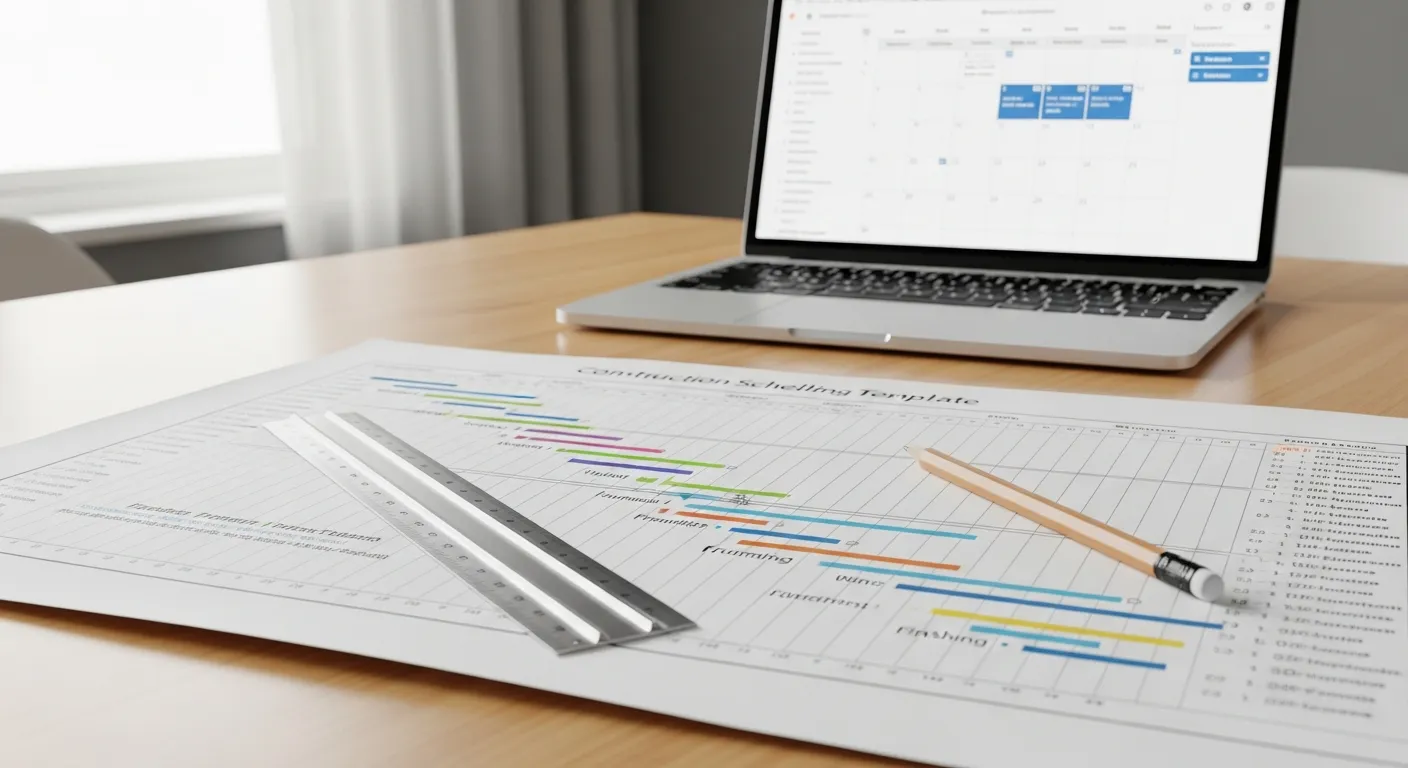
Free Construction Schedule Template
A solid construction schedule keeps your jobs on track, your crews busy, and your clients happy. Grab our free...
Read More →