
Pre-Engineered Metal Building Guide for GCs
If you have been in this business long enough, you have probably seen at least one metal building project go sideways. Maybe the anchor bolts were off by two inches. Maybe the building package showed up and nobody had a crane lined up. Or maybe the GC figured “it’s just a kit building, how hard can it be?” and learned the answer the hard way.
Pre-engineered metal buildings are one of the most common project types in commercial construction. Warehouses, shops, agricultural buildings, retail spaces, churches, gyms. They are everywhere. And because manufacturers market them as simple and cost-effective, a lot of GCs underestimate the coordination these projects actually require.
This guide is written for general contractors who are either new to PEMB work or want to tighten up their process. We will walk through the full project lifecycle, from early planning through final punch list, and call out the spots where things tend to go wrong.
Understanding Pre-Engineered Metal Buildings and How They Differ from Conventional Steel
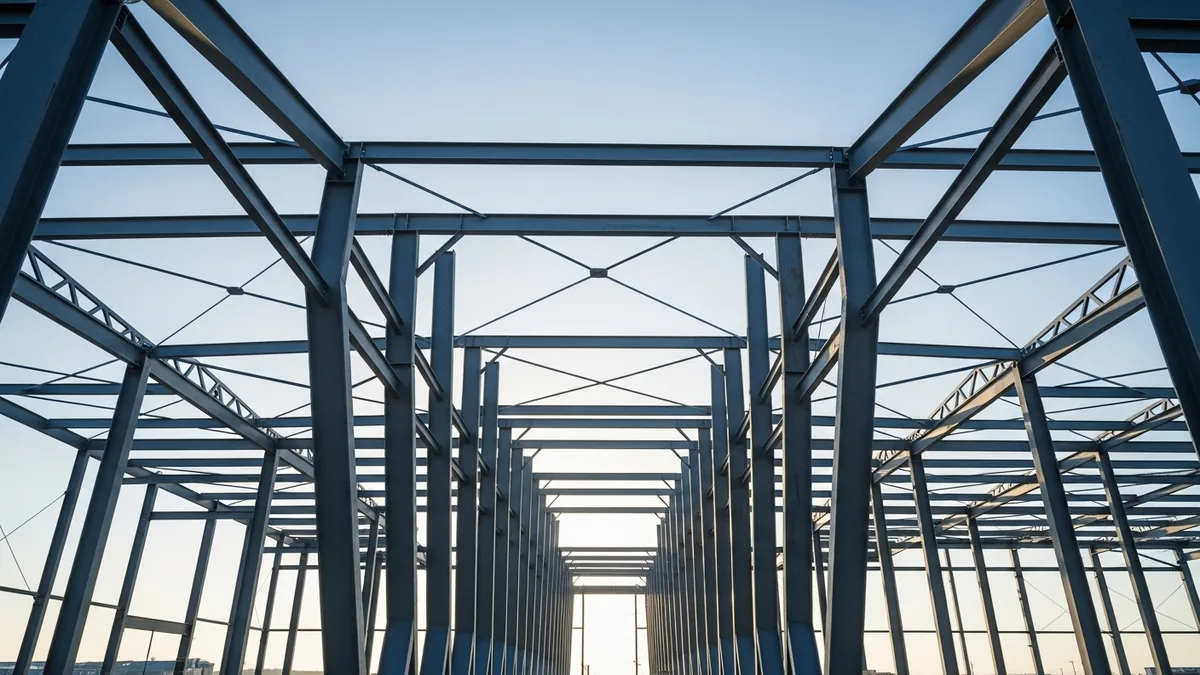
A pre-engineered metal building is exactly what it sounds like: a building system designed and fabricated by a manufacturer before it ever reaches your site. The manufacturer takes your building dimensions, loads, and requirements, then engineers a complete structural package. Primary rigid frames, secondary purlins and girts, roof and wall panels, trim, fasteners, and all the associated hardware ship to your site ready for assembly.
This is fundamentally different from conventional steel construction, where an engineer designs the structure using standard hot-rolled shapes and a fabricator cuts and welds everything per those drawings. If you want a deeper look at conventional steel work, check out our steel erection guide for that side of things.
PEMBs use tapered I-beam rigid frames. The web depth varies along the length of each column and rafter, with the deepest sections at the knee (where the column meets the rafter) and at the ridge. This means less steel overall compared to using a constant-depth beam, which is where the cost savings come from.
Here is what catches some GCs off guard: the manufacturer is the engineer of record for the building structure, but NOT for the foundation. You get a set of anchor bolt plans and a load reaction sheet. Everything below the base plate is your responsibility (or your foundation engineer’s responsibility). This split is clean on paper but gets messy in practice when the foundation design does not match what the building actually needs.
A few key things that make PEMB projects different from ground up:
- Lead times are long. Plan on 8 to 16 weeks from order to delivery, sometimes longer. This is not something you can rush.
- The building is a system. You cannot swap out components the way you would with conventional steel. If a part is damaged or missing, you are waiting on the manufacturer.
- Erection sequencing matters. These buildings go together in a specific order. Skip steps or get creative and you will have problems.
- Tolerances are tight. Especially on anchor bolts. There is very little room for error on the foundation side.
Pre-Construction Planning That Actually Prevents Problems
The best PEMB projects are won or lost before anyone picks up a wrench. Pre-construction is where you set yourself up for success or create headaches that follow you through the whole job.
Start with the building order timeline. Work backwards from your target erection date. If you need the building on site by June 1, and lead time is 12 weeks, you need the order placed by early March. But the order cannot go in until the design is finalized, and design takes 2 to 4 weeks of back-and-forth with the manufacturer on approval drawings. So realistically, you need to be engaged with the building supplier 4 to 5 months before you want steel in the air.
This is where solid estimating and scheduling come together. Your estimate needs to account for the building package cost, erection labor, crane rental, concrete work, insulation, doors, and all the secondary trades that follow steel. Your schedule needs to show the critical path clearly, because on a PEMB job, the critical path almost always runs through the building delivery date.
Approval drawings deserve your full attention. The manufacturer sends approval drawings based on your specifications. These show frame geometry, wall and roof panel layouts, framed openings for doors and windows, and all connection details. Review them carefully. Every opening, every wall light location, every canopy and lean-to needs to be on these drawings before you approve them.
Changes after approval are expensive. Changes after fabrication are brutal. I have seen GCs approve drawings without confirming door locations with the tenant, then eat a $15,000 change order to add a framed opening that should have been there from the start.
Coordinate your MEP trades early. Plumbing penetrations through the slab, electrical conduit runs, mechanical curb locations on the roof. All of this needs to be figured out before the building package is finalized. A rooftop unit curb that does not land on a structural frame line means the manufacturer needs to add additional framing, and that needs to happen during design, not during erection.
Get your geotechnical report done early. Foundation design depends on soil conditions, and soil conditions drive cost. If you are on expansive clay or in an area with a high water table, that changes your foundation approach significantly. Our concrete basics guide covers foundation types and common issues you will want to be aware of.
Foundation Work: Where Anchor Bolt Accuracy Makes or Breaks the Job
If there is one thing experienced PEMB contractors will tell you, it is this: get the anchor bolts right. Everything else is fixable. Anchor bolts that are wrong will haunt you for the entire project.
The manufacturer provides an anchor bolt plan showing the location, projection, and bolt pattern for every column. These dimensions are measured from precise building grid lines. Your concrete crew needs to set these bolts within very tight tolerances, typically plus or minus 1/8 inch.
Use a template. Do not try to set anchor bolts by measuring and marking individually. Build plywood templates or use steel anchor bolt templates that bolt to the form work. Check them twice before the pour. Check them again after the pour while you can still adjust if the concrete has not set.
Don’t just take our word for it. See what contractors say about Projul.
A few common anchor bolt mistakes that will cost you:
- Bolts too low. Not enough projection above the slab means you cannot get a nut and washer on with enough thread engagement. The fix usually involves coring and epoxying new bolts, which is slow and expensive.
- Bolts shifted off layout. If the bolt pattern is rotated or shifted, the base plate will not line up. Sometimes you can ream the base plate holes, but that requires engineering approval.
- Wrong bolt size or grade. The manufacturer specifies the bolt size, grade, and embedment. Do not substitute. A 3/4-inch A36 bolt is not the same as a 3/4-inch Grade 5 bolt.
The slab itself matters too. Check for flatness and levelness, especially along the building perimeter where the wall panels will sit. A slab that is an inch out of level across 60 feet means your wall panels will not line up cleanly with the trim at the top.
One more thing on foundations: your slab turndown or grade beam needs to be at the right elevation relative to the finished floor. The building base trim typically laps down over the slab edge. If the slab is too high or too low relative to what the manufacturer detailed, your trim will not work as designed.
Erection Day: Sequencing, Crews, and Crane Considerations
Erection is the exciting part, but it is also where the most can go wrong in the shortest amount of time. A single day of crane downtime or weather delays can blow your schedule by a week.
Crew selection matters. PEMB erection is specialized work. The crew needs to understand the assembly sequence, know how to read the manufacturer’s erection drawings, and be comfortable working at height with structural steel connections. Most GCs sub this out to erection crews that do metal buildings full-time. If you are thinking about using your own carpenters or general labor, reconsider. The liability exposure and rework risk are not worth the savings.
Crane planning is critical. Before the crane shows up, you need to know the heaviest pick, the longest reach, and the ground conditions where the crane will be set up. The rigid frame rafters on a PEMB are often the heaviest individual pieces, and they can weigh several tons on a larger building. Size the crane for your worst-case pick, not your average pick. And make sure your site logistics plan accounts for crane placement, swing radius, and material staging.
Speaking of cranes, if this is new territory for you, our crane safety guide is worth reading before you get to erection day. Rigging failures on steel erection are no joke.
The typical PEMB erection sequence looks like this:
- Set columns on anchor bolts, plumb, and temporarily brace.
- Lift and connect rafters to columns at the knee connection. Pin at the ridge.
- Install purlins and girts to provide lateral bracing between frames.
- Install roof and wall bracing (rod bracing or portal frames, depending on the design).
- Hang eave struts and framed opening headers.
- Install roof panels, starting from one end and working to the other.
- Install wall panels.
- Install trim, gutters, and downspouts.
- Install doors, windows, and accessories.
Do not skip bracing steps or rush to get panels on before the structure is stable. An unbraced rigid frame is essentially a hinge waiting to fold. The manufacturer’s erection manual specifies the bracing sequence for a reason.
Material staging and delivery logistics deserve attention too. A PEMB package for even a modest building is a lot of steel. You will get multiple truckloads of framing, bundles of panels, boxes of trim, and pallets of fasteners. Having a clear plan for where everything goes on site keeps erection moving. If your crew has to dig through a pile to find the right purlin clip, you are burning expensive crane time.
Insulation, Weatherproofing, and the Trades That Follow Steel
Once the shell is up, the building is not done. It is barely started. The trades that follow erection are where the bulk of your remaining budget goes, and where coordination determines whether you finish on time or spend two months chasing punch list items.
Insulation goes in during or immediately after panel installation. Most PEMB projects use fiberglass blanket insulation (vinyl-faced batts) installed between the girts and the wall panels, and between the purlins and the roof panels. The insulation system needs to be specified during design because it affects girt and purlin spacing. If you are doing a conditioned space with higher R-value requirements, you may need a liner panel system or spray foam, which changes the whole approach. Our insulation guide breaks down the options and what works best for different building types.
Weatherproofing details matter more than people think. Metal buildings rely on sealant, closures, and proper panel laps to keep water out. Every penetration (pipe boots, exhaust fans, conduit) is a potential leak point. Butyl tape at panel laps, foam closures at eave and ridge, and proper flashing at wall-to-roof transitions all need to be done right the first time. Chasing leaks in a metal building after the fact is miserable work.
Concrete flatwork inside the building often happens after the shell is up, especially if you are doing a full interior slab separate from the perimeter foundation. Coordinate this with your mechanical and plumbing trades. Under-slab plumbing and electrical conduit need to be in before you pour, and those trades need the building enclosed (or at least covered) to work efficiently.
MEP rough-in in a metal building is different from wood-frame or CMU construction. You are attaching everything to steel, which means self-drilling screws, beam clamps, and threaded rod hangers instead of wood screws and nail plates. Make sure your mechanical and electrical subs have done metal building work before. The ones who have not will be slow and may damage panels trying to figure out attachment methods.
Overhead doors, personnel doors, and windows are typically installed after the wall panels. The manufacturer provides framed openings with jambs and headers, and the door or window supplier provides the units sized to fit. Verify the rough opening dimensions against the actual door or window units before installation. I cannot count the number of times a door shows up that is a different size than what was specified in the building order.
Budgeting, Scheduling, and Keeping PEMB Projects Profitable
Metal building projects have a reputation for being “simple” and “cheap.” And compared to conventional steel or tilt-up concrete, they often are. But that does not mean they are easy to make money on. The margins on PEMB work can be thin, and the places where you lose money are predictable if you know where to look.
The building package is only part of the cost. A common mistake in PEMB estimating is focusing on the building price and underestimating everything else. The building package (framing, panels, trim, hardware) might be 30 to 40 percent of the total project cost. The rest is foundation, erection labor, crane, insulation, concrete flatwork, MEP, doors, site work, and general conditions. If you price the building at $150,000 and tell the owner the project will be $250,000, you are probably low.
Track your costs in real time. PEMB projects move fast once erection starts. If you are not tracking labor hours, material deliveries, and change orders as they happen, you will not know you are over budget until it is too late. This is where having solid project management software matters. If you are still running jobs off spreadsheets and gut feel, it might be time to look at tools built for contractors. Book a demo and see how purpose-built software handles the scheduling and cost tracking side of construction.
Schedule float is your friend. Build buffer into your schedule around three key milestones: building delivery, erection completion, and interior trade start. If the building ships late (and it might), you need float so the whole schedule does not collapse. If erection takes an extra week due to weather, your interior trades need to be flexible enough to shift without walking off to another job.
Change orders on PEMB projects usually come from three places:
- Owner changes after the building is ordered. Adding a door, moving a wall light, changing the roof slope. All of these cost money because the manufacturer has to re-engineer and possibly re-fabricate components.
- Foundation issues. Bad soil, high water, or inaccurate survey data that forces a foundation redesign.
- Field conditions during erection. Damaged panels that need replacement, missing hardware, or site access issues that require smaller equipment than planned.
Document everything. Photograph the delivery. Note any damaged or missing components on the bill of lading before the truck leaves. Your put to work (sorry, your negotiating power) with the manufacturer drops to zero once you sign off on a clean delivery receipt.
One final scheduling note: do not underestimate the punch list phase on metal buildings. Trim alignment, sealant touch-up, panel scratches that need paint pens, gutter adjustments, door hardware fine-tuning. This is fiddly work that takes longer than you think. Budget a solid week for punch list on a typical commercial PEMB. Two weeks on a larger or more complex building.
Try a live demo and see how Projul simplifies this for your team.
The contractors who consistently make money on metal buildings are the ones who plan thoroughly, coordinate early, track everything, and do not assume “simple” means “easy.” These are good projects when they are run well. Build your process around the details covered in this guide, and you will be in solid shape for your next PEMB job.
Frequently Asked Questions
How long does it take to erect a pre-engineered metal building?
What type of foundation does a pre-engineered metal building need?
Can a general contractor erect a PEMB without specialized steel crews?
What is the difference between a pre-engineered metal building and conventional steel construction?
Who is responsible for the metal building design in a PEMB project?
Related Articles
Construction Home Addition Management: What Every GC Needs to Know
Home additions are some of the most profitable and most complex residential projects a GC can take on. Here's what you...
Read More →
Construction Pool Building Guide: What Every GC Needs to Know
Pool construction is one of the most coordination-heavy projects a GC can take on. This guide breaks down what you...
Read More →
Design-Build vs. Design-Bid-Build: A Contractor's Honest Comparison
Design-build and design-bid-build are two fundamentally different ways to deliver a construction project. This guide...
Read More →