
Construction Mobilization Planning Checklist
You won the bid. The contract is signed. The client is excited. Now comes the part that separates contractors who run smooth jobs from contractors who spend the first two weeks putting out fires: mobilization.
Mobilization is not glamorous. Nobody posts about it on social media. But it is the single most important phase for setting the tone of an entire project. Get it right, and your crew hits the ground running. Get it wrong, and you are playing catch-up for weeks.
This guide breaks down what mobilization actually involves, how to build a checklist that covers your bases, the right way to stage equipment, how to onboard crews for new projects, and the first-week mistakes that trip up even experienced contractors.
What Is Construction Project Mobilization?
Mobilization is everything that happens between signing the contract and breaking ground. It is the phase where you move from paperwork to action, getting people, equipment, materials, and plans to the job site so construction can actually begin.
Think of it this way: if the project is a road trip, mobilization is packing the car, checking the tires, loading the GPS, and making sure everyone knows where they are going before you pull out of the driveway.
Here is what mobilization typically includes:
- Site preparation and access. Clearing the site, establishing entry and exit routes, setting up fencing and security, and installing temporary signage.
- Equipment delivery and staging. Getting the right machines and tools to the right spots on site, fueled up and ready to run.
- Material procurement and delivery. Ordering materials with enough lead time and coordinating delivery schedules so nothing shows up before you have a place to put it.
- Temporary facilities. Job trailers, portable restrooms, temporary power, water, and communication lines.
- Permits and inspections. Making sure every required permit is pulled and posted before anyone picks up a hammer.
- Crew and subcontractor coordination. Assigning teams, confirming start dates, and making sure every person on site knows the plan.
- Safety planning. Site-specific safety plans, emergency procedures, PPE requirements, and OSHA compliance.
Mobilization is not a single task. It is a collection of dozens of tasks that all need to land at the right time. That is why it needs its own plan, its own timeline, and its own accountability structure.
If you are still managing projects with spreadsheets and phone calls, mobilization is where that approach falls apart fastest. A tool like Projul’s project management features can help you track every mobilization task in one place so nothing slips through the cracks.
Building Your Mobilization Checklist
Every contractor needs a mobilization checklist. Not a mental list. Not a sticky note. A real, written checklist that you can hand to your project manager and say, “Make sure every one of these boxes is checked before we start.”
Here is a framework you can adapt to your operation:
Permits and Legal
- All required permits pulled and posted on site
- Utility locates completed and marked
- Insurance certificates on file for all subs
- Signed contracts from every subcontractor
- Notice to proceed issued
Site Setup
- Site access routes established and communicated
- Fencing, barriers, and security in place
- Temporary signage installed (company, safety, directional)
- Job trailer or field office delivered and set up
- Portable restrooms placed
- Temporary power connected
- Temporary water connected
- Dumpsters and waste management arranged
Equipment and Materials
- Equipment delivery schedule confirmed with vendors
- Staging areas identified and marked on site plan
- Fuel and maintenance supplies on hand
- Initial material deliveries scheduled
- Storage areas secured for materials and tools
- Tool inventory completed and assigned
Crew and Subcontractors
- Crew assignments finalized
- Start dates confirmed with all subcontractors
- Contact list distributed to all team leads
- Site-specific orientation scheduled
- PPE requirements communicated
- Parking and site access instructions sent to all workers
Communication and Documentation
- Project schedule distributed to all stakeholders
- Daily reporting process established
- Photo documentation protocol set up
- Change order process reviewed with field team
- Client communication plan in place
This is not a one-size-fits-all list. A demolition project has different mobilization needs than a ground-up commercial build. The point is to have a starting template that you refine for each project.
The contractors who do this well build their checklist into their scheduling software so every task has an owner and a due date. That way, when something gets missed, you know who dropped the ball and can fix it before it costs you a day on site.
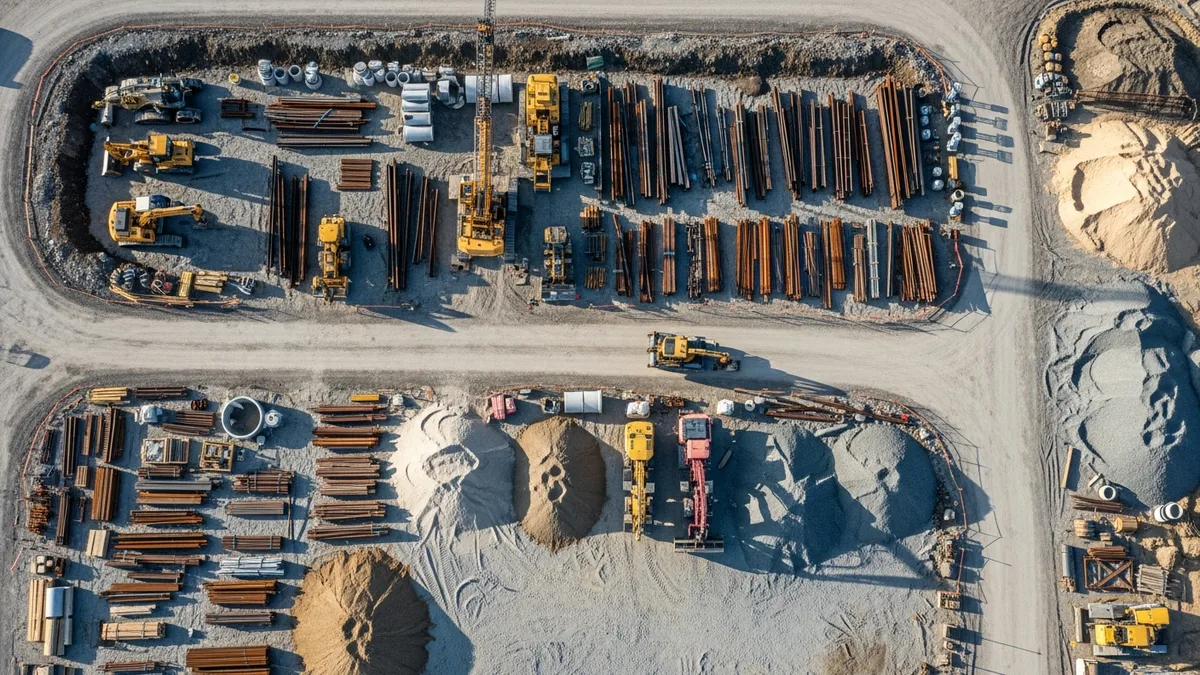
Equipment Staging Done Right
Equipment staging is one of those things that sounds simple until you do it wrong. And doing it wrong can cost you real money in lost productivity, re-mobilization fees, and damaged equipment.
Here is how to think about equipment staging:
Plan the Layout Before Anything Arrives
Before the first piece of equipment shows up, you need a staging plan. Walk the site. Look at your site plan. Figure out where each piece of equipment needs to be based on the sequence of work, not just where it is convenient to park it.
Ask yourself:
- Where will the excavator need to work first, and is there a clear path to get it there?
- Where should material deliveries be staged so they are close to where they will be used but not blocking equipment paths?
- Is there enough room for equipment to maneuver safely around stored materials and temporary facilities?
- Where do the dumpsters go so trucks can access them without crossing active work zones?
Sketch this out on a site plan and share it with your superintendent and equipment operators before delivery day.
Schedule Deliveries in Sequence
Do not have everything show up on the same day. Stagger deliveries based on when each piece of equipment is actually needed. Equipment that sits idle on site for a week before it is used is equipment you are paying for without getting any return.
If you are renting, this is especially important. Every day a machine sits idle is money out of your pocket. Coordinate delivery and pickup dates tightly with your equipment management plan so you are not paying for downtime.
Fuel, Maintenance, and Operator Access
Make sure every piece of equipment arrives with a full tank or a charged battery. Have your maintenance supplies on site, including hydraulic fluid, grease, filters, and basic repair tools. And confirm that every operator has the certifications and training required for the machines they will be running.
This is also a good time to review your approach to renting versus owning equipment. If you are mobilizing for a short project, renting may save you the headache of transport and long-term maintenance costs.
Crew Onboarding for New Projects
Onboarding does not just happen when you hire someone new. Every new project needs its own onboarding process for the crew assigned to it, even if those people have worked for you for years.
Curious what other contractors think? Check out Projul reviews from real users.
Why? Because every site is different. The hazards are different. The access routes are different. The client expectations are different. And if your crew shows up on day one without knowing these things, you are starting behind.
Hold a Project Kickoff Meeting
Before anyone steps on site, gather the whole team for a kickoff meeting. This does not need to be a three-hour corporate presentation. Thirty minutes to an hour is plenty. Cover:
- Project overview. What are we building? Who is the client? What is the timeline?
- Site logistics. Where do we park? Where is the field office? Where are the restrooms? What are the access routes?
- Schedule. What is the sequence of work? What are the critical milestones?
- Safety. What are the site-specific hazards? What PPE is required? Where is the first aid station? Who is the safety lead?
- Communication. How do we report issues? Who do we call if something goes wrong? How are daily updates handled?
- Roles and responsibilities. Who is running each phase? Who do the subs report to?
Print out the project schedule, the site plan, and the emergency contact list. Hand them to every team lead. Do not assume people will look things up on their phones.
Subcontractor Orientation
Your subs need the same orientation your own crew gets. Do not skip this because “they are experienced.” They may be experienced in general, but they do not know your site, your safety requirements, or your reporting expectations.
Require every subcontractor to attend an orientation before they start work. Cover site rules, safety protocols, schedule expectations, and your change order process. This is also the time to collect and verify insurance certificates and signed contracts if you have not already.
Good crew management during mobilization means fewer surprises once work begins. The time you invest in onboarding pays back tenfold in fewer mistakes, fewer safety incidents, and fewer “I didn’t know” conversations.
Document Everything
From day one, establish your documentation process. Daily logs, progress photos, time tracking, and material usage should all be captured consistently. If you wait until week two to start documenting, you have already lost data you might need later for billing, disputes, or change orders.
Set up your job costing tracking from the first hour of the first day. When costs get away from you early, they rarely come back.
Common First-Week Mistakes (and How to Avoid Them)
The first week sets the tone for the entire project. Here are the mistakes that cost contractors the most time and money during mobilization and early construction.
Mistake 1: Starting Without All Permits in Hand
This one is painfully common. The permit is “almost ready” or “should be approved any day now,” so you mobilize anyway. Then the inspector shows up and shuts you down. Now you have a crew sitting idle, equipment burning rental fees, and a client who is losing confidence.
The fix: Do not mobilize until every required permit is issued, printed, and posted on site. No exceptions. Build permit lead time into your project schedule from the start.
Mistake 2: No Clear Chain of Command
When three different people are giving directions and nobody knows who is actually in charge, chaos follows. Subs do not know who to report to. Decisions get made and then reversed. Work gets done out of sequence.
The fix: Publish an org chart for the project. It does not need to be fancy. A one-page document that shows who reports to who and who has decision-making authority is enough. Distribute it at the kickoff meeting.
Mistake 3: Underestimating Setup Time
Contractors routinely schedule productive work to begin on the same day as mobilization. That never works. Setting up temporary facilities, unloading equipment, and getting organized takes longer than you think, especially on a new site you have not worked on before.
The fix: Block out at least one to two full days for setup before scheduling any production work. For larger projects, block a full week. Your construction schedule should show mobilization as its own phase with its own timeline.
Mistake 4: Skipping the Safety Orientation
“We will cover safety tomorrow” turns into “we will cover it next week” turns into a near-miss or an injury. Safety orientation needs to happen before any work begins. Period.
The fix: Make safety orientation a gate. Nobody picks up a tool, climbs a ladder, or operates a machine until they have completed the site-specific safety briefing. Log attendance and keep the records on file.
Mistake 5: Poor Material Coordination
Materials show up before the site is ready to receive them. Or they do not show up at all because nobody confirmed the delivery date. Or they show up at the wrong location because the driver did not have clear directions.
The fix: Assign one person to own material logistics for the first week. They confirm every delivery date, provide site directions to every driver, and designate staging areas for every shipment. Over-communication beats under-communication every time.
Mistake 6: Ignoring the Budget During Mobilization
Mobilization costs money. Equipment transport, temporary facilities, site prep, and crew time all add up. If you are not tracking these costs from day one, you are starting the project with a blind spot in your budget.
The fix: Set up cost tracking before mobilization begins. Every expense during this phase should be logged against the project budget so you have an accurate picture of where you stand before production work even starts.
Making Mobilization a Repeatable Process
The best contractors do not treat mobilization as a one-off scramble for every project. They build it into a repeatable system that gets better over time.
Here is how to do that:
Create a Master Template
Take the checklist from earlier in this guide and turn it into your company’s master mobilization template. After every project, review what went well and what got missed. Update the template. Over time, it becomes a living document that captures everything your team has learned.
Assign Ownership Early
The day a contract is signed, assign a mobilization lead. This person is responsible for working through the checklist, coordinating with vendors and subs, and reporting progress to the project manager. If mobilization does not have an owner, it does not get done right.
Use Technology to Stay Organized
A checklist on paper is better than no checklist at all. But a checklist inside your project management software is better still. When every mobilization task has an owner, a due date, and a status, nothing gets lost in the shuffle.
Projul lets you build task templates that you can apply to every new project. That means your mobilization checklist is already loaded and assigned before you even think about it. No rebuilding from scratch every time.
Debrief After Every Mobilization
After the first week of every project, hold a quick debrief with your team. What went smoothly? What caused delays? What do we need to add to the checklist for next time?
These debriefs do not need to be long. Fifteen minutes over coffee is enough. But they are the difference between a team that keeps making the same mistakes and a team that gets sharper with every project.
Build in Buffer Time
No matter how good your plan is, something will go sideways. A delivery will be late. A permit will take an extra day. Weather will not cooperate. Build buffer time into your mobilization schedule so these hiccups do not cascade into delays on your production schedule.
A good rule of thumb: add 20 to 25 percent buffer to whatever you think mobilization will take. If you finish early, great. If you need the extra time, you will be glad you planned for it.
Mobilization is where projects are won or lost before a single wall goes up or a foundation gets poured. The contractors who plan this phase with the same rigor they plan the rest of the build are the ones who finish on time, on budget, and with their reputation intact.
Start with a solid checklist. Stage your equipment with intention. Onboard every crew member and sub like they are new to the company, because they are new to the project. Track your costs from hour one. And treat every mobilization as a chance to get better at the process.
Curious how this looks in practice? Schedule a demo and we will show you.
The first week is not just the beginning of the project. It is the foundation for everything that follows. Make it count.
Frequently Asked Questions
What does mobilization mean in construction?
How long does construction mobilization usually take?
What should be on a construction mobilization checklist?
Who is responsible for mobilization on a construction project?
How can I avoid delays during the first week of a construction project?
Related Articles

How to Implement Construction Software Without Losing Your Mind
Most construction software rollouts fail. Not because the software is bad, but because the rollout was rushed. Here are...
Read More →
How Selections Can Pay for Themselves in Three Easy Steps
Most contractors lose thousands each year on wrong material orders, slow client decisions, and missed upsell chances....
Read More →
3 Free Concrete Estimate Templates for Every Pour Type (2026)
Three ready-to-use concrete estimate templates with realistic line items, material costs, labor rates, and markup...
Read More →