
Renovation vs New Build: Key Differences for GCs
If you have been in construction long enough, you already know that renovation work and new construction are two completely different animals. They might both involve framing, electrical, plumbing, and finishes, but the way you manage them, price them, and communicate with clients could not be more different.
The problem is that too many contractors try to run renovation projects with the same playbook they use for new builds. That is where budgets blow up, timelines slide, and client relationships fall apart.
This guide breaks down the real differences between renovation vs new build construction so you can manage both types of work profitably and keep your sanity in the process.
Why Renovations Are Harder to Manage Than New Builds
New construction is predictable. You start with a clean slab or cleared lot, you have engineered plans, and you build from the ground up. Every trade knows what they are walking into because the drawings tell the whole story.
Renovations throw all of that out the window.
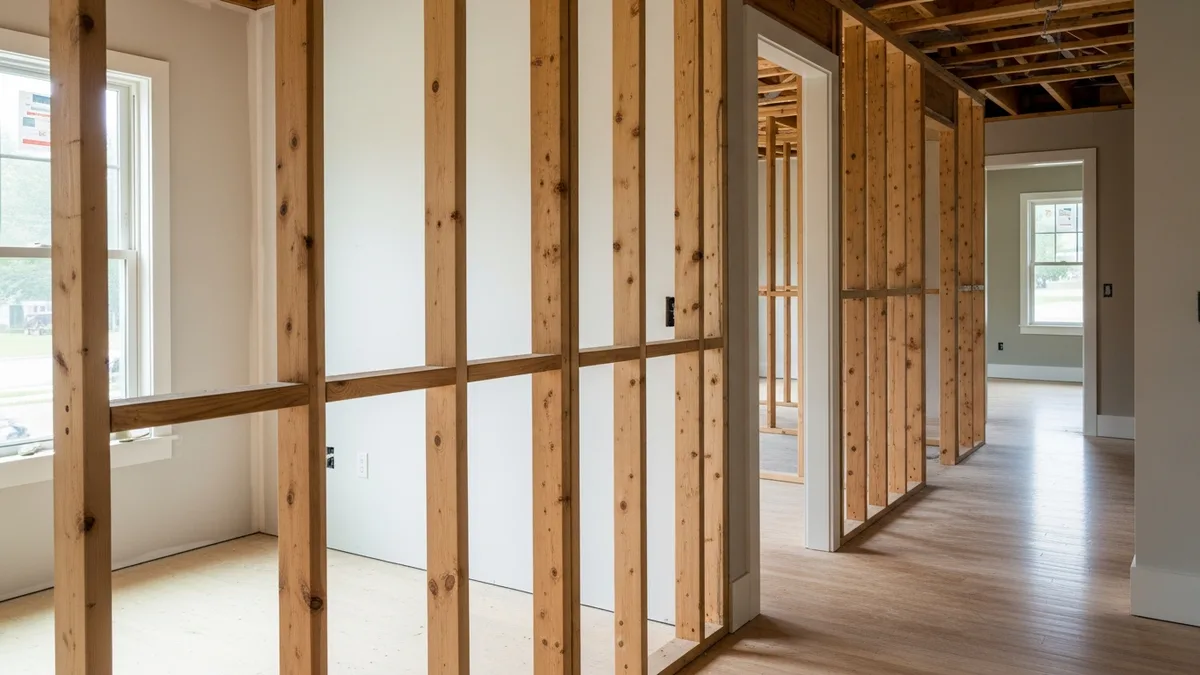
When you are working inside an existing structure, you are dealing with decades of previous work, some of it done well and some of it done by the homeowner’s uncle over a weekend. You do not know what is behind the drywall until you open it up. You do not know if the floor joists are sized correctly until you are standing in the crawlspace with a flashlight.
Here is what makes renovation management harder on a practical level:
- Existing conditions are unpredictable. Rot, mold, outdated wiring, undersized plumbing, and structural shortcuts are all common discoveries once demo starts. Knowing how to identify load-bearing walls before swinging a sledgehammer is critical. Each surprise triggers a conversation, a change order, and a schedule adjustment.
- The work area is constrained. You cannot just park a forklift wherever you want. Material staging is limited. Access points are tight. Your crew is working around existing walls, fixtures, and sometimes furniture.
- Occupied spaces add complexity. Many renovation clients live in the home during the project. That means dust control, noise restrictions, limited work hours, and constant interaction with the homeowner.
- Sequencing is harder to plan. In new construction, the critical path is well defined. In renovations, you often cannot determine the full sequence until you have completed selective demolition and assessed what you are working with.
None of this means renovation work is bad work. It often commands higher margins when you price it right. The key is recognizing that it requires a different management approach from day one.
Estimating Renovations: The Unknown Factor Problem
Estimating a new build is relatively straightforward. You have complete architectural and structural plans. You can do accurate material takeoffs. Your labor hours are based on well-understood production rates for standard framing, MEP rough-ins, and finishes.
Renovation estimating is a different game entirely.
Read real contractor reviews and see why Projul carries a 9.8/10 on G2.
The biggest challenge is what you cannot see. You are pricing work based on assumptions about existing conditions, and those assumptions are wrong more often than you would like. A bathroom remodel estimate can double when you discover galvanized supply lines that need full replacement, or a subfloor that is rotted through, or a joist that someone notched to run a drain line twenty years ago.
Here is how to protect yourself:
Build contingency into every renovation estimate. A 15 to 25 percent contingency line is not padding. It is honest pricing that reflects the reality of working on existing structures. Explain this to your clients upfront so they understand why it is there.
Use allowances for areas you cannot inspect. If you cannot access a wall cavity or crawlspace before signing the contract, call it out with an allowance and explain that the actual cost will be determined once you open things up.
Document your assumptions. Your estimate should clearly state what you are assuming about existing conditions. “Estimate assumes existing framing is structurally sound and to code.” If that assumption turns out to be wrong, you have a documented basis for a change order.
Use your estimating tools to track renovation-specific costs. Being able to quickly build estimates with contingency lines, allowances, and assumption notes built in saves you hours and protects your margins.
The contractors who struggle with renovation profitability are usually the ones who estimate renovations the same way they estimate new builds. They use the same markup, the same contingency (or none at all), and the same assumptions about productivity. That approach will burn you.
Scheduling Around Existing Structures and Occupied Spaces
On a new build, your schedule is driven by the critical path: foundation, framing, dry-in, rough-ins, inspections, finishes. Each phase flows logically into the next, and your subs know their windows well in advance.
Renovation scheduling has to account for factors that do not exist on new construction.
Discovery phases change the schedule. You might plan a two-week kitchen demo and rebuild, but once the cabinets come out, you find that the plumbing stack needs to be relocated. Now your plumber needs an extra three days, your tile guy gets pushed back, and your finish carpenter is sitting idle.
Occupied spaces restrict your work windows. If the homeowner is living in the house, you may be limited to working 8 AM to 5 PM with no weekends. Noise-heavy work like demo and concrete cutting might be restricted even further. This stretches your timeline compared to the same scope in an empty building.
Material staging requires creativity. You cannot stack lumber in the living room or leave drywall in the driveway for two weeks. Material deliveries need to be timed more precisely, and you might need to break larger deliveries into smaller ones that can be stored in the work area.
Access and logistics eat time. Carrying materials up three flights of stairs in a brownstone takes longer than rolling them in through a garage door on a new build. Protecting finished areas with floor coverings and plastic barriers takes time every morning and every evening.
The best approach to renovation scheduling is to build in buffer time between each phase. Do not stack your subs back-to-back the way you might on new construction. Give yourself breathing room for the inevitable discoveries and delays. Your project management software should make it easy to shift schedules and notify affected trades when timelines change.
If you are not already tracking how renovation schedules compare to your original plans, start doing it. Over time, you will build a database of how much buffer different types of renovation work actually need, and your scheduling accuracy will improve significantly.
Code Compliance: When Old Meets New
Code compliance on new construction is simple. You design to current code, you build to current code, you pass inspections. Done.
Renovation code compliance is full of gray areas.
The fundamental question is: how much of the existing structure needs to be brought up to current code when you renovate? The answer depends on your local jurisdiction, the scope of the renovation, and sometimes the individual inspector.
Here are the common scenarios:
Cosmetic renovations like paint, flooring, and fixture swaps usually do not trigger code upgrades. You are not changing the structure or systems, so the existing conditions are generally grandfathered in.
System-specific renovations like a panel upgrade or re-plumbing require the new work to meet current code, but the rest of the house can typically remain as-is. You are only responsible for bringing the scope of your work up to current standards.
Major renovations and additions are where it gets complicated. Many jurisdictions use a threshold, often 50 percent of the building’s value, to determine when a full code upgrade is required. Cross that threshold and suddenly you are bringing the entire electrical, plumbing, and structural system up to current code, not just the area you are working in.
The practical implications for contractors:
- Walk the job with the building inspector before you finalize your estimate. Get their interpretation of what will and will not be required. Get it in writing if possible.
- Include potential code upgrade costs in your estimate as allowances. Explain to the client that existing conditions may trigger additional code requirements once work begins.
- Train your field team to recognize code issues during demo. The earlier you identify a problem, the sooner you can issue a change order and keep the project on track.
- Keep a cheat sheet of your local jurisdiction’s renovation code triggers. Every municipality handles this differently, and knowing the rules before you bid saves you from expensive surprises.
Code compliance is one of the biggest sources of scope creep on construction projects. A renovation that starts as a kitchen remodel can balloon into a full electrical upgrade if you are not careful about understanding the code triggers before you start.
Client Communication During Renovation Projects
Client communication on new builds follows a predictable pattern. You give updates at major milestones, the client visits the site periodically, and most decisions are made during the design and selection phase before construction starts.
Renovation clients need a completely different communication approach.
Renovation clients are more emotionally invested. This is their existing home or business. They have memories attached to the space. They are more sensitive to disruption, more anxious about decisions, and more likely to change their minds when they see the work in progress.
Decisions happen in real time. On a new build, the client picks their tile six months before it gets installed. On a renovation, you might open a wall and discover that the layout option they chose will not work because of an existing beam. Now they need to make a new decision today so your crew can keep working tomorrow.
The discovery process creates anxiety. When you tell a renovation client that you found knob-and-tube wiring in their walls and it needs to be replaced, they hear dollar signs and delays. How you communicate discoveries directly impacts whether the client trusts you or starts questioning every line item.
Strategies that work:
Set expectations during the sales process. Tell clients upfront that renovations involve discoveries and that change orders are a normal part of the process, not a sign that something went wrong. Frame change orders as protection for both parties.
Use a customer portal for real-time updates. Give clients a single place to see project progress, review and approve change orders, and ask questions. This reduces the “what’s happening with my project?” phone calls and gives clients a sense of control.
Document everything visually. When you discover an issue behind a wall, take a photo or video before you explain it. Showing a client a photo of rotted framing is far more effective than trying to describe it over the phone. It builds trust because they can see exactly what you are dealing with.
Communicate cost implications immediately. Do not wait until the end of the week to tell a client about a discovery that will affect their budget. The faster you communicate, the faster they can make decisions, and the less likely they are to feel blindsided.
Renovation clients who feel informed and included are far more likely to approve change orders without a fight, refer you to their friends, and leave positive reviews. The ones who feel surprised and out of the loop are the ones who end up in disputes.
Software Features That Help With Renovation-Specific Challenges
Most construction management software is built with new construction in mind. The features work fine for planned, predictable projects that follow a linear path from start to finish.
Renovation work exposes the gaps in those tools fast.
Here are the software capabilities that matter most when you are managing renovation projects:
Flexible estimating with contingency and allowance support. Your estimating tool needs to make it easy to add contingency percentages, allowance line items, and assumption notes. You should not have to work around your software to build an honest renovation estimate.
Fast change order processing. Renovation change orders need to move quickly. When you discover a problem on Tuesday morning, you need to price it, document it, send it to the client for approval, and have an answer by Wednesday so your crew is not standing around. A clunky change order process costs you real money on renovation work. Look for change order features that let you create, send, and get approval in minutes, not days.
Client-facing communication tools. A customer portal where clients can see updates, review documents, and approve changes reduces the back-and-forth that eats up your time on renovation projects. It also creates a documented trail of every communication and approval.
Photo and document management. Renovation projects generate far more documentation than new builds. Before and after photos of existing conditions, photos of discovered issues, inspection reports, change order documentation. Your software needs to store all of this in one place, tied to the project, and accessible to your team in the field.
Schedule flexibility. Your scheduling tool needs to handle the constant adjustments that renovation work requires. Dragging and dropping tasks, notifying subs of changes, and maintaining an accurate timeline even when the plan changes weekly.
Budget tracking with change order integration. You need real-time visibility into your original budget versus actual costs, including all approved change orders. On renovation projects, the final cost can look very different from the original estimate, and you need to track that progression to make sure you are staying profitable.
If your current software makes any of these tasks harder than they should be, it might be time to look at a platform built to handle the realities of renovation work alongside new construction. Check out Projul’s pricing to see how a purpose-built solution compares to what you are using today.
The Bottom Line
Renovation vs new build construction comes down to one thing: predictability. New builds are predictable. Renovations are not. Every decision you make about estimating, scheduling, code compliance, client communication, and software needs to account for that fundamental difference.
The contractors who thrive on renovation work are the ones who have built systems specifically for handling uncertainty. They estimate with contingency. They schedule with buffer. They communicate proactively. And they use tools that flex with the job instead of fighting against it.
Book a quick demo to see how Projul handles this for real contractors.
Whether you specialize in renovations, new builds, or both, the key is having the right processes and the right tools for each type of work. Treating them the same is the fastest way to lose money and lose clients.
Frequently Asked Questions
Is renovation work more profitable than new construction?
How much contingency should I include in renovation estimates?
What is the biggest mistake contractors make on renovation projects?
Do renovation projects require more change orders than new builds?
Can construction management software handle both renovation and new build projects?
Related Articles

Construction Team Meetings: A Practical Guide to Meetings That Actually Get Results
Most construction team meetings waste time. Here's how to run weekly check-ins, safety meetings, kickoffs, and...
Read More →
Project Management for Small Contractors: You Don't Need Enterprise Software
You don't need a 50-person company to benefit from project management. Even a 5-person crew loses money without a...
Read More →
Free Construction Schedule Template
A solid construction schedule keeps your jobs on track, your crews busy, and your clients happy. Grab our free...
Read More →