
Construction Team Communication Tips for 2026
Every contractor has lived through the same nightmare. You told the framing crew one thing, the project manager heard something different, and the client got a third version of the story. The result? Rework, wasted material, a blown schedule, and three people who are all frustrated because they thought they were on the same page.
Construction team communication is not some soft skill you can ignore and hope for the best. It is the backbone of every project that finishes on time, on budget, and without someone losing their mind. The companies that figure this out build faster, waste less, and keep their best people. The ones that don’t spend half their time cleaning up messes that never should have happened.
This guide breaks down why communication falls apart on construction projects, what the best teams do differently, and the specific tools and routines that keep everyone aligned from groundbreaking to punch list.
Why Communication Breakdowns Are the #1 Cause of Construction Problems
If you ask a room full of contractors what causes the most rework on their jobs, you will hear the same answers over and over. Miscommunication. Assumptions. “I thought you said…” It is almost never a lack of skill. Your crews know how to build. The problem is that the right information did not reach the right person at the right time.
Communication breakdowns show up in dozens of ways:
- A change order gets approved in the office but never makes it to the field
- Two crews show up on the same day because nobody updated the schedule
- Material gets ordered twice, or not at all, because three people each thought someone else handled it
- A sub starts work based on outdated plans because they never got the revision
- A client calls angry because nobody told them the timeline shifted
Every one of these costs you money. According to industry research, rework caused by poor communication accounts for billions in losses across the construction industry every year. On a single project, even a small miscommunication can eat up thousands in labor and materials that you will never get back.
The tricky part is that most contractors do not have a “we never talk” problem. They have a “we talk constantly but nothing sticks” problem. Information lives in text threads, voicemails, sticky notes, the back of a napkin, and somebody’s memory. There is no single source of truth, so everyone is operating on a slightly different version of reality.
That is why fixing construction team communication is not about talking more. It is about building systems that make sure the right information gets to the right people without depending on someone remembering to pass it along.
Field-to-Office Communication: Bridging the Gap
The biggest communication gap on any construction project is between the people in the field and the people in the office. This is where things fall apart the fastest, and it is where the biggest gains are hiding. For a detailed look at the tools and workflows that close this gap, check out our guide on office-to-field communication systems.
Field crews deal with reality. They see what is actually happening on the ground: the soil conditions nobody expected, the material that showed up damaged, the inspection that got pushed back. The office deals with planning, billing, client updates, and coordination. Both sides need each other’s information to do their jobs well, but the flow between them is usually terrible.
Here is what typically happens. A crew lead notices a problem on site at 8 AM. They text the project manager, who is in a meeting. The PM sees the text at 10, asks a clarifying question, and gets a response at noon. By then the crew has been standing around for two hours or made a judgment call that may or may not match what the office would have wanted.
Multiply that by every crew on every job, every day, and you start to see the real cost.
The fix is not complicated, but it does require intention. You need a communication path between the field and office that is fast, documented, and does not depend on one person being available at exactly the right moment.
What works:
- Digital daily logs that field crews fill out on their phones. Photos, notes, hours, issues, all captured in real time and instantly visible to the office. No more waiting until Friday to find out what happened on Tuesday.
- Shared schedules that update in real time. When the office adjusts a timeline, the field sees it immediately. When a crew finishes early, the office knows right away and can pull the next trade forward.
- A single platform instead of scattered texts and calls. When everyone checks the same system for updates, you stop playing telephone.
The goal is not to eliminate phone calls. Sometimes you need to pick up the phone and talk it out. The goal is to make sure routine information flows automatically so that phone calls are reserved for the things that actually need a conversation.
Choosing the Right Communication Tools for Your Team
Not every communication tool works for every construction team. A crew of five running residential remodels has different needs than a GC managing 30 people across multiple commercial sites. The key is matching the tool to the workflow, not the other way around.
Not sure if Projul is the right fit? Hear from contractors who use it every day.
Here is a breakdown of common communication tools and where they fit:
Text messages and group chats. Fast, familiar, and already on everyone’s phone. The problem is that important details get buried in threads, there is no organization by project, and nothing is searchable a week later. Texting works for quick, informal updates. It falls apart as your primary communication system once you are running more than a couple of jobs.
Email. Better for formal communication with clients, suppliers, and architects. Useful for anything that needs a paper trail. Terrible for fast-moving field communication because nobody on a job site is checking email every 30 minutes.
Walkie-talkie apps. Good for instant voice communication across a large site. Helpful when crews need to coordinate in real time. Limited because nothing is documented and you cannot reference a conversation later.
Project management and construction software. This is where serious teams land. A platform built for construction gives you scheduling, daily logs, document sharing, messaging, and client communication all in one place. The learning curve is real, but once your team is on it, the difference is night and day.
What to look for in a communication tool:
- Works on mobile. Your field crews are not sitting at desks.
- Organizes information by project, not by conversation.
- Creates a record. If it is not documented, it did not happen.
- Connects scheduling, logs, and messaging so information does not have to be entered twice.
- Easy enough that your least tech-savvy crew member will actually use it.
The biggest mistake contractors make is trying to bolt together five different apps and hoping they play nice. You end up with your schedule in one place, your daily logs somewhere else, your client updates in email, and your crew communication in a group text. That is not a system. That is chaos with extra steps.
Morning Huddles, Daily Logs, and End-of-Day Check-Ins
Tools matter, but routines matter more. The best software in the world will not help if your team does not have habits around how and when they communicate. The most effective construction teams build their day around three simple communication touchpoints.
The Morning Huddle
Five to ten minutes. That is all it takes. Gather the crew at the start of each day and cover:
- What is the priority today? What absolutely has to get done?
- Are there any safety concerns or hazards to be aware of?
- What materials and equipment do we need, and are they on site?
- Are any inspections, deliveries, or subs expected today?
- Is there anything from yesterday that carried over?
The morning huddle eliminates the “I did not know we were doing that today” conversations that waste an hour before lunch. It takes discipline to do it every single day, but the crews that commit to it wonder how they ever worked without it.
Daily Logs
If the morning huddle is the start, the daily log is the finish. At the end of each day, someone on every crew should be documenting what happened. Not a novel. Just the basics:
- Work completed
- Hours worked and crew members on site
- Materials used or received
- Weather conditions
- Any problems, delays, or safety incidents
- Photos
A paper daily log is better than nothing, but a digital daily log is better than paper in every way. It is faster to fill out, it is legible, it is searchable, and it is available to the office the moment it is submitted. No more chasing down a crumpled piece of paper three weeks later when a client disputes something.
The End-of-Day Check-In
This one is less formal but just as important. Before your PM or super leaves for the day, they should touch base with the office on anything that needs attention. Did an issue come up that affects tomorrow’s schedule? Does a material order need to be placed tonight? Is there a client conversation that needs to happen?
This check-in can be a quick phone call, a message in your project management software, or a note in the daily log. The format does not matter. What matters is that nothing falls through the cracks overnight.
When you combine a morning huddle, daily logs, and an end-of-day check-in, you create a rhythm. Your team knows what is expected, information flows in both directions, and small problems get caught before they become big ones.
Communicating With Clients, Subs, and Suppliers
Construction team communication does not stop at your own crew. Your project involves clients who want updates, subcontractors who need coordination, and suppliers who need accurate orders and timelines. Each relationship has its own communication needs, and dropping the ball on any of them can derail a job.
Client Communication
Most client frustration comes from silence, not from problems. Homeowners and commercial clients alike can handle bad news. What they cannot handle is no news. When days go by without an update, their imagination fills in the gaps, and it is never with something positive.
The fix is proactive updates. Do not wait for the client to call you. A brief weekly summary with photos and a note about what is coming next goes a long way. Better yet, give them access to a customer portal where they can check progress on their own time. This cuts your inbound calls in half and keeps clients feeling informed and respected.
If writing that weekly summary is the part that keeps slipping, hand the first draft to AI. On Projul’s Pro plan, Projul AI Connect lets the assistant you already use (ChatGPT, Claude, or Gemini) read the project’s notes, schedule, and files and draft the recap. Your PM reviews it and sends it, because the assistant can’t text or email clients on its own.
For a deeper look at managing client conversations, check out our full guide on construction client communication.
Subcontractor Communication
Subs are running their own businesses with their own schedules. The number one thing they need from you is clarity: when they need to be on site, what the scope is, and who to contact when they have questions.
Share your project schedule with subs so they can see where they fit. Confirm scope in writing before they start. And give them a single point of contact instead of making them track down three different people for answers. The easier you make it for subs to work with you, the more reliable they will be.
Common sub communication failures:
- Calling a sub in for Tuesday when the site will not actually be ready until Thursday
- Changing scope without updating the sub in writing
- Having multiple people give subs conflicting instructions
- Not sharing schedule changes that affect their start date
Every one of these is avoidable with a shared schedule and a clear communication process.
Supplier Communication
Material delays kill schedules. The best defense is communication that stays ahead of problems. Confirm lead times before you need them, not after you are already waiting. Send purchase orders with specific delivery dates and job site addresses. Follow up on long-lead items regularly instead of assuming everything is on track.
When a supplier tells you something is backordered or delayed, that information needs to reach your PM and your field crew immediately so they can adjust the schedule instead of showing up to a job site with nothing to install.
How Construction Software Centralizes Communication
You can have great communication habits and still struggle if your information is scattered across ten different tools. That is where construction software pulls everything together.
The right platform acts as a single source of truth for your entire operation. Instead of checking one app for the schedule, another for daily logs, a third for client messages, and a text thread for crew updates, everything lives in one place. When someone needs information, they know exactly where to find it.
Here is what centralized communication looks like in practice:
Scheduling and coordination. Your schedule is visible to everyone who needs it: PMs, field crews, subs, and the office. When something changes, everyone sees it in real time. No more phone trees to communicate a shifted timeline.
Daily logs and field documentation. Crews submit daily logs from their phones. Photos, notes, hours, and issues are instantly available to the office. Nothing gets lost, and everything is tied to the right project.
Client updates. A customer portal gives clients a window into their project without requiring you to be the middleman for every question. They can see progress photos, upcoming milestones, and documents whenever they want.
Document management. Plans, permits, specs, and change orders are stored in one place and accessible to everyone who needs them. No more outdated prints floating around the job site.
Messaging and notifications. When something needs attention, the right people get notified. Not everyone, not no one, but the specific people who need to act.
The real power of centralized construction software is not any single feature. It is the fact that all of these features talk to each other. When a schedule changes, the daily log reflects it. When a client approves a change order, the field crew sees it. When a sub confirms their start date, the PM knows immediately.
This is what separates companies that are organized from companies that are just busy. Both types of companies work hard. The organized ones spend more of that effort on actual building and less of it on tracking down information and fixing miscommunication.
If you are still running your communication through a patchwork of texts, emails, spreadsheets, and memory, it might be time to see what a purpose-built platform can do. Take a look at Projul’s pricing to see what fits your team.
Bringing It All Together
Construction team communication is not a problem you solve once and forget about. It is a daily practice that has to be built into how your company operates. The good news is that it does not require anything complicated. It requires intention.
Start with the basics. Hold a morning huddle every day. Fill out daily logs every day. Check in with the office before you leave the site every day. Give your clients proactive updates. Share your schedule with your subs. Use one platform instead of ten.
The companies that master communication do not just run smoother projects. They attract better employees, keep better subs, earn more referrals, and spend a lot less time apologizing for mistakes that never should have happened.
Try a live demo and see how Projul simplifies this for your team.
Your crews know how to build. Give them the information they need, when they need it, and get out of the way. That is what great construction team communication looks like.
Frequently Asked Questions
What is the biggest communication challenge in construction?
How do I improve communication with subcontractors?
Are morning huddles really worth the time on a construction site?
What should be included in a construction daily log?
Can construction software really replace texting and phone calls for team communication?
Related Articles
Construction Team Meetings: A Practical Guide to Meetings That Actually Get Results
Most construction team meetings waste time. Here's how to run weekly check-ins, safety meetings, kickoffs, and...
Read More →
Project Management for Small Contractors: You Don't Need Enterprise Software
You don't need a 50-person company to benefit from project management. Even a 5-person crew loses money without a...
Read More →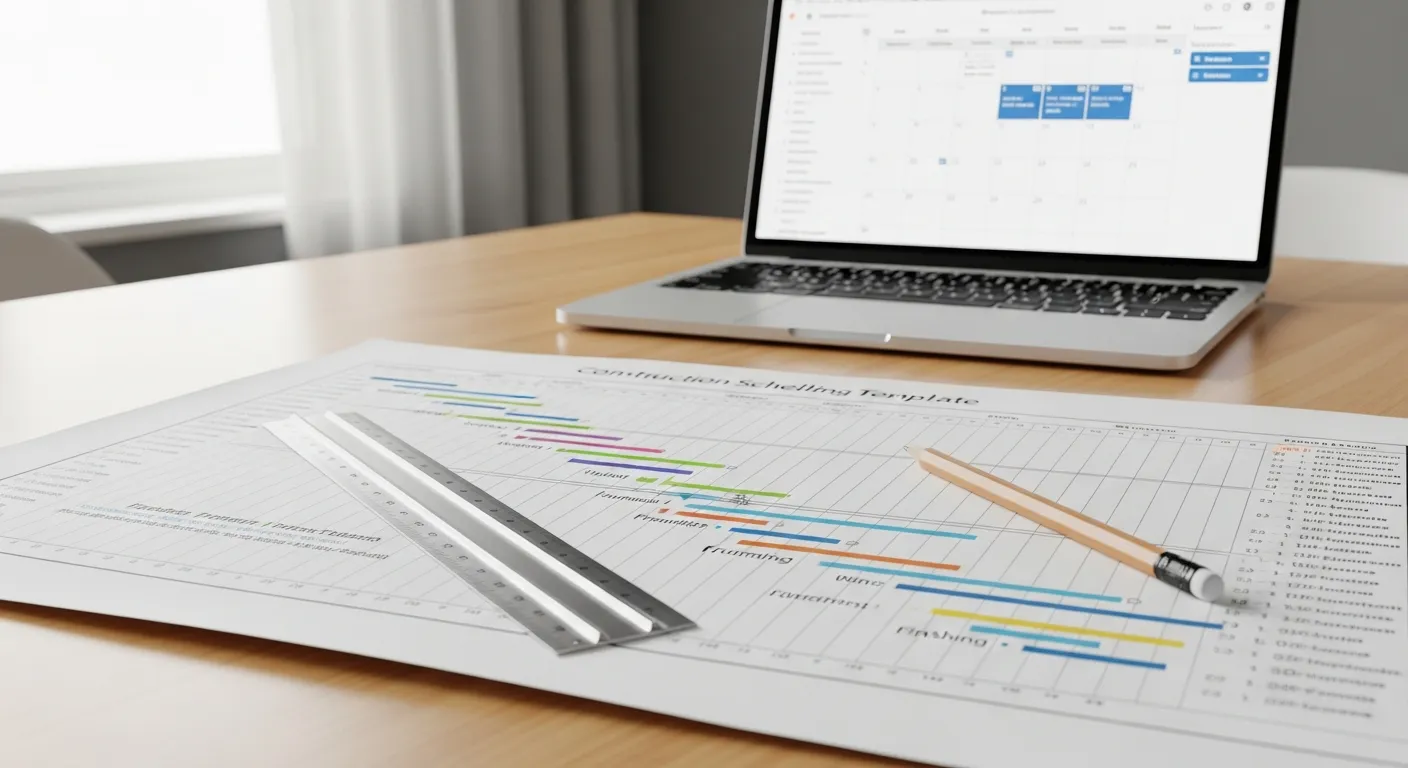
Free Construction Schedule Template
A solid construction schedule keeps your jobs on track, your crews busy, and your clients happy. Grab our free...
Read More →