
3 Free Paving and Asphalt Estimate Templates (2026)
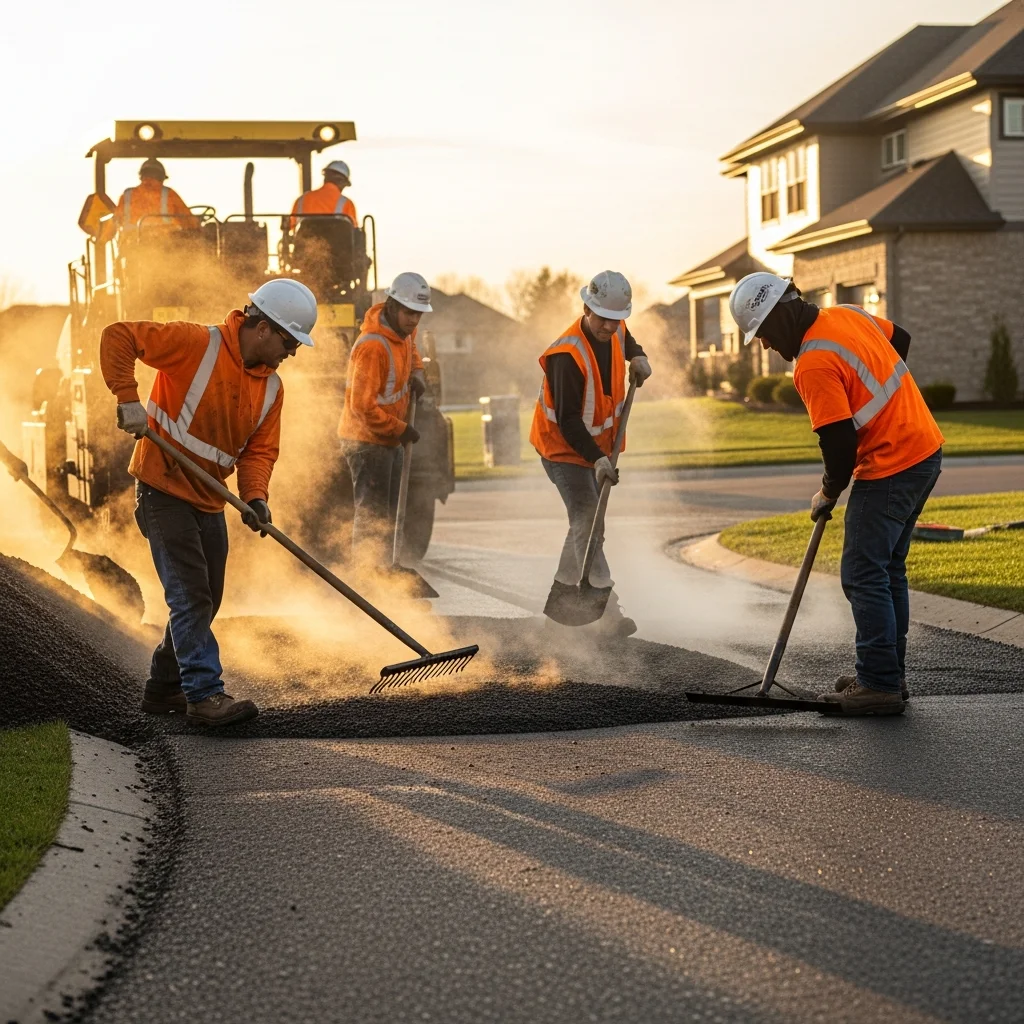
TL;DR: Three free paving estimate templates (residential driveway, commercial parking lot, and repair/maintenance) with 2026 pricing, material costs, and markup formulas. Plus a full breakdown of asphalt pricing by project type, material cost calculations, how weather affects your bids, and equipment rental costs so you can price every paving job with confidence.
Paving and asphalt work is a numbers game. Your material costs are tied to oil prices, your crew size determines how many square feet you can lay in a day, and your profit lives in the gap between your estimate and your actual costs. Get the estimate wrong, and that gap disappears fast.
The biggest challenge for paving contractors is not the physical work. It is pricing the job accurately before you start. Asphalt prices fluctuate with crude oil. Base material costs depend on local quarry pricing and haul distance. Site conditions vary from flat, clean driveways to sloped, tree-root-damaged parking lots that need full demolition and re-grading.
A good estimate template forces you to account for all of these variables before you hand the customer a price. Instead of guessing at a per-square-foot number, you break the job into its actual components: demolition, grading, base preparation, paving, striping, and cleanup. Each component gets its own pricing, and your total reflects the real cost of the work.
This guide includes three paving estimate templates. The first covers residential driveway installation. The second handles commercial parking lot paving. The third is for asphalt repair and maintenance work. Each template uses 2026 pricing that you can adjust for your market and material costs.
Get Your Free Estimate Templates
Download Projul’s free construction estimate templates, built by contractors, ready to customize. Create professional estimates in minutes and win more jobs.
What Makes Paving Estimates Different
Paving and asphalt work has several characteristics that make accurate estimating both critical and difficult:
Material costs are volatile. Asphalt is a petroleum product. When oil prices move, asphalt prices follow. A ton of hot mix asphalt can swing $10 to $20 per ton in a single quarter. If you quoted a large project three months ago and material prices jumped, your margin could evaporate. Always include a material price escalation clause or a quote expiration date of 14 to 30 days.
Volume drives pricing. A 500-square-foot residential driveway costs more per square foot than a 50,000-square-foot parking lot. Setup, mobilization, and minimum load charges eat into small jobs. Your template needs to reflect this reality with different per-unit pricing based on job size.
Weather affects scheduling and cost. Asphalt plants shut down in cold weather (typically below 40 to 50 degrees F ambient). In northern states, the paving season runs from April to November. Compressing your revenue into 7 to 8 months means you need higher margins to cover year-round overhead.
Base preparation is where the money hides. Customers see the smooth black asphalt on top. They do not see (or want to pay for) the base work underneath. But the base determines whether the pavement lasts 5 years or 25 years. Underbidding base work is the most common mistake in paving estimates.
Drainage is everything. Water is the number one enemy of asphalt pavement. If the grading does not move water off the surface and away from the edges, the pavement will fail prematurely. Your estimate should always include grading and drainage considerations, even if the customer did not ask about them.
Template 1: Residential Driveway Installation
This template covers a new asphalt driveway installation for a typical residential property. The example uses a 600-square-foot driveway (12 feet wide by 50 feet long).
Site Preparation
| Line Item | Unit | Qty | Unit Cost | Total |
|---|---|---|---|---|
| Site survey and layout | each | 1 | $200 | $200 |
| Remove existing driveway (asphalt, 2-3”) | sq ft | 600 | $1.50 | $900 |
| Haul and dispose of demolition debris | ton | 8 | $65 | $520 |
| Clear and grub vegetation at edges | linear ft | 124 | $3.00 | $372 |
| Fine grading and compaction of subgrade | sq ft | 600 | $1.25 | $750 |
| Geotextile fabric (if soft soil) | sq ft | 600 | $0.45 | $270 |
Subtotal: $3,012
Notes: If the existing driveway is concrete, demolition costs increase to $2.50 to $4.00 per square foot because concrete is heavier and harder to break up. Haul costs depend on the distance to the nearest dump or recycling facility. Always check if the existing surface contains any hazardous materials before quoting removal.
Base Installation
| Line Item | Unit | Qty | Unit Cost | Total |
|---|---|---|---|---|
| Aggregate base material (3/4” crushed stone) | ton | 20 | $28.00 | $560 |
| Deliver aggregate (local quarry) | load | 2 | $125.00 | $250 |
| Spread and grade base (6” compacted depth) | sq ft | 600 | $0.85 | $510 |
| Compact base (vibratory roller) | sq ft | 600 | $0.40 | $240 |
| Base grade verification (spot check elevations) | each | 1 | $150 | $150 |
Subtotal: $1,710
Notes: Base thickness depends on soil conditions and expected traffic. For standard residential use (cars and light trucks), 6 inches of compacted aggregate is sufficient on stable soil. For RVs, heavy trucks, or clay soil, increase to 8 to 10 inches. The base must be properly compacted to 95% maximum density. Skipping compaction testing is how cheap driveways fail in 3 to 5 years.
Asphalt Paving
| Line Item | Unit | Qty | Unit Cost | Total |
|---|---|---|---|---|
| Tack coat (existing surface bond, if overlay) | sq ft | 600 | $0.15 | $90 |
| Hot mix asphalt (surface course, 2.5” compacted) | ton | 9 | $110.00 | $990 |
| Asphalt delivery | load | 1 | $175.00 | $175 |
| Paving labor (hand work and machine) | sq ft | 600 | $1.25 | $750 |
| Rolling and compaction (steel wheel + pneumatic) | sq ft | 600 | $0.35 | $210 |
Subtotal: $2,215
Notes: Hot mix asphalt weighs approximately 145 pounds per cubic foot compacted. For a 600-square-foot driveway at 2.5 inches thick, you need roughly 9 tons. Always order 5% to 10% extra to account for waste and thickness variations. Asphalt must be placed at 275 to 325 degrees F and compacted before it cools below 175 degrees F.
Finishing and Drainage
| Line Item | Unit | Qty | Unit Cost | Total |
|---|---|---|---|---|
| Asphalt edging (hand tamp and shape) | linear ft | 124 | $2.50 | $310 |
| Driveway apron transition to road | each | 1 | $400 | $400 |
| Gravel shoulder grading | linear ft | 100 | $3.00 | $300 |
| Swale or drainage grading (direct water away) | linear ft | 50 | $5.00 | $250 |
| Site cleanup and sweeping | each | 1 | $200 | $200 |
Subtotal: $1,460
Summary for Residential Driveway
| Category | Total |
|---|---|
| Site Preparation | $3,012 |
| Base Installation | $1,710 |
| Asphalt Paving | $2,215 |
| Finishing and Drainage | $1,460 |
| Subtotal | $8,397 |
| Overhead (10%) | $840 |
| Profit (15%) | $1,386 |
| Total Estimate | $10,623 |
Effective rate: $17.71 per square foot (all-in with demo, base, pave, and margin). This is typical for a residential driveway replacement in a mid-cost market. New installation without demolition would be $13 to $15 per square foot.
Template 2: Commercial Parking Lot Paving
Commercial parking lots are larger, require heavier-duty construction, and involve additional elements like striping, ADA compliance, signage, and stormwater management. This template covers a 20,000-square-foot parking lot (approximately 50 spaces).
Demolition and Site Preparation
| Line Item | Unit | Qty | Unit Cost | Total |
|---|---|---|---|---|
| Mobilization (equipment transport) | each | 1 | $1,500 | $1,500 |
| Remove existing asphalt (3” avg depth) | sq ft | 20,000 | $1.25 | $25,000 |
| Haul and dispose of millings | ton | 200 | $35.00 | $7,000 |
| Remove existing concrete curbs | linear ft | 400 | $6.00 | $2,400 |
| Fine grade and compact subgrade | sq ft | 20,000 | $0.75 | $15,000 |
| Proof roll subgrade (loaded truck test) | each | 1 | $800 | $800 |
| Remediate soft spots (undercut and replace) | cu yd | 30 | $55.00 | $1,650 |
Subtotal: $53,350
Base Construction
| Line Item | Unit | Qty | Unit Cost | Total |
|---|---|---|---|---|
| Aggregate base (3/4” crushed stone, 8” compacted) | ton | 700 | $24.00 | $16,800 |
| Aggregate delivery | load | 28 | $110.00 | $3,080 |
| Spread, grade, and compact base | sq ft | 20,000 | $0.65 | $13,000 |
| Compaction testing (nuclear density gauge) | test | 10 | $125.00 | $1,250 |
Subtotal: $34,130
Asphalt Paving
| Line Item | Unit | Qty | Unit Cost | Total |
|---|---|---|---|---|
| Asphalt binder course (2” compacted, 19mm mix) | ton | 130 | $95.00 | $12,350 |
| Asphalt surface course (2” compacted, 9.5mm mix) | ton | 130 | $105.00 | $13,650 |
| Tack coat between lifts | sq ft | 20,000 | $0.12 | $2,400 |
| Paving labor and equipment | sq ft | 20,000 | $0.90 | $18,000 |
| Compaction (steel drum and pneumatic roller) | sq ft | 20,000 | $0.25 | $5,000 |
| Asphalt delivery | load | 10 | $175.00 | $1,750 |
Subtotal: $53,150
Concrete Work
| Line Item | Unit | Qty | Unit Cost | Total |
|---|---|---|---|---|
| Concrete curb and gutter | linear ft | 400 | $28.00 | $11,200 |
| Concrete sidewalk (4” thick, 5’ wide) | sq ft | 500 | $8.50 | $4,250 |
| ADA-compliant ramp with truncated domes | each | 4 | $1,200 | $4,800 |
| Concrete wheel stops | each | 50 | $85.00 | $4,250 |
Subtotal: $24,500
Striping and Signage
| Line Item | Unit | Qty | Unit Cost | Total |
|---|---|---|---|---|
| Parking stall striping (standard) | each | 46 | $18.00 | $828 |
| Handicap stall striping (with symbol) | each | 4 | $75.00 | $300 |
| Fire lane striping | linear ft | 100 | $2.50 | $250 |
| Directional arrows | each | 6 | $45.00 | $270 |
| Handicap signage (post-mounted) | each | 4 | $175.00 | $700 |
| Stop signs | each | 2 | $225.00 | $450 |
| No parking / fire lane signs | each | 4 | $150.00 | $600 |
Subtotal: $3,398
Drainage
| Line Item | Unit | Qty | Unit Cost | Total |
|---|---|---|---|---|
| Storm drain inlet (catch basin) | each | 4 | $2,500 | $10,000 |
| Storm drain pipe (12” HDPE) | linear ft | 200 | $35.00 | $7,000 |
| Connect to existing storm system | each | 1 | $2,000 | $2,000 |
| Grading for proper drainage slope (1-2%) | sq ft | 20,000 | $0.25 | $5,000 |
Subtotal: $24,000
Permits and Engineering
| Line Item | Unit | Qty | Unit Cost | Total |
|---|---|---|---|---|
| Civil engineering (grading and drainage plan) | each | 1 | $3,500 | $3,500 |
| Building/grading permit | each | 1 | $1,200 | $1,200 |
| Stormwater management plan (if required) | each | 1 | $2,500 | $2,500 |
| As-built survey | each | 1 | $1,500 | $1,500 |
Subtotal: $8,700
Summary for Commercial Parking Lot
| Category | Total |
|---|---|
| Demolition and Site Prep | $53,350 |
| Base Construction | $34,130 |
| Asphalt Paving | $53,150 |
| Concrete Work | $24,500 |
| Striping and Signage | $3,398 |
| Drainage | $24,000 |
| Permits and Engineering | $8,700 |
| Subtotal | $201,228 |
| Overhead (8%) | $16,098 |
| Profit (12%) | $26,079 |
| Total Estimate | $243,405 |
Effective rate: $12.17 per square foot (all-in). Commercial work runs lower per square foot than residential because of economies of scale, but the total project value is much higher.
Template 3: Asphalt Repair and Maintenance
Repair and maintenance work keeps your crews busy between big paving jobs and builds ongoing relationships with property managers and homeowners. This template covers common repair items that you can mix and match for any maintenance estimate.
Crack Sealing
| Line Item | Unit | Qty | Unit Cost | Total |
|---|---|---|---|---|
| Route cracks (mechanical router) | linear ft | 500 | $0.75 | $375 |
| Clean cracks (compressed air) | linear ft | 500 | $0.25 | $125 |
| Hot-pour crack sealant | linear ft | 500 | $1.50 | $750 |
| Mobilization | each | 1 | $250 | $250 |
Subtotal: $1,500
Pothole Repair
| Line Item | Unit | Qty | Unit Cost | Total |
|---|---|---|---|---|
| Saw-cut perimeter of repair area | linear ft | 60 | $3.50 | $210 |
| Remove failed asphalt | sq ft | 100 | $2.00 | $200 |
| Compact and prep base | sq ft | 100 | $1.50 | $150 |
| Tack coat | sq ft | 100 | $0.15 | $15 |
| Hot mix asphalt patch (full depth, 3”) | sq ft | 100 | $8.00 | $800 |
| Compact patch | sq ft | 100 | $0.50 | $50 |
| Mobilization | each | 1 | $350 | $350 |
Subtotal: $1,775
Asphalt Overlay (Resurfacing)
| Line Item | Unit | Qty | Unit Cost | Total |
|---|---|---|---|---|
| Clean and prep existing surface | sq ft | 5,000 | $0.20 | $1,000 |
| Mill existing surface (1.5” depth) | sq ft | 5,000 | $1.00 | $5,000 |
| Haul millings | ton | 50 | $35.00 | $1,750 |
| Tack coat | sq ft | 5,000 | $0.12 | $600 |
| Hot mix asphalt overlay (2” compacted) | ton | 32 | $105.00 | $3,360 |
| Paving and compaction | sq ft | 5,000 | $0.85 | $4,250 |
| Adjust utility covers and drains to new grade | each | 6 | $250.00 | $1,500 |
Subtotal: $17,460
Sealcoating
| Line Item | Unit | Qty | Unit Cost | Total |
|---|---|---|---|---|
| Clean surface (power broom/blower) | sq ft | 5,000 | $0.05 | $250 |
| Fill minor cracks (cold pour) | linear ft | 200 | $1.00 | $200 |
| Apply sealcoat (two coats, coal tar or asphalt emulsion) | sq ft | 5,000 | $0.35 | $1,750 |
| Barricade and traffic control during cure | each | 1 | $200 | $200 |
| Mobilization | each | 1 | $200 | $200 |
Subtotal: $2,600
Re-Striping
| Line Item | Unit | Qty | Unit Cost | Total |
|---|---|---|---|---|
| Layout and chalk lines | each | 1 | $300 | $300 |
| Parking stall striping | each | 50 | $15.00 | $750 |
| Handicap stalls and symbols | each | 4 | $65.00 | $260 |
| Fire lane markings | linear ft | 100 | $2.00 | $200 |
| Directional arrows | each | 6 | $40.00 | $240 |
| Mobilization | each | 1 | $200 | $200 |
Subtotal: $1,950
Tips for Accurate Paving Estimates
1. Get current asphalt pricing from your plant. Hot mix asphalt prices change frequently. Call your plant and get a current quote before pricing any job. Ask about minimum load requirements and delivery charges. Most plants require a minimum of 2 to 3 tons per load, which matters for small residential jobs.
2. Measure with a wheel or GPS. Walking off dimensions leads to errors. Use a measuring wheel for small jobs and a GPS or drone survey for large commercial lots. A 5% error on a 20,000-square-foot lot means 1,000 square feet of pricing difference.
3. Check the subgrade before quoting base work. Dig a few test holes or use a probe to check soil conditions. Clay soil, organic material, and high water table all mean more base work and higher costs. If you cannot test the subgrade before quoting, include a contingency allowance or clearly state that the price assumes stable subgrade conditions.
4. Account for temperature and season. Asphalt work has a limited window in cold climates. If you are quoting a job for late fall, factor in the risk of weather delays. Many contractors add 5% to 10% to late-season jobs to cover the possibility of rescheduling.
5. Include mobilization on every job. Moving a paver, roller, dump trucks, and crew to a job site costs money. For residential jobs, mobilization typically runs $250 to $500. For commercial jobs with heavy equipment, it can be $1,000 to $2,500. Listing it as a separate line item ensures you recover this cost.
6. Specify your asphalt mix. Different jobs need different mixes. A residential driveway uses a 9.5mm or 12.5mm surface mix. A commercial lot might use a 19mm binder course with a 9.5mm surface course. Specify the mix type on your estimate to avoid disputes about material quality.
7. Include a price escalation clause. For projects that will not start for 30 or more days, include language that allows you to adjust the price if material costs increase by more than 5%. This protects your margin on large projects with long lead times.
8. Price maintenance work as a package. Offer property managers an annual maintenance package that includes crack sealing, pothole repair, sealcoating, and re-striping. Recurring maintenance contracts provide steady revenue and are easier to sell than one-time services because the cost is predictable for the customer.
Common Mistakes in Paving Estimates
Underestimating tonnage. Asphalt is sold by the ton, but jobs are measured in square feet and inches. The conversion trips up many contractors. One ton of hot mix covers approximately 80 square feet at 2 inches compacted thickness. Double-check your tonnage calculations on every estimate.
Ignoring haul distance. The asphalt plant might be 10 minutes from one job site and 45 minutes from another. Longer haul distances mean higher delivery costs, more temperature loss, and less working time before the asphalt cools. Price accordingly.
Skimping on base preparation. The number one cause of premature pavement failure is a bad base. Customers who see you spending time on base work might wonder why you are not paving yet. But contractors who rush the base to save money end up with callback repairs that cost far more than doing it right the first time.
Not including traffic control. Commercial parking lot work often requires traffic control, barricades, and flagging to keep the lot partially open during construction. These costs can run $500 to $2,000 per day and are easy to forget.
Quoting small jobs like big jobs. A 500-square-foot driveway cannot be priced at the same per-square-foot rate as a 50,000-square-foot parking lot. Small jobs have higher per-unit costs because of minimum load charges, mobilization, and fixed setup time. Your template should have different pricing tiers based on job size.
Forgetting about utility adjustments. When you overlay an existing surface, manholes, water valve covers, and drain grates need to be raised to the new grade. Each adjustment costs $150 to $350 and there might be a dozen on a commercial lot. Include these on your estimate or they come out of your profit.
Asphalt Pricing by Project Type
Not all paving work prices out the same. A residential driveway, a commercial parking lot, and a county road each have different spec requirements, equipment needs, and crew sizes. Knowing the typical price ranges for each project type helps you quote accurately and spot bids that are too low to be profitable.
Residential Driveways
Residential driveway paving typically runs $3 to $7 per square foot installed, depending on your market, the condition of the existing base, and whether you are doing new construction or replacing an old driveway. The low end of that range covers a straightforward new pour over a prepped base with good soil. The high end covers full removal of an existing driveway, base repair, and new asphalt in a high-cost metro area.
Most residential driveways fall in the 400 to 800 square foot range, which means total project prices land between $4,000 and $12,000 for a typical job. The challenge with residential work is that small jobs carry higher per-square-foot costs because of mobilization, minimum asphalt plant loads, and setup time. A 400-square-foot driveway might cost $7 per square foot while a 1,200-square-foot driveway might come in at $4.50 per square foot for the same spec.
Use Projul’s estimating tools to build out separate templates for small, medium, and large residential jobs so your per-unit pricing reflects the actual cost structure of each size category.
Commercial Parking Lots
Commercial parking lots run $2.50 to $5 per square foot for the asphalt portion of the work, not including concrete curbs, drainage, striping, or engineering. The lower per-square-foot cost compared to residential work comes from economies of scale. A 20,000-square-foot lot lets your paver run continuously instead of constantly repositioning, and your material deliveries are larger and more efficient.
The total project cost for a commercial lot is significantly higher, though. A 50-space lot (roughly 20,000 square feet) with full demo, base work, paving, curbs, drainage, striping, and permits typically runs $200,000 to $300,000 depending on site conditions and local requirements. Commercial work also involves longer sales cycles, more detailed specs, and engineer-stamped plans. Factor your overhead and sales costs into your markup accordingly.
Track material, labor, and equipment costs against your commercial estimates in real time with Projul’s budgeting features so you know whether a job is profitable before it wraps up.
Road and Highway Work
Municipal and highway paving runs $4 to $8 per square foot and comes with prevailing wage requirements, bonding costs, traffic control plans, and strict DOT specifications. The per-square-foot rate is higher than commercial work because of the thicker pavement sections (4 to 6 inches of asphalt over 10 to 12 inches of base), the regulatory burden, and the traffic control requirements.
Road work also requires specialized equipment that many paving contractors do not own outright. If you are subcontracting road paving, your bid needs to account for equipment rental or subcontractor markups. If you are a prime contractor on road work, your bonding capacity and insurance requirements will be significantly higher than residential or commercial work.
Overlay vs Full Depth
An asphalt overlay (1.5 to 2 inches of new asphalt over the existing surface) costs roughly 30% to 50% less than a full-depth installation. Overlays run $1.50 to $3.50 per square foot compared to $3 to $7 per square foot for full depth. The catch is that overlays only work when the existing base is still structurally sound. If the base has failed (you will see alligator cracking, large potholes, or significant settling), an overlay is a waste of money. It will crack through within a year or two.
Always inspect the existing pavement before quoting an overlay. Core samples or test cuts let you see the base condition. If a customer wants an overlay but the base is shot, be honest about it. Quoting an overlay on a bad base leads to a callback that costs more than doing the full replacement would have cost in the first place.
Sealcoating
Sealcoating runs $0.15 to $0.30 per square foot for a standard two-coat application, with most residential driveways coming in at $150 to $400 and commercial lots at $1,500 to $4,000. It is the highest-margin work in the paving business because the material cost is low, the equipment is inexpensive, and a two-person crew can knock out multiple jobs per day.
Sealcoating is also a great lead-in service. Every sealcoating job is an opportunity to identify driveways and lots that need repair or replacement. Build sealcoating into your annual maintenance packages and you create a pipeline of future paving work. Send maintenance reminders and track customer history with Projul’s CRM features to stay in front of property owners when their pavement needs attention.
Material Cost Breakdown
Understanding your material costs at a granular level is what separates profitable paving contractors from the ones who are busy but broke. Here is what each major material costs and how to calculate quantities accurately.
Hot Mix Asphalt
Hot mix asphalt (HMA) runs $80 to $140 per ton depending on your region, the mix design, and current oil prices. A standard 9.5mm surface mix for residential work sits in the $100 to $120 range in most markets. Polymer-modified mixes and specialty mixes for heavy-duty commercial work run $120 to $140 per ton.
The tonnage formula every paving contractor should know:
Tons = (Square Feet x Depth in Inches x 110) / 2000
The 110 factor accounts for the density of compacted hot mix asphalt in pounds per cubic foot (actual density varies from 140 to 150, but the formula uses 110 because asphalt is sold in a slightly different density state than it compacts to). For a 600-square-foot driveway at 2.5 inches:
600 x 2.5 x 110 / 2000 = 8.25 tons
Always round up and add 5% to 10% for waste. Order 9 to 9.5 tons for this example. Running short on asphalt mid-pour is one of the worst things that can happen on a job. The plant might not have another load ready, and a cold joint in the middle of a driveway looks terrible and creates a weak point.
Base Aggregate
Crushed stone base aggregate (3/4-inch minus, also called crusher run or road base) costs $15 to $30 per ton delivered, depending on your distance from the quarry. A 6-inch compacted base requires roughly 1 ton per 30 square feet. An 8-inch base requires about 1 ton per 22 square feet.
Haul distance is the biggest variable in aggregate pricing. If the nearest quarry is 30 miles away instead of 10, your per-ton delivered cost could double. For large commercial jobs, negotiate a project rate with the quarry that includes delivery. For smaller residential jobs, factor in the delivery charge per load (typically $100 to $200 per load) separately.
Tack Coat
Tack coat is the sticky emulsion applied between asphalt layers to bond them together. It costs $0.10 to $0.20 per square foot applied, and it is one of the most overlooked items on paving estimates. Skipping tack coat saves a few hundred dollars on a job but risks delamination, where the top layer separates from the layer below. That is a failure that you will be called back to fix at your own expense.
Fabric Underlayment
Paving fabric (geotextile) costs $0.30 to $0.60 per square foot installed and is used between the base and asphalt layer on overlay projects or areas with soft subgrade. The fabric helps prevent reflective cracking (where cracks in the old surface telegraph through the new overlay) and adds structural support over weak soil. It is not needed on every job, but listing it as a line item on your estimate lets you include it where appropriate and explain the value to the customer.
Keep your material pricing current by updating your cost library in Projul whenever your suppliers change pricing. Projul’s invoicing features pull from the same cost data as your estimates, so your final invoice matches the approved price.
How Weather and Season Affect Paving Bids
Weather is not just a scheduling inconvenience for paving contractors. It directly impacts your material costs, your crew productivity, and your ability to deliver quality work. Understanding these impacts helps you price jobs accurately and set customer expectations.
Asphalt Plant Shutdowns
Most asphalt plants in northern states shut down from late November through March. In the upper Midwest and Northeast, the season can be even shorter. When plants close, you cannot get material. Period. This compresses the paving season into 7 to 8 months, which means you need to generate your entire year’s revenue in that window.
This has real implications for your pricing. Your annual overhead (office rent, insurance, equipment payments, admin salaries) runs 12 months, but your revenue runs 7 to 8 months. Your markup needs to account for this compression. Contractors who price based on a 12-month revenue assumption will underbid every time.
Spring Premium Pricing
When plants reopen in spring, demand spikes. Every paving contractor in your area is trying to get started on their backlog at the same time. This creates two problems: asphalt plants may run at capacity with longer wait times for loads, and your competitors are hungry for work after a long winter, which can drive bid prices down.
Smart contractors pre-sell spring work during the winter months when customers have time to think about their properties. Getting commitments in January and February for April and May work helps you plan your season and lock in pricing before the spring rush. Use Projul’s scheduling features to map out your spring lineup and balance crew workloads across the first few months of paving season.
Temperature Requirements
Asphalt must be placed when ambient temperatures are at least 50 degrees F and rising. Below that threshold, the asphalt cools too fast and cannot be properly compacted, resulting in a porous surface that will deteriorate quickly. Surface temperature of the existing base matters too. Paving on a frozen base is a recipe for failure.
For late-season work (October and November in northern markets), you are gambling with the weather every day. Some contractors add a 5% to 10% premium for late-season jobs to cover the risk of weather delays, reschedules, and the possibility of having to hold a crew on standby while waiting for a suitable paving day.
Rain Delays
Rain shuts down paving operations immediately. You cannot lay asphalt on a wet surface, and the material itself cannot get wet during placement. A surprise rainstorm in the middle of a pour can ruin a load of asphalt (which you still have to pay for) and damage the work already completed.
For multi-day commercial projects, build 1 to 2 rain days into your schedule. If the weather cooperates and you finish early, great. If not, you are not scrambling to explain delays to the property owner. Track actual vs planned schedules across all your jobs with Projul’s job management features to identify weather-related patterns in your scheduling.
Night Paving Premiums
Some commercial and municipal projects require night paving to minimize disruption to businesses or traffic. Night work typically carries a 15% to 25% premium over daytime rates because of shift differentials for your crew, the need for additional lighting equipment, and reduced productivity. Asphalt also cools faster at night, especially in shoulder-season months, which can limit your compaction window and require more careful temperature management.
If you are bidding night work, make sure your estimate accounts for the full cost premium. Many contractors bid night work at daytime rates and then wonder why their margins are thin. Track your crew hours and overtime with Projul’s time tracking features to understand the true labor cost of night paving operations.
Paving Equipment Costs
Equipment is one of the biggest line items in any paving operation, whether you own it outright or rent it per job. Knowing these costs helps you build accurate estimates and decide when it makes sense to buy versus rent.
Paver
An asphalt paver rental runs $1,500 to $3,000 per day depending on the size and type. A small track paver suitable for residential driveways and small commercial lots rents for $1,500 to $2,000 per day. A large highway-class paver capable of laying 12-foot-wide passes rents for $2,500 to $3,000 per day.
Purchasing a paver is a significant capital investment. Used pavers in good condition start at $75,000 to $150,000 for smaller models and $200,000 to $500,000 for larger equipment. If you are paving 150 or more days per year, ownership usually pencils out. Below that threshold, renting per job or per week keeps your fixed costs lower.
Roller
Vibratory rollers (steel drum and pneumatic tire) rent for $800 to $1,500 per day. You typically need both types on any paving job. The steel drum roller does the initial breakdown compaction, and the pneumatic roller finishes and seals the surface. Some contractors get by with just a steel drum roller on small residential jobs, but commercial specs usually require both.
Dump Trucks
You need dump trucks to haul asphalt from the plant to the job site. Dump truck rental runs $400 to $700 per day with operator, or you can hire trucking companies per load at $75 to $150 per load depending on distance. The number of trucks you need depends on the haul distance and the paving speed. A general rule: you want a truck arriving at the paver every 15 to 20 minutes to keep the operation continuous. Waiting for material is dead time for your paver and crew.
Mobilization Fees
Moving heavy equipment to and from job sites costs $250 to $500 for residential jobs and $1,000 to $2,500 for commercial jobs with larger equipment. These costs include lowboy trailer transport, pilot cars if required for oversized loads, and the setup and teardown time at each end. Always list mobilization as a separate line item on your estimate. Rolling it into your per-square-foot price hides the cost and makes your unit pricing look artificially high.
When to Own vs Rent
The decision to buy or rent equipment depends on your annual utilization. Here is a rough guide:
Buy when: You use the equipment more than 120 to 150 days per year, you have the capital or financing capacity, and your revenue is stable enough to support the payments during the off-season.
Rent when: You use the equipment less than 100 days per year, you are growing and not sure of your long-term volume, or you need specialized equipment (milling machines, large pavers) for occasional projects.
Lease when: You want predictable monthly costs, you upgrade equipment every 3 to 5 years, or you want to keep the equipment off your balance sheet.
Track your equipment hours, maintenance costs, and utilization across jobs to make data-driven rent-vs-buy decisions. The more jobs you can manage through a single platform like Projul, using features for estimating, scheduling, and time tracking, the clearer your equipment economics become.
How Projul Helps Paving Contractors
Paving contractors often run multiple crews on different job sites at the same time. You might have one crew doing a residential driveway, another resurfacing a parking lot, and a third on a sealcoating route. Keeping estimates, schedules, and job costs organized across all of those jobs is tough in spreadsheets.
Projul’s estimating tools are built for multi-crew operations. Here is what that looks like:
Material cost tracking. Set up your asphalt, aggregate, and concrete costs in Projul and update them when prices change. Every estimate you build pulls from your current cost library, so you are never quoting with outdated numbers.
Estimate templates by job type. Create separate templates for driveways, parking lots, overlays, sealcoating, and crack sealing. Each template has the right line items and default quantities. Adjust for the specific job and send it.
Multi-estimate comparison. For large commercial bids, create multiple estimate versions (good, better, best) and let the customer compare options. This increases your average job value because many customers choose the middle option.
Crew scheduling integration. Once an estimate is approved, assign the job to a crew and schedule the work. Your estimating and scheduling live in the same system, so nothing falls through the cracks between “estimate approved” and “job starts.”
Job costing. Track your actual material usage, labor hours, and equipment costs against your estimate in real time. If a job is running over budget, you know it while you can still do something about it, not two weeks later when the invoice comes in.
Ready to Send Better Paving Estimates?
These templates give you a solid starting point for residential, commercial, and repair estimates. Copy them, plug in your local material and labor costs, and start sending more accurate estimates today.
Or skip the manual work entirely and build your estimates inside Projul, where your line items, pricing, templates, and customer approvals all live in one system. Manage everything from the office or the job site with Projul’s mobile apps for iOS, Android, Windows, and Mac. For more ways to keep your paving operation profitable, check out our guide on how to reduce construction costs and grab our free construction budget templates.
Projul Plans:
- Core - Estimating, scheduling, and job management for paving contractors
- Core+ - Everything in Core plus advanced features for growing companies
- Pro - Full platform for high-volume paving operations running multiple crews
Schedule a Demo and see how Projul can help your paving company send winning estimates in less time.
Frequently Asked Questions
How much does asphalt paving cost per square foot in 2026?
How thick should a residential asphalt driveway be?
How long does an asphalt driveway last?
What is the difference between asphalt overlay and full replacement?
Should I include sealcoating in my paving estimate?
What is the minimum job size for asphalt paving?
How do I calculate how many tons of asphalt I need?
Related Articles

Construction Bidding Strategies: How to Win More Jobs at Better Margins
Most contractors lose bids not because their price is wrong, but because their process is. These bidding strategies...
Read More →
Construction Estimating for Beginners: A Plain-English Guide
Construction estimating does not have to be complicated. This guide breaks it down into plain English so you can create...
Read More →
Free Cabinet and Countertop Estimate Templates
Three ready-to-use cabinet and countertop estimate templates with realistic line items, material costs, labor rates,...
Read More →