Construction Project Management Software - Schedules, Budgets, and Crews in One Place
Schedule a Demo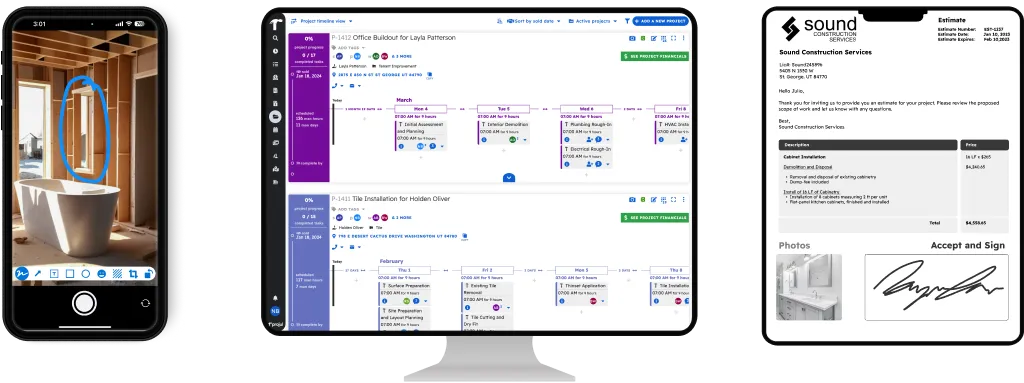
What Construction Project Management Actually Means
Project management in construction isn’t about moving cards around a Kanban board. It’s about knowing where every crew is, which materials have been ordered, whether you’re on budget, and if that inspection is going to hold up the drywall crew.
Projul’s construction project management software connects scheduling, budgets, documents, and crew tracking in one platform built by a contractor. Over 5,000 contractors manage multiple active jobs with real-time field updates from any device. Projul offers flat-rate pricing with no per-user fees for construction companies of all sizes.
Real construction project management ties together your schedule, your budget, your documents, and your people into one system. When the framing crew finishes early, your scheduler should know immediately so the electrician can start. When a change order gets approved, your budget should update automatically.
That’s what Projul was built to do. Not project management in theory. Project management the way it actually works on a job site.
Why Generic PM Tools Fail on Job Sites
A lot of contractors try tools like Monday, Asana, or Trello before they find construction-specific software. And every time, the same problems show up.
No understanding of construction workflows. Generic PM tools don’t know what a punch list is. They don’t support progress billing. They can’t track retainage or manage subs. You end up building workarounds on top of workarounds until the tool is more work than it’s worth.
No field-friendly mobile experience. Your crew isn’t sitting at a desk. They need to update task status, upload photos, and check assignments from a phone with muddy hands and bad cell service. Most generic tools weren’t designed for that. Projul is rated 9.8 out of 10 on G2 for ease of use because it was built for the field first.
No connection to financials. In construction, schedule and budget are joined at the hip. When a task takes longer than planned, it costs more. Generic PM tools track tasks but have zero concept of job costing, budgets, or invoicing. You end up with two separate systems that don’t talk to each other.
No construction document management. RFIs, submittals, daily logs, job site photos. Construction generates a mountain of documents that need to be tied to specific projects and tasks. Generic tools treat everything as an attachment on a card. Projul organizes it all automatically.
How Projul Handles Project Management Differently
Projul isn’t a generic tool with a construction skin on it. It was designed from the ground up by a contractor who ran projects in the field.
Everything connects
Your estimate becomes your budget. Your schedule drives your task assignments. Your tasks generate time entries. Your time entries feed your invoices. Nothing exists in a silo. When something changes, the whole system updates.
Real-time field updates
When a crew member marks a task complete on their phone, the office sees it immediately. No more calling the site to ask “where are we at?” This keeps your scheduling accurate and your clients informed.
Visual scheduling that makes sense
Projul’s linear project timeline and interactive Gantt view let you see all your active projects on one screen. Drag and drop tasks, manage dependencies, and spot conflicts before they cause delays.
Built-in time tracking
Time tracking is part of the platform, not a bolt-on. Your crew clocks in from their phone, hours get tied to specific tasks and projects, and labor costs flow into your job costing reports automatically.
Job management for every project type
Whether you’re running a single custom home or managing 30 active commercial jobs, Projul’s job management gives you one place to track status, documents, budgets, and communications for every project.
Linear Project Timeline and Gantt Views
Projul’s linear project timeline view lets you balance multiple projects at a glance. Grab a bird’s-eye view of what’s happening on your projects or add details, tasks, and steps, or send messages, photos, and documents in seconds.
Quickly switch from the project timeline view to a more traditional Gantt view and manage job dependencies with ease.
Detailed task management with steps, mobile notifications, and real-time job progress from the field. Quickly understand the status of any of your projects and associated tasks while on the go.
Workers are more efficient and profitable when they have a clear picture of the job. Projul’s project management tools provide detailed step-by-step assignments and progression so that steps are never skipped and customers are always happy.
Project templates make task creation even easier. Create tasks and steps for a specific project type once, save, and apply to the next project. It’s that easy.
Photos, Documents, and Job Site Evidence
Tired of filling up your phones and computers with job photos and documents? Projul automatically organizes, tags, and stores your photos and documents in secure cloud servers for you.
Our gallery makes it quick and easy to find and access your content. With Projul every employee is now your photographer. Never miss out on estimating, before, and after shots again.
Photo markup helps you communicate back and forth with workers. Projul’s photo and document tools keep everything organized and easy to find.
Build your schedule and track your budget in one place
Scheduling lets you drag and drop tasks across your project timeline, while budgeting tracks every dollar against your estimate in real time. You’ll spot overruns and delays before they become problems.
Keep your team connected
Construction communications keeps messages tied to the right project so nothing gets buried in group texts. Upload job site evidence with photos and document management and keep everything organized automatically.
Mobile Access From Any Job Site
Construction project management only works if your field crew actually uses it. That means the software has to work on a phone, in the sun, with one bar of signal.
Projul’s mobile app gives your crew everything they need on site. They can check their assignments, mark steps complete, upload photos, log time, and send messages - all from their phone. When they update progress, the office sees it in real time without making a single phone call.
For project managers bouncing between sites, the mobile app shows a full view of every active job. Check task status, review daily logs, approve time entries, and respond to crew questions from the truck. You don’t need to be at your desk to run your projects.
Offline support means the app keeps working even when cell service drops. Data syncs automatically when the connection comes back. Your crew never loses work because of a dead zone on a rural job site.
The Real Cost of Bad Project Management
Bad project management doesn’t always show up as one big disaster. It’s death by a thousand cuts. A missed task here, an untracked change order there, a crew that shows up to a site that isn’t ready for them.
Here’s what poor project management actually costs you:
Wasted labor hours. When crews don’t have clear assignments, they waste time figuring out what to do next. Or worse, they do the wrong thing and you have to fix it. Even 30 minutes of confusion per crew per day adds up to thousands per month.
Material waste. Without tight coordination between scheduling and procurement, materials show up too early (and get damaged on site) or too late (and your crew sits idle). Either way, it costs you.
Missed deadlines. Every day a project runs long, you’re paying for it. Extended overhead, delayed starts on the next job, liquidated damages on commercial work. Good project management software keeps your timeline honest.
Client frustration. When clients can’t get a straight answer about project status, trust erodes fast. That leads to disputes, slow payments, and lost referrals. Projul gives you real-time status to share with clients confidently.
Rework. When steps get skipped because nobody was tracking them, you end up doing work twice. Projul’s step-by-step task management makes sure every phase gets completed in order before the next one starts.
The contractors who grow consistently aren’t just good at building. They’re good at managing the work around the building. That’s what construction project management software is for.
Who Needs Construction Project Management Software?
If you’re running more than two or three jobs at a time, you need it. Here’s who benefits most:
General contractors managing multiple projects with different subs, timelines, and budgets. You need one place to see everything, not five different spreadsheets.
Specialty contractors running high-volume service work alongside project-based jobs. Projul handles both with job management that flexes to your workflow.
Growing companies that have outgrown whiteboards and spreadsheets. When you go from 5 jobs to 25, your old system breaks. Projul scales with you because there are no per-user fees holding you back.
Multi-location operations where the office needs visibility into field progress across sites. Real-time updates from time tracking and task completion keep everyone on the same page.
Why 5,000+ Contractors Trust Projul for Project Management
Contractors don’t switch software because they’re bored. They switch because their current setup is costing them time and money. Here’s what Projul’s users see after making the switch:
2+ hours saved daily. That’s time reclaimed from manual data entry, phone calls to the field, and spreadsheet updates. It adds up to over 500 hours a year per office employee.
32% average profit increase. When you can see your budget, schedule, and reporting in one place, you catch problems before they eat your margin. That’s the difference between guessing and knowing.
Crew adoption on day one. The 9.8/10 G2 ease-of-use rating isn’t a marketing number. It’s based on real reviews from real contractors. Your team will be using Projul by lunch on their first day.
No per-user fees. Most construction project management software charges per seat. That discourages you from giving access to subs, field workers, and part-time staff who actually need the information. Projul’s flat rate means everyone gets in.
What Makes Construction Project Management Different
Construction project management is nothing like managing a marketing campaign or a software release. The work happens outside, across multiple locations, with crews and subcontractors who may not even be your employees. The tools that work for an office team sitting at desks all day will fall apart the moment you try to use them on a job site.
Here’s what makes construction different from every other industry when it comes to managing projects.
You’re scheduling around things you can’t control
Weather delays, failed inspections, permit hold-ups, back-ordered materials. In construction, your schedule gets disrupted by forces that no amount of planning can prevent. Your project management tool needs to handle constant rescheduling without losing the thread on dependencies, crew assignments, and deadlines. Generic tools like Asana and Monday let you move cards around, but they don’t understand that pushing the concrete pour back three days means the framing crew, the plumber, and the electrician all need to shift too.
Projul’s scheduling was built for exactly this. Task dependencies update automatically when timelines shift, so you’re not manually rearranging 40 tasks every time an inspection gets delayed.
Your workers don’t all work for you
On most construction projects, you’re coordinating a mix of your own employees and subcontractors. Subs have their own schedules, their own crews, and their own way of doing things. You need a system where you can assign work to subs, share relevant project details with them, and track their progress without giving them access to your entire business.
Trello and Asana have no concept of this. They’re built for teams where everyone is in the same company, with the same access level, checking the same board. Construction doesn’t work that way.
Every project has a budget that changes
In software or marketing, the “budget” is often just a spending cap. In construction, your budget is a living document tied to materials, labor rates, equipment rentals, subcontractor bids, and overhead allocation. It changes with every change order, every material price increase, and every crew that works overtime.
You need project management software that ties your schedule directly to your budget. When a task runs three days long, you should see the cost impact immediately, not at the end of the month when you’re wondering where your margin went.
Field-to-office communication is the bottleneck
The biggest source of waste on construction projects isn’t bad workers or expensive materials. It’s bad communication. The office doesn’t know what’s happening in the field. The field doesn’t know what changed in the plans. Subs show up to a site that isn’t ready. Materials get ordered twice because nobody updated the spreadsheet.
Generic PM tools assume everyone is looking at the same screen. In construction, your project manager might be on site, your estimator is at the office, your crew lead is in the truck, and your sub is at a different job entirely. You need a system that pushes the right information to the right person on whatever device they have in their hand.
Why Trello and Asana don’t work for contractors
These tools were built for knowledge workers. They’re great for tracking content calendars and sprint backlogs. But they’re missing everything a contractor needs:
- No job costing. You can’t track costs per task or compare actual vs. estimated labor and materials.
- No progress billing. You can’t invoice based on percentage complete or project milestones.
- No retainage tracking. Commercial contractors holding 10% retainage have no way to manage it.
- No daily logs. There’s no built-in way to record weather conditions, crew counts, safety incidents, or daily notes.
- No photo organization by job. Job site photos end up as random attachments instead of organized documentation.
- No change order management. When the scope changes (and it always changes), you need a system that updates the estimate, budget, and schedule in one place.
Contractors who try to force-fit these tools into construction workflows spend more time building workarounds than actually managing their projects. That’s time you could spend building.
Managing a Construction Project from Start to Finish in Projul
One of the biggest advantages of using a platform built for construction is that every phase of a project connects to the next. Here’s how a typical project flows through Projul, from the first estimate to the final invoice.
Step 1: Win the estimate and create the project
It starts with a won estimate. When your client accepts your bid, you convert that estimate into a project with a few clicks. The line items from your estimate carry over and become the foundation of your project budget. You’re not retyping anything or copying numbers between spreadsheets.
Step 2: Build your schedule
With the project created, you build out your schedule. Add tasks for each phase of the work: demo, rough-in, framing, electrical, plumbing, drywall, paint, trim, punch list. Set dependencies so tasks flow in the right order. Assign start and end dates based on your crew availability and the project deadline.
If you’ve done this type of project before, you can apply a project template that pre-loads all your tasks and steps. A standard kitchen remodel, a deck build, a bathroom renovation. Set it up once and reuse it on every similar job.
Step 3: Assign crews and subs
Each task gets assigned to a crew member or subcontractor. They get a notification on their phone with their assignment details, including what to do, when to do it, and what steps to follow. No more printing out scope sheets or texting instructions that get lost in a group chat.
Step 4: Track daily progress from the field
As your crews work, they mark steps complete on their phones. They upload photos. They log their hours through time tracking. All of this data flows back to the office in real time. You can see exactly where every project stands without picking up the phone.
Daily logs capture weather conditions, crew counts, notes, and anything else you need for your records. If a dispute comes up six months later, you have a complete history of what happened on site every single day.
Step 5: Manage the budget as work progresses
Your budget updates as costs come in. Labor hours from time tracking feed into your job costing. Material costs get logged against the right tasks. You can compare your actual costs to your estimated costs at any point during the project and see exactly where you stand.
If you’re tracking costs across multiple cost codes (labor, materials, equipment, subs), Projul breaks it all down so you know which categories are on track and which are running hot.
Step 6: Handle change orders without the chaos
Scope changes happen on every project. The client wants to upgrade the countertops. The inspector requires additional fire blocking. The excavator hits rock. Whatever the reason, you need to document the change, get approval, update the budget, and adjust the schedule.
In Projul, change orders tie directly to your project. The additional cost gets added to the budget. The new tasks get added to the schedule. Everything stays connected so you’re not chasing down the financial impact of changes three weeks later.
Step 7: Invoice at milestones
When you hit a billing milestone, you generate an invoice directly from the project. Progress billing based on percentage complete, milestone billing tied to specific tasks, or time-and-materials billing pulled from your time entries. The data is already there because your team has been logging it throughout the project.
No more sitting down at the end of the month to reconstruct what you did and what you’re owed. Invoicing becomes a five-minute task instead of a half-day ordeal.
Step 8: Close out the project
When the punch list is done and the final payment comes in, you close out the project. All your photos, documents, daily logs, time entries, budgets, and communications are archived and searchable. If the client calls back in a year with a warranty question, you can pull up the complete project history in seconds.
This entire lifecycle happens in one platform. You’re not exporting data from one tool, importing it into another, and hoping nothing gets lost in between.
One Platform vs. Five Separate Tools
Talk to most contractors about their current setup and you’ll hear some version of the same story. They use one app for estimates, another for scheduling, a spreadsheet for job costing, an invoicing tool (or worse, paper invoices), and group texts for communication. Maybe throw in a shared drive or Dropbox for photos and documents.
On paper, each tool does its individual job fine. In practice, this setup creates gaps that cost you time and money every single day.
Data doesn’t connect
When your estimate lives in one tool and your budget lives in a spreadsheet, nobody is checking whether actual costs match estimated costs until the project is over. By then, the margin is already gone. You can’t fix a budget problem you didn’t see coming.
When your schedule is in one app and your time tracking is in another, you have no way to compare planned hours against actual hours at the task level. You know the project took 400 hours total, but you don’t know which tasks ran over and by how much.
Things fall through the cracks
Change orders get approved over text but never make it into the budget. A sub finishes their work but nobody updates the schedule, so the next trade doesn’t show up on time. An invoice goes out without capturing the last change order because the estimator didn’t tell the bookkeeper.
Every handoff between tools is a chance for something to get dropped. The more tools you use, the more handoffs you have, and the more things slip through.
You waste hours on data entry
When systems don’t talk to each other, someone has to be the bridge. That usually means an office manager or project manager spending hours each week copying data from one tool to another. Time entries into the job costing spreadsheet. Estimate totals into the invoicing tool. Schedule updates into the client-facing report.
That’s not productive work. That’s busy work caused by a broken system.
Projul puts it all in one place
With Projul, your estimate becomes your budget. Your schedule drives your task assignments. Your task completions generate time entries. Your time entries and material costs feed your budget. Your budget data powers your invoices. Your communications, photos, and documents are tied to the project automatically.
One source of truth. No copying data between tools. No wondering if the spreadsheet is up to date. No missed change orders. No lost invoices. Just one connected system where every piece of project data lives together.
That’s not a small improvement. For most contractors, consolidating from five tools to one saves 10+ hours per week in admin time alone. That’s 500+ hours a year you can spend on billable work or growing your business.
Why Flat-Rate Pricing Changes Everything for Project Management Software
Most construction project management software charges per user, per month. That sounds reasonable until you think about who actually needs access to your project management tool.
Per-user pricing forces you to limit access
At $50 to $100 per user per month, you start making hard choices. Does the lead carpenter get a seat? What about the apprentice? The part-time office admin? The subcontractor who’s on site for three weeks?
In practice, per-user pricing means only managers and a few key employees get access. Everyone else is locked out and relying on secondhand information, phone calls, or group texts. That defeats the entire purpose of having project management software.
Construction needs more people in the system, not fewer
Think about all the people who touch a construction project:
- The estimator who creates the bid
- The project manager who builds the schedule
- The superintendent who oversees the site
- The crew leads who assign daily work
- The field workers who log progress and time
- The subcontractors who need to see their scope and schedule
- The office manager who handles invoicing and payroll
- The owner who wants to see the big picture
That’s eight or more people on a single project. On per-user pricing, giving all of them access could cost you $400 to $800 per month, per project. So you don’t. And then you wonder why communication breaks down and things fall through the cracks.
Projul’s flat rate means everyone gets access
Projul charges a flat rate with no per-user fees. Your entire team gets access. Every field worker, every office employee, every project manager, every sub who needs to see their assignments. It doesn’t matter if you have 5 people or 500.
This changes how you use the software. Instead of gatekeeping access, you give everyone the visibility they need. Crews check their own assignments instead of waiting for a text. Subs see their schedule without calling the office. The owner checks project status from their phone instead of interrupting the PM.
When everyone on the project can see what they need to see, communication gets better, mistakes go down, and projects move faster. That’s the real impact of flat-rate pricing. It’s not just about saving money on subscription fees. It’s about removing the barrier that keeps your team from using the tool the way it was meant to be used.
What flat-rate pricing looks like in practice
A 20-person contracting company on per-user pricing at $75/user/month would pay $1,500/month, or $18,000/year, just for software access. And they’d probably limit access to 10 people to keep costs down, which means half the team is in the dark.
With Projul, that same company pays a flat annual rate and gives access to all 20 people, plus their subs, plus seasonal workers, plus the owner’s spouse who does the books on weekends. Everyone sees what they need. Nobody is locked out. And the total cost is lower than what most per-user tools charge for half the team.
That’s not just a pricing difference. It’s a fundamentally different approach to how construction teams should work together.
Getting Started with Projul’s Project Management
Switching project management tools sounds painful. We get it. But Projul is designed to get you running fast.
Set up your first project in minutes. Create a project, add tasks with steps, assign crew members, and set your timeline. If you’ve got repeating project types (like a standard bathroom remodel or a deck build), save it as a template and apply it to the next job with one click.
Your crew adopts it fast. Field workers download the app, log in, and see their assignments. They mark steps complete, upload photos, and log time. That’s it. No training manuals, no two-day onboarding sessions. The 9.8/10 ease-of-use rating exists because contractors actually use it.
Connect your existing tools. Projul integrates with QuickBooks Online so your financial data stays in sync. Your project management, invoicing, and accounting all connect without manual work.
Scale as you grow. Whether you’re managing 5 projects or 50, the workflow is the same. And since there are no per-user fees, adding team members costs you nothing extra. Your project managers, estimators, field leads, and office staff all work in the same system.