Photos, Markup, & Storage: Automatically Organized
Schedule a Demo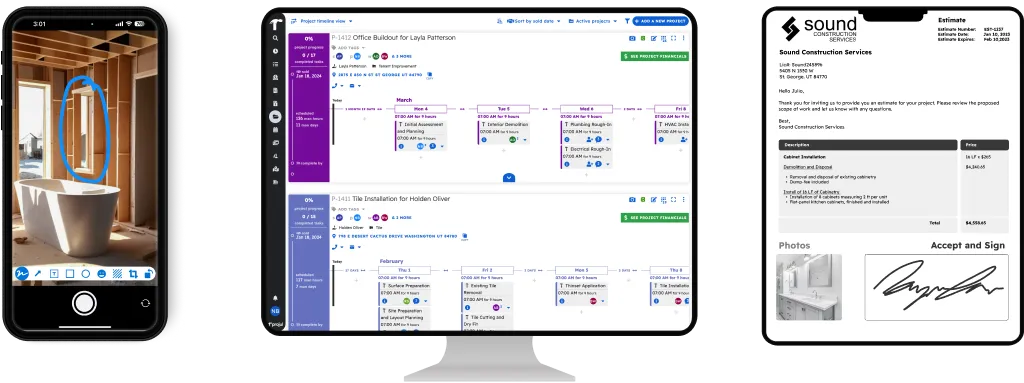
Stop Losing Job Site Photos and Documents
Every contractor has the same story. You need a photo from a job three months ago and it’s gone. It was on someone’s phone that got replaced. Or it’s buried in a camera roll with 5,000 other pictures. Or it was in a text thread that’s been scrolled past a hundred times.
Construction document management shouldn’t be this hard. And contractor photo management definitely shouldn’t depend on whether your crew remembers to email pictures to the office.
Projul’s Photo and Document Management automatically organizes every job site photo and file by project, with tagging, markup tools, and cloud storage accessible from any device. Never lose a project photo again. Projul offers flat-rate pricing with no per-user fees for construction companies of all sizes.
Projul fixes this by automatically organizing every photo and document by project the moment it’s uploaded. Over 5,000 contractors use Projul to keep their project files in order without any extra steps from the field.
Why Paper Files and Phone Photos Don’t Cut It
If your document management system is a filing cabinet and a camera roll, you’re sitting on a ticking time bomb. Here’s why:
Paper gets lost or destroyed. A contract left in a truck. A change order that fell behind a desk. A permit that got rained on. Physical documents are one bad day away from disappearing.
Phone photos have no context. Your crew takes 50 photos a week. Three months later, nobody remembers which job, which phase, or which issue a specific photo was for. Without tags and organization, those photos are useless.
Text threads and email are not a filing system. When you need a specific document, searching through months of text messages is miserable. And if the person who sent it leaves your company, those files go with them.
You can’t find what you need in a dispute. A homeowner claims the work was done wrong. You know your crew did it right, but you can’t find the photos to prove it. That’s an expensive problem.
Projul solves every one of these issues by storing everything in the cloud, attached to the project, with automatic tagging and organization.
What Good Document Management Looks Like on a Job Site
Good construction document management means your crew doesn’t have to think about it. They snap a photo, and it ends up in the right place. Here’s what that looks like with Projul:
Photos auto-organize. Every photo is tagged by project, customer, and project type the moment it’s taken in the Projul app. Your crew doesn’t file anything. It just happens.
Custom tags for fast search. Add tags like BEFORE, AFTER, INSPECTION, or DAMAGE. When you need to pull all the before-and-after photos for a client presentation, it takes seconds instead of hours.
Documents stay with the project. Contracts, permits, plans, and specs all live inside the project record. Anyone on the team can access them from any device. Nothing gets lost in someone’s email inbox.
Markup photos to communicate clearly. Circle a problem area, draw an arrow to show where a fixture goes, or write a note directly on the photo. Share it through Projul’s messaging so the sub or crew member knows exactly what you mean.
Job Site Photo Capture That Actually Works
Taking photos on a construction site should be simple. Open the app, snap the picture, move on. Projul makes it that easy.
Your crew opens the Projul app on their phone, takes a photo from within a task or project, and it uploads to the cloud automatically. The photo gets tagged with the project name, date, and task. No manual filing, no emailing to the office, no “I’ll upload it later” that never happens.
This works even on spotty cell service. Projul queues photos when the connection is weak and uploads them when the signal comes back. Your crew doesn’t have to worry about whether the upload went through. It handles itself.
The result is a complete visual record of every project without asking your crew to do anything extra. They’re already on the job site. They’re already looking at the work. All they have to do is tap a button.
Before-and-After Documentation
Before-and-after photos are some of the most valuable assets in your business. They prove the quality of your work to potential clients. They protect you in disputes. And they give your team a visual record of what the site looked like at every stage.
Projul makes before-and-after documentation automatic. Tag photos as BEFORE when you arrive on site and AFTER when the work is complete. Filter by those tags later to pull a complete set of before-and-after shots for any project in seconds.
Use these photos for:
- Client presentations. Show a homeowner the transformation. Nothing sells future work like seeing what you’ve already accomplished.
- Marketing. Post before-and-after shots on your website or social media. Whether you’re a roofing contractor, a remodeling company, or a general contractor, real project photos from real jobs are more convincing than stock images.
- Disputes. If a homeowner claims the work wasn’t done right or that your crew caused damage, timestamped before-and-after photos are your best defense.
- Training. Show new crew members what a finished job should look like compared to where it started.
Permit, Plan, and Contract Storage
Photos get most of the attention, but documents are just as important. Permits, plans, contracts, specs, insurance certificates, and inspection reports all need to be accessible and attached to the right project.
Projul stores all your project documents in the cloud alongside your photos. Upload a building permit and it stays with the project forever. Share architectural plans with your subs so they can pull them up on their phone at the job site. Store signed contracts where your PM, super, and office manager can all access them.
No more lost permits. Upload it once and it’s there. No more driving back to the office because the inspector wants to see the permit and nobody can find it.
Plans on every device. Your carpenter can pull up the floor plan on their phone. Your electrician can check the electrical drawings on their tablet. No more printing 20 copies of a plan set and hoping everyone has the current version.
Contracts and change orders in one place. When a homeowner disputes a charge, pull up the signed contract and the approved change order in seconds. Having the documentation at your fingertips makes those conversations much shorter.
Insurance and Dispute Protection
Construction disputes happen. Homeowners claim damage. Subs blame each other. Insurance companies want proof. The contractor who has documentation wins. The one who doesn’t, pays.
Every photo in Projul is timestamped and tied to a specific project, task, or daily log entry. That means you can show exactly what the site looked like on a specific date, what work was done, and what condition things were in before and after your crew was there.
This kind of documentation has real dollar value. A single dispute can cost thousands. One well-documented photo showing the pre-existing condition of a driveway or the correct installation of a flashing can save you that entire amount.
Projul also keeps a complete history. Photos and documents don’t get deleted when someone leaves your company or gets a new phone. They’re in the cloud, attached to the project, available whenever you need them. Even if the dispute comes up two years after the project is complete.
Sharing Photos and Documents With Clients
Clients love seeing progress on their project. It builds trust, reduces “just checking in” phone calls, and makes them feel involved without being in the way on the job site.
Projul lets you share photos and documents directly with clients through the platform. Send progress photos at the end of each day or week. Share inspection reports and permits so the homeowner knows everything is on track. Give them access to before-and-after photos when the project wraps up.
This kind of transparency sets you apart from contractors who go dark between the start date and the walkthrough. Homeowners talk to their neighbors. The contractor who sends regular photo updates gets the referral.
How to Set Up a Photo Documentation System Your Crew Will Actually Follow
Most contractors know they should be documenting job sites with photos. The problem isn’t awareness. It’s getting your crew to actually do it consistently. Here’s a practical system that works.
Make it part of the task, not an extra step. When you assign a task in Projul, add a note that says “photo required before starting” or “photo required when complete.” When taking a photo is built into the task itself, it becomes part of the workflow rather than something extra to remember. Tie photo requirements to your estimates converted to tasks so documentation expectations are set from the moment work begins.
Set clear expectations for what to photograph. Don’t just say “take photos.” Tell your crew exactly what you need. Before starting demo, photograph every wall and surface. After rough-in, photograph all framing, plumbing, and electrical before drywall covers it. At completion, photograph the finished product from multiple angles. Specific instructions get better results than vague ones.
Use tags consistently across every project. Pick a standard set of tags and stick with them. BEFORE, AFTER, PROGRESS, ISSUE, INSPECTION, and COMPLETE cover most situations. When everyone uses the same tags, finding photos later takes seconds instead of minutes. This pays off when you need to pull documentation for an insurance claim or client dispute.
Review photos weekly, not monthly. Check your project photos every Friday. If a crew member isn’t documenting their work, you’ll catch it while you can still get the photos you need. Waiting until the end of a project to realize nobody photographed the rough-in means those photos are gone forever.
Connect photos to your daily logs. When your crew fills out daily logs in Projul, have them attach the day’s photos. This creates a dated visual record of the project that’s tied to written notes about what happened. For commercial contractors running multi-phase jobs, this daily photo log becomes your most valuable project record.
Use e-signatures for sign-off documentation. When a client approves a phase or change order, capture their signature digitally alongside the photos from that stage. Having both the visual proof and the written approval in one system makes disputes nearly impossible for the other side to win.
Snap, Upload, and Find Photos in Seconds
Projul automatically tags and organizes every photo by project, project type, and customer the moment you snap or upload it. With a 4.9 out of 5 G2 rating for ease of use, your crew will actually use it in the field, not fight with it.
Tag documents and photos with your own custom tags for fast retrieval across projects and customers. Want a quick way to locate before-and-after photos for your website? Use BEFORE and AFTER tags and filter by them in the gallery.
Share and Mark Up Photos From the Field
Photos can be taken or added directly to tasks and communications in Projul. Share photos with your crew to clarify what needs to happen, and mark up images right in the app to provide immediate direction.
Draw a circle around the area that needs rework. Add an arrow pointing to where the outlet should go. Write a note on the photo explaining the issue. That marked-up photo is worth 10 minutes of verbal explanation and there’s no room for misunderstanding.
Over 5,000 contractors use Projul to keep their project documentation organized. No more deleting pictures off your phone to make space, and no more digging through camera rolls to find that one photo from three weeks ago.
All Your Documents in One Place
Projul automatically uploads project photos from all employee phones and stores them in the cloud, not scattered across devices. On Core at $4,788/year, with no per-user fees and unlimited projects, your entire team’s documents stay organized without extra cost.
Documents and files can be shared directly with workers, subs, and clients to keep everyone on the same page. No more lost photos, no more missing files. Everything stays attached to the project where it belongs.
Photos That Connect to Your Projects
Every photo ties to project management and to-dos and daily logs. Your crew snaps a photo from a task, and it’s automatically organized with that project. No hunting through camera rolls.
Get mobile notifications when new photos or documents are added to your projects so you always know what’s happening in the field, even when you’re not there.
The Photo Problem Every Contractor Faces
Here’s a scene that plays out on construction sites every single day. You’re on the phone with a homeowner who swears your crew damaged their existing hardwood floors during a kitchen remodel. You know for a fact those floors had scratches and water stains before your guys ever set foot in the house. You remember seeing it. You might have even mentioned it to your lead carpenter. But where’s the photo?
It’s somewhere. Maybe on your lead’s old phone - the one that fell off a scaffold two months ago. Maybe it’s buried in a camera roll between 4,000 other pictures, mixed in with his kid’s soccer photos and screenshots of memes his buddy sent him. Maybe he texted it to you, but that was 47 jobs ago and your text history only goes back so far.
The photo exists. Or it existed. But right now, when you actually need it, it might as well not exist at all.
This is the photo problem every contractor faces, and it gets worse the more your business grows.
Six Phones, Zero Organization
Think about how many phones are taking job site photos across your company right now. You’ve got your phone. Your project manager’s phone. Your lead carpenter or foreman. A couple of crew members. Maybe a sub or two snapping photos of their work. That’s five, six, maybe eight different devices capturing photos every single day.
Now think about where those photos actually go. They go into each person’s personal camera roll. Mixed in with everything else in their life. Vacation photos from last weekend. Screenshots. Selfies. Pictures of receipts. That job site photo you desperately need three months from now is sitting between a photo of someone’s lunch and a screenshot of a fantasy football score.
Nobody can find anything. Not quickly, anyway.
And it gets worse when people leave. When your lead quits and takes his phone with him, every photo he ever took for your company walks out the door too. All those before shots. All those progress photos. All that documentation - gone. You never owned those photos because they were never stored anywhere your company controls.
The Real Cost of Disorganized Photos
You might think this is a minor inconvenience. It’s not. Disorganized job site photos cost contractors real money every single year. Here’s how:
Disputes you can’t win. A client says your crew caused damage. You know they didn’t, but you can’t find the before photo. So you eat the cost of fixing something that wasn’t your fault. One lost photo can cost you $5,000, $10,000, or more depending on the claim.
Insurance claims that get denied. Your insurance company wants documentation of the damage. You have photos somewhere, but you can’t pull them together in time. The claim gets denied or delayed. You’re out of pocket for repairs that should have been covered.
Hours wasted searching. How much time does your office manager spend each week trying to track down a specific photo or document? Calling crew members, scrolling through text threads, digging through email. At $30 an hour, even two hours a week of searching adds up to over $3,000 a year in wasted labor.
Client trust that erodes. A homeowner asks for progress photos and you can’t find any recent ones. Or the ones you find are low quality and don’t tell the story of what’s been happening. That homeowner starts wondering what’s going on at their job site. Trust problems lead to payment problems.
Marketing opportunities you miss. You finished an incredible bathroom renovation last month but nobody took good before-and-after photos. Or they did, but those photos are lost on someone’s phone. That’s a portfolio piece, a social media post, and a sales tool you’ll never get back.
Why “Just Use a Shared Folder” Doesn’t Work
Some contractors try to solve this with shared Google Drive folders or Dropbox. On paper, it sounds reasonable. In practice, it falls apart fast.
First, your crew has to remember to upload photos to the folder. That’s an extra step. After a long day on the job site, nobody is going to sit in their truck uploading photos to a cloud folder. They’re going to drive home, eat dinner, and forget about it completely.
Second, even when photos do get uploaded, they end up as a wall of files with names like IMG_4782.jpg and IMG_4783.jpg. No tags. No project association. No context. Finding a specific photo three months later is like looking for a needle in a haystack.
Third, shared folders don’t connect photos to anything. They’re just files floating in space. There’s no link between a photo and the project it belongs to, the task it documents, or the daily log entry it should be attached to. You lose all the context that makes a photo valuable.
The real solution isn’t a folder. It’s a system that captures, organizes, and connects photos to your projects automatically - without asking your crew to do anything extra.
How Projul Organizes Every Photo and Document by Project
Projul solves the photo problem by making organization automatic. When your crew takes a photo inside the Projul app, that photo is immediately attached to the project they’re working on. No extra steps. No uploading. No filing. It just happens.
Here’s how it works in practice. Your carpenter opens Projul on his phone, taps into the project he’s working on, and hits the camera button. He takes the photo. Done. That photo is now in the cloud, attached to the right project, tagged with the date and the task he was working on. He didn’t have to think about organization. He didn’t have to email anything to the office. He just took a picture and got back to work.
This is exactly how construction photo management should work. Your crew is already on the job site. They’re already looking at the work. The only thing between a complete visual record and nothing is whether they have to do extra steps. With Projul, there are zero extra steps.
Every Document Tied to the Right Job
Photos are just the start. Every document your project generates - contracts, permits, insurance certificates, architectural plans, spec sheets, inspection reports, change orders - all of it lives inside the project record in Projul.
Upload a building permit and it’s attached to that project forever. Upload architectural plans and every person on the project team can pull them up on their phone. Upload a signed contract and it’s sitting right there next to the job photos, the budget, and the daily logs.
This means you never have to wonder where something is. Every document has a home, and that home is the project it belongs to. When you need to find a permit for a job you did eight months ago, you don’t search through filing cabinets or email archives. You open the project in Projul and it’s right there.
On the Pro plan, Projul AI Connect can do the filing for you. Hand ChatGPT, Claude, or Gemini a permit PDF or a batch of walkthrough photos, and it uploads them to the right project. Give it your final walkthrough notes, and it turns them into a punch list.
Search That Actually Finds What You Need
When every photo and document is organized by project, searching becomes incredibly fast. Projul’s powerful search lets you find any photo or document across all your projects in seconds. Search by project name, customer name, tag, date, or document type.
Need all the photos tagged BEFORE from the Johnson kitchen remodel? Two taps. Need the signed contract from that commercial job you did in June? Type the project name and it’s on your screen. Need every inspection report from the last quarter? Filter by document type and date range.
Compare that to your current system. How long does it take you to find a specific photo right now? Five minutes? Thirty minutes? Sometimes you just give up because it would take longer to find the photo than it’s worth.
With Projul, every search takes seconds. That’s not an exaggeration. When documents are organized and tagged from the moment they’re created, finding them later is almost instant.
How This Connects to Your Projects
Photo and document management doesn’t live in a vacuum. In Projul, your files are part of your project management system. Photos link to tasks. Documents link to project phases. Everything connects.
That means when you open a task in Projul, you see the photos that were taken during that task. When you open a project phase, you see all the documents and photos from that phase. When you look at the project timeline, you see a visual history of the entire job from start to finish.
This connected approach means your photos and documents aren’t just stored - they’re useful. They tell the story of the project. They show what happened, when it happened, and who was involved. That story is what protects you when things go sideways.
Using Photos to Protect Your Business
Let’s talk about something most contractors don’t think about until it’s too late: the protective value of job site photos. The photo you take today might save you $50,000 in court next year. That’s not hyperbole. It happens in this industry all the time.
Before Photos Are Your First Line of Defense
Before you start any work on a property, document everything. The condition of the driveway. The existing cracks in the walls. The stains on the carpet. The scratches on the hardwood floors. The dent in the garage door that was already there.
This takes five minutes. Walk through the site with your phone open to Projul, tag everything as BEFORE, and move on. Those five minutes of effort create a timestamped record of exactly what the property looked like before your crew touched anything.
When a homeowner calls three weeks later claiming your crew cracked their foundation or damaged their landscaping, you pull up the before photos. Conversation over. The evidence speaks for itself.
Without those before photos, it’s your word against theirs. And in that scenario, the contractor usually loses. Homeowners are sympathetic figures. Judges and insurance adjusters tend to side with them when there’s no documentation either way. Before photos shift that dynamic entirely.
Progress Photos for Client Updates and Legal Protection
Taking progress photos throughout the project serves two purposes. First, they keep your clients happy. People love seeing their project come together. A weekly progress photo update through Projul is one of the easiest ways to build trust and reduce those “just checking in” phone calls that eat up your day.
Second, progress photos create a dated timeline of your work. If a dispute arises about when something was installed, how it was installed, or whether it was installed at all, your progress photos tell the whole story.
Connect your progress photos to your to-dos and daily logs and you’ve got a complete daily record: written notes about what happened, photos showing what it looked like, and timestamps proving when it all took place. That combination is incredibly powerful in any dispute.
Damage Documentation for Insurance Claims
When something goes wrong on a job site - storm damage, theft, vandalism, equipment failure - the first thing your insurance company is going to ask for is documentation. Photos, specifically. When did the damage occur? What did it look like? What was the extent?
If you’re already in the habit of taking daily progress photos in Projul, you’ve got documentation of what the site looked like right before the damage occurred. That gives your insurance company exactly what they need to process your claim quickly.
Without documentation, insurance claims drag on. Adjusters have to make site visits. They have to take their own photos and try to piece together what happened. The whole process takes longer, and the payout is often lower because there’s less evidence to support your claim.
Contractors who document their job sites daily get their insurance claims processed faster and get paid more. That’s not a theory - it’s a pattern that plays out across the industry.
Pre-Existing Condition Documentation
This deserves its own callout because it’s that important. Before you start work on any property, document every pre-existing condition you can find. Every crack, stain, scratch, dent, and imperfection.
This applies especially to:
- Remodeling work where you’re working inside someone’s finished home. Document the condition of floors, walls, countertops, and fixtures in every room your crew will pass through - not just the rooms you’re working in.
- Roofing where you need to document the condition of gutters, siding, landscaping, and anything else near the work area. Homeowners love to blame roofers for dented gutters that were already dented.
- Exterior work like painting, siding, or concrete. Document the condition of driveways, walkways, fences, and neighboring properties before you set up equipment.
- Commercial projects where the building owner will inspect every surface after you leave. Document common areas, elevators, hallways, and anything your crew or materials will contact.
Tag all of these photos as PRE-EXISTING in Projul. When a property owner files a claim months later, you pull up those tagged photos in seconds and shut down the dispute before it goes anywhere.
The $50K Photo
Here’s a real scenario that happens more often than you’d think. A homeowner hires you for a major renovation. Midway through the project, they notice a crack in their foundation wall. They blame your crew. They hire a structural engineer who says the crack needs $50,000 in repairs. They’re coming after you for the money.
You pull up Projul. You open the project. You filter by the BEFORE tag. There it is - a timestamped photo from day one showing that exact crack already present before your crew did a single thing. Photo was taken inside the Projul app, tagged automatically to the project, with metadata showing the date and time.
Case closed. You just saved $50,000 with a photo that took three seconds to take.
Now imagine that same scenario without Projul. You think you might have taken a before photo, but it was on your old phone. Or maybe your foreman took it, but he left the company two months ago. You can’t find it. You can’t prove the crack was pre-existing. You’re writing a $50,000 check.
That’s the difference between organized documentation and hoping for the best.
Sharing Documents With Clients and Subs
One of the biggest time drains for contractors is being the middleman for information. Your sub needs the architectural plans. Your client wants to see progress photos. Your inspector needs the permit. Your insurance company needs the certificate. And every one of them is calling or texting you to get it.
You become the bottleneck. Every request flows through you. You stop what you’re doing, pull up the document, take a screenshot or download a file, and send it to whoever asked. Multiply that by ten requests a day and you’ve lost an hour just playing delivery driver for files.
Projul eliminates this by giving the right people access to the right documents without you being in the middle.
Client Portal Access to Project Photos
Through Projul’s customer portal, your clients can log in and see their project photos, documents, and progress updates on their own time. They don’t have to call you to ask how things are going. They don’t have to text you asking for photos. They just open the portal and see everything.
This does three important things for your business:
It reduces phone calls and texts. The number one reason clients call during a project is to ask for updates. When they can see photos and documents in the portal, those calls drop dramatically. Your phone stops ringing as much and you get more actual work done.
It builds trust. Transparency builds trust faster than anything else. When a homeowner can log into a portal and see exactly what’s happening at their job site, they feel informed and respected. That trust translates into smoother projects, fewer disputes, and more referrals.
It sets you apart from competitors. Most contractors go dark between the proposal and the walkthrough. The homeowner doesn’t hear from them for weeks. When you give clients a portal with real-time photos and documents, you look like a completely different kind of contractor. The kind that gets recommended to neighbors.
Sending Plans and Specs to Subcontractors
Your subs need access to plans, specs, and project details to do their work correctly. The traditional approach is to email a PDF or print copies and leave them on site. Both of those approaches fail regularly.
Emails get buried. PDFs get lost. Printed copies get rained on, stepped on, or left in someone’s truck. And when the plans get revised, you have to re-send or re-print everything and hope everyone is working from the current version.
With Projul’s construction communications tools, you can share documents directly with your subs through the platform. They get notified when new documents are available. They can pull up plans on their phone at the job site. And when you upload a revised plan, they automatically have access to the latest version.
No more “I didn’t get the email.” No more working from outdated plans. No more printing 15 copies of a plan set and hoping they all make it to the right people.
Keeping Insurance Certificates on File
If you work with subcontractors, you know the insurance certificate headache. You need certificates of insurance from every sub before they step on your job site. Those certificates expire. You need to track expiration dates. And when a certificate expires, you need to get an updated one before that sub can work again.
Projul lets you store insurance certificates right inside the system, attached to the subcontractor or the project. You can see at a glance whether a sub’s insurance is current. No more digging through file folders or email archives trying to figure out if your electrician’s liability policy is still active.
This protects you legally. If a sub gets hurt on your job site and their insurance has lapsed, you could be on the hook. Knowing their certificate status before they show up to work is basic risk management that too many contractors skip because keeping track of paperwork is a pain. Projul makes it painless.
Permit Documentation and Inspection Records
Permits and inspection records need to be accessible at the job site, in the office, and potentially years after the project is complete. An inspector shows up and wants to see the permit? Pull it up on your phone in two seconds. A client calls two years later asking about the permit status of their addition? Open the project and it’s right there.
Store every permit, inspection report, and approval document inside the project in Projul. They’re accessible from any device, backed up in the cloud, and connected to the project timeline so you can see exactly when permits were pulled and inspections were passed.
Everyone Gets What They Need - Without You
The goal of good document sharing is simple: everyone has what they need, and you’re not the one delivering it. Your client checks the portal for photos. Your sub pulls up plans on their phone. Your office manager finds the insurance certificate in the system. Your PM grabs the permit from the project record.
None of those actions require you. None of them require a phone call, a text, or an email. The information is there, organized and accessible, for whoever needs it.
That’s what Projul gives you. Not just a place to store photos and documents, but a system that puts the right information in front of the right people at the right time. You stop being the bottleneck and start being the contractor who runs a tight operation.
Document the Job From Start to Finish
Use photos alongside job management to keep a visual record of every phase. Before-and-after shots, progress updates, and issue documentation all stay with the job where they belong. When it’s time for a client walkthrough, insurance claim, or dispute, everything is right there.
Your photos and documents are part of the complete project record in Projul. They connect to your budget, your schedule, your daily logs, and your communications. One platform, one source of truth, from the first site visit to the final payment.
Over 5,000 contractors trust Projul to manage their project documentation. Starting with Core at $4,788/year, with no per-user fees, your entire team can capture, store, and share photos and documents without extra cost.