Construction Job Management Software Built by Contractors
Projul keeps every job organized from the first estimate to the final invoice. Over 5,000 contractors run their jobs in one place with honest, flat-rate pricing.
- Get paid for all your work with a lightweight change order process.
- Keep everyone organized by managing tasks and schedules together.
- Detailed reporting keeps you up to date on every job's progress.
What Job Management Actually Means for Contractors
Job management isn’t just a dashboard with a list of projects. For contractors, it means having one place to handle everything that happens between winning a job and collecting the final payment.
Projul’s job management software gives contractors one platform to run estimates, scheduling, budgeting, time tracking, change orders, and invoicing for every job. Built by a contractor, it covers 26+ feature areas with no per-user fees. Projul offers flat-rate pricing for construction companies of all sizes.
That includes the estimate, the schedule, the budget, daily task lists, change orders, time tracking, client communication, photos, documents, and invoicing. When any of those pieces live in a different app, spreadsheet, or filing cabinet, things get missed. And missed things cost money.
Construction job management software exists to keep all of that in one system. But most platforms either try to do too much and become impossible to learn, or they cover the basics and leave you duct-taping the rest together with spreadsheets and sticky notes.
Projul hits the middle ground. It’s built by a contractor who ran jobs before he built software. It covers 26+ feature areas, and your crew can pick it up by lunch on day one. Over 5,000 contractors use it to run their jobs daily.
The Problem With Running Jobs Across Multiple Tools
Most contractors don’t start out looking for job management software. They start with a problem. Maybe it’s a whiteboard schedule that nobody updates. Maybe it’s an Excel spreadsheet that three people edit at the same time and nobody trusts. Maybe it’s a filing cabinet full of paper estimates that takes 20 minutes to search.
So they buy a tool for scheduling. And a different tool for estimating. And they keep using QuickBooks for invoicing. And their crew texts photos to a group chat. And daily logs go on paper forms that sit in the truck for a week.
Before long, the “system” looks like this:
- Estimates in one app
- Schedule on a whiteboard or in a different app
- Time tracking on paper or a third app
- Photos in text threads and camera rolls
- Invoices in QuickBooks
- Change orders in email
- Daily logs on paper or not at all
- Client communication via phone calls, texts, and email
None of these tools talk to each other. Your estimator builds a bid in one system, and your PM rebuilds the same scope as tasks in another. Your crew logs hours on paper, and someone in the office types them into the payroll system. Photos from the job site sit in someone’s text thread and never make it to the project file.
The result is wasted time, duplicated effort, and lost information. You don’t know if a job is profitable until it’s over. You can’t find the change order the client approved two months ago. Your schedule doesn’t reflect the actual scope because it was built separately from the estimate.
Projul replaces that mess with one platform that handles every part of the job. One system means one source of truth. Everyone works from the same data.
From Sold to Done in One Platform
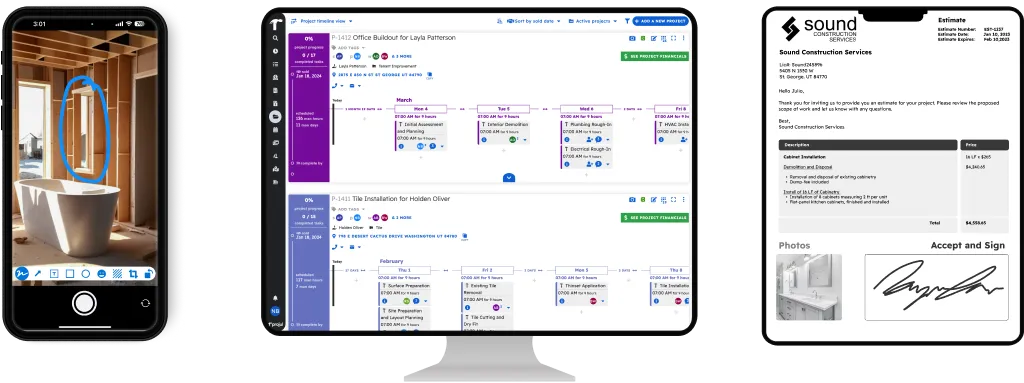
Here’s what a job looks like in Projul, from the moment you win it to the final invoice.
The Estimate Gets Approved
Your client taps “approve” on their phone. No printing, no scanning, no driving across town for a signature. Projul sends the approval notification to your team, and the estimate syncs to QuickBooks automatically. Your bookkeeper sees the sold job without you forwarding an email.
Tasks Get Created From the Estimate
Projul converts your labor line items into tasks. No retyping. No double entry. Every line item from the approved estimate becomes a task on the project. Drag them onto your schedule, assign workers, and the job is planned in under a minute.
Your Crew Gets to Work
Workers see their tasks and daily schedules on the mobile app. They clock in with GPS time tracking, log progress, snap photos, and check off to-dos from the field. You see all of it in real time from the office or your truck.
Your crew doesn’t need training sessions or user manuals. Projul is rated 4.9 out of 5 on G2 for ease of use. Most workers are comfortable with it by the end of their first day.
Change Orders Happen
Because they always do. A homeowner wants to add recessed lighting. The inspector flags a plumbing issue. The client changes their mind about the tile.
Projul makes it easy to create a change order, send it to the client for digital approval, and add the new work to the schedule. The budget updates automatically so you always know where you stand financially. No scrambling to update three different systems.
You Track Costs as You Go
Labor hours, material costs, and subcontractor expenses all feed into Projul’s job costing. You see your actual costs against the budget in real time, not at the end of the job when it’s too late to do anything about it.
If the framing is running 20% over budget, you find out this week, not when you’re doing the final accounting three months from now. That early warning is the difference between protecting your margin and discovering you lost money.
The Job Wraps Up
Send the final invoice from Projul, and it syncs to QuickBooks. The client pays online. The payment records in both systems. Done. One platform from sold to done.
Managing Multiple Job Sites at Once
Running one job is manageable. Running five or ten at the same time is where things get complicated. You need to know where every crew is, what every job needs this week, which projects are on track, and which ones are falling behind.
Projul gives you a single view across all your active projects. From the dashboard, you can see:
- Every active job with its current status and completion percentage
- Your schedule across all projects, showing which crews are where and when
- Budget health for each job, showing actual costs against the estimate
- Upcoming milestones and deadlines across your whole portfolio
- Unscheduled tasks that need to be planned
This bird’s-eye view is what separates organized companies from ones that are constantly putting out fires. When you can see all your jobs at once, you spot problems early. You see that Project A needs more labor next week while Project B has a gap in the schedule. You move resources before it becomes a crisis.
For contractors managing multiple job sites, Projul’s mobile access means you can check on any project from anywhere. Pull up the project on your phone while you’re at a different job site. See the latest photos, check the daily log, review the budget. All without calling the PM or driving across town.
Estimates and Change Orders Without the Paper Chase
Projul lets you send estimates and change orders digitally using templates, and your customers approve them with a tap. No more waiting for a signed paper to come back. No more “I’ll look at it this weekend” holding up the job for two weeks.
Estimate templates save you even more time on repeat jobs. If you bid similar projects regularly, build a template once and use it every time. Customize the details for each client, but don’t start from scratch on every bid.
Your accounting team knows about approvals the moment they happen because Projul syncs with QuickBooks. And because estimates convert directly to tasks, the approved scope becomes your project schedule without any re-entry.
Resource Assignment and Crew Management
Knowing who’s doing what and when is the core of job management. Projul’s scheduling and task assignment tools let you:
- Assign workers to tasks and have them notified automatically via mobile notifications
- See crew availability across all your projects at a glance
- Move workers between jobs with drag-and-drop scheduling
- Track who worked where through GPS time tracking
- Manage subcontractors alongside your own crews
When your electrician finishes at one job site and you need them at another, you update the schedule in Projul and they get the notification on their phone. No phone calls, no confusion about where to go next.
Milestone Tracking and Progress Billing
Construction jobs have natural milestones. Foundation complete. Framing done. Rough-ins passed inspection. Drywall finished. Each milestone often corresponds to a progress payment.
Projul’s task completion and progress tracking give you clear documentation of when milestones are reached. When 40% of the tasks on a project are complete, you have the data to justify a 40% progress payment. No guessing, no arguing with the client about how far along the project really is.
This is especially important on larger jobs where cash flow depends on timely progress billing. When you can show the client real data about project completion, payment requests go smoother and faster.
Reports That Actually Help You Make Decisions
Projul’s WIP reports show you exactly where every job stands in real time. Contractors using Projul see a 32% average profit increase because they catch problems early instead of discovering them at closeout.
Drill into labor costs by project, compare closing ratios across your sales team, and see which jobs are making money and which ones are bleeding. Projul’s reporting gives you the numbers you need to make decisions, not guesses.
Here’s what you can pull from Projul’s reports:
- Work in Progress (WIP). See every active job’s estimated value, costs to date, percentage complete, and projected final cost. This is the single most important report for a construction company.
- Profit and loss by job. Know which jobs made money and which ones didn’t. Identify patterns so you can bid smarter.
- Labor cost breakdown. See how many hours each crew member worked on each project and compare that to what you estimated.
- Sales pipeline. Track leads, proposals, and closing ratios so you know how your sales effort is performing.
- Closing ratio comparison. Compare your estimators’ close rates side by side to see who’s winning work and who’s leaving money on the table.
Pre-configured reports mean you’re not spending an hour building a spreadsheet formula. Open the report, see the data, act on it.
Client Visibility Without Extra Work
Your clients want to know how their project is going. And they don’t want to wait for your weekly email update that you sometimes forget to send.
Projul gives you real-time data that you can share with clients when they ask. Pull up the project on your phone, show them the progress, share photos from the daily log. You look organized and professional because you actually are.
For contractors who want to give clients direct access, Projul’s system keeps everything documented and accessible. When the client calls with a question, you have the answer in seconds, not hours.
Project Management That Keeps Everyone on the Same Page
Projul converts estimates to tasks and adds them to your schedule so you always have a clear record of who’s doing what. Create daily task lists and add locations to tasks. Add detailed instructions to make sure the work gets done right.
Real-time progress updates let you know exactly how the job is going. Your project management and scheduling tools work together so you can assign tasks, track progress, and adjust the calendar without jumping between apps.
Drag and drop scheduling makes it simple to build out your job calendar. Use real-time progress reports to see where everyone is and what work has been getting done. Keep everyone focused by creating daily task lists that show up on their phones.
Track Job Costs in Real Time
Keep an eye on budgets as the job progresses so you know when things are going sideways before it’s too late. Projul’s job costing tracks labor, materials, and sub costs against your estimate in real time.
When the numbers don’t look right, you find out now, not at the end of the job. That’s how you protect your margins and avoid the “we lost money on that one” conversation that ruins your week.
What “Job Management” Actually Means for a Contractor
If you ask ten contractors what “job management” means, you’ll get ten different answers. Some think it’s a fancy to-do list. Others think it’s project scheduling with a nicer interface. A few will tell you it’s just another name for project management software with a construction skin slapped on top.
None of those answers are wrong, but none of them tell the full story either.
For a contractor, job management is the ability to know - at any given moment - where every dollar, every crew member, and every deadline stands across every single job you’re running. Not just one project. All of them. At the same time.
Think about what that actually involves. You’ve got crews on three different sites. One job is waiting on a permit. Another has a change order that the homeowner hasn’t approved yet. A third is running behind because the drywall crew got pulled to another project last week. Your estimator just sent out two new proposals, and if both get approved, you need to figure out where those fit into your schedule.
That’s job management. It’s not one task. It’s the entire operation of your construction business, viewed through the lens of the work that actually makes you money - your jobs.
The Difference Between 5 Jobs and 20 Jobs
When you’re running three to five jobs, you can keep most of it in your head. You know which crew is where. You remember that the Smith kitchen remodel needs tile delivered on Thursday. You can mentally track that the Johnson project is about 60% done and you should send a progress invoice.
But somewhere between five and ten concurrent jobs, your memory stops being reliable. You forget to order materials for one project because you were dealing with an emergency on another. You lose track of a change order approval because it came in while you were on a roof. You miss a deadline because nobody put it on the calendar and you were counting on remembering it.
By the time you’re running 15 or 20 jobs, managing from memory isn’t just unreliable - it’s impossible. And that’s the point where most contractors either stop growing or start hiring project managers at $60,000 to $80,000 a year just to keep things organized.
Job management software exists to push that ceiling higher. Instead of maxing out at five jobs before things start falling apart, the right system lets you scale to 15, 20, or more without adding overhead. Your brain gets replaced by a dashboard. Your sticky notes get replaced by task lists that your crew can see on their phones. Your gut feeling about job profitability gets replaced by real numbers updated in real time.
It’s About Control, Not Complexity
Here’s the thing that trips up a lot of contractors when they start looking at software. They see the word “management” and they picture something complicated. Gantt charts with 500 tasks. Earned value calculations. Resource leveling algorithms. Enterprise project management stuff that makes sense for a $200 million highway project but has no place in residential or light commercial construction.
That’s not what we’re talking about.
Job management for a contractor means knowing the answers to simple questions:
- Which jobs are active right now?
- Which ones need attention today?
- Are we on budget on every project?
- Who’s working where this week?
- Are there any approvals I’m waiting on?
- Which invoices are outstanding?
- Is anything behind schedule?
If you can answer those questions in under 60 seconds without making a phone call, you’re doing job management well. If it takes you 30 minutes of digging through emails, spreadsheets, and text threads to piece together the answers, you’ve got a problem that’s costing you money every single day.
Projul gives you those answers fast. Not because it’s complicated, but because everything lives in one place. When your estimate, schedule, budget, time tracking, change orders, and invoices all live in the same system, you don’t have to hunt for information. It’s just there.
Why Contractors Specifically Need This
General project management tools like Monday.com or Asana work fine if you’re managing marketing campaigns or software releases. But construction has specific needs that generic tools don’t address.
You need estimates that convert into project tasks. You need change orders that update the budget automatically. You need time tracking with GPS so you know your crew is actually at the job site. You need progress billing tied to real completion data. You need QuickBooks integration so your bookkeeper doesn’t have to re-enter everything.
Generic project management tools don’t do any of that. And enterprise construction platforms like Procore or Buildertrend charge per user, which gets expensive fast when you need your entire crew to have access.
Projul was built by a contractor who dealt with all of these problems firsthand. It covers every part of running construction jobs, and its Core plan is a flat $4,788 per year for up to 10 users, with no per-user fees. Your whole team gets access - office staff, PMs, estimators, crew leads, and field workers. Nobody gets left out because of a per-seat license cost.
The Real Cost of Not Having a System
Let’s talk numbers for a second. The average construction company loses between 5% and 10% of revenue to inefficiency. That includes rework from miscommunication, unbilled change orders, time tracking errors, duplicate data entry, and wasted hours searching for information.
For a company doing $2 million in annual revenue, that’s $100,000 to $200,000 in lost profit. Every year.
Even if you only recover a fraction of that, you’re paying for Projul many times over. Contractors using Projul see a 32% average profit increase. That’s not because the software does magic. It’s because when you stop losing information, stop missing change orders, and stop finding out about budget overruns three months too late, you keep more of the money you earn.
Job management isn’t about adding more process to your day. It’s about protecting the revenue you’re already generating and making sure every dollar you’re owed actually shows up in your bank account.
Managing Multiple Jobs Without Losing Control
There’s a moment in every growing contractor’s career where things start slipping. Not because you’re bad at your job - you’re great at the actual construction work. But the business side starts getting away from you because there’s just too much to keep track of.
You’ve got a bathroom remodel wrapping up on the west side of town. A new build just broke ground. Two smaller repair jobs are scattered across the week. And your estimator just landed a commercial tenant improvement that starts in three weeks.
Somewhere in all of that, you forgot to schedule the plumber for the bathroom remodel. The framing crew on the new build ran out of materials because nobody checked the delivery schedule. And the commercial TI? You haven’t even started planning the schedule because you’ve been too busy putting out fires on the other jobs.
This is the trap. And it catches almost every contractor who tries to grow past a certain point.
The Dashboard That Shows You Everything
Projul’s dashboard gives you a single view across every active job. When you open it in the morning, you see all your projects laid out with their current status. Not a list of project names - actual useful information.
You can see which jobs are on track and which ones are falling behind. You can see budget health at a glance - is the kitchen remodel running over on labor? Is the new build still in good shape financially? You see it without drilling into each project individually.
This is the difference between reacting to problems and preventing them. When you can see all your jobs at once, patterns jump out. You notice that two projects need the same subcontractor next week, and you can coordinate before there’s a conflict. You see that one job has been sitting at 80% complete for two weeks, which probably means something is blocking the finish.
Scaling From 3 Jobs to 15
The contractors who grow successfully are the ones who figure out how to manage more work without proportionally adding more overhead. If you hire a project manager every time you add five jobs to your plate, your margins shrink even as your revenue grows.
Projul lets you scale your job count without scaling your management team at the same rate. Here’s how:
Everything is visible. When every job’s status, schedule, budget, and tasks are in one system, you don’t need someone whose full-time job is gathering that information. It’s already there. One person can oversee more jobs because the information is organized for them.
Tasks drive the schedule. Instead of keeping a mental list of what needs to happen on each job, Projul turns your estimate line items into tasks that go on the calendar. Your crew sees their assignments on their phones. You’re not spending your morning making calls to tell people where to go.
Problems surface early. Budget overruns, schedule conflicts, missing approvals - these all show up in Projul before they become emergencies. When you’re running 15 jobs, you can’t afford to discover problems after they’ve already cost you money.
Communication stays organized. Instead of text threads and phone calls that nobody can search later, job-related communication happens inside the project. Photos, notes, daily logs - it’s all attached to the right job. When the client calls with a question about something that happened two months ago, you pull up the project and find the answer in seconds.
The contractors who use Projul’s project management and scheduling tools together find they can manage significantly more work with the same team. That’s not about working harder. It’s about working with better information.
Knowing Which Jobs Need Attention Today
This might be the most underrated part of job management. Not the big-picture planning - the daily triage. Every morning, you need to know: which of my 12 active jobs needs something from me today?
Maybe it’s a change order that needs to be sent before the client loses patience. Maybe it’s a delivery that needs to be confirmed. Maybe it’s a job that’s falling behind schedule and needs a crew reassignment.
Without a system, you figure this out by scrolling through texts, checking your email, calling your PMs, and hoping you don’t miss anything. With Projul, you open the app and it’s right there. Tasks due today. Approvals pending. Budgets that need review. Jobs with no activity that might be stalled.
You spend five minutes in the morning getting oriented instead of 45 minutes piecing together the puzzle. And you go through your day confident that you’re not forgetting something important.
When You Actually Need to Hire a PM
To be clear - there’s a point where you do need to add project management help. If you’re running 25+ jobs or doing complex commercial work, a good PM is worth their weight in gold.
But the point is that Projul pushes that threshold much higher. Instead of needing your first PM at five concurrent jobs, you might not need one until 15 or 20. That’s years of growth where the software is handling what a salaried employee would otherwise be doing.
And when you do hire that PM, they’re more effective because they’re working in a system that already has all the data organized. Their ramp-up time is faster. They spend less time on administrative work and more time actually managing projects. Projul becomes their tool, not their replacement.
From Lead to Closeout: The Full Job Lifecycle
Most contractors think of their business in stages. There’s the sales side - generating leads, writing estimates, closing deals. There’s the production side - scheduling, managing crews, tracking progress. And there’s the back office - invoicing, payments, accounting.
The problem is that most companies use different tools for each stage. The CRM doesn’t talk to the estimating tool. The estimating tool doesn’t talk to the scheduling tool. And nobody talks to QuickBooks until someone manually enters everything at the end.
Projul connects the entire lifecycle of a job into one continuous flow. Here’s what that looks like from start to finish.
Stage 1: The Lead Comes In
A homeowner fills out a form on your website. Or a general contractor emails you about a subcontract opportunity. Or a past client calls with a referral.
However the lead arrives, it goes into Projul’s CRM. The contact information is captured. The job type and basic scope are noted. And the lead gets assigned to the right salesperson or estimator.
No more leads sitting in someone’s email inbox for three days before anyone follows up. No more sticky notes with phone numbers that fall behind the desk. Every lead is tracked from the moment it enters your pipeline.
Stage 2: The Estimate Goes Out
Your estimator builds the proposal in Projul using templates or from scratch. Materials, labor, subcontractor costs, markup - it all goes into a professional-looking estimate that you send digitally.
The client receives a link. They review the estimate on their phone or computer. They can approve it with a tap. No printing, no scanning, no driving paperwork across town.
Meanwhile, you can see in Projul’s pipeline exactly which estimates are out, how long they’ve been sitting, and what your close rate looks like. That visibility into your estimates and change orders pipeline helps you follow up at the right time and stop losing deals to slow response.
Stage 3: The Contract Gets Signed
When the estimate is approved, Projul records it. Your bookkeeper gets notified. QuickBooks gets updated. And the job moves from your sales pipeline to your active project list.
This transition - from “sold” to “in production” - is where a lot of companies drop the ball. Information that lived in the estimate doesn’t make it to the project plan. Scope details get lost. Pricing gets muddled.
In Projul, there’s no handoff to fumble. The estimate data is the project data. Line items become tasks. The budget is already set from the estimate totals. Nothing gets lost because nothing moves between systems.
Stage 4: The Project Kicks Off
With tasks already created from the estimate, you drag them onto the schedule, assign crews, and set dates. Your team sees their assignments on the mobile app. Material deliveries get planned. Subcontractors get notified.
The job is underway, and every person involved knows what they’re doing, when they’re doing it, and where they need to be.
Stage 5: Tasks Get Assigned and Work Gets Tracked
As your crew works through the project, they update task progress from the field. They clock in and out with GPS time tracking. They upload photos of completed work. They log daily notes about what happened on site.
All of this feeds back into the project in real time. You see actual progress compared to the plan. You see actual labor hours compared to the estimate. If something’s going sideways, you find out now - not at the end of the job.
Stage 6: Change Orders Happen (Because They Always Do)
The client wants to upgrade the countertops. The inspector requires an additional support beam. The plumber finds a problem behind the wall that wasn’t in the original scope.
You create a change order in Projul, send it to the client, and they approve it digitally. The new work gets added to the schedule. The budget adjusts automatically. The invoice will reflect the additional scope.
This is where a lot of contractors leave money on the table. Without a system, small changes get done without documentation, and you eat the cost. With Projul, every change is recorded, approved, and billed. You get paid for all the work you do.
Stage 7: The Invoice Goes Out
When the job hits a billing milestone - or when it’s complete - you generate an invoice in Projul. It reflects the original estimate plus any approved change orders. It syncs to QuickBooks. The client can pay online.
No more invoicing from memory and hoping you didn’t forget anything. No more chasing down change order approvals to figure out the final total. The invoice is accurate because it’s built from the same data that ran the entire job.
Stage 8: Payment Gets Collected
The client pays through Projul’s online payment portal or by traditional methods. The payment records in Projul and syncs to QuickBooks. Your bookkeeper reconciles it without a phone call.
For contractors who do progress billing, this process repeats at each milestone. Each invoice reflects the actual work completed, backed by task completion data and daily logs.
Stage 9: Warranty and Closeout
After the final payment, the job closes out in Projul. All the documentation - estimates, change orders, photos, daily logs, invoices, payments - stays attached to the project record. If the client calls two years later with a warranty question, you pull up the job and have the full history in front of you.
One System, Start to Finish
The power of running the full lifecycle in one platform isn’t any single feature. It’s the connections between features. The estimate becomes the budget. The budget compares against actual costs. The costs come from time tracking and expense entries. The invoice reflects the estimate plus change orders. Everything links together.
When you break that chain by using different tools for different stages, you create gaps where information gets lost and money slips through. Projul keeps the chain intact from the first phone call to the warranty callback.
Job Management on Your Phone
Here’s a reality of construction work that a lot of software companies don’t understand: you’re not sitting at a desk. You’re in a truck. You’re on a roof. You’re walking a job site with a client. You’re bouncing between three different locations before lunch.
If your job management system only works well on a desktop computer, it doesn’t work at all. Because by the time you get back to the office and sit down at your computer, half the day is gone and the decisions you needed to make at 9 AM are now six hours late.
Projul is built to work from your phone. Not a stripped-down mobile version that only shows you half the information. The real thing. The full system, in your pocket.
Checking Job Status From the Truck
You’re driving between sites and your phone rings. It’s the homeowner on the kitchen remodel wanting to know if the cabinets are going in this week.
Instead of saying “let me check and call you back,” you pull over, open Projul on your phone, and pull up the project. You see the schedule - cabinet install is Thursday. The materials delivery is confirmed for Wednesday. You tell the client right there on the phone.
That interaction took 30 seconds. Without the app, it would have been a call to your PM, who might not answer because they’re also on a job site. Then a callback an hour later, after the client has already started wondering if their project is actually on track.
Being able to answer questions instantly makes you look professional. More importantly, it keeps your clients confident that their project is in good hands.
Updating Progress From the Field
Your crew lead finishes the framing on a room addition. In Projul’s mobile app, they mark the framing tasks complete, snap a few photos, and add a note about a minor issue they noticed with the window rough-in.
That update is visible to you immediately. You see the progress from your own phone or from the office. The budget tracker updates to reflect the completed work. And the photos are attached to the project record - not lost in someone’s camera roll.
This is especially valuable for contractors who aren’t on every job site every day. When your crew is updating progress in real time, you have visibility into what’s happening across all your projects without driving to each one.
Approving a Change Order Between Site Visits
You’re parked at a supply house when you get a notification. Your PM created a change order for the bathroom remodel - the homeowner wants to switch from a standard shower valve to a thermostatic one. The price difference is $480 in labor and materials.
You open the change order on your phone, review the scope and pricing, and approve it. Projul sends it to the homeowner for their digital approval. By the time you’re done loading materials into the truck, the homeowner has approved it and the work is authorized.
That whole exchange happened in five minutes without anyone going back to the office. Without the mobile app, that change order sits until someone gets to a computer, which might be tomorrow. The crew either waits (wasting time) or does the work without approval (risking not getting paid for it).
Everything You Need Without Going Back to the Office
Here’s a list of things you can do from your phone with Projul:
- Check the status of any active job
- Review and update the schedule
- See budget health and cost tracking
- Approve or create change orders
- Review and send estimates
- Check daily logs and crew updates
- View job site photos
- Send invoices
- Track time with GPS verification
- Communicate with your team through project notes
- See your sales pipeline and follow up on leads
A decade ago, all of this required being at a desk in front of a computer. Now it fits in your pocket. And for contractors who spend 80% of their day away from a desk, that’s not a nice-to-have - it’s a requirement.
Your Crew Uses It Too
It’s not just you on your phone. Your crew members use Projul’s mobile app every day. They see their task assignments, clock in and out, upload photos, and check off completed work.
The key is that Projul is simple enough for field workers to actually use. A lot of construction software looks great in a demo but falls apart when you hand it to a framing crew. If it takes more than two taps to clock in or check a task list, your crew won’t use it. And software your crew won’t use is worthless.
Projul is rated 4.9 out of 5 on G2 for ease of use. That rating comes from actual construction workers, not desk jockeys. Your crew picks it up fast, usually by the end of their first day, and they actually keep using it because it makes their life easier, not harder.
Field and Office Stay Connected
The biggest benefit of mobile job management is that it kills the information gap between the field and the office. In the old way of doing things, what happened on the job site stayed on the job site until someone drove back to the office and reported it. Daily logs got written on paper and filed in a cabinet. Photos lived on someone’s phone. Problems didn’t surface until the weekly meeting.
With Projul, the field and the office see the same data at the same time. When a crew lead updates progress, the office sees it. When the office updates the schedule, the crew sees it. When a change order gets approved, everyone knows.
That real-time connection is what makes it possible to manage more jobs with fewer people. You don’t need a runner going between the field and the office carrying information. The app does it automatically.
For contractors who are serious about running their business from anywhere, Projul’s mobile app is the tool that makes it possible. Check it out along with all the platforms Projul supports on iOS, Android, Windows, and Mac.
Manage Every Job From One Place
Projul gives you one platform for every part of the job. Your crew can snap and upload photos right from the field to document progress and protect you on callbacks. Daily logs and to-dos keep the work organized. Time tracking feeds into job costing. And everything syncs to QuickBooks.
No more juggling five different apps. No more wondering where the latest change order approval went. No more losing money because you didn’t find out about a budget overrun until the project was finished. It’s all in Projul.
On the Core plan, $4,788/year covers up to 10 users with no per-user fees and unlimited projects, so your entire team gets access. From the office to the field, everyone works in one system. That’s how you run jobs without dropping the ball.