Collect Payments Right From Your Invoices
Projul’s integrated payment processing lets clients pay invoices digitally from a secure payment link attached to your invoice. Over 5,000 contractors use Projul to collect payments faster and keep cash flow steady.
Projul’s payment processing lets construction clients pay invoices by credit card or ACH directly from a secure link. Contractors get real-time payment notifications and can pass processing fees to clients with built-in surcharging. Projul offers flat-rate pricing with no per-user fees for construction companies of all sizes.
Get real-time payment notifications when customers pay via ACH or card. No more wondering if a check is in the mail.
Why Getting Paid Is the Hardest Part of Construction
You’d think the hardest part of running a construction business is the work itself. Framing walls, pulling wire, pouring concrete. But most contractors will tell you the same thing: getting paid is harder than doing the job.
Here’s why payment is such a headache in this industry:
Long payment cycles. Residential and commercial projects can take weeks or months. You’re paying for materials and labor upfront, but your client might not owe you the final payment for 90 days. That gap kills cash flow.
Multiple billing stages. You don’t send one invoice and move on. Deposits, progress payments, change orders, retainage, final invoices. Every project has multiple billing events, and each one is an opportunity for delays.
Clients who “forget.” Some clients genuinely forget. Others are slow on purpose. Either way, you’re the one chasing money while trying to run your next job. Without a system that makes paying easy and sends automatic reminders, you’ll spend hours every week following up.
Checks are slow and unreliable. A check takes days to arrive and days to clear. It can bounce. It can get lost. Meanwhile, you’ve got a crew expecting paychecks on Friday. Card and ACH payments solve all of these problems.
No system in place. A lot of contractors are still emailing PDF invoices and hoping for the best. There’s no payment link, no tracking, no reminders. It’s the equivalent of leaving money on the counter and hoping nobody walks by.
Projul fixes this by connecting your invoicing directly to payment processing. Your client gets an invoice with a payment link. They click, pay, done. You get notified instantly.
Credit Card vs. ACH vs. Check: Which Is Best for Contractors?
Every payment method has trade-offs. Here’s a straightforward breakdown so you can decide what works best for your business.
Credit card payments
Pros: Fastest clearing time. Clients can pay instantly from their phone. Higher likelihood of on-time payment because it’s so easy.
Cons: Processing fees are higher (typically 2.5-3.5%). On a $50,000 invoice, that’s $1,250-$1,750. For large invoices, that adds up.
Best for: Smaller invoices, deposits, service calls, and situations where speed matters more than fee savings.
ACH payments (bank transfer)
Pros: Much lower processing fees than credit cards. Still faster than checks (typically 2-3 business days). No risk of bounced checks.
Cons: Slightly slower than credit card. Clients need to enter bank details, which some find inconvenient the first time.
Best for: Larger invoices, progress billing payments, and clients you work with regularly.
Checks
Pros: No processing fees.
Cons: Slow (mail time plus clearing time). Can bounce. Easy to lose. Requires a trip to the bank. No automatic tracking.
Best for: Honestly? Very little in 2026. The time you spend waiting and chasing checks usually costs more than processing fees.
The bottom line
Most contractors do best with a mix of credit card and ACH, letting the client choose. For smaller jobs and deposits, credit card is fast and easy. For larger progress payments, ACH saves on fees. Projul supports both, and your client picks their preferred option right from the invoice.
How Integrated Payment Processing Saves You Time
“Integrated” isn’t just a buzzword here. It means your payment processing lives inside the same tool you use for estimating, invoicing, and project management. That changes everything.
No double entry
When a client pays through Projul, the payment is recorded automatically. The invoice status updates, your reports reflect the payment, and if you’re using QuickBooks integration, the payment syncs there too. You don’t log into a separate portal to reconcile anything.
Automatic payment tracking
Projul’s dashboard shows you which invoices are paid, which are outstanding, and which are overdue. You don’t have to cross-reference bank statements with invoice spreadsheets. It’s all in one place.
Faster payment collection
The numbers don’t lie. Contractors who add digital payment options to their invoices get paid faster. When a client can tap a link and pay in 30 seconds, they do it. When they have to write a check, find an envelope, and drive to the mailbox, they put it off.
Surcharge options
Processing fees eating into your margins? Projul lets you pass those fees to your clients. The surcharge is calculated and applied automatically. Just make sure you check your state’s rules on surcharging, since they vary.
What Happens When You Don’t Have a Payment System
Contractors without integrated payment processing usually follow the same painful pattern:
- Create an invoice in one tool (or a Word doc).
- Email it as a PDF.
- Wait.
- Call the client after a week to ask if they got it.
- Client says they’ll “send a check.”
- Wait another week.
- Check arrives. Drive to the bank.
- Check clears three days later.
- Manually update your records.
That’s 2-3 weeks from invoice to cash in your account. And it requires multiple follow-ups from you or your office staff.
With Projul, that same process looks like this:
- Create an invoice (auto-populated from your estimate).
- Client gets it with a payment link.
- Client pays by card or ACH.
- You get notified. Payment is recorded automatically.
That’s days instead of weeks. And you didn’t have to pick up the phone once.
Payment Processing for Every Project Stage
Construction payment processing isn’t one-size-fits-all. Different project stages need different payment approaches.
Deposits. Collect deposits before work starts to cover initial material costs. Projul makes it easy for clients to pay a deposit invoice with a credit card right away.
Progress payments. As you hit milestones, progress billing lets you invoice for completed work. Attaching payment processing to these invoices means clients can pay each stage immediately.
Final payments. The last invoice on a project is often the hardest to collect. Making it as easy as possible to pay (one click from the invoice) reduces the delay between project completion and final payment.
Service calls. For T&M and service work, quick payment collection is critical. Your tech finishes the job, sends the invoice from Projul, and the client pays before they leave the site.
Integrate ACH and Credit Card Payments
Projul supports both credit card and ACH payments directly from your invoices, giving clients flexible options to pay you faster. With no per-user fees, your entire team can send payment-enabled invoices from Projul without added cost.
Replace weekly check collections with ACH payment options built right into Projul.
Pass processing fees to clients
Projul lets you pass processing fees to clients, putting transaction costs back into your business profits. Contractors using Projul see a 32% average profit increase, and keeping processing fees off your plate is part of that.
Projul automatically calculates and applies processing costs to invoices for card and ACH payments.
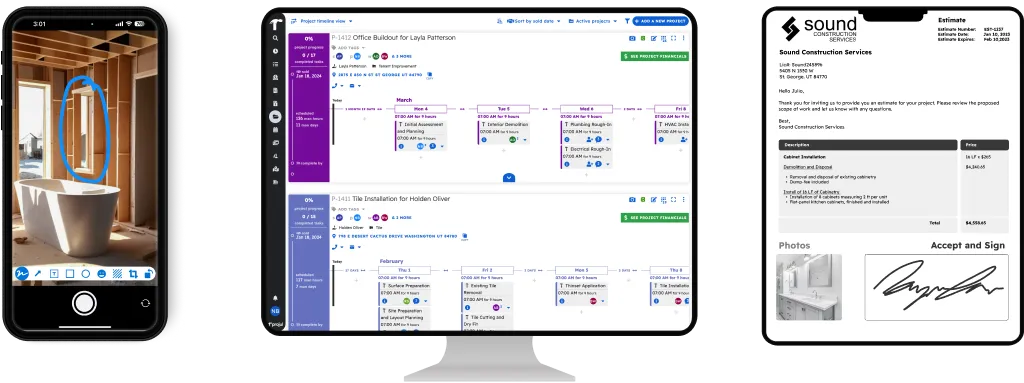
- Stay on top of every invoice and estimate
- Quickly check the progress using visualizations
- Filter and sort the invoice cards to suit your needs
Get paid on every type of job
Whether it’s a quick service call or a months-long build, Projul has you covered. Invoicing handles standard billing, while service invoicing pulls time and materials into invoices automatically. For longer projects, progress billing lets you collect payments at each milestone.
Security and Trust in Digital Payments
Some contractors worry about digital payment security, both for themselves and their clients. Here’s what you should know.
Projul partners with JustiFi for payment processing. All transactions are encrypted and PCI-compliant. Your clients’ payment data is protected with the same standards used by major financial institutions.
Clients trust secure payment links. When your client gets an invoice with a professional payment link (not a random Venmo request), it builds confidence. They see your company name, the invoice details, and a secure payment form. It’s the professional experience they expect.
You get confirmation instantly. No more “I sent the check last week” conversations. When a client pays through Projul, you get a real-time notification. The payment is recorded, timestamped, and tracked in your dashboard.
Dispute protection. Digital payments create a clear paper trail. If a client disputes a charge, you have the invoice, the payment confirmation, and the full transaction history. That’s harder to argue with than a canceled check.
Common Payment Mistakes That Cost Contractors Money
After working with thousands of construction businesses, the same payment mistakes show up again and again. Avoiding these will keep more money in your pocket and fewer headaches on your plate.
Not collecting a deposit before starting work. This is the single biggest cash flow mistake in residential construction. You buy materials, mobilize a crew, and start work with zero money in hand. If the client backs out or delays payment, you are stuck covering those costs. Always collect a deposit, typically 25-50% depending on the job size, before you break ground. Projul’s estimates and change orders let you set deposit amounts right in the bid so the client knows the expectation from the start.
Waiting until the job is done to send the invoice. On any project longer than a week, you should be billing in stages. Waiting until completion means you are financing the entire project yourself. Set up milestone payments or use progress billing to collect as work gets completed. Your bank account will thank you.
Not offering digital payment options. Every day you wait for a check is a day your cash flow is stuck. Clients who can pay by card or ACH from their phone pay faster than clients who need to write a check and mail it. The processing fee is almost always less than the cost of delayed payment.
Forgetting to track retainage on commercial work. Commercial projects often hold back 5-10% retainage until final completion. If you are not tracking that retainage separately, you will forget to invoice for it later, or you will lose track of how much is owed. Use Projul’s budgeting tools to track retainage as a separate line item so nothing slips through the cracks.
Sending invoices without clear payment terms. “Net 30” means nothing if you do not enforce it. Put your payment terms on every invoice, set up automated client reminders to follow up when invoices are overdue, and make it as easy as possible for the client to pay on time. The combination of clear terms and a one-click payment link cuts your average collection time significantly.
Not reconciling payments with your accounting software. If you collect a payment in one system and enter it manually into QuickBooks, you are creating opportunities for errors. Projul syncs payments automatically so your books match your invoices without double entry.
Avoiding these mistakes will not just improve your cash flow. It will make your business look more professional to clients and give you more predictable revenue month to month. For contractors working across commercial and residential projects, having a consistent payment process is what separates growing companies from ones that are always chasing money.
Why Getting Paid Faster Matters More Than You Think
Here’s a stat that should keep every contractor up at night: cash flow problems are the number one reason construction businesses fail. Not bad work. Not a lack of leads. Cash flow.
The construction industry has some of the longest payment cycles of any business. The average days-to-pay in construction sits somewhere between 60 and 90 days. Think about that. You finish a job in April, and you might not see the money until June or July. Meanwhile, your material suppliers want payment in 30 days. Your subs expect checks every two weeks. Your crew needs payroll every Friday.
That gap between when you spend money and when you collect it is where contractors get crushed.
The real cost of slow payments
When you are waiting 60 to 90 days for payment, you are essentially running a bank for your clients. You are fronting the cost of materials, labor, equipment, and overhead - and hoping the money shows up before your own bills come due.
Here is what that actually looks like in practice:
You cannot buy materials for the next job. Your supplier has a credit limit for your account. If you have $40,000 in outstanding invoices and your credit limit is $50,000, one more medium-sized job maxes you out. Now you are paying cash at the counter or delaying the start of a new project because you cannot get materials on account.
You miss early-pay discounts. Many suppliers offer 2% discounts for paying within 10 days. On $500,000 in annual material purchases, that is $10,000 left on the table simply because your clients are slow to pay you.
You pay your subs late. And when you pay subs late, the good ones stop answering your calls. They go work for the contractor who pays on time. Over a few years, slow payments cost you your best trade partners - the ones who show up when they say they will and do quality work.
You take on debt. Lines of credit, credit card balances, equipment loans with bad terms. Contractors who cannot collect fast enough end up borrowing to cover the gap. That interest eats into already-thin margins.
You turn down work. This is the one that really stings. A great project comes along, but you cannot take it because you do not have the cash to front materials and labor. Your money is tied up in invoices that clients have not paid yet. So you watch the job go to someone else.
How online payments change the math
When you attach a digital payment link to your invoices, the average time to payment drops dramatically. Instead of mailing a check (which takes days to arrive and days to clear), your client clicks a link and pays in under a minute.
Contractors using online payment options through Projul typically see payments land in their account within 1 to 3 business days for ACH, and even faster for credit card transactions. Compare that to the 60 to 90 day industry average with traditional billing methods.
That speed creates a compound effect on your business:
- You pay suppliers on time and keep your credit lines open for the next project
- You pay subs on time and keep your best trade partners loyal
- You skip the borrowing because you do not need a line of credit to cover gaps
- You take on more work because your cash is not locked up in unpaid invoices
- You sleep better because you are not wondering if you can make payroll
The difference between getting paid in 5 days and getting paid in 75 days is not just a convenience thing. It is a survival thing. Contractors who collect fast grow. Contractors who collect slow go under. It really is that simple.
And the fix is not complicated. You do not need to overhaul your business or hire a collections team. You just need to make it stupid easy for clients to pay you the moment they get an invoice. That is what Projul’s payment processing does.
The snowball effect of faster payments
Think about it this way. If you have 10 active projects and each one pays you 60 days faster than before, that is a massive amount of cash that was previously locked up and is now flowing through your business.
Say each project invoices $25,000 on average. That is $250,000 that used to sit in “accounts receivable” limbo for two months. Now it is in your bank account within a week. With that kind of working capital, you can fund the next round of projects without borrowing, negotiate better terms with suppliers, and invest in the equipment and people that let you grow.
Getting paid faster is not just about this invoice or that invoice. It is about changing the financial foundation of your entire operation. And it starts with something as simple as adding a “Pay Now” button to your invoices.
How Online Payments Work in Projul
If you have never used online payment processing before, the whole thing might sound complicated. It is not. Here is exactly how it works from start to finish, step by step.
Step 1: Create your invoice
You build your invoice inside Projul, just like you normally would. If you started with an estimate, Projul can pull line items directly from the approved bid so you are not retyping anything. Add your payment terms, due date, and any notes for the client.
Whether it is a standard invoice through Projul’s invoicing or a milestone payment through progress billing, the process is the same.
Step 2: Send it with a payment link
When you send the invoice to your client, Projul automatically attaches a secure payment link. Your client receives a professional-looking invoice with your company name, logo, line items, and a clear “Pay Now” button. No extra setup needed on your end.
The invoice goes out via email, and your client can open it on their phone, tablet, or computer. There is no app to download, no account to create. They just click the link.
Step 3: Client chooses their payment method
Your client sees the invoice details and picks how they want to pay - credit card or ACH (bank transfer). They enter their payment information into a secure form powered by JustiFi, Projul’s payment processing partner. The entire experience is PCI-compliant and encrypted.
Most clients complete the payment in under 60 seconds. That is important because every extra step or minute you add to the payment process increases the chance they put it off until later. And “later” in construction usually means “weeks from now.”
Step 4: Money hits your account
Credit card payments typically process within 1 to 2 business days. ACH transfers take 2 to 3 business days. Either way, you are looking at days instead of the weeks (or months) it takes to collect a check.
You get a real-time notification the moment your client submits the payment, so you know the money is on its way without having to check your bank account or call the client.
Step 5: Invoice auto-marked as paid
This is where the “integrated” part really shines. When the payment comes through, Projul automatically marks the invoice as paid. You do not need to log into a separate portal, update a spreadsheet, or manually change the invoice status.
If you have QuickBooks integration set up, the payment syncs there too. Your books stay accurate without any extra work from you or your bookkeeper.
Step 6: Job costing updates
Here is the part most payment tools miss entirely. When a payment is recorded in Projul, it flows into your job costing and budgeting data. You can see exactly how much has been collected on each project, what is still outstanding, and how your actual revenue compares to your estimated budget.
That means you are not just collecting payments - you are building a real-time picture of your project profitability. No end-of-month reconciliation needed. No surprises when you finally sit down to look at the numbers.
The whole flow at a glance
Send invoice with pay link - client clicks - pays by card or ACH - money hits your account - invoice auto-marked paid - job costing updates. Six steps, mostly automatic, and your client does the heavy lifting by simply clicking a button.
Compare that to printing an invoice, mailing it, waiting for a check, depositing the check, waiting for it to clear, and manually updating your records. The old way has at least twice as many steps, takes 10 times longer, and requires you to do most of the work.
Credit Cards vs ACH vs Checks: What Smart Contractors Accept
You already know Projul supports credit card and ACH payments. But which one should you push clients toward? And is there ever a reason to still accept checks? Let us break down the real numbers and trade-offs so you can make the right call for your business.
Processing fees: the honest comparison
This is usually the first thing contractors ask about, so let us get right to it.
Credit cards typically carry processing fees in the range of 2.5% to 3.5% of the transaction. On a $10,000 invoice, that is $250 to $350. On a $50,000 invoice, that is $1,250 to $1,750. The fees are real, and on large invoices, they add up.
ACH payments are significantly cheaper. Fees are usually a flat dollar amount or a very small percentage - often under 1%. On that same $10,000 invoice, you might pay $5 to $10 in ACH fees. On a $50,000 invoice, maybe $10 to $25. The savings are substantial, especially on larger amounts.
Checks have zero processing fees. But they are not free. When you factor in the time spent waiting for checks to arrive, trips to the bank, the risk of bounced checks, and the labor hours spent tracking and reconciling paper payments, checks actually cost you more than most contractors realize. One study estimated that processing a single paper check costs businesses between $4 and $20 when you account for all the hidden labor and administrative overhead.
Speed: how fast does the money actually land?
Credit cards: 1 to 2 business days. The fastest digital option. Client pays on Monday, money is in your account by Wednesday at the latest.
ACH: 2 to 3 business days. Slightly slower, but still dramatically faster than checks. Client pays Monday, you have it by Thursday.
Checks: 7 to 14 days on a good day. That includes mail time (2 to 5 days), deposit time (you have to actually go to the bank or use mobile deposit), and clearing time (1 to 3 business days). And that assumes the check does not get lost or bounce.
What do clients actually prefer?
Here is something a lot of contractors do not think about: your clients have preferences too. And when you make payment easy and flexible, they pay faster.
Younger homeowners and most commercial clients expect to pay digitally. They pay every other bill in their life from their phone. When you send them a paper invoice and expect a check, you are making yourself the hardest vendor to pay. That puts you at the bottom of the payment stack.
Older clients or those in rural areas may still prefer checks or ACH over credit cards. That is fine. The key is giving them options.
The data is clear: contractors who offer both credit card and ACH options get paid faster than those who only accept one method. When clients can choose, they are more likely to pay right away instead of putting it off because the available method was inconvenient.
When to pass fees to the client
Projul has a built-in surcharge feature that lets you pass credit card processing fees directly to your clients. The fee is calculated and added to the invoice automatically - your client sees it as a line item so there are no surprises.
Here is when passing fees makes sense:
Large invoices (over $5,000). On big payments, the processing fee is significant enough that absorbing it cuts into your margin. Most clients understand that a $500 convenience fee on a $20,000 invoice is the cost of paying by credit card. Many will switch to ACH on their own to avoid it.
Repeat clients. If you work with the same client across multiple projects, set the expectation early. “We accept card and ACH. Card payments include a processing fee, ACH does not.” Simple, transparent, professional.
When your margins are tight. On competitive bids where you have already sharpened your pricing, absorbing 3% in credit card fees might not be an option. Pass the fee through and let the client decide if convenience is worth it.
When to absorb fees
Small invoices (under $2,000). The processing fee on a $1,000 credit card payment is around $30. That is probably not worth the friction of adding a surcharge line item. Just absorb it and keep the payment experience clean.
First-time clients. When you are building a new relationship, a surcharge on the very first invoice can feel nickel-and-dime-y. Consider absorbing the fee on the first project to set a positive tone, then transition to surcharging on future work.
Service calls and small jobs. For quick, high-volume service work, speed of payment matters more than saving $20 on a processing fee. The faster the client pays, the sooner you can close out the job and move on.
The smart contractor approach
The best strategy is to accept everything - credit cards, ACH, and yes, even checks if a client insists. But make digital payments the default by sending invoices with a payment link and guiding clients toward ACH for larger amounts and credit cards for smaller ones.
Here is a simple framework:
- Deposits and small jobs: Credit card, absorb the fee
- Progress payments and mid-size invoices: ACH preferred, credit card with surcharge as a backup
- Final payments on large projects: ACH, with a credit card surcharge option for clients who want the convenience
- Commercial clients: ACH almost always - they are used to it, and the fees are minimal
You do not need a complicated policy. Just offer options, be transparent about fees, and make it easy. Projul handles the rest.
A note on state surcharge laws
Not every state allows you to surcharge credit card fees to clients. Some states have restrictions or outright bans. Before you turn on surcharging in Projul, check your state’s rules. Projul’s support team can point you in the right direction, but this is one of those things where spending 10 minutes on research saves you a headache down the road.
Automated Payment Reminders That Actually Get You Paid
Chasing late payments is one of the worst parts of running a construction business. You have already done the work. You have already sent the invoice. And now you are spending your evenings and weekends calling clients, sending follow-up emails, and feeling awkward about asking for money you already earned.
Here is the thing: most late payments are not malicious. Your client is busy. They meant to pay the invoice last Tuesday but got sidetracked. Then it fell off their radar. Two weeks later, they still have not paid - not because they are trying to stiff you, but because nothing reminded them.
That is exactly the problem automated client reminders solve.
Set it and forget it
Projul lets you configure payment reminders that go out automatically before and after invoice due dates. You set the schedule once, and Projul handles the rest. No more sticky notes on your desk reminding you to call Mrs. Johnson about that overdue invoice.
Here is a reminder schedule that works well for most contractors:
- 7 days before due date: A friendly heads-up. “Just a reminder that Invoice #1247 for $8,500 is due next week. Click here to pay.”
- On the due date: A direct but polite reminder. “Invoice #1247 is due today. Pay now to keep your account current.”
- 3 days after due date: A gentle nudge. “Invoice #1247 was due on March 15. Please submit payment at your earliest convenience.”
- 7 days after due date: A firmer follow-up. “Your payment of $8,500 is now 7 days past due. Please click the link below to pay today.”
- 14 days after due date: Final automated reminder before you pick up the phone.
You can adjust the timing and frequency to match your business. Some contractors prefer more aggressive follow-up on large invoices. Others keep things light on residential work where the relationship matters more. The point is that the system does the work for you.
Professional tone that protects the relationship
One of the biggest reasons contractors hate chasing payments is the awkwardness. You are not a debt collector. You are a builder. Calling a client to ask for money feels weird, especially when you want them to refer you to their neighbors.
Automated reminders fix this by removing the personal element. The reminder comes from “your company” - not from you personally. It is professional, matter-of-fact, and includes a direct payment link so the client can act immediately.
The tone matters more than you might think. A well-worded reminder says, “Hey, this is due - here is a quick link to pay.” It does not say, “Why have you not paid me yet?” That distinction preserves your client relationship while still getting money in the door.
And because the reminder includes a payment link, you are removing every possible barrier. The client does not need to find the original invoice, look up your mailing address, or write a check. They click the link, pay in 60 seconds, and you are both done.
What happens when reminders are not enough
Sometimes a client still does not pay after multiple reminders. That is when you step in personally. But here is the difference: instead of being the first point of contact about late payment, you are the escalation. The automated reminders did the initial legwork. Your personal call now carries more weight because the client knows they have already been reminded several times.
Projul tracks every reminder that goes out, so when you do pick up the phone, you have a clear history. “I see we sent reminders on March 8, March 15, March 18, and March 22. Can we get this taken care of today?” That is a much more effective conversation than, “Hey, just checking in on that invoice.”
The numbers behind reminders
Contractors who use automated payment reminders in Projul report getting paid significantly faster than those who rely on manual follow-up. The reason is simple: consistency. A human forgets to follow up. A system does not.
When every invoice gets a pre-due-date reminder and timely follow-ups after the due date, clients learn that your business takes payments seriously. Over time, they start paying before the reminders even go out because they know the system is watching.
That behavioral shift is where the real value lives. It is not just about collecting on this one overdue invoice. It is about training your entire client base to pay you promptly because that is how your business operates.
Pair reminders with online payments for maximum effect
Automated reminders work best when paired with digital payment options. A reminder that says “your invoice is overdue” is useful but limited. A reminder that says “your invoice is overdue - click here to pay now” is dramatically more effective because it removes every excuse.
The client cannot say, “I will mail a check this weekend.” They cannot say, “I lost the invoice.” The payment link is right there in the reminder email. One click, 60 seconds, done.
That combination of automated reminders plus online payment links is one of the most powerful things you can do for your cash flow. It attacks late payments from both sides: the reminder creates urgency, and the payment link removes friction. Together, they turn your accounts receivable from a headache into a system that mostly runs itself.
For more on how the full reminder system works, check out the automated client reminders feature page.
Stop chasing payments
Tired of following up on unpaid invoices? Automated client reminders send payment notifications on your schedule so you don’t have to pick up the phone.