Turn tracked hours into paid invoices with Projul's Service Invoicing.
Your crew tracks time on a project, but invoicing happens somewhere else. Hours slip through the cracks. You're not losing money because the work didn't get done. You're losing it because it never made it onto an invoice. Service Invoicing pulls approved time logs directly into invoices so every billable hour gets captured, itemized, and sent to your client.
- Stop losing revenue to forgotten labor. Import approved time logs into a draft invoice with one click. All project time or a specific date range, nothing gets left behind.
- Give clients invoices they won't question. Task descriptions, steps, and comments show up as line item details so clients see exactly what they're paying for.
- Your default markup applies automatically. Time clocked to the project flows into the invoice with your company's standard markup already built in.
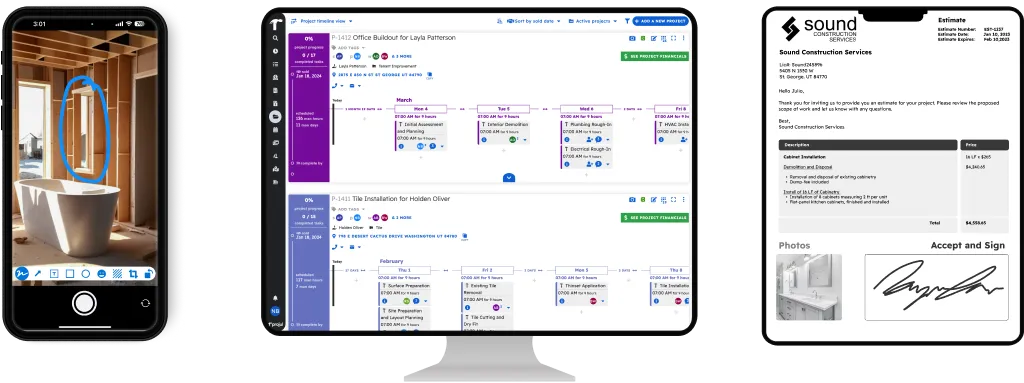
Import time logs, send invoices, get paid
Manually typing hours into invoices is slow, error-prone, and easy to put off. With Service Invoicing, you pick the project, choose a date range if you need one, and pull in approved time logs as ready-to-send line items.
Projul’s Service Invoicing imports approved time logs directly into draft invoices with task descriptions and default markup applied automatically. Every billable hour gets captured so contractors never lose revenue to forgotten labor. Projul offers flat-rate pricing with no per-user fees for construction companies of all sizes.
Each line item includes the task details and comments your crew logged, so the invoice tells a clear story. Your company’s default markup applies automatically, and the draft is ready to review and send in minutes.
- One-click import from tracked time to invoice. Pick a project, choose your date range, and import. Approved time logs become itemized line items with descriptions and markup already applied.
- Invoice directly from tasks and schedules. Service workers don’t have to wait for the office. They can generate invoices straight from their tasks, keeping billing moving as fast as the work itself.
- Accurate line items your clients can trust. Every line item comes from actual time data with task descriptions, steps, and comments attached. Clients see the work, understand the charges, and pay faster.
The real cost of forgotten billable hours
Every contractor has been there. A crew spends three days on a service call. The hours get tracked, but nobody creates the invoice right away. A week goes by. Then two weeks. By the time someone gets around to billing, half the details are fuzzy and some hours get missed entirely.
This isn’t a small problem. For service-heavy contractors running multiple jobs every week, unbilled labor can add up to thousands of dollars every month. Not because the work didn’t happen, but because the invoicing process was too slow to keep up.
The math is straightforward. If you have 10 field workers billing at $85/hour and each one has just 2 unbilled hours per week, that’s $1,700 a week walking out the door. Over a year, that’s more than $88,000 in revenue you earned but never collected.
Service Invoicing closes that gap by making invoicing as fast as time tracking. Your crew logs hours on Monday. You pull those hours into an invoice on Tuesday. The client has a bill in their inbox before they’ve forgotten the work was done.
How the invoice creation workflow works
The process from tracked time to sent invoice takes about two minutes. Here’s exactly how it works in Projul:
Step 1: Your crew tracks time. Whether they use standard time tracking or geo-fenced time tracking, hours get logged against the project and task. Task descriptions, steps completed, and comments all attach to the time entry.
Step 2: Time gets approved. Your project manager or office staff reviews and approves time entries. This is your quality check to make sure hours and descriptions are accurate before they hit an invoice.
Step 3: Import into a draft invoice. From the project or from the Service Work Profitability report, click to import approved time logs. Choose all time on the project or filter by date range. Projul creates a draft invoice with each time entry as a separate line item.
Step 4: Review and adjust. Your draft shows every line item with the task description, hours, rate, and your company’s default markup applied. Add materials if it’s a T&M job. Remove any line items that shouldn’t be on this particular invoice. Adjust descriptions if you want to.
Step 5: Send. Hit send and the invoice goes to your client with a clear, itemized breakdown of the work. If you have payment processing enabled, the client can pay right from the invoice with a credit card or ACH.
The whole process replaces what used to be 30 to 60 minutes of manual data entry with two minutes of review and a click.
Progress billing for ongoing service work
Not every job wraps up in a single visit. For projects that span weeks or months, you need to bill as work progresses rather than waiting until the end. Service Invoicing handles this naturally because you control which time entries go on each invoice.
Run a service project that lasts six weeks? Bill every Friday by importing that week’s approved hours. Your client gets a weekly invoice that matches the work they saw happen. Your cash flow stays healthy because you’re collecting as you go instead of floating a month’s worth of labor.
This works alongside Projul’s progress billing tools for larger projects. Whether you’re billing by percentage complete, by phase, or by time period, Projul gives you the flexibility to invoice the way that makes sense for each job.
For contractors who handle a mix of small service calls and larger projects, this flexibility is critical. A one-day service call might get a single invoice. A three-month renovation might get weekly progress bills. Both workflows live in the same system.
Deposit invoicing and collecting upfront payments
Before the work even starts, many contractors collect a deposit. Service Invoicing works hand in hand with Projul’s standard invoicing to handle deposits cleanly.
Create a deposit invoice based on your estimate or a flat amount. Once the deposit clears, begin work and track time normally. When you generate service invoices for the labor, the deposit is already on record so you can see exactly how much the client still owes.
This keeps your accounts receivable clean and eliminates the awkward conversations about how much has already been paid. The client sees the deposit credited on their invoice, and you see the remaining balance in your dashboard.
Change order billing without the headaches
Scope changes happen on almost every project. A client wants an additional outlet. The inspection requires a fix you didn’t plan for. The homeowner decides to upgrade the fixtures mid-project.
When you create a change order through estimates and change orders, the extra work gets its own scope and budget. Your crew tracks time against those change order tasks just like any other work. When it’s time to bill, those hours show up in Service Invoicing ready to be imported.
You can bill change order work on a separate invoice or include it with the regular project billing. Either way, the line items clearly show which work was part of the original scope and which was added through change orders. Clients see exactly what they’re paying for, and you don’t leave change order revenue on the table.
This is where a lot of contractors lose money. They do the extra work, track the hours, but never get around to billing the change order separately. With Service Invoicing, those hours are just as easy to invoice as any other tracked time.
Online payments that speed up collection
Sending an invoice is only half the job. Getting paid is the other half. Projul’s payment processing lets your clients pay directly from the invoice using a credit card or ACH transfer.
When you send a service invoice, the client gets an email with a link. They click, review the line items, and pay. The payment records automatically in Projul and syncs to QuickBooks. No check to deposit. No payment to manually record. No spreadsheet to update.
Online payments speed up your collection timeline significantly. Instead of mailing a paper invoice, waiting for a check, depositing it, and waiting for it to clear, you get paid in days instead of weeks. For service contractors who bill weekly, that faster cash cycle makes a real difference in your ability to cover payroll and materials.
QuickBooks sync keeps your books clean
Every service invoice you create in Projul syncs automatically to QuickBooks Online or QuickBooks Desktop. The invoice details, line items, amounts, and customer information all push to your accounting software without anyone touching QuickBooks.
When the client pays, the payment syncs too. Your books stay current in real time. Your bookkeeper or accountant sees the same data you see in Projul, just organized in their preferred accounting format.
This eliminates the most tedious part of service invoicing for most contractors: the double entry. Before Projul, you’d create the invoice in your project management tool, then recreate it in QuickBooks. Every invoice, twice. With Service Invoicing and the QuickBooks sync running, you create it once and your accounting software updates automatically.
For contractors processing 50 or 100 invoices a month, the time savings add up fast. Even at 5 minutes per manual QuickBooks entry, 100 invoices means over 8 hours a month of pure data entry that goes away completely.
Payment reminders that get you paid faster
Not every client pays on time. Some forget. Some are slow. Some need a nudge. Projul helps you follow up without being the bad guy.
Track which invoices are outstanding, how long they’ve been open, and how much is owed. When a payment is overdue, send a reminder directly from Projul. The client gets a professional follow-up with the invoice attached and a link to pay online.
This takes the personal awkwardness out of collections. You’re not calling someone to ask about a bill. You’re sending an automated, professional reminder that includes everything they need to pay right now. Most clients who get a reminder with a one-click payment link pay within 48 hours.
For contractors with a lot of outstanding invoices, this alone can recover significant revenue. Money you already earned sitting in accounts receivable isn’t helping your business. Getting it collected faster means healthier cash flow and fewer end-of-month scrambles.
Spot unbilled work and invoice it on the spot
Your Service Work Profitability report already shows which projects have unbilled hours sitting on them. Now you can act on that immediately. When you see labor you haven’t invoiced yet, pull those time logs into an invoice and get it out the door.
No more letting billable hours pile up while you “get around to it.”
- Go from report to invoice without switching tools. The Service Work Profitability report flags unbilled hours. From there, import those time logs into an invoice and send it, all within Projul.
- Keep cash flow healthy by invoicing as you go. Don’t wait until the end of a project to bill for labor. Invoice completed work regularly so money keeps coming in while the project’s still active.
- Never let billable hours go unnoticed again. Between the profitability report and one-click importing, there’s no reason for labor to go unbilled. Every tracked hour has a clear path to an invoice.
Time and materials invoicing, finally made simple
For T&M work, invoicing has always been a headache. You need accurate labor hours and materials on the same invoice, and getting it all together usually means juggling spreadsheets or bouncing between systems.
With Service Invoicing, you import your tracked time as line items and add materials to the same invoice. Your markup applies to the labor automatically, giving your client one clean, itemized invoice that covers the full scope of work.
- Combine labor and materials on a single invoice. Import time logs for the labor side, then add materials directly to the same invoice. One document, one send, no piecing things together.
- Give T&M clients full transparency. Each line item shows the task details and time behind the labor charges, with materials listed right alongside them. Clients see exactly what got done and what got used.
- Bill T&M jobs as work progresses. Don’t wait for the project to wrap up. Import the latest time logs, add recent materials, and send an invoice for the current period so you’re getting paid along the way.
Simple for the field, powerful for the office
Your service workers are out doing the work and tracking their time. Now they can invoice for that work right from their tasks and schedule without handing it off to someone in the office.
For office staff, the ability to pull time data into invoices across any project means billing stays current without chasing down spreadsheets or timesheets.
- Service workers can invoice from the field. Crew members generate invoices directly from their tasks and schedules, so billing doesn’t have to wait until someone’s back at a desk.
- No double entry, no manual hour tracking. Time data flows from the clock to the invoice. Your team tracks time once, and that same data becomes the invoice line item.
Pull hours from any time clock
Service Invoicing works with both standard time tracking and geo-fenced time tracking. However your crew clocks in, those hours are ready to import into an invoice. GPS-verified hours carry the same detail and accuracy into your invoices as standard time entries.
From invoice to payment in one flow
Once you send the invoice, payment processing handles the rest. Your client pays online, and the payment ties back to the invoice automatically. No chasing checks, no reconciling spreadsheets. The payment syncs to QuickBooks, your books update, and you move on to the next job.
What Is Service Invoicing (And How It Differs From Project Invoicing)
If you run a service-based contracting business - plumbing, HVAC, electrical, pest control, appliance repair, locksmith work, or any trade where the job starts and ends in a single visit - you already know that your billing cycle looks nothing like a general contractor running a six-month build.
Project invoicing is built around phases. You send a deposit invoice before the work starts, bill at milestones along the way, and send a final invoice when the punch list is done. The timeline stretches across weeks or months. You have time to sit down at the office, pull together your numbers, and create a polished invoice because the next billing milestone is two weeks away.
Service invoicing is a completely different animal.
You show up. You diagnose the problem. You fix it. You bill the client. And then you drive to the next call. The entire cycle - from arrival to payment - might happen in under two hours. If you don’t invoice before you leave the driveway, that job joins a growing pile of “I’ll get to it later” tickets that may or may not get billed by Friday.
The speed problem every service contractor faces
Here’s the core tension: service work moves fast, but most invoicing software was designed for slow, project-based billing. You end up with a system that wants you to create an estimate, convert it to a project, track phases, and then generate an invoice against milestones. That’s fine for a kitchen remodel. It’s overkill for a 45-minute water heater replacement.
What you actually need is the ability to pull up the job, confirm the labor and materials, and fire off an invoice before your engine cools down. No estimate conversion. No milestone tracking. No “I’ll batch these at the end of the week.”
Because here’s what happens when you batch service invoices at the end of the week:
- You forget line items. That extra fitting you grabbed from the truck? The 20 minutes you spent explaining the issue to the homeowner? Gone. You can’t remember every detail from Tuesday’s third call when you’re sitting at your desk on Friday night.
- You underbill. When details are fuzzy, most contractors round down. You remember spending “about an hour” on a call that actually took an hour and twenty minutes. Multiply that across 15 calls a week and you’re giving away hours of paid labor.
- You delay cash flow. Every day between “work done” and “invoice sent” is a day you’re floating that labor cost. Your crew got paid Friday regardless. If the invoice doesn’t go out until next week, and the client takes 14 days to pay, you’re carrying three weeks of labor cost on every job.
- Some jobs never get invoiced at all. This is the worst outcome, and it’s more common than anyone wants to admit. A job gets done, the paperwork gets shuffled, and nobody ever sends a bill. The client doesn’t complain. You don’t notice until you’re wondering why revenue is down this quarter.
What makes service invoicing different in practice
When we talk about service invoicing in Projul, we’re talking about a workflow built for speed and accuracy on individual visits. Here’s how it differs from project invoicing in practical terms:
One visit, one invoice. Most service calls result in a single invoice tied to a single visit. You’re not tracking completion percentages or billing against a contract value. You’re billing for the work you did today, on this call, at this address.
Labor and materials are straightforward. You spent 1.5 hours. You used two parts. Your rate is $95/hour. The parts cost $47. That’s the invoice. No allocation across budget categories, no percentage-of-completion calculations, no retainage holdbacks.
The client expects a bill immediately. Homeowners and property managers who call for service work expect to see an invoice the same day, if not while you’re still standing in their kitchen. Sending an invoice three days later feels unprofessional. Sending one three weeks later is a collections problem waiting to happen.
Volume matters. A project-based contractor might send 10 invoices a month. A busy service contractor might send 10 invoices a day. When you multiply any inefficiency in your invoicing process by that volume, small problems become expensive ones fast.
Repeat clients are common. Service contractors build relationships with property managers, facility managers, and homeowners who call back regularly. Fast, professional invoicing is part of the service. When your invoice arrives before the client has even thought about it, that’s the kind of experience that gets you the next call.
Where project invoicing and service invoicing overlap
They’re not completely separate worlds. Plenty of contractors do both. You might run a remodel project that takes three months and also handle service calls every day. Projul handles both workflows in the same system, so you don’t need separate invoicing tools for different types of work.
The key difference is pacing. Project invoicing lets you bill methodically over time. Service invoicing demands that you bill quickly, accurately, and repeatedly. Projul’s Service Invoicing feature is built for that second mode - getting an invoice out the door while the work is still fresh and the client is still thinking about it.
If you’ve been treating service invoicing as an afterthought - something you batch on Friday afternoons - you’re almost certainly leaving money on the table. The sections below walk through exactly how to invoice service work in Projul so that every call gets billed, every hour gets captured, and your cash flow stays where it belongs.
Creating and Sending a Service Invoice in Under 2 Minutes
Two minutes. That’s the time between finishing a service call and having a professional invoice in your client’s inbox. Not two hours back at the office. Not two days when you “get around to it.” Two minutes, from the truck, before you pull away.
Here’s the exact workflow.
Pull up the job
Open the job in Projul. Whether you got there from your schedule, your task list, or a notification, the job screen shows you everything tied to this service call - the client info, the address, the time your crew tracked, and any materials logged.
You don’t need to look anything up. You don’t need to cross-reference a spreadsheet. Everything your crew recorded during the visit is already attached to the job.
Add labor and materials
If your crew tracked time using Projul’s time tracking or geo-fenced time tracking, those hours are ready to import. One tap brings in the approved time logs as line items, complete with task descriptions, steps, and comments.
For materials, add them directly to the invoice. If you pulled a part from your truck stock or picked something up on the way to the job, add the item, the quantity, and the cost. It takes seconds.
Here’s what each line item looks like on the finished invoice:
- Labor line items show the task description, hours worked, your billing rate, and your default markup. If your tech logged “Replaced expansion tank on water heater - old tank corroded at connection” as a task comment, that description appears right on the invoice. The client sees what was done without having to call and ask.
- Material line items show the part or supply name, quantity, unit cost, and your markup. A client looking at “$47.50 - 3/4 inch expansion tank (1)” knows exactly what they’re paying for.
Apply your rates
Your company’s default billing rates and markup percentages apply automatically. You set these up once in Projul, and every service invoice uses them unless you choose to override on a specific line item.
This is important because it removes a decision from the invoicing process. You’re not sitting in the truck trying to remember what you charge for labor on residential service calls versus commercial ones. Projul already knows. The rate is applied. The markup is calculated. You just review the total and confirm it looks right.
If this particular job has a different agreed-upon rate - maybe you quoted a flat rate for a maintenance contract client - you can adjust the line item before sending. But for the vast majority of service calls, the default rates are correct, and you don’t need to touch them.
Hit send
That’s it. Tap send, and the invoice goes to your client’s email. It arrives as a professional, itemized document with your company name, logo, and contact information. If you have payment processing turned on, the invoice includes a direct pay link. The client can open the email, review the charges, and pay by credit card or ACH right from their phone.
No driving back to the office. No “I’ll do it tonight.” No Friday afternoon billing marathon where you’re trying to reconstruct what happened on Tuesday’s second call.
What happens after you hit send
The invoice doesn’t just go to the client. It also:
- Shows up in your invoicing dashboard where you can track its status - sent, viewed, paid, or overdue.
- Syncs to QuickBooks automatically if you have the integration turned on. The invoice, line items, and client details push to your accounting software without any double entry.
- Starts the payment clock. With online payments enabled, most service clients pay within 24 to 48 hours. Some pay within minutes of receiving the invoice, especially homeowners who want to close out the job mentally.
Why two minutes matters
Let’s do the math on what slower invoicing actually costs.
Say you have five service technicians, each running four calls a day. That’s 20 invoices per day, 100 per week. If each invoice takes 15 minutes to create manually back at the office (looking up job details, typing in hours, finding material costs, formatting the invoice, sending it), that’s 25 hours a week spent on invoicing alone. That’s more than half a full-time employee doing nothing but data entry.
At two minutes per invoice from the field, those same 100 invoices take about 3.3 hours total. And that time is spread across your five techs, each spending roughly 8 minutes a day on invoicing. They handle it between calls. It’s not a separate job.
The difference isn’t just time saved. It’s invoices that go out immediately, cash that comes in faster, and details that are accurate because the work just happened five minutes ago.
The end of batch invoicing
If you’re currently doing batch invoicing - saving up all your service tickets and billing them once a week or once every two weeks - this workflow changes everything about your cash flow.
Instead of a lump of invoices going out Friday afternoon (and payments arriving the following week, maybe), you have a steady stream of invoices going out every day. Payments come in every day. Your bank account doesn’t swing between empty and flush. It stays consistent because your billing is consistent.
For service contractors, switching from batch invoicing to same-day invoicing is one of the single biggest improvements you can make to your cash flow. And with Projul, it takes less time, not more, because the two-minute workflow is faster than whatever you’re doing now.
Service Invoicing From Your Phone
Here’s the scenario that plays out a hundred times a day for service contractors across the country: Your tech finishes a job. The homeowner is standing right there. They say “Looks great - what do I owe you?” And your tech says… “We’ll send you an invoice.”
That moment - when the client is happy, the work is fresh, and everyone is face to face - is the absolute best time to invoice. The client is ready to pay. They’re satisfied. They’re not going to question anything because they just watched your tech do the work.
But if your invoicing system lives on a desktop computer back at the office, that moment passes. By the time the invoice shows up in the client’s email two days later, the emotional connection to the work is gone. Now it’s just another bill in their inbox competing with every other bill.
Mobile-first means phone-first
Projul’s mobile apps for iOS, Android, Windows, and Mac aren’t watered-down versions of the desktop experience. The invoicing workflow on your phone is the same workflow described above: pull up the job, import time logs, add materials, review, send. Same two minutes. Same professional invoice. Same pay link.
This matters because your service techs don’t carry laptops to job sites. They carry phones. If the invoicing tool doesn’t work on a phone - and work well, not just technically function - then it doesn’t work for service contractors. Period.
Invoice while the work is fresh
Memory is unreliable. Even five hours after a service call, your tech’s recollection of exactly what happened starts getting fuzzy. Was it 1.5 hours or 1.75? Did they use two fittings or three? What was the model number on that part they replaced?
When you invoice on site, immediately after the work, none of that is a question. The tech just did the work. They know exactly what they used, exactly how long it took, and exactly what they did. The invoice is accurate because it’s created in context.
This is especially true for materials. Service techs pull parts from their truck stock all the time. If they don’t log it immediately, those parts become invisible. Nobody remembers to bill for a $12 coupling that got used three days ago. But standing at the truck right after the job, adding that coupling to the invoice takes five seconds.
The “standing right there” advantage
When you invoice on site while the client is present, something powerful happens: disputes drop to almost zero.
Think about it from the client’s perspective. Your tech just fixed their problem. They watched it happen. Now they see an invoice that itemizes exactly what was done - the labor hours they observed, the parts they saw get installed. Everything matches their experience. There’s nothing to question.
Compare that to an invoice that arrives three days later. The client doesn’t remember exactly how long the tech was there. They don’t remember what parts were used. The invoice feels abstract, disconnected from the work. That’s when clients start questioning line items, asking for breakdowns, and delaying payment.
On-site invoicing eliminates that friction entirely. The client sees the invoice in context. They approve it mentally on the spot. Many of them will pull out their phone and pay the invoice right there while your tech is packing up. You leave the job site with money in your account. That’s the ideal outcome for everyone.
What your techs need to know
Switching to mobile invoicing doesn’t require a training overhaul. If your techs already use Projul to check their schedule, view job details, and track time, they already know the app. Invoicing is just one more thing they can do from the same tool.
The key points for your field team:
- Track time during the job. This is probably something they’re already doing. The time log becomes the basis for the invoice, so accurate time tracking equals accurate invoicing.
- Log materials as they use them. When they pull a part from the truck, add it to the job. When they pick up supplies, log them. This takes seconds and means the invoice is complete when the job is done.
- Review before sending. The draft invoice takes a few seconds to scan. Make sure the hours look right, the materials are listed, and the markup is applied. Then hit send.
- Let the client know. A simple “I just sent the invoice to your email - there’s a link to pay online if that’s easiest” goes a long way. Most clients appreciate the immediate follow-up.
For the office: visibility without bottlenecks
When your techs invoice from the field, the office sees every invoice in real time. You don’t have to wait for someone to come back and hand over a stack of work orders. The invoice is in the system the moment it’s sent.
This means:
- Accounts receivable is always current. No lag between work completed and invoices recorded.
- Cash flow forecasting gets accurate. You know what’s been billed and what’s outstanding at any given moment.
- Office staff focus on exceptions. Instead of creating 20 invoices a day from scratch, the office reviews the ones that come in from the field and handles the edge cases. The routine billing is done before the tech drives to the next call.
Some contractors worry that giving techs invoicing access will lead to mistakes. In practice, the opposite happens. Techs who invoice on site produce more accurate invoices than office staff who reconstruct the job from notes and time sheets two days later. The person who did the work knows the work best.
Property managers and commercial clients
For service contractors who work with property management companies or commercial facility managers, mobile invoicing is a competitive advantage. These clients manage dozens or hundreds of properties. They deal with service vendors all day. The contractor who sends a clean, professional invoice before the tech has left the property stands out.
Property managers especially appreciate fast invoicing because it lets them close out their own work orders promptly. They can match your invoice to their maintenance ticket, approve payment, and move on. When they have to chase contractors for invoices weeks after the work was done, it creates extra work for them and damages the relationship.
If you’re trying to win and keep property management contracts, fast mobile invoicing isn’t just a convenience. It’s part of the service you’re delivering.
Tracking Service Revenue and Profitability
Sending invoices is half the equation. The other half is understanding which service calls are actually making you money - and which ones are quietly draining your profits.
Most service contractors have a gut feeling about their profitability. “Residential calls are good.” “Commercial maintenance contracts keep the lights on.” “Emergency calls are where the real money is.” But gut feelings are often wrong, and they’re always incomplete.
Projul’s reporting and budgeting tools give you actual numbers. Not feelings. Numbers. And those numbers tell a story that might surprise you.
Which service calls are profitable?
Not all calls are created equal. A 30-minute faucet replacement at $150 is great margin work. A 3-hour diagnostic call where your tech can’t find the problem and you end up eating the labor to keep the client happy? That’s a loss leader, and you need to know how many of those you’re running each month.
Projul tracks the full cost of each service call:
- Labor cost: Hours worked multiplied by your internal labor rate (what you pay the tech, not what you bill the client). This includes drive time if you track it.
- Material cost: What you paid for the parts and supplies used on the job, before markup.
- Billed amount: What the client was invoiced.
- Collected amount: What actually got paid.
The gap between billed amount and total cost is your gross margin on that call. When you can see this for every service call, patterns emerge fast.
Average ticket size
Your average ticket size - the average dollar amount per service invoice - is one of the most important numbers in your business. It tells you how much revenue you generate per truck roll.
If your average ticket is $175 and it costs you $110 in labor and materials to run a call (plus drive time, fuel, insurance, and overhead), your margin per call is thin. You need high volume to make the numbers work.
If your average ticket is $450 and your costs are $180 per call, you’ve got breathing room. You can run fewer calls, give each one more attention, and still grow revenue.
Tracking average ticket size over time also shows you trends. Is your average ticket going up because you’re doing more complex work? Going down because you’re taking on too many small calls to fill the schedule? Staying flat while your costs increase? These trends tell you whether your pricing strategy is working or needs adjustment.
Revenue by service type
If you tag or categorize your service calls by type - water heater installs, drain cleaning, fixture replacement, maintenance inspections - you can break down your revenue by category. This shows you which types of work generate the most total revenue and which types are the most profitable per call.
You might discover that drain cleaning makes up 40% of your calls but only 25% of your revenue. Meanwhile, water heater replacements are 15% of your calls but 30% of your revenue. That tells you something important about where to focus your marketing, which calls to prioritize in scheduling, and where to invest in training.
This kind of breakdown is only possible when your invoicing data is clean and tied to specific job types. When you invoice from the field using Projul, every invoice is linked to a job with a type, a client, and a location. That data feeds directly into your reports without any extra tagging or categorization after the fact.
Spotting your most profitable work
Once you have a few months of service invoicing data in Projul, you can start asking the questions that actually move your business forward:
-
Which zip codes are most profitable? Drive time eats into margins. If you’re spending 45 minutes driving to a neighborhood where the average ticket is $125, that’s a different calculation than a 10-minute drive to a $400 job. Knowing your profitable service areas helps you set minimum call charges, adjust pricing by zone, or focus marketing on the neighborhoods that pay best.
-
Which techs generate the most revenue? This isn’t about pitting your team against each other. It’s about understanding who needs more training, who’s ready for bigger jobs, and whether your dispatching is putting the right tech on the right call. A senior tech on a simple job is over-serving. A junior tech on a complex diagnostic might be undercharging because they’re not confident identifying all the billable work.
-
Which clients are worth keeping? Repeat clients are the backbone of a service business. But not all repeat clients are equally valuable. A property manager who sends you 10 calls a month at $200 each and pays in 3 days is very different from one who sends 10 calls a month at $150 each and takes 45 days to pay. Your invoicing data shows you exactly who your best clients are.
-
What’s your real cost per call? Beyond labor and materials, you have vehicle costs, fuel, insurance, tool wear, callbacks, and warranty work. When you know your true fully-loaded cost per truck roll, you can set minimum charges that make sense. Too many service contractors set their minimum call fee based on what competitors charge instead of what it actually costs them to send a truck.
The Service Work Profitability report
Projul’s Service Work Profitability report pulls all of this together in one view. You can see:
- Projects with unbilled labor hours (money you’ve earned but haven’t invoiced)
- Gross margin by job, by client, by time period
- Labor cost versus billed amount for each service call
- Trends over time so you can spot when profitability is slipping before it becomes a crisis
The report isn’t just for looking at. When you spot unbilled hours, you can act on them immediately - import those time logs into an invoice and send it. When you see a client whose jobs are consistently low-margin, you can adjust your pricing for the next call. When you notice a service type that’s underperforming, you can dig into why and fix it.
Connecting invoicing to budgeting
For contractors who set annual revenue targets or monthly budgets, Projul’s budgeting tools tie directly into your invoicing data. You can see where you stand against your targets in real time - not at the end of the month when it’s too late to course-correct.
If you budgeted $85,000 in service revenue for March and you’re sitting at $52,000 on March 20th, you know you need to push hard in the last ten days or adjust your forecast. That visibility comes from having clean, timely invoicing data. When every service call gets invoiced the same day, your revenue numbers are always current.
This is another reason same-day invoicing matters beyond cash flow. It gives you accurate, real-time data about your business performance. Batch invoicing on Fridays means your revenue data is always a few days behind reality. Same-day invoicing means your dashboard reflects what’s actually happening right now.
Making data-driven decisions about your service business
The contractors who grow their service businesses year over year aren’t just working harder. They’re working on the right jobs, in the right areas, at the right prices. They know which calls to chase and which to let go. They know which clients deserve priority scheduling and which ones aren’t worth the drive.
All of that knowledge comes from data. And all of that data starts with accurate, timely invoicing. When you invoice every call from the field using Projul, you’re not just getting paid faster - you’re building the dataset that tells you how to run a more profitable business.
Stop leaving money on the table
Every hour your crew tracks is revenue you’ve earned. Service Invoicing makes sure that revenue actually makes it onto an invoice and into your bank account. Over 5,000 contractors use Projul to close the gap between work completed and money collected. At $4,788/year with no per-user fees, your whole team can track time, create invoices, and collect payments from one platform.