Demolition Contractor Software. Built by construction pros with honest pricing.
Demo work has zero margin for error on compliance. Between hazmat assessments, permit timelines, and heavy equipment coordination, one missed step shuts the whole job down. Projul gives demolition contractors a single system to manage every phase from environmental clearance to final load-out. 5,000+ contractors rely on Projul daily.
- Track demo permits, hazmat abatement milestones, and environmental clearance per project
- Schedule excavators, loaders, dumpster pulls, and crew assignments on one timeline
- Document asbestos and lead assessments with photos and attached lab reports
- Estimate selective demo, total demo, shoring, and debris removal with reusable templates
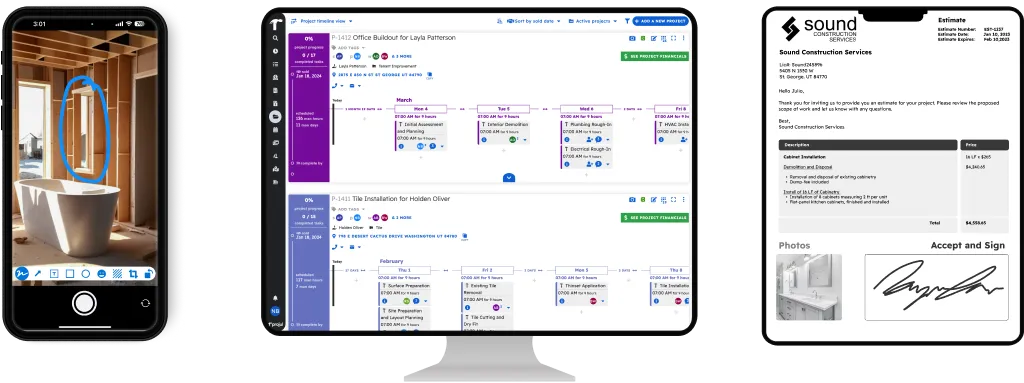
What Is Demolition Contractor Software?
Demolition contractor software is a project management platform that helps demo companies estimate tear-down scopes, track hazmat assessments and abatement, schedule heavy equipment and dumpster logistics, manage permit timelines across municipalities, and maintain OSHA safety documentation from bid through final site clearance.
Projul’s demolition contractor software helps demo companies track permits, schedule equipment logistics, and manage safety documentation from one platform built by contractors who understand regulated work. Projul offers flat-rate pricing with no per-user fees for construction companies of all sizes. If you run a demolition company, you know the actual tearing down is the straightforward part. The complicated part is everything that has to happen before, during, and after the wrecking ball swings. Hazmat surveys. Asbestos abatement. Lead paint testing. Permit applications. Utility disconnects. Neighbor notifications. Environmental compliance. Dumpster scheduling. Equipment logistics. Safety documentation for every person on every site.
One missed step and the whole job shuts down. A forgotten asbestos survey means your permit gets denied. A utility that’s still live when your excavator starts means someone could get hurt or killed. Demolition software exists to make sure nothing gets missed.
Why Demolition Companies Need Dedicated Software
Demo work has more regulatory touch points than almost any other trade. Every project involves coordination between your office, your field crews, government agencies, utility companies, environmental labs, disposal facilities, and sometimes the neighbors next door.
Running that coordination through spreadsheets, emails, and phone calls works when you have one or two active jobs. Once you’re running five or ten, things start falling through the cracks. A permit renewal date passes. A dumpster pull gets forgotten. An abatement clearance certificate never gets attached to the project file, and your environmental inspector shows up to an incomplete record.
Demolition contractor software turns all of that coordination into a connected system. When the hazmat assessment is complete, the abatement gets scheduled. When abatement clears, the demo permit moves forward. When the permit is approved, the equipment gets booked and the dumpsters get ordered. Each step triggers the next, and nothing falls through the cracks.
Projul gives demolition companies this connected workflow with 26+ features covering the full project lifecycle. Over 5,000 contractors across every trade use Projul daily, and demo contractors specifically benefit from the compliance tracking, equipment scheduling, and document management that keep projects on track and out of trouble.
Demolition Estimating: Selective vs. Full Tear-Down
Every demo job starts with the estimate, and getting that estimate right determines whether you make money or lose it. The scope difference between selective demolition and total demolition is massive, and your estimate needs to reflect that.
Selective Demolition
Selective demo means taking out specific elements while preserving the rest of the structure. Strip the interior walls but keep the exterior shell. Remove the second floor but save the first. Take out the old kitchen and bathrooms without damaging the adjacent rooms.
This work is slower, more labor-intensive, and requires more skilled operators than total demolition. Your estimate needs to account for the careful approach, including hand demolition versus machine demolition, temporary shoring to protect remaining structure, and the sorting of debris into different disposal streams.
Projul’s estimating templates let you build selective demo bids with separate line items for each scope element. Interior strip-out labor. Shoring and bracing. Debris sorting. Dumpster pulls by debris type. When the customer changes the scope mid-project, you send a change order from the app and your budget updates automatically.
Total Demolition
Total demo is more straightforward in scope but brings its own estimating challenges. You need to account for heavy equipment rental or mobilization, operator hours, disposal by tonnage, dumpster quantity and rotation schedule, site prep, and site restoration after the structure is gone.
The biggest estimating risk on total demo is disposal costs. Concrete weighs different from wood frame. Mixed debris costs more to dump than sorted material. If your tonnage estimate is off, your disposal bill eats your profit.
Projul lets you build total demo templates with line items for every cost category. Equipment mobilization. Daily operator rates. Disposal by estimated tonnage with a contingency factor built in. Site grading after demo. You quote accurately and protect your margin.
Demolition contractors using Projul report up to 32% profit improvement by estimating all scope elements upfront and billing for every change order instead of absorbing it.
Hazmat Assessment and Abatement Tracking
Hazardous materials are a fact of life in demolition. Any structure built before 1980 likely contains asbestos. Lead paint is common in pre-1978 buildings. PCBs show up in old electrical equipment and caulking. Mercury lives in old thermostats and fluorescent fixtures.
Missing hazmat during the assessment phase doesn’t just create a compliance problem. It creates a health and safety crisis and a financial disaster. Unplanned abatement on a project you already priced is one of the fastest ways to lose money in demolition.
Asbestos and Lead Testing
Before any demolition work begins, you need a hazmat survey. For most jurisdictions, that means a certified inspector collecting samples of suspect materials and sending them to an accredited lab. The results determine whether abatement is required before demo can proceed.
Projul tracks the entire testing workflow as a task sequence on the project. Schedule the inspector visit. Log the sample collection. Set a reminder for lab results. When the results come back, attach the lab report to the project record and create abatement tasks if needed. Your permit application doesn’t move forward until the hazmat assessment is complete, and Projul makes that dependency visible to everyone on the team.
Hidden Hazmat Discovery
This is one of the biggest pain points in demolition. You complete the pre-demo hazmat survey, get clearance, start the tear-down, and your crew uncovers asbestos behind a wall that wasn’t accessible during the initial survey. Everything stops. You need a new assessment, a new abatement plan, and possibly new permits.
Demolition software can’t prevent hidden hazmat, but it can help you respond fast when it happens. Your crew documents the discovery with photos in the Projul mobile app. Your office creates an emergency abatement task sequence. You send a change order to the customer with documentation of the discovery. The project timeline adjusts, and everyone knows the new plan.
Abatement Workflow
Once hazmat is identified, the abatement process has its own multi-step workflow. Containment setup. Air monitoring. Material removal by certified abatement workers. Disposal in approved containers to approved facilities. Post-abatement air testing. Environmental clearance certification.
Projul tracks each of these steps as tasks with dependencies. Containment must be complete before removal starts. Air monitoring runs during the entire removal. Post-abatement testing happens after removal. The clearance certificate must be attached before demo work resumes. Every step is documented, timestamped, and accessible from any device.
Disposal and Dumpster Scheduling
Disposal logistics can make or break a demo project’s profitability. Dumpsters need to arrive on time, get pulled when they’re full, and be replaced before your crew runs out of space. The disposal facility needs to accept the material type you’re sending. And the cost per ton needs to match what you estimated.
Dumpster Rotation Management
On a busy demo job, you might cycle through three or four dumpsters in a week. Each one needs to be scheduled for delivery, monitored for fill level, and pulled on time. If the hauler is late on a pull, your crew is stacking debris on the ground and losing productivity.
Projul lets you schedule every dumpster delivery and pickup as a task on the project timeline. Set reminders for expected fill dates. When a pull gets delayed, reschedule on the timeline and your crew gets notified. Your office sees the full dumpster schedule across all active jobs, so you can coordinate with your hauler efficiently.
Disposal Cost Tracking
Disposal cost surprises are a major profit killer in demolition. You estimated disposal at $45 per ton for clean concrete, but the load got rejected because of rebar contamination and now you’re paying $75 per ton at a different facility. Or your mixed debris tonnage ran 30% over estimate because the building had more interior finishes than expected.
Projul’s job costing tracks estimated versus actual disposal costs on every project in real time. You see the disposal spending accumulate against your budget. When costs start running over, you catch it early enough to adjust your approach, whether that means sorting more aggressively on site to reduce disposal rates or sending a change order to the customer for the additional tonnage.
Heavy Equipment Tracking and Scheduling
Demolition runs on heavy equipment. Excavators, loaders, skid steers, concrete crushers, and sometimes cranes. Whether you own the equipment or rent it, knowing where each machine is, which job it’s assigned to, and when it’s available for the next project is critical.
Projul’s scheduling board shows equipment assignments alongside crew assignments. See which excavator is committed to which job and when it frees up. When a project runs long and your loader needs to stay an extra day, you see the scheduling conflict for the next job immediately and can adjust before anyone shows up to a site without equipment.
Equipment Mobilization
Moving heavy equipment between job sites costs money. Lowboy trailers, permits for oversized loads, and mobilization labor all add up. If you’re not tracking mobilization costs as a line item on your estimate, you’re absorbing them.
Projul lets you include equipment mobilization as a separate line item on every demo estimate. Track the actual mobilization cost against the estimate. Over time, you build a clear picture of what mobilization really costs and quote it accurately on future bids.
Environmental Compliance and Mitigation Plans
Demolition generates dust, noise, and vibration that affect neighboring properties. Most jurisdictions require mitigation plans, and some require monitoring during active demo. Failing to comply doesn’t just earn you a fine. It can get your permit revoked and shut down the project.
Dust and Noise Mitigation
Your dust mitigation plan might include water suppression, dust barriers, and air monitoring at the site perimeter. Your noise mitigation plan might include restricted operating hours, sound barriers, and notification to adjacent properties.
Projul lets you store your mitigation plans on the project record and create monitoring tasks on the project timeline. Schedule dust suppression checks throughout the demo. Log noise monitoring readings. Attach inspection results. When the environmental officer asks for your mitigation compliance records, everything is organized and timestamped.
Neighbor Notification Requirements
Many jurisdictions require notification to adjacent property owners before demolition begins. Some require it 30 days in advance. Others require it with the permit application. Miss the notification and your permit can be challenged or revoked.
Track neighbor notification as a task on your permit checklist in Projul. Set the deadline based on your jurisdiction’s requirements. Attach proof of notification, whether that’s certified mail receipts or door hanger photos. When the notification requirement is met, the task clears and your permit process moves forward.
Utility Disconnect Coordination
Before any demolition starts, every utility serving the structure must be disconnected. Gas, electric, water, sewer, and sometimes telecommunications. Each utility company has its own process, its own timeline, and its own paperwork.
Projul lets you set up utility disconnect tasks for every service as part of your demo permit checklist. Each disconnect gets its own deadline and assigned owner. Track the disconnect request, the scheduled date, and the confirmation. The demo work does not start until all utilities show as disconnected in the project timeline. That dependency is visible to everyone on the team and keeps your crew safe.
Dealing With Utility Timelines
Utility disconnect timelines are one of the most frustrating parts of demolition permitting. You submit the disconnect request and then wait. Some utilities respond in a week. Others take a month. And if there’s a scheduling backlog, your entire project timeline shifts.
Demolition software won’t make the utility company move faster, but it will make sure you’re tracking every pending disconnect and following up before the delays stack up. Projul’s dashboard shows you every project waiting on utility disconnects, sorted by request date. You see which ones are overdue and which ones need a follow-up call.
Salvage Value Tracking
Smart demolition contractors know that what comes out of a building has value. Copper wiring, steel beams, architectural fixtures, reusable lumber, and even old brick can offset your disposal costs and add to your profit margin.
Projul lets you add salvage items as line items on your project estimate with their expected recovery value. Track what your crew actually recovers during demo. The difference between estimated salvage and actual recovery shows up in your job cost report. On larger projects, accurate salvage tracking can turn a thin margin into a solid one.
Salvage vs. Disposal Economics
For every material your crew pulls out, you’re making a decision: salvage it or dump it. That decision depends on current scrap prices, the condition of the material, and the labor cost to separate and transport it. Copper is almost always worth salvaging. Clean steel has value. Mixed debris with nails and fasteners may cost more to sort than it’s worth.
Tracking salvage and disposal costs separately in your demolition software gives you real data on which materials are worth pulling and which ones should go straight in the dumpster. Over time, that data helps you estimate salvage value more accurately on future bids.
Safety Documentation and OSHA Compliance
Demolition is one of the most dangerous trades in construction. OSHA has specific standards for demolition work, including requirements for engineering surveys before demo begins, fall protection, hazardous material handling, and competent person designations.
Projul stores safety plans, crew certifications, toolbox talk records, and OSHA documentation on each project. Every upload gets a timestamp. When a safety audit happens or an incident requires documentation, your records are organized and accessible from any device.
Crew Certifications and Training Records
Your demo crews need current certifications for hazmat handling, heavy equipment operation, and OSHA safety training. Letting a certification lapse means that worker can’t be on certain job sites, and it means liability exposure for your company.
Track crew certifications in Projul with expiration dates and renewal reminders. When a certification is about to expire, you know before it becomes a problem. Your project manager can check which crew members are qualified for a hazmat job before making the assignment.
Keep Your Demo Crews Connected From Any Job Site
Your demo crews work in harsh environments. Inside gutted buildings. On active tear-down zones. In areas with poor cell coverage and heavy dust. They need a tool that works where they work.
Projul’s native mobile app works offline so your crew can log hours and upload site photos even without a signal. Once they’re back in range, everything syncs automatically. Geofencing tracks when crews arrive and leave each site, so your time records are accurate without paper timesheets.
From the app, your crew can view their schedule, check task assignments, document hazmat discoveries, upload photos, and log materials. Everything syncs to the office in real time once they have a connection.
Job Costing That Catches Overruns Early
Demo projects have a lot of cost variables. Equipment rental rates. Disposal tonnage. Abatement costs. Dumpster pulls. Labor hours on a selective demo that’s taking longer than estimated. If you’re not tracking costs against your estimate in real time, you won’t know you lost money until the project is done.
Projul tracks estimated versus actual costs on every demolition project as the work happens. You see labor hours accumulating against your budget. You see disposal costs and equipment charges hitting the project record. When a job starts trending over budget at week one, you catch it and adjust before the overrun eats your profit.
Demolition contractors using Projul report up to 32% profit improvement. That number comes from accurate estimating, real-time cost tracking, and billing for every scope change instead of absorbing it.
Why Demolition Contractors Switch to Projul
Most demo contractors come to Projul after outgrowing spreadsheets or getting frustrated with generic project management tools that don’t understand demolition workflows. Here’s what makes Projul work for demolition companies:
- Built by a contractor. Kurt Clayson started Projul after years of running his own construction company. Every feature exists because a real contractor needed it.
- Flat-rate pricing. $4,788 per year for your entire company. No per-user fees. Your estimators, equipment operators, abatement crews, office staff, and project managers all get full access.
- Compliance-ready documentation. Store hazmat reports, safety plans, permits, and clearance certificates on every project with timestamps and easy retrieval.
- Rated 9.8 on G2. For both ease of use and quality of support. That rating comes from contractors who use it on actual job sites.
- Over 5,000 contractors. From small demo companies to large operations running heavy equipment across dozens of sites.
Growing a Demolition Business Beyond Word of Mouth
Most demo companies get their first jobs through word of mouth and general contractor relationships. That works until it doesn’t. When your GC slows down or a referral source dries up, you need your own pipeline of work coming in.
Projul’s CRM and lead tracking gives demolition contractors a system to capture and follow up on every inquiry. When a property owner calls about tearing down a garage, that lead goes into your pipeline with contact info, project details, and a follow-up date. When a GC asks you to bid on a strip-out for a commercial renovation, you track that opportunity the same way. No more sticky notes on the dashboard of your truck.
The CRM also shows you where your work comes from. Are most of your leads from GC relationships? Direct from property owners? Real estate developers? Knowing your lead sources helps you decide where to spend your marketing time and money. If 60% of your revenue comes from three GCs, that is a risk you want to see clearly so you can start building other channels.
Your estimates are your first impression with new clients. A detailed, professional bid that breaks out mobilization, abatement, demolition, hauling, and site restoration tells the client you know what you are doing. A one-line quote that just says “demo - $45,000” looks sloppy next to a competitor who itemized everything. Projul’s templates help you send the detailed bid without spending two hours building it.
As your demo company grows, you add equipment, crews, and job sites. Projul’s scheduling tools scale with you. Go from tracking two jobs on a whiteboard to managing ten active projects with equipment assignments, dumpster rotations, and crew schedules all on one screen. Your office manager sees the full picture. Your field crews see their daily assignments on their phone.
The demo companies that grow past the five-truck stage are the ones with systems. They track their leads, send professional bids, schedule their equipment carefully, and know their numbers on every job. Projul gives you those systems without the learning curve that makes your crew ignore the software. Over 5,000 contractors use it daily because it was built for the job site, not the boardroom.
Honest Pricing for Demolition Contractors
Most demo contractor software charges per user. That pricing model punishes you for having the team you need. Add a safety officer? More money. Give your equipment operators mobile access? More money. Let your abatement subs see their schedule? Even more money.
Projul starts at $4,788 per year for your entire demolition company. No per-user fees. Your estimators, crew leads, equipment operators, and office staff all get full access without inflating the bill. Over 5,000 contractors use Projul to manage their operations, and demolition contractors consistently report saving 2+ hours daily on admin work. G2 users rate Projul 9.8 for ease of use and 9.8 for quality of support.
Asbestos and Lead Abatement Record Keeping That Passes Audits
Abatement documentation is not just a box to check. It is the record that stands between your company and six-figure fines from the EPA or your state environmental agency. When an auditor walks onto your completed job site or pulls your project file two years after the work is done, they expect a complete chain of documentation from initial survey through final clearance. Gaps in that chain mean violations, and violations in abatement work carry penalties that can shut down a small demolition company.
For asbestos abatement, the documentation trail starts with the pre-demolition survey conducted by a certified inspector. That survey identifies the location, type, condition, and quantity of asbestos-containing materials in the structure. From there, your abatement plan details the containment method, removal procedure, air monitoring protocol, worker protection measures, and disposal plan. During removal, air monitoring results must be logged continuously. After removal, clearance testing by an independent third party confirms that airborne fiber levels are below the permissible exposure limit. Every one of these steps generates paperwork that needs to be stored, organized, and retrievable.
Projul gives you a structured place for every piece of that documentation. Attach the initial survey report to the project record. Upload the abatement plan as a project document. Log air monitoring results as daily entries tied to the project timeline. Attach the clearance certificate when the independent tester signs off. Every document gets a timestamp, and every document is tied to the specific project where the work occurred.
Lead abatement follows a similar documentation pattern but with different regulatory requirements. The EPA’s Renovation, Repair, and Painting Rule requires specific containment practices, worker certifications, and waste handling procedures for any work disturbing lead-based paint in pre-1978 buildings. Your documentation needs to show that certified workers performed the abatement, that containment met EPA standards, that waste was disposed of at an approved facility, and that clearance testing confirmed the space is safe.
For demolition contractors running multiple abatement projects at once, the documentation burden multiplies fast. Each project has its own survey, its own abatement plan, its own daily monitoring logs, and its own clearance certificates. Projul keeps each project’s documentation separate and organized so your compliance manager is not digging through shared drives or filing cabinets trying to match a clearance certificate to the right job.
Our construction hazmat abatement guide covers the full regulatory framework and best practices for asbestos and lead work on demolition projects. Pair that knowledge with Projul’s document management and you build an abatement record that holds up under any audit, any time.
Debris Hauling Manifests and Chain of Custody Documentation
When a loaded dumpster leaves your demolition site, you need to know where it goes, what it weighs, what it contains, and that it arrived at an approved disposal facility. That chain of custody is not optional. Regulated materials like asbestos waste, lead-contaminated debris, and PCB-containing materials require manifests that track the material from your site to the disposal facility with signatures at every handoff point.
Even for non-hazardous demolition debris, tracking your hauling manifests protects your business. If a load of concrete ends up at an unapproved dump site, you could face illegal dumping charges even though your hauler made the decision. A manifest showing you directed the load to an approved facility and the hauler signed for it shifts the liability where it belongs.
Projul lets you create hauling tasks tied to each dumpster pull on a project. Log the dumpster number, the hauler, the estimated contents, and the destination facility. When the load is accepted at the facility, attach the weight ticket and disposal receipt to the project record. Your project file shows a complete record of every load that left the site, where it went, and how much it weighed.
For hazardous waste loads, the documentation requirements are stricter. Asbestos waste manifests must include the generator information, transporter information, designated facility, waste description, and quantity. These manifests require signatures from the generator (you), the transporter, and the receiving facility. The generator copy comes back to you as proof of proper disposal. Losing that copy means you cannot prove the waste was handled legally.
Projul’s project record serves as your digital filing cabinet for every manifest, weight ticket, and disposal receipt across every load on every project. When your state environmental agency asks for disposal documentation from a job you completed eighteen months ago, you pull it up in thirty seconds instead of spending a day searching through paper files in your office.
Disposal cost tracking ties directly into your job costing. Every weight ticket feeds your actual disposal cost on the project. When your estimated tonnage was 200 tons but the actual loads total 260 tons, you see that variance building in real time and can send a change order to the client before the project closes. The construction waste management and dumpster planning guide on our blog covers strategies for estimating disposal volumes more accurately on future bids.
Structural Demolition Sequencing and Load Path Planning
Tearing down a structure is not just swinging a wrecking ball or putting an excavator through a wall. Every structural demolition requires a sequence that accounts for load paths, temporary stability, and the safety of your crew and neighboring structures. Get the sequence wrong and you risk an uncontrolled collapse that puts people in danger and creates a liability nightmare.
The engineering survey required before structural demolition identifies the load-bearing elements, the connection types, and the sequence in which elements can be safely removed. For a steel-frame building, that means understanding which beams carry which loads and removing secondary members before primary ones. For a concrete structure, it means identifying post-tensioned elements that store enormous energy and require specialized cutting procedures. For wood-frame buildings, it means knowing which walls carry roof loads and which ones can come out first.
Projul lets you build the demolition sequence as a series of dependent tasks on the project timeline. Phase one might be interior strip-out of non-structural elements. Phase two is mechanical and electrical removal. Phase three is the structural demolition starting from the roof down. Phase four is foundation removal. Each phase depends on the previous one being complete, and Projul enforces that dependency so a crew does not jump ahead to structural work while the strip-out team is still inside the building.
For selective demolition where you are removing specific structural elements while preserving the rest of the building, sequencing becomes even more critical. Temporary shoring must be in place before you remove a load-bearing wall. The shoring must be engineered for the specific loads it will carry. Your crew needs to know which elements get shoring, which ones get removed, and in what order. Documenting that sequence in Projul means every crew member can review the plan on their phone before starting work each day.
Your scheduling board shows the sequencing visually with the interactive Gantt view. Your project manager sees the full demolition sequence laid out with dependencies, durations, and crew assignments. When weather delays push phase one back two days, the Gantt chart shows exactly how that delay cascades through the rest of the project. You adjust the timeline once and every downstream task shifts automatically.
Sequencing also affects your equipment scheduling. The excavator cannot start structural demolition until the strip-out crew clears the building. The crusher cannot process concrete until the excavator creates a pile. The loader cannot move debris until the crusher runs. Each piece of equipment has a window on the project timeline, and Projul shows those windows alongside your crew schedule so you are not paying for an excavator that sits idle because the previous phase ran long.
Salvage Yard Coordination and Recycling Documentation
Demolition waste is not all trash. Metals, clean concrete, brick, dimensional lumber, architectural fixtures, and mechanical equipment all have value in the salvage and recycling market. The difference between a demolition contractor who makes money on salvage and one who dumps everything comes down to documentation and coordination.
Tracking what comes out of a building starts during the pre-demolition walk. Before the first wall comes down, identify the salvage opportunities. Copper plumbing and wiring. Steel beams and columns. Aluminum window frames. Architectural elements like mantels, doors, and hardware that antique dealers or reuse stores will buy. Mechanical equipment that still has value. Document these items in Projul with photos and estimated quantities so your crew knows what to pull before the excavator starts.
During demolition, your crew separates salvage materials as they work. Copper goes in one container. Steel goes in another. Reusable fixtures get set aside and protected from damage. This sorting takes extra labor, but the salvage revenue offsets it when you are organized about what you are pulling and where it is going.
Projul’s project record tracks salvage items as they come out of the building. Log the material type, estimated weight, and destination. When your crew pulls 2,000 pounds of copper wiring, that entry goes into the job record with photos. When the scrap yard weighs it in at 1,850 pounds and pays you at the current copper rate, log the actual revenue. Your job cost report shows the difference between your salvage estimate and the actual recovery, which makes your future salvage estimates more accurate.
Recycling documentation matters for LEED projects, municipal green building requirements, and clients who care about their environmental footprint. Many commercial demolition contracts include a waste diversion requirement, often 75% or higher, meaning you must document that at least three quarters of the demolition waste was recycled or reused rather than sent to a landfill. That documentation includes weight tickets from recycling facilities, receipts from salvage buyers, and a summary showing total waste generated versus waste diverted.
Projul stores every weight ticket, scrap yard receipt, and recycling facility manifest on the project record. When the client or the LEED consultant asks for your waste diversion report, you pull the numbers from your project file and build the summary. No guessing, no reconstructing from memory, and no scrambling through paper receipts in a shoebox.
For contractors looking to build a stronger salvage operation, the construction demolition guide on our blog covers salvage best practices and market strategies. Accurate salvage tracking in Projul turns what most demo contractors treat as an afterthought into a consistent revenue stream that improves your margins on every project.
Stop Losing Days to Compliance Chasing and Paperwork
If your demolition company is still tracking permits in spreadsheets, managing hazmat documentation through email, and scheduling equipment with phone calls, you’re risking delays on every single job. Missed compliance steps don’t just cost you time. They cost you permits, projects, and your reputation.
Demolition contractor software like Projul brings your entire operation into one system. Estimates, permits, hazmat tracking, equipment scheduling, disposal logistics, safety documentation, and invoicing all connected. Your team spends less time on paperwork and more time tearing things down.
Over 5,000 contractors have already made the switch. They’re catching compliance issues earlier, keeping equipment productive, and getting paid faster. Your competition is probably one of them.