Drywall Contractor Software. Make sure your customers are happy when the dust settles. Built by construction pros with honest pricing.
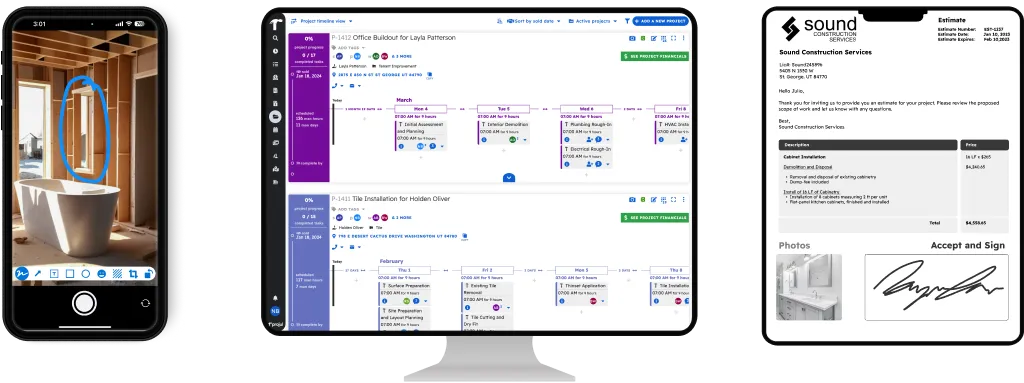
Estimates, schedules, job costing, invoicing, and crew management in one platform built by a contractor. Stop juggling spreadsheets and text threads. Projul gives your entire drywall company full access for a flat $4,788/year with zero per-user fees.
- Provide accurate estimates with our assemblies calculator
- Deliver on time with clear scheduling and crew communication
- Keep the client up to date with our customer portal
What Is Drywall Contractor Software?
Drywall contractor software is a business management platform built for companies that hang, tape, finish, and texture drywall. It connects estimating, scheduling, job costing, crew management, and invoicing in one system so nothing gets lost between the office and the job site.
Projul’s drywall contractor software helps drywall companies manage crew scheduling, accurate sheet counts in estimates, and fast invoicing from one platform built by a real contractor. Projul offers flat-rate pricing with no per-user fees for construction companies of all sizes. If you run a drywall company, you know the work itself is only half the battle. The other half is making sure your bids are accurate, your crews show up at the right job on the right day, your materials arrive on time, and you actually collect payment before the builder moves on to the next trade. Drywall software handles the business side so you can focus on clean walls and tight deadlines.
Why Drywall Companies Need Dedicated Software
Drywall work sits in one of the most time-sensitive slots on any construction project. You come in after framing and rough-in trades finish. Every trade behind you, from painters to trim carpenters, is waiting on your work. A one-day delay on your end creates a ripple that pushes back the entire project timeline.
That pressure makes organization critical. You cannot afford to show up at a job site only to find that the electrician still has open boxes in the walls. You cannot afford to under-count sheets on a bid and eat the difference. And you cannot afford to let invoices sit for weeks because your office is buried in paperwork.
Drywall contractor software like Projul gives you the tools to manage all of this from one platform. Over 5,000 contractors use Projul to stay organized and profitable, and drywall companies using the platform consistently report saving 2+ hours daily on admin work.
Most drywall business software on the market was designed for general contractors and then loosely adapted for specialty trades. You end up paying for features you never use while missing the ones you actually need, like separate scheduling for hanging and finishing crews or assembly-based estimating for board counts. Projul works for drywall companies because it was built by a contractor who understood how specialty trades actually operate.
Board Takeoffs and Material Estimating
Getting your material counts right is the foundation of every profitable drywall job. Undercount the sheets on a 4,000-square-foot house and you eat the cost of extra deliveries. Overcount on a commercial project and you’re paying to haul unused material back to the shop.
Projul’s estimating tools let you build assembly templates that calculate sheets per room based on square footage, ceiling height, and wall layout. Add line items for joint compound, paper tape, mesh tape, corner bead, and screws. Save templates for your most common project types so a standard residential bid takes minutes instead of an hour.
For commercial drywall projects, you can build separate templates that account for fire-rated assemblies, sound-rated wall systems, and multi-layer board applications. When a spec calls for double-layer 5/8-inch Type X on a two-hour fire wall, your template handles the math so you bid it right the first time.
Drywall software that handles material estimating at this level keeps your bids tight and your margins healthy. No more eyeballing board counts on the back of a napkin and hoping the number is close enough.
Mud, Tape, and Corner Bead Estimating
Consumables add up faster than most drywall contractors realize. A box of mud here, a roll of tape there, and suddenly your material costs are 15% over what you estimated. Projul lets you build consumable quantities into your assembly templates so every estimate includes the full material picture.
Track corner bead by the linear foot. Estimate joint compound by the bucket based on your typical coverage rates. Include specialty items like bullnose bead, J-trim, and L-bead for specific applications. When your estimate covers every item that goes on the truck, your job costing stays accurate from day one.
Scheduling Hanging Crews and Finishing Crews Separately
Here is something that general-purpose construction software gets wrong about drywall: hanging and finishing are two completely different operations with different crews, different timelines, and different skill sets. Your hangers move fast and need sheets, screws, and a lift on site. Your finishers need compound, tape, and time for coats to dry between passes.
Projul’s scheduling tools let you assign hanging and finishing as separate phases on the same project. Schedule your hanging crew for Monday and Tuesday, then your finishing crew starts Wednesday. If you run texture on top of that, add a third phase with the right crew assigned.
This separation matters because it prevents the scheduling conflicts that cost drywall companies money every week. Your hanging crew doesn’t show up to find the finishers still working. Your finishers don’t arrive before the board is up. Each crew sees their specific assignments on the mobile app and knows exactly where to be and when.
Coordinating With Other Trades Before Close-Up
Drywall is the last chance to catch problems before walls close up. Once your board is hung, nobody is getting back behind those walls without cutting. That makes coordination with electricians, plumbers, HVAC techs, and low-voltage installers absolutely critical.
Projul’s interactive timeline shows you where other trades stand on the project timeline. You can see when the rough-in inspection is scheduled and plan your hanging crew accordingly. When a plumber calls and says they need one more day, you drag your start date forward and your crew gets the update on their phone instantly.
Built-in project messaging keeps these conversations tied to the job record. Six months later, when someone asks why you started a day late, the communication trail is right there in the project file. No more digging through text threads trying to find who said what.
Texture Matching and Specialty Finishes
Residential remodel and repair work often requires matching existing wall textures. Whether it is orange peel, knockdown, skip trowel, or popcorn, your finishing crew needs to know the target texture before they show up.
Use Projul’s project notes and photo attachments to document existing textures during the estimate visit. Snap a photo of the current wall finish, attach it to the project, and your finishing crew sees it on their phone before they mix a single batch of mud. This eliminates the callback where a homeowner says “that doesn’t match” after your crew has already packed up and left.
For commercial projects with specific finish levels (Level 3, Level 4, Level 5), you can note the required finish level in the project details and build your estimate template accordingly. A Level 5 finish takes significantly more labor than a Level 3, and your pricing should reflect that from the start.
Managing Multi-Story and Commercial Drywall Projects
Commercial drywall work brings a different set of challenges than residential. You are dealing with larger volumes of material, tighter schedules driven by general contractor timelines, and specifications that include fire-rated and sound-rated assemblies.
Projul’s job costing tools track estimated versus actual costs on commercial projects in real time. When you are hanging 500 sheets in a three-story office building, you need to know by the end of week one whether your labor pace is on track. If your crew is running 20% slower than estimated, you catch it early and adjust before the overrun eats your profit.
For multi-story work, your material logistics get more complex. Sheets need to get to the right floor. Lifts need to be scheduled and shared with other trades. Projul’s task management lets you break a commercial project into floor-by-floor phases so your crew knows exactly what is happening on each level.
Fire-Rated Assemblies and Sound-Rated Walls
Spec work on fire-rated and sound-rated walls requires specific materials and installation methods. Type X gypsum board, resilient channel, acoustic sealant, and double-layer applications all need to be in your estimate and on your material order.
Build dedicated templates in Projul for common rated assemblies. A one-hour fire wall gets one template. A two-hour fire wall with double-layer Type X gets another. An STC-rated party wall between hotel rooms gets its own template with resilient channel and acoustic caulk included. This approach means you never miss a line item on a spec-driven bid.
Crew Productivity and Labor Tracking
Labor is the single biggest cost in drywall work. Your margins live and die on how productive your crews are and whether your bids accurately reflect the hours needed.
Projul’s time tracking includes GPS verification so you know your crew is on the right job site. They clock in from the mobile app, the system confirms their location, and the hours feed directly into your job cost report. No more paper timesheets filled out from memory on Friday afternoon.
Track hanging productivity in sheets per day and finishing productivity in square footage per day. Over time, you build a data set that makes your future estimates more accurate. If you know your hanging crew averages 60 sheets per day on residential work, you can bid labor hours with confidence instead of guessing.
Managing Seasonal Swings in Drywall Work
Drywall work follows construction seasonality. Spring and summer bring a rush of new construction starts. Winter slows down in cold climates when builders pause framing. If you do repair and remodel work, you might see a bump in fall when homeowners want projects finished before the holidays.
Projul’s lead pipeline helps you manage these swings by capturing every inquiry and tracking it through your sales process. During slow months, you follow up on older leads that went cold. During busy months, you prioritize jobs by margin and timeline so your crews work on the most profitable projects first.
Drywall business software that tracks your lead-to-close ratio across seasons also helps you plan hiring. If you know March through September requires three hanging crews but winter only needs one, you staff accordingly instead of carrying overhead through the slow months.
Dust Control and Job Site Requirements
Dust is the unavoidable byproduct of drywall work, and it causes friction with other trades, homeowners, and general contractors. Sanding generates fine gypsum dust that settles on everything, triggers complaints from HVAC crews who just installed ductwork, and creates cleanup costs that eat into your profit if you did not account for them.
Use Projul’s estimating templates to build dust control costs into every bid. Plastic sheeting, zip walls, air scrubbers, and final cleanup labor should all have line items in your template. When these costs are baked into the estimate from the start, you are not eating them at the end of the job.
Document your dust control setup with photos in Projul’s project record. If a GC or homeowner claims you damaged something with dust, you have timestamped photos showing your containment measures were in place. That kind of documentation protects you from disputes that would otherwise come out of your pocket.
Estimating That Wins More Drywall Work
Your estimate is the first impression a builder or homeowner gets of your drywall company. A clean, itemized estimate that breaks out board, finishing, and texture as separate line items tells the client you know what you are doing. A vague lump-sum number on a text message tells them you are guessing.
Projul’s drywall software lets you send professional estimates with your company branding, detailed line items, and clear pricing. Clients can approve estimates digitally with an e-signature. When they say yes, the estimate converts directly into a scheduled project. The line items become your job cost budget. No re-entering data and no copy-paste errors.
Contractors using Projul report cutting their estimating time in half with saved templates. That means more bids going out the door, which means more work coming in. When you can turn around a detailed drywall estimate in 15 minutes instead of 45, you respond to builder requests faster than your competitors.
Job Costing That Protects Drywall Margins
Drywall margins are thin. A typical hang-and-finish job might target 25% to 35% gross margin, and it does not take much to wipe that out. One extra day of labor, a material reorder, or a texture callback can turn a profitable job into a break-even job.
Projul tracks estimated versus actual costs on every project in real time. You see labor hours accumulating against your estimate. You see material costs posting against your budget. By the middle of the job, you know whether you are on track or heading for a loss.
This visibility is what separates profitable drywall companies from ones that are busy but broke. Catching a labor overrun at day three gives you time to adjust. Discovering it after the job is done just teaches you an expensive lesson.
Invoicing and Getting Paid on Time
Cash flow problems kill drywall businesses. You buy materials upfront, pay your crews weekly, and then wait 30 to 60 days for the builder to pay your invoice. That gap is where companies go under.
Projul’s invoicing tools let you invoice throughout the project. Send a deposit invoice before materials ship. Bill for the hanging phase when board is up. Bill for finishing when the last coat is sanded. Your clients can pay online directly from the invoice by card or ACH, which means faster payments with less chasing.
Change orders are tracked inside the project record. When a builder adds a room or upgrades to a Level 5 finish mid-project, you document the change, get approval, and the cost automatically updates your budget and your next invoice. No more lost revenue from verbal agreements that never got written down.
Mobile App Your Drywall Crews Will Actually Use
Your hanging and finishing crews are covered in dust and joint compound all day. They are not going to sit down at a computer to update project status. They need a mobile app that works with one hand and loads fast on a job site with spotty cell signal.
Projul’s native iOS and Android app was designed for field crews. Big buttons, simple navigation, and it works on a dusty phone with one bar of signal. Your crews can clock in with GPS, view their schedule, update task progress, snap photos, and send messages. Everything syncs to the office in real time.
Rated 4.9/5 on G2 for ease of use, Projul’s mobile app is something your crew will actually open. That matters because the best drywall contractor software in the world is useless if your field team ignores it.
QuickBooks Integration for Drywall Companies
Double-entering invoices and payments into your accounting software wastes time and creates errors. Projul integrates with QuickBooks Online and QuickBooks Desktop so your financial data syncs automatically.
When you send an invoice in Projul, it appears in QuickBooks. When the client pays, both systems update. Your bookkeeper stays happy, your numbers stay accurate, and nobody is spending Friday afternoon reconciling two different systems.
Honest Pricing for Drywall Contractors
Most drywall software charges per user. That pricing model punishes you for growing. Hire a new estimator? More money. Bring on a second finishing crew and give the lead access? More money. Give your office manager a login? Even more money.
Projul starts at $4,788 per year for your entire drywall company. No per-user fees. Your estimators, crew leads, project managers, and office staff all get full access without inflating the bill. Over 5,000 contractors use Projul to manage their operations, and drywall contractors consistently report saving 2+ hours daily on admin work. G2 users rate Projul 4.9/5 for ease of use and 4.9/5 for quality of support.
Texture Matching and Finish Level Documentation
Texture work is where drywall contractors either build trust or destroy it. A homeowner who pays for a patch repair expects the new section to disappear into the existing wall. When your finishing crew shows up without knowing whether the existing texture is orange peel, knockdown, skip trowel, or hand-applied swirl, you are gambling with your reputation on every repair job.
Document the existing texture during every estimate visit. Projul’s photo and document management lets you snap close-up photos of the current wall finish and attach them directly to the project record. Take photos from multiple angles and distances. A texture that looks like knockdown from three feet away might actually be a hand-troweled finish that requires a completely different application technique. Your finishing crew sees these photos on their phone before they mix a single batch of mud, which means they show up with the right tools and the right approach.
For new construction and commercial work, finish levels matter even more. The Gypsum Association defines five levels of drywall finish, and each one carries different labor requirements and material costs. A Level 3 finish (tape embedded in compound with one additional coat) is standard behind tile and in garage spaces. Level 4 (tape plus two additional coats) is the minimum for flat paint in residential. Level 5 (skim coat over the entire surface) is required for high-gloss paint, critical lighting conditions, or any surface where imperfections would show.
Build separate estimate templates in Projul for each finish level you commonly bid. A Level 5 finish takes roughly 50% more labor than Level 4 on the same square footage. If you are bidding Level 5 work with Level 4 pricing, you are losing money on every square foot. Your templates should reflect the actual labor difference so your margin stays consistent regardless of finish specification.
Track which finish level was specified, which was delivered, and any callbacks related to finish quality. Over time, this data shows you which crews handle Level 5 work well and which ones need additional training. It also gives you documentation if a general contractor disputes the finish quality after the fact. When you have photos of the completed surface alongside the spec sheet in the project record, the conversation stays professional instead of turning into a finger-pointing match. Refer to our drywall guide for more detail on finish standards and best practices your crew can reference in the field.
Multi-Room Phasing for Occupied Buildings
Remodel and tenant improvement work in occupied buildings adds a layer of complexity that new construction does not have. People are living or working on the other side of the wall while your crew is hanging board, taping joints, and sanding compound. Dust migrates. Noise disrupts. And the building owner wants the project done in phases so only part of the space is affected at any given time.
Projul’s scheduling tools let you break a project into room-by-room or floor-by-floor phases with separate crew assignments and timelines for each phase. If you are drywalling a 10-unit apartment renovation where tenants remain in occupied units, you schedule units in groups of two or three. Your hanging crew finishes units 1 through 3, your finishing crew moves in behind them, and units 4 through 6 start the next week. The tenants in units 7 through 10 are not affected until their phase arrives.
This phasing approach requires tight coordination between your crews and the general contractor or property manager. Use Projul’s built-in messaging to keep everyone aligned on which rooms are active, which are complete, and which are coming up next. When a property manager asks “when will unit 7 be affected?” you pull up the project timeline and give them an exact date instead of a vague “a few weeks.”
Dust containment planning also changes with occupied building work. You cannot just sand and let the dust settle when there are people breathing on the other side of a zip wall. Build dust control costs into each phase of your estimate: plastic sheeting, zip walls, air scrubbers, and HEPA vacuums for final cleanup. These are not optional line items on occupied building work. They are requirements, and your estimate should reflect them.
Material staging in occupied buildings is another challenge. You cannot stack 200 sheets of drywall in the lobby of a working office building. Plan your deliveries to match your phasing schedule so materials arrive just before each phase starts. Projul’s task management lets you set material delivery dates for each phase so your supplier knows when and where to drop each load. No more storing a full project’s worth of material in a space that still has people using it. Our project phasing guide covers the planning details that keep multi-phase work on track.
Material Waste Tracking Per Room
Drywall material waste is one of those costs that hides in plain sight. You order 60 sheets for a house, your crew uses 55, and the other 5 end up as cut-offs in the dumpster. Multiply that by 20 jobs a month and you are throwing away 100 sheets of drywall every month. At $15 per sheet, that is $1,500 in waste that never shows up on a line item but absolutely shows up in your profit margin.
Projul’s job costing tools let you track material usage at the project level so you can compare estimated sheets against actual sheets used. Log your sheet count when material arrives on-site and again when the job is complete. The difference is your waste. Track this number across every job for a few months and you will start seeing patterns.
Some waste is unavoidable. Cuts around windows, doors, and electrical boxes generate off-cuts that are too small to use. But other waste comes from poor planning: ordering full sheets when half-sheets would work, cutting from the wrong direction and creating unusable scraps, or damaging sheets during transport because they were not properly secured on the truck.
Break your material tracking down by room when possible. If your template estimates 12 sheets for the master bedroom and your crew used 14, that is a 17% overage you need to understand. Was the room measurement off? Did the crew damage sheets during hanging? Was there an issue with the framing that required extra cuts? Answering these questions job after job is how you tighten your estimating accuracy and reduce waste over time.
Material waste tracking also helps you bid more competitively without sacrificing margin. If you know from your data that your crews average 8% waste on residential work and 12% on commercial, you build those percentages into your templates instead of guessing at a flat 15% waste factor on everything. Tighter waste estimates mean lower bid prices with the same margin, which means you win more work. Check our material waste reduction guide for specific techniques that drywall crews can use to cut waste on every job.
Track your dumpster costs alongside your material waste. If you are paying $400 to $600 per dumpster pull and filling half of it with drywall scraps, reducing your waste directly reduces your disposal costs. Some markets also have gypsum recycling facilities that accept clean drywall scrap at lower rates than landfill disposal. Knowing your waste volume helps you evaluate whether recycling makes financial sense for your operation.
Fire-Rated Assembly Compliance
Fire-rated drywall work is not optional and it is not forgiving. When a spec calls for a one-hour or two-hour fire-rated assembly, every component matters: the board type, the number of layers, the fastener pattern, the joint treatment, and even the sealant at penetrations. Miss one detail and the assembly does not meet code. That means a failed inspection, a teardown, and a reinstall on your dime.
Build dedicated fire-rated assembly templates in Projul for every rated wall and ceiling type you commonly install. A one-hour fire wall using single-layer 5/8-inch Type X gypsum board gets its own template with the correct board, fastener spacing (typically 7 inches on ceilings and 8 inches on walls for rated assemblies), and joint treatment specified. A two-hour fire wall with double-layer Type X gets a separate template that includes the additional board, staggered joints between layers, and the extra fasteners required.
Document the UL assembly number or GA file number in your Projul project record for every fire-rated job. When the inspector arrives, your crew can pull up the project on the mobile app and show exactly which assembly they built to. This eliminates the “what assembly is this?” conversation that slows down inspections and creates uncertainty.
Penetration firestopping is the detail that catches the most contractors. Every electrical box, pipe penetration, HVAC duct, and cable tray that passes through a fire-rated wall needs proper firestopping. Use your Projul estimate template to include firestop materials as a line item: intumescent caulk, firestop putty pads for electrical boxes, and rated dampers for duct penetrations. When firestopping is in your estimate, it goes on your material order and your crew installs it during the job instead of getting a callback from the inspector.
Track fire-rated work as a separate project category in your Projul reports. Fire-rated assemblies carry higher material costs (Type X board costs more than standard lightweight), longer labor hours (double-layer applications take significantly more time), and stricter quality requirements. If you are lumping fire-rated work into the same reporting category as standard drywall, you cannot see whether your pricing on rated assemblies is actually profitable. Separate the data and you might discover that your fire-rated pricing needs adjustment.
Keep your crew’s certifications and training records current for fire-rated work. Some jurisdictions require specific installer certifications for rated assemblies. Even where certification is not legally required, having documented training protects you in a liability situation. If a fire-rated wall fails during an actual fire and your installation is questioned, documented training and detailed project records in Projul show that your company followed proper procedures and installed to the specified assembly. That documentation is not just good practice. It is your legal protection.
Inspectors also look at draft stopping and fire blocking in concealed spaces. When your drywall crew is closing up soffits, chases, or dropped ceilings, make sure the framing contractor completed the required fire blocking before your board goes up. Note the fire blocking status in your Projul project record during the pre-hang walkthrough. If blocking is missing, document it with photos and notify the GC before you cover it. Finding missing fire blocking after drywall is hung means cutting open finished walls, and nobody wants to pay for that. Review our construction safety management guide for broader safety documentation practices that apply to fire-rated and general drywall work.
Stop Running Your Drywall Business From a Spreadsheet
If you are still managing your drywall company with spreadsheets, text messages, and paper timesheets, you already know it is not working. You are losing time on admin, losing money on inaccurate bids, and losing track of details that cost you callbacks and reputation hits.
Drywall contractor software like Projul is not about adding technology for the sake of it. It is about running a tighter operation so you can bid more work, protect your margins, and get home before dark. Over 5,000 contractors have already made the switch. Your competition is probably one of them.