Fencing software. Break down barriers between you and your clients, with Projul. Built by construction pros with honest pricing.
Estimate by the linear foot, schedule install crews, track permits, and invoice clients from one platform. Projul saves fencing contractors 2+ hours daily on admin so you can focus on selling and installing. Flat-rate pricing means your whole team gets access without per-user fees.
- Easily schedule your work and team
- Get paid quickly with professional invoices
- See all your leads in one place
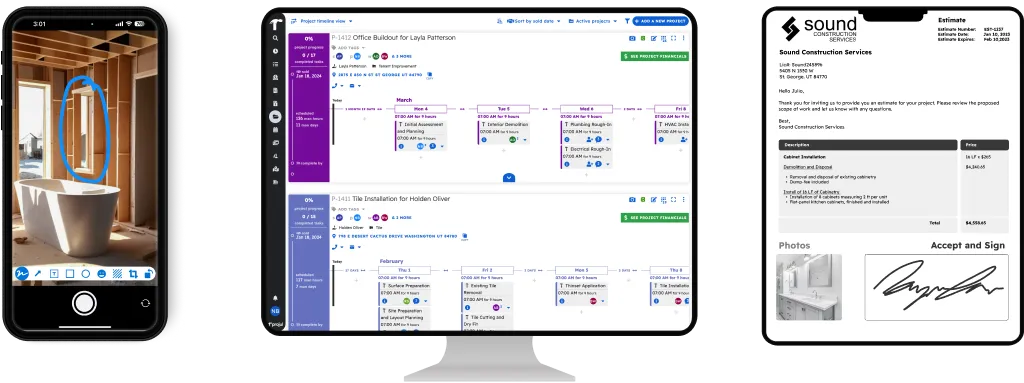
What Is Fence Contractor Software?
Fence contractor software is a business management platform that helps fencing companies estimate jobs by the linear foot, schedule install crews, track materials, and invoice clients from one connected system. It replaces the spreadsheets, paper estimates, and phone calls that slow down fencing operations.
Projul’s fence contractor software helps fencing companies estimate jobs by the linear foot, schedule install crews, and track permits from one platform built by a real contractor. Projul offers flat-rate pricing with no per-user fees for construction companies of all sizes. If you run a fencing company, you already know the work is more than digging holes and setting posts. Property line coordination, utility locates, HOA approvals, permit applications, and material ordering all happen before a single post goes in the ground. Fencing software handles the business side so your crews can focus on straight lines and solid installs.
Why Fencing Companies Need Dedicated Software
Fencing work moves fast once it starts. A typical residential install takes one to three days. Commercial perimeter jobs might run a few weeks. Either way, the window between signing the contract and setting the first post is packed with logistics that can go wrong.
You need to confirm property lines before you dig. You need utility locates completed and marked. You need materials ordered, delivered, and staged. You need permits pulled in jurisdictions that require them. And you need your crew scheduled so they show up on install day with the right materials on the right truck.
When any of those steps gets missed, you burn a day. Your crew sits idle, your schedule backs up, and your next customer starts calling to ask why their fence is not started yet.
Fence contractor software like Projul organizes all of these moving parts in one platform. Over 5,000 contractors use Projul to run their operations, and fencing contractors report saving 2+ hours daily on admin work. That is real time you get back for selling, installing, or actually going home at a reasonable hour.
Linear Footage Estimating by Material Type
Every fencing estimate starts with linear footage, but the material type changes everything about the price. A 200-foot run of 6-foot cedar privacy fence costs significantly more than 200 feet of 4-foot chain link. Your estimating tools need to handle both with equal accuracy.
Projul’s fencing software lets you build estimate templates for each material type you install. Create one template for wood privacy fencing with line items for posts, rails, pickets, concrete, and hardware. Create another for vinyl with different post spacing and panel sizes. Build a chain link template that accounts for terminal posts, line posts, top rail, tension wire, and fabric by the roll.
Save these templates and reuse them on every job. A residential wood fence estimate that used to take 45 minutes in a spreadsheet takes 15 minutes in Projul. Adjust the footage, update quantities, and send a professional estimate the client can approve with an e-signature. Need a starting point? Download our free fencing estimate templates to see how professional fence bids are structured.
When the client says yes, that estimate converts directly into a scheduled project. Line items become your job cost budget. No re-entering data, no copy-paste errors, no lost details between the sales call and the install.
Post Spacing and Gate Calculations
Post spacing varies by material and fence height. Wood fences typically use 8-foot spacing. Chain link runs 10 feet between line posts. Vinyl panels come in fixed widths that dictate post placement. Getting post counts right on the estimate prevents material shortages on install day.
Build post spacing logic into your Projul templates. A 200-foot wood fence at 8-foot spacing needs 26 posts. Add terminal posts for corners and ends. Add gate posts with heavier gauge or larger diameter for each gate opening. Include gate hardware, hinges, latches, and drop rods for double gates.
Projul calculates totals automatically as you enter footage and gate counts. Your estimate reflects the actual materials going on the truck, not a rough guess that leaves your crew short three posts and a bag of concrete on install day.
Material Price Swings and Protecting Your Margins
Fencing materials, especially wood and metal, are subject to significant price swings. Lumber prices can shift 20% or more in a single quarter. Steel and aluminum follow commodity markets that move weekly. A bid you sent last month at one price might cost you more to install this month.
Use Projul’s estimating tools to keep your material pricing current. Update your template unit costs when supplier prices change. For jobs with longer lead times between estimate and install, build a price escalation note into your terms. Projul’s job costing then tracks your actual material spend against the estimate so you see exactly how price changes affect each project.
Fencing software that connects your estimates to real-time job costing is the difference between knowing you lost money on lumber and catching the cost increase before it turns your profit into a loss.
Scheduling Installs and Managing Crews
Fencing installs are weather-dependent and sequence-dependent. You cannot set posts in frozen ground. You cannot pour concrete in heavy rain. And you cannot install fence until the posts have cured. That means your schedule needs flexibility built in.
Projul’s drag-and-drop scheduler lets you move installs when weather kills a day, reassign crews to different jobs, and keep your production calendar full. Your crew sees their assignments on the mobile app with addresses, gate codes, and project notes. No morning check-in calls. No confusion about which job comes first.
For larger fencing companies running multiple crews, Projul shows all crew assignments across every active project on one board. Assign your wood fence crew to a backyard install on Monday while your chain link crew handles a commercial job across town. See the gaps in your schedule and fill them with smaller jobs that keep trucks moving.
Weather Delays and Post Setting
Post setting is the most weather-sensitive phase of any fence install. Wet ground shifts posts before concrete sets. Frozen ground breaks auger bits and adds hours to the dig. Standing water in post holes weakens the concrete cure.
Build weather buffer days into your Projul schedule. When you know rain is coming Thursday, move the post-setting phase to Friday or the following Monday with a few taps. Your crew gets the update instantly, and you do not waste a day sending a team to a muddy job site.
Track weather delays in your project record so you have documentation if a customer complains about timeline. A simple note in Projul showing “post setting delayed two days due to rain” keeps everyone on the same page and protects you from disputes about late completion.
Property Line Coordination and Survey Management
Nothing creates bigger problems on a fencing job than setting posts on the wrong side of a property line. A fence installed six inches over the line can mean tearing it out and starting over at your cost. Property line disputes between neighbors can stall your project or turn into legal issues.
Fencing software helps you manage this risk. Attach survey documents and plat maps to the project record in Projul. Note pin locations in your project details. Take photos of survey markers before you dig and attach them to the project file.
When a neighbor disputes the line mid-install, your documentation is right there on your phone. You can show the survey, show the pin locations, and keep the project moving instead of shutting down while everyone argues about where the line actually falls.
Utility Locate Requirements
Every fencing company has a “we hit a line” story, and it is never a good one. Striking a gas line, water main, fiber optic cable, or electrical conduit means project delays, repair costs, potential fines, and serious safety risks.
Use Projul’s task management to build utility locate requests into your standard workflow. Create a task template that triggers a locate request as soon as a fencing job is confirmed. Set a reminder for the response deadline. Attach the locate ticket and marking photos to the project record.
When your crew arrives on install day, they can pull up the locate information on the mobile app and see exactly where the marked lines run. This protects your company, your crew, and your timeline from an underground surprise that can cost thousands.
HOA Compliance and Permit Management
In residential neighborhoods with homeowner associations, fence style, height, material, and color often require HOA approval before you can install. Missing this step means tearing out a fence after install or dealing with an angry homeowner who gets fined by their association.
Track HOA requirements in your Projul project record. Note the specific HOA rules for each neighborhood you work in frequently. Attach approval letters to the project file. Set task reminders for HOA submission deadlines so approvals do not become the bottleneck that delays your install.
For jurisdictions that require fence permits, build permit fees into your estimate template and track permit status as a project task. When the permit is approved, mark the task complete and your crew knows the job is cleared to start. No more showing up to install and discovering nobody pulled the permit.
HOA Approval Delays
HOA boards often meet monthly, which means a fence approval can add 30 or more days to your project timeline. If you do not account for this in your scheduling, you end up with a signed contract and a frustrated customer waiting weeks for an install date.
Projul’s lead pipeline helps you manage this gap. Tag projects that need HOA approval and track them separately from jobs that are ready to schedule. When the approval comes through, move the project into your install queue and slot it into the next available crew opening. Your customer gets a professional update instead of radio silence while they wait.
Commercial Security Fencing
Commercial fencing projects bring different requirements than residential work. Security perimeters often involve chain link with barbed wire or razor wire, anti-climb panels, crash-rated bollards, or ornamental iron with specific picket spacing to meet security standards.
Projul handles commercial fencing projects with the same tools that run your residential work, just scaled up. Job costing tracks estimated versus actual costs on a 2,000-foot commercial perimeter just as easily as a 150-foot backyard. Scheduling handles multi-phase installs. Invoicing supports progress billing so you collect on completed phases instead of financing the entire project until the end.
For commercial clients who require documentation, Projul’s project records hold everything from material certifications to inspection reports. When the property manager needs proof that your chain link meets ASTM F668 standards, the documentation is attached to the project and accessible from your phone.
Lead Tracking So No Fencing Job Slips Away
Fencing is a competitive business. When a homeowner calls three fencing companies for quotes, the one that responds fastest and most professionally usually wins the job. If your leads are living in a voicemail box or a stack of sticky notes, you are losing work to the contractor who followed up first.
Projul’s CRM and lead pipeline captures every inquiry from first contact through signed contract. See which estimates are pending, which need follow-up, and which are about to close. Set automatic reminders so no lead sits untouched for a week while you are busy installing.
Fence contractor software that manages your sales pipeline is not a luxury. It is the difference between growing your business and wondering where all those leads went.
Invoicing and Cash Flow for Fencing Companies
Fencing materials are expensive upfront. A residential wood fence might need $2,000 to $5,000 in lumber and hardware before you set the first post. Commercial jobs can require $20,000 or more in materials. If you are not collecting deposits and billing for completed phases, you are financing your customers’ projects with your own cash.
Projul’s invoicing tools let you send deposit invoices before materials ship. Bill for post setting when the concrete is poured. Bill for the balance when panels and gates are installed. Clients pay online by card or ACH directly from the invoice, which means faster payments and less time chasing checks.
Change orders are tracked inside the project record. When a homeowner adds a gate or upgrades from dog-ear to flat-top pickets mid-project, you document the change, get digital approval, and the cost updates your budget and invoice automatically.
Mobile App for Fence Install Crews
Your install crews are in the field all day. They are not going to sit at a computer to check schedules or update project status. They need an app that works in the sun, loads fast on rural cell service, and does not require a training course.
Projul’s native iOS and Android app was built for field crews. Your installers check their next job, view the estimate and material list, clock in with GPS verification, take photos of the completed install, and send messages to the office. Everything syncs in real time.
Rated 4.9/5 on G2 for ease of use, Projul’s mobile app is the kind of tool your crew will actually open. And when they use it, your office gets real-time updates on crew locations, job progress, and time logged. Fencing software only works if the people doing the work actually use it.
QuickBooks Integration for Fencing Companies
Entering invoices into QuickBooks by hand wastes time and introduces errors. Projul integrates with QuickBooks Online and QuickBooks Desktop so your invoices, payments, and customer records sync automatically.
Send an invoice in Projul and it shows up in QuickBooks. Client pays and both systems update. Your bookkeeper stays happy, your financial records stay clean, and nobody spends Friday afternoon reconciling mismatched numbers.
Honest Pricing for Fencing Contractors
Most fencing software charges per user. That pricing model punishes growth. Add a new crew lead? More money. Give your estimator access? More money. Let your office manager log in? Even more money.
Projul starts at $4,788 per year for your entire fencing company. No per-user fees. Your estimators, crew leads, office staff, and installers all get full access without inflating the bill. Over 5,000 contractors use Projul to manage their operations, and fencing contractors consistently report saving 2+ hours daily on admin work. G2 users rate Projul 4.9/5 for ease of use and 4.9/5 for quality of support.
Fencing Guides for Your Team
Whether you are training new installers or tightening up your process, our fencing construction guide covers post spacing, material selection, and installation techniques across wood, vinyl, chain link, and ornamental iron.
For contractors working on job sites, events, or municipal projects that require perimeter control, our temporary fencing and barriers guide walks through setup methods, anchoring options, and compliance requirements.
Seasonal Demand Planning for Fencing Companies
Fencing is one of the most seasonal trades in construction. Spring and summer bring a flood of residential calls as homeowners finish landscaping projects, replace storm-damaged fencing, and prep yards for outdoor living. Fall tapers off, and winter in cold climates can slow installations to a crawl depending on frost depth and ground conditions.
The problem most fencing contractors face is not the busy season itself. It is the whiplash between months where you cannot keep up and months where your crews sit idle. If you hire to meet June demand, you are carrying payroll in January with nothing to bill. If you stay lean year-round, you turn away summer work and watch it go to a competitor who staffed up.
Projul’s lead management and CRM tools give you the data to plan ahead instead of reacting. Track your lead volume by month and year over year. See which months generate the most estimates and which ones convert at the highest rate. When you know that March leads close at 45% but July leads close at 30% because homeowners are shopping three contractors by midsummer, you adjust your sales approach accordingly.
Use Projul’s scheduling board to plan crew capacity months in advance. If you know April through September is your window, start pre-selling January and February installs at a winter discount to keep crews working during the slow months. Commercial and HOA projects often have flexible timelines, making them good candidates for off-season scheduling.
Material pre-ordering is another seasonal advantage. Lumber and vinyl prices tend to climb as demand increases in spring. If you have contracts signed in February for April installs, you can lock in material pricing early and protect your margins. Track your material costs in Projul’s job costing to compare seasonal pricing trends and spot the best windows for bulk purchasing.
Seasonal planning also affects your marketing and sales approach. During slow months, ramp up outreach to commercial clients, property managers, and HOA boards who plan fence replacements on annual budgets. These clients often prefer off-season work because it causes less disruption to residents. Projul’s CRM lets you tag commercial leads separately from residential so you can run targeted follow-up campaigns during the months when residential calls dry up.
Crew retention is another seasonal challenge. Good fence installers are hard to find, and losing them during a slow winter means scrambling to hire and train when spring demand hits. By using Projul to book off-season work and keep your schedule visible months ahead, you give your best crew members the confidence that the work will stay steady. That retention saves you thousands in recruiting and ramp-up costs every spring.
Seasonal planning also affects your marketing and sales approach. During slow months, ramp up outreach to commercial clients, property managers, and HOA boards who plan fence replacements on annual budgets. These clients often prefer off-season work because it causes less disruption to residents. Projul’s CRM lets you tag commercial leads separately from residential so you can run targeted follow-up campaigns during the months when residential calls dry up.
Crew retention is another seasonal challenge. Good fence installers are hard to find, and losing them during a slow winter means scrambling to hire and train when spring demand hits. By using Projul to book off-season work and keep your schedule visible months ahead, you give your best crew members the confidence that the work will stay steady. That retention saves you thousands in recruiting and ramp-up costs every spring.
The fencing contractors who grow past one or two crews are the ones who stop treating their schedule like a calendar and start treating it like a forecast. Projul gives you the historical data and forward visibility to staff, price, and schedule based on what is actually coming, not what you hope will happen.
Managing Gate and Access Control Projects
Gates are where fencing projects get complicated and profitable. A standard privacy fence is straightforward: set posts, hang panels, done. But the moment a project includes a driveway gate, a motorized sliding gate, or a commercial access control system, the scope changes significantly.
Gate projects involve coordination that a basic fence install does not. You need to size the opening correctly, account for slope and swing clearance, spec the right hardware, and often coordinate with an electrician for powered gates. Motorized gates require a power source, a control board, keypads or remote receivers, and sometimes integration with security cameras or intercom systems.
Most fencing contractors handle basic pedestrian gates as part of every job. But the companies that build real revenue growth take on driveway gates, cantilever sliding gates, and commercial access control installations. These projects command higher margins because they require more expertise and fewer competitors bid on them.
Projul helps you manage the added complexity of gate and access control work. Create estimate templates specifically for gate projects that include line items for the gate frame, operator, control board, safety sensors, concrete pad, and electrical rough-in. When you bid a motorized driveway gate, your estimate covers every component instead of discovering mid-install that you forgot to price the safety photo eyes or the concrete pad for the operator.
Use Projul’s task management to sequence gate installations properly. The concrete pad for a slide gate operator needs to cure before you mount the motor. The electrician needs to run conduit before you set the gate post. The gate itself hangs after the adjacent fence sections are complete so you get the alignment right.
Track subcontractor coordination in the project record. If you are bringing in an electrician or a low-voltage installer for access control wiring, their schedule needs to align with your fence crew’s timeline. Projul keeps that coordination visible so nobody shows up to a site that is not ready for them. For more on managing these relationships, our construction communications guide covers how to keep field teams and subs on the same page.
For commercial properties, access control projects often involve coordination with security integrators who handle cameras, card readers, and intercom systems. Your fence company handles the physical gate and operator while the security company handles the electronics. Projul’s project records keep both scopes visible in one place so you can verify that your gate installation timeline aligns with the security company’s wiring schedule. Delays on either side ripple through the project, and having both timelines visible prevents the finger-pointing that happens when nobody tracked the dependencies.
Pricing gate projects accurately also requires accounting for the post-installation programming and testing phase. A motorized gate that works mechanically but has not been programmed for the client’s remotes, keypads, or phone app is not a finished job. Build programming and testing time into your estimates as a separate line item so your crew allocates the time and your client understands the scope.
Gate and access control work also creates ongoing service opportunities. Motors need maintenance, keypads need reprogramming, and hinges wear out. Track these relationships in Projul’s CRM so you can follow up with gate clients for annual service contracts that generate recurring revenue between new installations.
Navigating HOA and Permitting Requirements
Every experienced fencing contractor has a story about a job that got delayed, fined, or torn out because of a missed HOA rule or a permit that nobody pulled. These are not edge cases. In many residential markets, HOA-governed neighborhoods represent 40% or more of your potential work. And most municipalities require a permit for any fence over a certain height.
The challenge is that every HOA has different rules and every jurisdiction has different permit requirements. One neighborhood allows 6-foot wood privacy fences but bans chain link. The HOA two miles away requires all fences to be wrought iron with a specific picket spacing. The city requires a survey and a setback certification. The county next door only needs a simple application and a fee.
Keeping all of this straight across dozens of active jobs is where fencing contractors get burned. Your estimator quotes a 6-foot cedar fence in a neighborhood that caps height at 4 feet. Your crew installs fence posts 2 inches past the setback line because nobody checked the survey. The homeowner gets a violation letter and calls you to fix it at your expense.
Projul lets you build institutional knowledge into your workflow instead of relying on memory. Create notes in your CRM for every HOA you work with frequently, documenting their specific fence rules, approval processes, and typical turnaround times. When a lead comes in from that neighborhood, your estimator sees the requirements before they ever drive to the property.
For permits, build the application into your project workflow as a standard task. Projul’s task templates let you create a permit checklist that fires automatically when a new fencing project starts. Include steps for checking local requirements, submitting the application, paying the fee, and tracking approval status. Attach the approved permit to the project record so your crew can show it to an inspector on site.
Our construction permit guide breaks down the permit process across different jurisdictions and gives you a framework for building permit tracking into your standard operations. And if you want to compare permit tracking tools across the market, our best construction permit tracking software roundup covers the options.
For multi-lot developments where the same HOA rules apply to every property, Projul saves you from re-researching the same requirements on every job. Your first project in a neighborhood builds the template. Every project after that follows the same checklist with the rules already documented. Scale that across 10 or 15 HOA neighborhoods in your service area and you have a competitive advantage that took months to build but saves hours on every bid.
The fencing companies that handle HOA and permit requirements smoothly are the ones that win repeat business in those neighborhoods. When a homeowner tells their neighbor “our fencing company handled all the HOA paperwork for us,” that referral is worth more than any ad you could run.
Post-Installation Warranty Tracking
The job is not really done when the last panel goes up. Most fencing contractors offer some form of warranty on their labor, and manufacturers provide separate warranties on materials. Wood fence warranties might cover structural defects for a year. Vinyl and aluminum manufacturers often warranty materials for 10 years or more. Motorized gate operators come with their own warranty terms.
The problem is tracking all of it. When a homeowner calls 14 months after installation saying their gate latch failed, can you pull up the project record and check whether that component is still under warranty? Do you know which manufacturer supplied that latch and what their warranty process requires? Or do you spend 30 minutes digging through emails and truck receipts trying to piece together what happened on that job?
Projul’s warranty tracking gives you a system for managing post-installation obligations. Log warranty terms on every project with start dates, durations, and coverage details for both labor and materials. When a warranty claim comes in, pull up the project, check the terms, and respond to the homeowner with accurate information instead of guesswork.
For material warranties, attach manufacturer warranty documents to the project record in Projul’s document management. When a vinyl fence panel cracks due to a manufacturing defect three years after install, you have the original purchase documentation, the manufacturer’s warranty certificate, and the installation photos all in one place. Filing the claim takes minutes instead of hours.
Our construction warranty management guide covers best practices for structuring warranty programs, handling claims efficiently, and using warranty service as a customer retention tool. For fencing contractors specifically, a well-managed warranty process turns a one-time install client into a long-term relationship.
Warranty tracking also protects your business from claims that fall outside your coverage. When a homeowner insists that a fence post shifted because of faulty installation, your project photos showing proper post depth, concrete volume, and plumb verification tell the real story. Documentation is your best defense against warranty disputes that would otherwise cost you a free repair on work that was installed correctly.
Warranty service also creates upsell opportunities. When you visit a property to inspect a warranty claim, you see the condition of the rest of the fence. A homeowner who installed a backyard fence two years ago might now want to fence the side yard or add a gate. Your warranty visit puts you on the property with a built-in reason to be there, and Projul’s CRM tracks the follow-up so you close the additional work.
Warranty service also creates upsell opportunities. When you visit a property to inspect a warranty claim, you see the condition of the rest of the fence. A homeowner who installed a backyard fence two years ago might now want to fence the side yard or add a gate. Your warranty visit puts you on the property with a built-in reason to be there, and Projul’s CRM tracks the follow-up so you close the additional work.
The contractors who track warranties properly also discover patterns. If a specific post bracket fails repeatedly across multiple jobs, you catch it early and switch suppliers before it becomes a bigger problem. If a certain wood species warps more than others in your climate, your job records show it and you adjust your material recommendations. Projul turns your warranty data into business intelligence that improves every future install.
Stop Running Your Fencing Business From a Spreadsheet
If you are still estimating fence jobs on a legal pad, scheduling crews through group texts, and invoicing from a Word document, you already know the system is breaking. Leads slip through, crews show up without the right materials, and invoices go out late because nobody had time to sit down and type them up.
Fence contractor software like Projul replaces all of that with one platform that handles your entire operation from first lead to final payment. Over 5,000 contractors have already made the switch. They are bidding faster, scheduling tighter, and getting paid sooner. Your competition is probably one of them.