Management Software for Hardscapers. Become a rockstar in your customers' eyes by delivering flawless service! Built by construction pros with honest pricing.
Hardscaper software helps you save time and grow your business. Projul does this by providing estimates, invoicing, and other tools to manage your jobs and stay on top of everything. with no per-user fees and unlimited projects, this gives you a competitive edge and helps to stay organized and save time.
- Impress your clients with our customer portal
- Create accurate proposals using our detailed and easy-to-use assemblies calculator
- Manage everything and everyone in one place
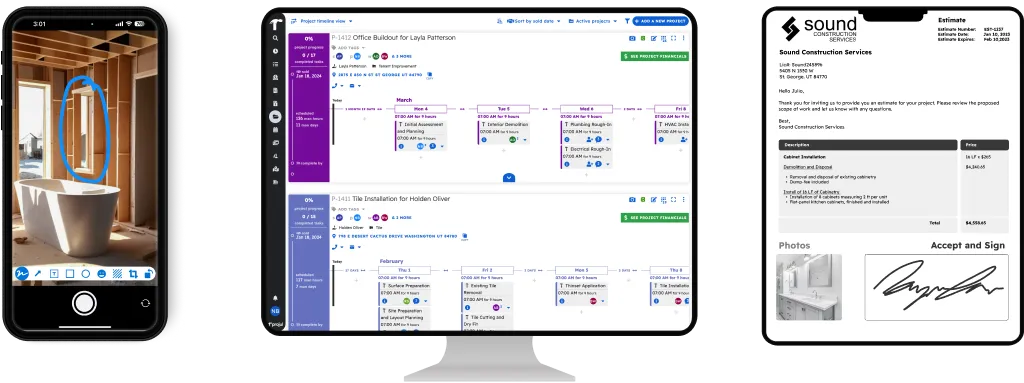
What Is Hardscaping Software?
Hardscaping software is a project management platform built for contractors who install patios, retaining walls, walkways, driveways, outdoor kitchens, and other stone or paver projects. It connects estimating, material takeoffs, scheduling, job costing, and invoicing so hardscapers can run their entire business from one tool.
Projul’s hardscaping software helps hardscape contractors manage material takeoffs, schedule crews around weather, and track job costs from one platform built by a contractor. Projul offers flat-rate pricing with no per-user fees for construction companies of all sizes. If you install pavers, stack retaining wall block, pour concrete, or build outdoor living spaces, you already know the business side is just as hard as the physical work. Calculating square footage for a patio, figuring base material depth, ordering the right number of pallets, and keeping your crew on schedule while weather keeps changing the plan. That is a lot to manage with spreadsheets and text messages.
Hardscape contractor software like Projul was built to handle exactly this. Over 5,000 contractors use Projul to manage their operations, and it started with a contractor who lived these same problems every day.
Manage Hardscape Projects From Design to Final Sweep
Hardscape projects move through distinct stages: site visit, design, estimating, material ordering, site prep, grading, base installation, paver or stone installation, edge restraints, polymeric sand, compaction, and cleanup. Miss a step or get them out of order and you end up ripping out work you already finished.
Projul helps hardscapers track every phase of every project in one platform. Your estimator prices the job. Your office orders materials. Your crew lead checks the schedule on his phone and knows exactly what is happening today. When a homeowner adds a fire pit to the patio scope mid-project, the change order updates your budget, your material list, and your invoice automatically.
Most hardscaping software on the market was designed for general contractors and then marketed to hardscapers. You can feel the difference when the tool does not understand the difference between a paver patio and a drywall job. Projul works for hardscapers because it was built by construction people who understand trade-specific workflows.
Estimate Pavers, Base Material, and Edge Restraints Without the Spreadsheet
Your estimate is where you make or lose money on a hardscape project. Get the square footage wrong and you order too many or too few pallets. Forget to account for base material depth and your margin disappears into gravel you did not budget for. Miss the edge restraint in your takeoff and you eat that cost.
Projul’s assemblies calculator lets you build detailed material takeoffs for every hardscape project. Enter the patio dimensions, select your paver pattern (running bond, herringbone, basket weave), and the system calculates:
- Pavers: Square footage plus waste factor, converted to pallets based on your supplier’s pallet coverage
- Base material: Tons of gravel based on area and compacted depth (typically 6 to 8 inches for patios)
- Bedding sand: Tons based on area and 1-inch depth
- Polymeric sand: Bags based on paver joint width and square footage
- Edge restraints: Linear feet of aluminum or plastic edging plus spikes
Save these assemblies as templates for your most common project types. A 400 square foot paver patio template. A per-linear-foot retaining wall template. A fire pit surround template. When a new lead comes in, pull the template, adjust the dimensions, and send a professional proposal in 15 minutes instead of spending an hour in a spreadsheet.
Hardscapers using Projul report a 32% average profit increase, and tighter material estimates are a big part of that number.
Retaining Wall Calculations That Account for Every Layer
Retaining walls are not just about stacking block. A proper retaining wall estimate needs to account for block quantity by course height, geogrid at specific intervals for walls over a certain height, drainage gravel behind the wall, perforated drain pipe, filter fabric, and cap stones. The material list changes significantly between a 2-foot garden wall and a 6-foot structural wall.
Projul lets you build assembly templates for different wall configurations. A 3-foot wall with no geogrid. A 5-foot wall with geogrid every other course. A 6-foot wall with engineered plans and deeper footings. Each template includes the right material ratios so your estimate is accurate from the start.
When the homeowner walks the site and asks to extend the wall another 15 feet, update the dimensions in Projul and your material quantities, labor hours, and total price adjust instantly. That change order gets documented, approved by the client through the portal, and added to your invoice. No verbal agreements that come back to bite you later.
Drainage Planning and Grading for Every Hardscape Project
Water is the enemy of every hardscape installation. A patio without proper pitch holds puddles. A retaining wall without drainage fails within a few years. An outdoor kitchen on poorly graded ground shifts and cracks.
Good hardscape contractor software helps you plan for water management on every project. Projul lets you include drainage components in your estimates and project plans: catch basins, channel drains, French drains behind retaining walls, and proper slope calculations. When you scope a patio project, your estimate should include the grading work and drainage materials alongside the pavers and base.
Track the grading and compaction phase as its own task in Projul’s scheduler. Your crew knows that base prep comes before paver installation, and the schedule reflects the right sequence. If grading takes an extra day because of unexpected soil conditions, shift the downstream tasks and your crew sees the updated timeline on their phones.
Outdoor Living Spaces: Patios, Fire Pits, and Outdoor Kitchens
The outdoor living market keeps growing, and hardscapers who can handle complex projects win the most profitable work. A backyard transformation might include a paver patio, a built-in fire pit, a retaining wall with seating, and an outdoor kitchen with a grill island and countertops.
These projects have multiple material types (pavers, natural stone, veneer, countertop material, gas lines), multiple trade sequences (grading, base work, masonry, gas plumbing, electrical for lighting), and long timelines. You need hardscaping software that can handle the complexity without making your head spin.
Projul lets you break a large outdoor living project into phases, each with its own schedule, material list, and budget. Phase one might be site prep and grading. Phase two is the patio and walkways. Phase three is the fire pit and seating wall. Phase four is the outdoor kitchen. Your crew sees what they are working on this week. Your client sees progress through the portal. Your job costing shows you whether each phase is on budget.
Over 5,000 contractors manage projects like this in Projul every day. The platform scales from a simple walkway repair to a $150,000 backyard transformation.
Material Ordering: Pallets, Tons, and Lead Times
Hardscape materials are heavy, expensive, and sometimes hard to get. A pallet of pavers weighs 2,500 pounds. A load of base gravel is measured in tons. Natural stone has lead times measured in weeks. Order too much and you are stuck storing it. Order too little and your crew sits idle while you wait for a delivery.
Projul’s material tracking ties your estimate quantities to your project timeline. You know exactly what materials you need and when you need them. Order base material for delivery during the grading phase. Schedule paver delivery for the week installation starts. Track what has been delivered, what has been used, and what is left over.
When material prices change between the estimate and the order date, update the cost in Projul and your job costing reflects the real numbers. That way you know your actual margin on the project, not just what you hoped it would be when you bid it.
Scheduling Crews Around Weather and Seasons
Hardscape work is weather dependent. Rain stops grading and compaction. Frozen ground stops everything. A week of wet weather can push your entire schedule and back up every project behind it.
Projul’s drag-and-drop scheduler lets you move tasks, reassign crews, and shift timelines when weather changes your plans. Seven schedule views give you the flexibility to see your day, your week, or your entire season at a glance. When you push a patio installation back three days because of rain, your crew sees the change on their phone immediately.
For seasonal businesses that do most of their hardscape work between April and November, Projul helps you maximize your building season. Pack your schedule tight, see gaps where you can fit smaller jobs, and make sure no crew sits idle on a buildable day.
Software for hardscapers should work the way your season works, and Projul does exactly that.
Job Costing That Shows You the Real Numbers
Knowing whether a hardscape project made money is not something you should figure out after the fact. You need to know during the project, while you can still do something about it.
Projul tracks estimated costs versus actual costs on every project in real time. Your labor hours feed in from time tracking. Your material costs come from your purchase records. Your sub costs post when you enter their invoices. At any point during the project, you can see whether you are on pace to hit your target margin or heading for a loss.
A patio project you estimated at $12,000 with a 40% margin should be at $7,200 in costs when it is done. If you are at $6,000 halfway through the project, you are on track. If you are at $8,000 halfway through, you have a problem that needs attention right now.
Hardscaping software with real-time job costing is the difference between hoping you made money and knowing you did. Contractors using Projul report a 32% average profit increase because they catch problems early.
Design-Build Workflow for Hardscape Contractors
Many hardscape companies operate as design-build firms. You meet the homeowner, help them plan the project, design the layout, estimate the materials, and then build it. That workflow requires tight coordination between your sales process, your design phase, and your production schedule.
Projul’s lead pipeline tracks prospects from first contact through signed contract. When the homeowner says yes, the estimate converts directly into a scheduled project. The line items become your job cost budget. The scope becomes your task list. No re-entering data between the design phase and the build phase.
Your client portal lets homeowners review the scope, approve changes, and track progress throughout the project. When they want to swap from a tumbled paver to a natural stone, you update the estimate, they approve the change, and the new cost flows through to your budget and invoice.
This connected workflow is what sets Projul apart from generic hardscaping software that treats estimating, scheduling, and invoicing as separate activities.
Mobile App That Works on Dusty Job Sites
Your hardscape crews do not sit at desks. They are on job sites moving pallets, running plate compactors, and cutting pavers. Any hardscape contractor software that requires them to sit down at a computer is dead on arrival.
Projul’s native iOS and Android app was designed for the field first. Big buttons. Simple navigation. It works on a cracked phone screen with one bar of signal. Your crew can:
- Clock in with GPS verification at the job site
- View today’s tasks and project details
- Update task status as work gets completed
- Take progress photos and attach them to the project
- Log materials received and used
- Send messages to the office without leaving the app
Everything syncs to the office in real time. When your crew marks the base compaction complete, your office sees it immediately. When a delivery shows up short, your crew lead logs it in the app and your PM knows before lunchtime.
Rated 9.8 on G2 for ease of use, Projul’s mobile app is built so your crew picks it up on day one without formal training.
Client Communication That Wins Referrals
Hardscape projects are visible. Your patio is the first thing the neighbors see when they come over for a barbecue. Happy clients become your best marketing. Unhappy clients become your worst.
Projul’s client portal keeps homeowners informed throughout the project. They can see the schedule, approved selections, invoices, and progress photos without calling you every other day. When the project is done, the whole experience feels professional and organized.
That level of service generates referrals. Hardscapers who use Projul consistently say their clients comment on how organized and communicative the process was. In a business built on word of mouth, that matters more than any ad you could run.
QuickBooks Integration for Clean Books
Entering invoices into your accounting software by hand is a waste of time and a source of errors. Projul integrates with QuickBooks Online so your invoices, payments, and customer records sync automatically.
Send an invoice in Projul. It shows up in QuickBooks. Client pays online through the invoice. Both systems update. Your bookkeeper does not need to re-enter anything, and your financial data stays accurate without extra effort.
Honest Pricing for Hardscaper Contractors
Most hardscaping software charges per user. That pricing model punishes you for growing. Add a second crew lead? More money. Give your office manager access? More money. Let your designer log in? Even more money.
Projul starts at $4,788 per year for your entire hardscaper company. No per-user fees. Your estimators, designers, crew leads, office staff, and subs all get full access without inflating the bill. Over 5,000 contractors use Projul to manage their operations, and hardscaper contractors consistently report saving 2+ hours daily on admin work.
G2 users rate Projul 9.8 for ease of use and 9.8 for quality of support. That is not marketing copy. That is contractors voting with their reviews.
Tracking Material Waste and Leftover Inventory
Hardscape materials come in bulk, and waste is part of every job. You order pavers by the pallet, but every cut around a curve or border produces offcuts. Base gravel comes in full truckloads even if you only need three-quarters of a load. Polymeric sand comes in bags, and you always open one more than you finish. The question is whether you track that waste or just absorb it as a cost of doing business.
On a typical paver patio, material waste runs 5% to 15% depending on the pattern and the number of cuts. A herringbone pattern with lots of border cuts generates more waste than a running bond layout. If you estimated a 10% waste factor and your crew actually wasted 18%, that difference on a $15,000 material order is $1,200 out of your pocket. Multiply that by twenty projects a season and you are looking at $24,000 in untracked waste.
Projul’s job costing tools track estimated material quantities against what your crew actually used. When a project wraps up, compare the planned waste factor to the real number. If one crew consistently runs higher waste than another, you have a training conversation to have, not a mystery expense. If a specific paver pattern always generates more waste than your 10% default, adjust your template so future estimates account for the real number.
Leftover materials are another issue. Half pallets of pavers, partial bags of sand, unused edge restraint. Some of this inventory has value if you can use it on the next job. Projul lets you track leftover materials in your project records so when a small repair or add-on job comes in, you check what you already have on hand before ordering new stock. That leftover half-pallet from the Johnson patio might be exactly what you need for the Smith walkway extension.
For contractors who want to reduce waste from the start, our material waste reduction guide covers ordering strategies, cut planning, and inventory practices that keep more money in your pocket.
Managing Multi-Phase Drainage and Grading Complexity
Simple patio jobs have simple drainage requirements: slope the surface away from the house at 1% to 2% grade. But the projects that pay the best, large outdoor living spaces, multi-level patios, retaining walls with grade changes, are also the ones where drainage gets complicated fast.
Consider a backyard project with a 200-square-foot upper patio, a 4-foot retaining wall, and a 400-square-foot lower patio with a fire pit. Water has to move off the upper patio, through or around the wall, across the lower patio, and into a drainage system that carries it away from the house. That means coordinating surface grading, a drainage aggregate layer behind the retaining wall, a perforated pipe at the wall footing, and possibly a catch basin or channel drain on the lower patio.
If any piece of that drainage plan fails, water pools somewhere it should not. Behind a retaining wall, trapped water causes hydrostatic pressure that pushes the wall out over time. On a patio, standing water grows algae, stains pavers, and makes the surface slippery. Homeowners blame you, not the water table.
Projul helps you break these complex projects into phases with clear task sequences. Grade and compact the subbase first. Install drainage pipe and aggregate behind the wall before backfilling. Set final grades on the patio surface before laying pavers. Each phase becomes a task in your project schedule with dependencies so your crew knows what must finish before the next step starts.
Track drainage materials as separate line items in your estimate: perforated pipe, drainage aggregate, filter fabric, catch basins, channel drains, and pop-up emitters. When the homeowner asks why the project costs more than a flat patio on level ground, your itemized estimate shows exactly where the money goes. For more on planning drainage correctly the first time, see our French drain and yard drainage guide and our site drainage and water management guide.
Cold Weather and Freeze-Thaw Impacts on Hardscape Work
Hardscape season in most of the country runs from April through November. But that does not mean weather stops affecting your business the other five months. Projects installed in late fall face freeze-thaw cycles before the polymeric sand has fully cured. Spring startups require checking last year’s work for frost heave damage. And clients who want hardscape work done in shoulder seasons need honest conversations about risk.
Polymeric sand needs a minimum temperature to activate and cure properly, typically 32 degrees Fahrenheit and rising. Install a patio in October, apply polymeric sand, and then get hit with a hard freeze the next week, and that sand may not bond correctly. The joints wash out in the first spring rain, and you are back on site doing warranty work that costs you labor and materials.
Freeze-thaw cycles are even harder on retaining walls. Water enters small cracks in the block face, freezes, expands, and spalls the surface. A wall that looked perfect in September can show cosmetic damage by March. Proper drainage behind the wall reduces this risk significantly, but you cannot eliminate it in northern climates.
Projul helps you document the installation conditions on every project. Log the date, the temperature, and the weather forecast at the time of polymeric sand application. Note whether the homeowner was advised about seasonal risks. This documentation protects you from warranty claims that result from weather, not workmanship. Our weather delay management guide covers how to plan around bad weather windows and communicate delays to clients professionally.
For scheduling purposes, Projul’s drag-and-drop calendar lets you plan your late-season work strategically. Schedule base prep and wall construction for October when ground conditions are still good. Hold paver installation and polymeric sand application for a window when the forecast shows several days above freezing. Split a project across two visits if the weather forces a pause. Your crew sees the revised plan on their phones and the homeowner sees the updated timeline in their portal.
Equipment Rental and Ownership Cost Tracking
Hardscape work requires heavy equipment: mini excavators for grading, skid steers for moving pallets, plate compactors for base and paver compaction, concrete saws for cutting, and sometimes cranes or boom trucks for delivering materials to tight access sites. Whether you own this equipment or rent it, the cost hits your bottom line, and most hardscapers do not track it well enough.
If you own a mini excavator, the cost per job includes depreciation, maintenance, insurance, fuel, and transport. If you rent one, the cost is the daily or weekly rate plus delivery. Either way, that cost needs to show up in your job costing for the project. A $500-per-day excavator rental on a three-day grading job is $1,500 that either comes from your margin or from the client’s estimate. If you forgot to include it in the bid, it comes from your margin.
Projul lets you add equipment costs as line items in your estimates and track them in your job cost budget. For owned equipment, set an internal hourly or daily rate that covers your true cost of ownership. For rentals, enter the actual rental invoice. At the end of the project, your job costing shows exactly how much equipment cost you and whether the estimate covered it.
Tracking equipment costs across projects also helps you make the rent-vs-buy decision with real numbers. If you rented a plate compactor forty times last season at $150 per day, that is $6,000 in rental costs. A new commercial plate compactor costs $3,000 to $5,000. The math says buy. But without tracking rental spend per equipment type, you would never see that pattern. For a deeper look at this decision, check out our crane rental vs. ownership guide, which covers the same rent-or-buy analysis for heavier equipment.
Equipment tracking also helps with scheduling. When you own two plate compactors and one mini excavator, Projul shows where each piece of equipment is committed on your schedule. If two jobs need the excavator on the same day, you see the conflict before it happens and either rent a second unit or shift one project. That beats the alternative: your crew showing up to a job site with no excavator and losing a full day of production.
Photographing Every Phase for Warranty Protection
Hardscape projects look finished on the surface, but the work that matters most is hidden underneath. The compacted base, the drainage aggregate, the geogrid layers in a retaining wall, none of these are visible once pavers are laid or backfill is in place. When a homeowner calls twelve months later because a section of their patio has settled, your only defense is documentation of what was installed below grade.
Projul’s mobile app lets your crew photograph every phase of the installation as it happens. Base compaction before pavers go down. Drainage pipe placement before backfill. Geogrid installation at each course of a retaining wall. These photos attach directly to the project record with timestamps and GPS location data.
When that warranty call comes in, you pull up the project in Projul, scroll to the base prep photos, and see that your crew compacted a full 6-inch base with proper aggregate. If the settlement is happening in an area where the homeowner later added a heavy planter or had a sprinkler leak washing out the base, your photos prove that the original installation was done correctly. That is the difference between a warranty repair on your dime and a conversation about what happened after you left.
Progress photos also serve your sales process. When a prospect asks to see examples of your work, you have a library of project photos organized by job type. Retaining wall photos showing every course being laid. Patio photos showing the transformation from bare dirt to finished outdoor living space. These real project photos are more convincing than any stock photography because they show your actual crew doing actual work.
Make progress photography a non-negotiable part of every project. It takes your crew two minutes per phase and saves you thousands in potential warranty disputes. Projul’s photo management tools keep everything organized so photos are useful instead of buried in someone’s camera roll.
Invoicing Hardscape Projects With Progress Billing
Hardscape projects often span two to six weeks, and waiting until the end to invoice means you are financing the homeowner’s patio with your own cash flow. Materials alone on a $30,000 outdoor living project can run $12,000 to $15,000, and you typically pay your supplier before the client pays you. If your invoicing process is slow or disorganized, that cash flow gap grows wider with every project.
Progress billing solves this by letting you invoice at defined milestones throughout the project. Collect a deposit before ordering materials. Bill for the grading and base work when it is complete. Invoice for paver installation after it is laid and compacted. Send the final bill for finishing work, polymeric sand, and cleanup.
Projul’s progress billing tools make this straightforward. Set up billing milestones tied to your project phases. When your crew completes the base compaction phase, mark it complete in Projul and send the corresponding invoice. The client receives it through the portal and can pay online. Your QuickBooks account updates automatically through the integration.
This approach also protects you from the homeowner who disappears after the project is 80% complete. If you have been billing progressively, you have already collected for the work that is done. The remaining balance is only the final phase, not the entire project cost.
For larger projects with multiple phases spanning several weeks, progress billing also gives your client predictable payment expectations. They know when each bill is coming and roughly how much it will be because you showed them the billing schedule in the estimate. That transparency builds trust and reduces payment friction. Contractors who bill progressively through Projul get paid an average of 14 days faster than those who send one invoice at the end.
Bidding Accuracy: Learning From Past Project Data
Every hardscape contractor has projects they wish they had bid differently. The patio you estimated at 40 hours of labor that took 55. The retaining wall where you forgot to include the cost of hauling away excavated soil. The outdoor kitchen where the gas line connection cost twice what you assumed.
The problem with most estimating processes is that they are forward-looking only. You build each new estimate based on your best guess, without systematically reviewing how your past estimates compared to actual costs. That means you keep making the same bidding mistakes on project after project.
Projul’s reporting tools let you compare estimated versus actual costs across completed projects. Filter by project type: paver patios, retaining walls, outdoor kitchens, walkways. See where your estimates are consistently accurate and where they are consistently off. If your labor estimate on retaining walls is averaging 20% under actual hours, you know to adjust your per-linear-foot labor rate before you send out the next wall bid.
This data also helps you identify your most profitable project types. Maybe paver patios at the $10,000 to $20,000 range are your sweet spot, with consistent 35% margins. Maybe small repair jobs under $3,000 eat up too much mobilization time relative to the revenue. With real numbers from past projects, you make better decisions about which work to pursue and which to price higher or pass on entirely.
Build a habit of reviewing completed projects in Projul before they disappear from your memory. A five-minute review of the cost report after each project wraps up gives you better data for the next bid. Over a season of 30 to 50 projects, that small habit adds up to significantly more accurate estimates and higher margins.
Your estimating accuracy directly determines your profitability. A hardscape contractor who consistently bids within 5% of actual costs wins more work at better margins than one who guesses high (and loses bids) or guesses low (and loses money). Projul gives you the historical data to stop guessing and start bidding with confidence. The contractors who treat past project data as a bidding tool are the ones who grow year over year without sacrificing profitability. For help building reusable estimate templates that capture all your cost categories, see how Projul’s assemblies feature lets you save material and labor formulas for your most common project types.
Stop Losing Money to Spreadsheets and Guesswork
If you are still estimating hardscape projects in Excel, scheduling on a whiteboard, and invoicing from Word documents, you are leaving money on the table every single day. A wrong material calculation costs you a pallet of pavers. A missed change order costs you the labor to install it. A late invoice costs you weeks of cash flow.
Hardscape contractor software like Projul exists to close those gaps. Over 5,000 contractors have already made the switch. They are spending less time on admin, catching budget problems earlier, and getting paid faster. Your competition is probably one of them.