HVAC Contractor Software. Built by construction pros with honest pricing.
Service calls stack up, installs run behind, and July hits like a freight train. Projul gives HVAC contractors one platform to dispatch techs, schedule installs, and keep every unit's warranty info where your team can actually find it. Over 5,000 contractors use Projul to stop losing jobs to disorganization.
- Dispatch service techs and schedule new installs from the same dashboard
- Track equipment serial numbers, warranty dates, and maintenance history per unit
- Handle summer and winter demand spikes without double-booking crews
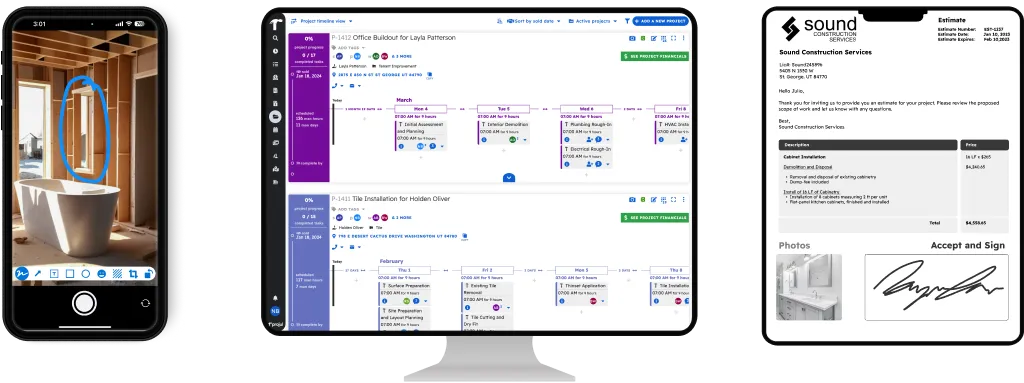
- Send estimates on-site and convert signed proposals into scheduled work instantly
- Pull job costing reports to see which calls make money and which ones bleed it
What Is HVAC Software?
HVAC software is a business management platform that helps heating, ventilation, and air conditioning contractors schedule service calls, manage new installs, track equipment warranties, and handle invoicing from one place. It connects your dispatch board, your techs in the field, and your office so nothing falls through the cracks between a customer call and a completed job.
Projul’s HVAC software helps heating and cooling contractors manage dispatch, service calls, and new installs with scheduling tools built by people who understand field operations and seasonal demand. Projul offers flat-rate pricing with no per-user fees for construction companies of all sizes.
If you run an HVAC company, you already know the business is a balancing act. Service calls come in without warning. Installs have to be scheduled weeks out. Summer and winter bring demand spikes that can overwhelm your team if you are not organized. And somewhere in between, you have maintenance agreements, warranty claims, and EPA paperwork that all need attention.
HVAC software exists to handle this complexity so you can focus on the work instead of the paperwork.
Why HVAC Contractors Need Dedicated Software
The HVAC trade has challenges that generic project management tools do not understand. You are not just running projects. You are running a hybrid operation that mixes scheduled project work with unpredictable service calls, and both have to happen at the same time with the same team.
Here is what happens without HVAC software. Your dispatcher takes a no-cool call at 8 AM. She checks the whiteboard, thinks Dave is available, and sends him across town. But Dave already picked up a side job from yesterday’s overflow, and nobody updated the board. Now you have an angry customer waiting and a tech driving to a job that does not exist anymore.
Or your install team finishes a commercial rooftop unit replacement. The paperwork for the warranty registration sits in someone’s truck for two weeks. When the unit has a problem six months later, nobody can find the serial number or confirm the warranty is active. The customer blames you.
HVAC contractor software prevents these problems by keeping your dispatch board, your project schedule, your equipment records, and your invoicing in one connected system. When something changes, everyone sees it.
Over 5,000 contractors use Projul to manage this kind of coordination. HVAC companies that switch from manual processes report a 32% average profit increase because they stop losing money to miscommunication and missed details.
Dispatch Techs and Schedule Installs From One Dashboard
Most HVAC companies run two separate workflows: service dispatch and install scheduling. The service side is reactive. Calls come in, you send a tech. The install side is planned. You schedule jobs days or weeks in advance. The problem is when both workflows compete for the same techs.
Projul shows all your HVAC techs, their current assignments, and availability in one view. Dispatch a tech to a no-cool call in the morning and schedule a full system changeout for the afternoon without switching tools. When the phones blow up during a heat wave, slot emergency service calls into open gaps and reassign techs on the fly.
Handle Peak Season Without the Chaos
Every HVAC contractor knows the pattern. June hits and your phone rings nonstop. By August, your techs are running four or five calls a day and your install crew is booked three weeks out. Then October arrives and the phones go quiet until the first cold snap.
HVAC software like Projul gives you the visibility to manage these swings. During peak season, you see every tech’s workload at a glance. You spot the gaps where you can fit one more service call. You know which installs can shift a day to free up a tech for emergencies.
During the slower months, you fill the schedule with maintenance agreement visits and planned replacements. Projul’s scheduling tools make sure your techs stay productive year-round instead of sitting idle between the busy seasons.
Contractors using Projul report saving 2+ hours daily on admin work. During peak season, those hours are the difference between handling the call volume and losing customers to competitors who pick up faster.
Service Dispatch That Keeps Customers Happy
When a homeowner’s AC dies in July, they are calling every HVAC company in town until someone answers. The contractor who responds fastest and shows up soonest gets the job. Speed is everything in service dispatch.
Projul’s scheduling tools let your dispatcher assign a tech to a service call in seconds. The tech gets the notification on their phone with the customer’s address, equipment history, and any notes from previous visits. They know what they are walking into before they knock on the door.
This is where HVAC business software pays for itself. Instead of your dispatcher calling around to find out who is available, she looks at the board and assigns the call. Instead of your tech arriving blind, he has the equipment model, installation date, and past service records on his phone. The customer gets faster service, and your tech resolves the issue on the first visit more often.
Emergency Calls vs. Scheduled Work
The hardest part of running an HVAC company is balancing emergency service calls with scheduled project work. Pull a tech off an install to handle an emergency, and the install falls behind. Ignore the emergency, and you lose a customer.
HVAC software helps you make these decisions with better information. See which installs have flexibility in the schedule and which ones are on a tight deadline. Know which techs are closest to the emergency call. Reassign work without creating a cascade of problems across the rest of the week.
Projul’s drag-and-drop scheduler makes these real-time adjustments simple. Move a task, reassign a tech, and everyone’s phone updates instantly. No more phone tag trying to redirect your team.
Track Equipment, Warranties, and Maintenance History
HVAC work revolves around equipment. Every customer has specific units with specific serial numbers, warranty terms, and service histories. When your tech walks up to a condenser unit, they need to know what they are looking at before they open the panel.
Projul lets you attach equipment details, serial numbers, installation dates, and warranty expiration dates directly to each customer’s project record. When a compressor fails at 4 years on a 5-year warranty, your tech sees that on their phone and handles the warranty claim correctly. No more guessing, no more calling the office to look it up.
Warranty Management That Protects Your Reputation
Warranty issues can make or break your relationship with a customer. If a unit you installed fails under warranty and your team does not know it is covered, you either eat the cost or charge the customer for something they should not pay for. Both outcomes are bad.
HVAC software keeps warranty data accessible to your entire team. When a tech pulls up a customer record, the warranty status is right there. Covered or not covered. Active or expired. This clarity helps your techs make the right call on-site and protects your company from costly mistakes.
Refrigerant Tracking and EPA Compliance
The EPA requires HVAC contractors to track refrigerant usage and disposal. If you are still logging refrigerant on paper forms, you are one audit away from a headache. Lost logs, illegible handwriting, and missing records are all problems that proper HVAC software solves.
Projul’s project records let you attach refrigerant logs, recovery amounts, and disposal documentation to each job. When an inspector asks for your records, you pull them up on a screen instead of digging through filing cabinets. Your techs log refrigerant amounts in the field through the mobile app, so the data is captured in real time and tied to the right job.
Manage Maintenance Agreements as Steady Revenue
Maintenance agreements are the backbone of a healthy HVAC business. They provide predictable revenue during slow months, keep your techs busy year-round, and give you first-right-of-refusal when the customer needs a replacement.
But managing 200 or 500 maintenance agreements on a spreadsheet is a recipe for missed visits and lost customers. Which customers are due for their fall tune-up this month? Who has a spring visit scheduled next week? Which agreements are up for renewal?
Projul lets you set up recurring tasks for each maintenance agreement customer. When their service visit is due, it shows up on the schedule automatically. Your tech sees the customer’s equipment history, past service notes, and any issues flagged on the last visit. Nothing slips through the cracks.
This is where software for HVAC companies generates direct revenue. Every maintenance visit you miss is a customer who might not renew. Every visit you complete on time is a customer who trusts you with their next replacement.
Ductwork Projects and New Construction HVAC
Not all HVAC work is service calls and equipment swaps. Ductwork fabrication and installation on new construction projects requires project management that looks more like general contracting than service dispatch.
Projul handles both. For ductwork and new construction HVAC projects, use Projul’s project management tools to break the work into phases. Schedule rough-in, final connection, startup, and testing as separate tasks. Coordinate with electricians and plumbers on the same timeline. Track material costs for sheet metal, flex duct, registers, and controls.
HVAC Load Calculations and System Design
Proper system sizing starts with accurate load calculations. While Projul is not a Manual J calculator, it gives you a place to attach load calculation documents, system design specs, and equipment selections to the project record. When the inspector asks to see your load calculations during the permit inspection, your tech pulls them up on their phone.
Keeping these documents tied to the project also helps with future service calls. When a customer complains about hot spots two years later, your tech can review the original load calculations and system design to troubleshoot intelligently.
Permit and Inspection Tracking for HVAC Work
Most HVAC installs require mechanical permits and inspections. Miss a permit, and you risk fines. Miss an inspection, and you cannot close out the job. Managing permit status across 20 or 30 active installs is exactly the kind of detail that HVAC contractor software should handle.
Projul keeps permit documents and inspection records attached to each project. Your office staff sees which jobs are waiting on permits, which ones have passed inspection, and which ones have corrections to address. Your techs log inspection results from the field, so your office knows the status in real time.
This visibility prevents the all-too-common scenario where a job sits in limbo for two weeks because nobody realized the inspection was not scheduled. It also gives you a clean paper trail for any jurisdiction that wants to see your compliance records.
Job Costing That Shows Your Real Numbers
HVAC work has a wide range of profitability. A diagnostic call might cost you $85 to run but only bill at $65. A full system replacement might carry 40% margins. If you do not know which types of work make you money, you cannot make smart decisions about where to focus.
Projul’s job costing reports show profit or loss on every service call and install. Track labor hours, material costs, travel time, and equipment expenses against what you billed. When you see that your average diagnostic call loses money, you adjust your rates. When you see that commercial installs carry double the margin of residential ones, you market accordingly.
HVAC software that includes real-time job costing turns your gut feelings into actual data. Contractors using Projul report a 32% average profit increase because they finally see the real numbers behind every job.
Estimating That Wins More HVAC Jobs
Your estimate is your first impression. A sloppy bid on a generic PDF tells the homeowner you are not the organized contractor they are looking for. A clean, itemized estimate from Projul tells them you have your operation together.
Projul’s estimating tools let you build detailed bids with line items for equipment, materials, labor, and permits. Save templates for common job types like system changeouts, mini-split installs, or commercial rooftop units. When a new lead comes in, pull up the right template, adjust for the specific job, and send a professional estimate in minutes.
When the customer says yes, that estimate converts directly into a scheduled project. The line items become your job cost budget. No re-entering data. No copy-paste errors. The work flows forward.
Mobile App Your Techs Will Actually Use
HVAC techs run from call to call all day. They do not sit at desks. Any HVAC business software has to work on a phone or it does not work at all.
Projul’s native iOS and Android app gives your techs everything they need in the field. Equipment history, warranty details, the day’s schedule, customer notes, and past service records. They clock in with geofencing at each location, log parts used, take photos of the installation, and close out the job before driving to the next one.
Most HVAC techs are up and running on the app by their second call. That is not an accident. It is the result of building software that respects how field technicians actually work. Rated 9.8 on G2 for ease of use, Projul’s mobile experience is designed for gloved hands and busy days.
Invoicing and Getting Paid Faster
In HVAC, payment timing varies wildly. Service calls should be invoiced on the spot. Installs might require deposits, progress billing, and final payment. Maintenance agreements might bill monthly or annually.
Projul handles all of these scenarios. Send invoices from the field immediately after a service call. Bill installs in phases as work is completed. Set up recurring invoices for maintenance agreements. Your clients can pay online directly from the invoice, which means faster payments with less chasing.
When your invoicing connects to QuickBooks through Projul’s integration, your bookkeeper stops double-entering data and your financials stay accurate without extra work.
Why HVAC Contractors Switch to Projul
Most HVAC contractors come to Projul after outgrowing their current tools. Maybe they started with a dispatch board and a spreadsheet. Maybe they tried HVAC-specific software that charged per tech and got expensive when they staffed up for summer. The story is usually the same: the old way stopped working.
Here is what makes Projul different:
- Built by a contractor. Kurt Clayson started Projul after years of running his own construction company. Every feature exists because a real contractor needed it.
- Flat-rate pricing. $4,788 per year for your entire company. No per-user fees. Your install team, service techs, office staff, and dispatchers all get full access.
- All-in-one platform. CRM, estimating, scheduling, dispatching, job costing, time tracking, invoicing, and client portal. One login. One place.
- Rated 9.8 on G2. For both ease of use and quality of support. That is HVAC contractors voting with their reviews.
- Over 5,000 contractors. From two-truck shops to companies with 200+ employees. The platform scales with you.
Load Calculation Documentation and System Sizing Records
Proper HVAC system sizing starts with a Manual J load calculation. Get it wrong and the customer gets a system that short-cycles, struggles to maintain temperature, or runs up energy bills that make them regret hiring you. An oversized system costs more to install and costs the customer more to operate. An undersized system runs constantly and still cannot keep the house comfortable on the hottest day of the year.
The problem is not usually the calculation itself. Most HVAC contractors either run Manual J themselves or hire a third-party design firm to do it. The problem is what happens to that documentation after the system is installed. It goes in a folder, gets filed somewhere, and disappears. When the customer calls two years later complaining about hot spots in the master bedroom, your tech has no idea what the original load calculation showed for that zone. They troubleshoot blind instead of comparing actual performance against design intent.
Projul’s document management keeps load calculation reports attached to the customer’s project record permanently. Your tech pulls up the job on their phone, opens the Manual J report, and sees that the master bedroom was calculated at 12,000 BTU with a specific duct size and register layout. If the actual performance does not match the design, they know exactly where to start troubleshooting. Is the duct run restricted? Is the register undersized? Did someone close off a return air path during a renovation?
For new construction HVAC work, load calculation documentation also supports your permit application. Many jurisdictions now require Manual J calculations as part of the mechanical permit package. Having those documents already on file in your HVAC software means your office pulls them up and attaches them to the permit submission without tracking down the engineer or digging through email.
System sizing records also protect you from liability. If a customer claims their system was improperly sized, your documentation shows the load calculation, the equipment selection rationale, and the design conditions used. That paper trail is your defense. Without it, the dispute becomes your word against the customer’s complaint, and that rarely ends well for the contractor.
Over time, maintaining load calculation records across your customer base builds a reference library. You see which equipment models perform well in your climate zone, which duct configurations deliver consistent comfort, and which building types create recurring problems. That knowledge makes your next system design better and your next estimate more accurate. HVAC software that preserves this data turns every install into a learning opportunity for your entire team.
Equipment Serial Number Tracking Across Your Customer Base
Every HVAC system you install has a condenser, an air handler or furnace, and possibly a heat pump, a mini-split, or supplemental equipment. Each piece carries a serial number, a model number, a manufacture date, and a warranty registration. When your tech gets dispatched to a service call, knowing exactly what equipment is on site before they arrive saves time, prevents wrong-part trips, and makes warranty claims straightforward.
Without serial number tracking, your tech arrives at the customer’s house and spends the first 15 minutes reading data plates, looking up model numbers, and figuring out the warranty status. On a busy summer day with six calls on the board, that 15 minutes per call adds up to an hour and a half of wasted time across the day. Multiply that across your entire service team and you are losing hundreds of billable hours per year to information that should be at your tech’s fingertips.
Projul stores equipment details on each customer’s project record. When your tech pulls up the service call on the mobile app, they see the condenser model, serial number, install date, and warranty expiration before they leave the shop. They know whether to bring a warranty part or a billable part. They know if the unit is a 410A system or an older R-22 unit that needs different service procedures. They arrive prepared instead of starting from scratch at every call.
Serial number tracking also feeds your parts ordering process. When a compressor fails and you need a warranty replacement, the manufacturer wants the serial number, the installation date, and proof of proper maintenance. If that information is scattered across paper files, old invoices, and your memory, the warranty claim process drags on for days. With the data in Projul, your office files the claim in minutes with accurate information.
For companies that install multiple brands, serial number tracking by manufacturer helps you spot reliability trends. If you see that a specific condenser model from one manufacturer has a pattern of compressor failures at year four, you adjust your purchasing decisions and your extended warranty recommendations. That kind of insight only comes from organized data across your entire customer base, not from anecdotal memory. Our HVAC system selection guide covers equipment evaluation criteria that complement this tracking approach.
Maintenance Contract Management That Drives Recurring Revenue
Maintenance contracts are the most predictable revenue source in the HVAC business. A typical residential tune-up agreement runs $150 to $300 per year. If you have 400 maintenance customers, that is $60,000 to $120,000 in guaranteed annual revenue before a single service call comes in. That revenue covers your overhead during the shoulder seasons when install work slows down and emergency calls dry up.
But maintenance contracts only work financially if you actually complete the visits on time. Every missed visit is a customer who wonders why they are paying for a service they did not receive. Every late visit is a customer who considers switching to the competitor who mailed them a reminder card last month. The difference between a profitable maintenance program and a failing one is execution, and execution depends on tracking.
Most HVAC contractors start their maintenance program in a spreadsheet. It works at 50 customers. By 200 customers, the spreadsheet has errors, missed entries, and nobody trusts it. By 400 customers, the spreadsheet is a liability. You are missing visits, double-scheduling techs, and losing renewals because customers feel ignored.
Projul replaces the spreadsheet with recurring tasks tied to each maintenance customer. When Mrs. Johnson’s fall tune-up is due in October, it shows up on your scheduling board automatically. Your dispatcher assigns it to a tech who sees Mrs. Johnson’s equipment history, last service notes, and any open issues from the previous visit. The tech completes the tune-up, logs the service details, and the next visit auto-schedules for spring.
Renewal tracking is equally important. When a contract is up for renewal, a task alerts your office team. They reach out to the customer before the contract lapses, not three months after. Proactive renewal outreach keeps your retention rate above 80%, which is the difference between a maintenance program that grows every year and one that treads water. For more on building recurring revenue through service programs, check our property maintenance software guide.
The side benefit of a well-run maintenance program is replacement sales. Your tech is in the customer’s home twice a year, checking refrigerant charge, measuring airflow, and inspecting components. When that 15-year-old system starts showing signs of failure, your tech is the first person the customer thinks of. Maintenance contracts build the relationship that turns into a $10,000 system replacement down the road.
Permit and Inspection Scheduling for Mechanical Work
Every new HVAC install requires a mechanical permit, and most jurisdictions require at least one inspection before you can close out the job. Some require two: a rough-in inspection of the ductwork and refrigerant lines, and a final inspection of the completed system. Miss the permit, and you risk fines and stop-work orders. Miss the inspection, and the job sits open on your books, the customer cannot get their certificate of occupancy, and you do not collect final payment.
The challenge is tracking permit and inspection status across 20 or 30 active installs. Each job is in a different stage. Some are waiting on permits. Some have permits but need to schedule rough-in inspection. Some have passed rough-in and are waiting for final. Some failed final and need corrections before re-inspection. If this status tracking lives in your head or on sticky notes, something will fall through. It is not a question of if. It is a question of when.
Projul tracks permit status as a task sequence on every HVAC install project. Your office files the mechanical permit application and logs the submittal date on the project record. When the permit is issued, they update the task and the install crew gets the green light to begin. After rough-in is complete, the inspection task activates. Your tech or your office schedules the inspection, logs the date, and records the result. If corrections are needed, a follow-up task captures what the inspector flagged and assigns it to the right person.
This workflow prevents the most common permit-related delays. Your office sees at a glance which jobs are waiting on permits and can follow up with the building department before a two-week wait turns into a month. Your field team knows which jobs are cleared to start and which ones are still in the permit queue. Nobody wastes a trip to a site that is not ready. For a deeper look at permit processes, our construction permit guide covers what to expect across different jurisdictions.
For commercial HVAC work, the permit and inspection requirements are even more involved. Commercial mechanical permits may require engineered drawings, energy compliance documentation (Title 24 in California, IECC elsewhere), and coordination with other trades’ permits. Inspection sequences may include ductwork pressure testing, refrigerant leak checks, and commissioning verification. Tracking all of these steps as connected tasks in your HVAC software ensures that nothing gets missed on a project that might have 10 or 15 individual inspection milestones.
The contractors who close out jobs fastest are the ones who treat permit and inspection tracking as part of their standard workflow, not an afterthought. Building this process into your HVAC contractor software means your team follows the same steps on every install, and your office always knows which jobs are ready to close.
Honest Pricing for HVAC Contractors
Most HVAC software charges per user or per tech. That pricing model punishes you for growing. Add a tech for cooling season? More money. Bring on a dispatcher? More money. Give your office manager access? Way more money.
Projul starts at $4,788 per year for your entire HVAC company. No per-user fees. Your techs, installers, dispatchers, office staff, and sales team all get full access without inflating the bill. Over 5,000 contractors use Projul to manage their operations, and HVAC contractors consistently report saving 2+ hours daily on admin work. G2 users rate Projul 9.8 for ease of use and 9.8 for quality of support.
HVAC Guides for Installation and Coordination
On new construction and large remodels, HVAC often needs to coordinate ductwork and equipment placement with framing, electrical, and plumbing. Our HVAC coordination guide walks through scheduling dependencies and clash prevention so your installs don’t get held up by other trades.
Before your system passes final inspection, every component needs to meet code. Our HVAC rough-in inspection guide covers what inspectors look for and how to prep your work so you pass on the first visit.
Stop Losing Jobs to Disorganization
If you are still running your HVAC company with a whiteboard, a spreadsheet, and a stack of paper invoices, you already know it is not working. You are missing service calls, losing track of warranties, and spending hours on admin that HVAC software should handle.
Projul is not about adding technology for its own sake. It is about running a tighter operation so you can handle peak season without the chaos, keep your maintenance customers happy, and actually know which jobs make you money.
Over 5,000 contractors have already made the switch. They are spending less time on admin, catching budget problems earlier, and getting paid faster. Your competition is probably one of them.