Masonry Contractor Software. Managing projects shouldn't feel like banging your head against a brick wall! Built by construction pros with honest pricing.
From proposal to invoice, there's a lot to manage on masonry projects. But you don't have to do it alone! Projul gives you all the tools you need to save 2+ hours daily, be more efficient, and make more money.
- Upgrade your client experience with our customer portal
- Bring everything and everyone together in one app
- Use templates to create and send important documents in minutes
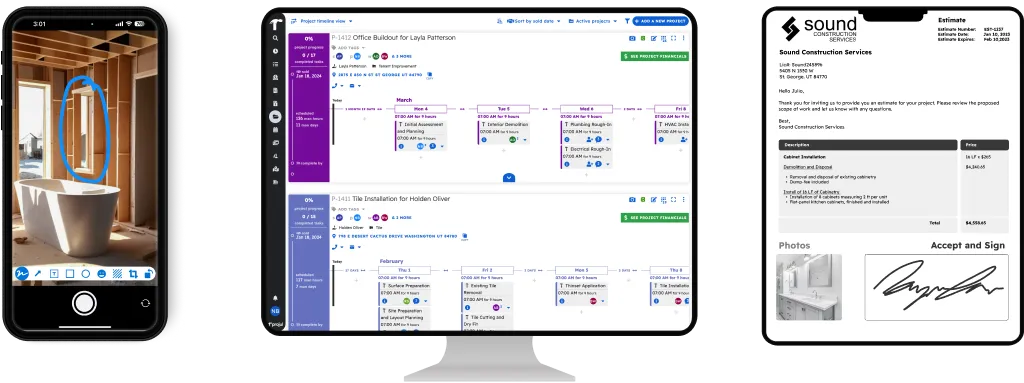
What Is Masonry Software?
Masonry software is a project management platform built for brick, block, and stone contractors that handles material takeoffs, weather-dependent scheduling, crew productivity tracking, and job costing for both commercial and residential masonry projects.
Projul’s masonry software helps brick, block, and stone contractors manage material takeoffs, weather-dependent scheduling, and crew tracking from a platform built by construction professionals who understand trade work. Projul offers flat-rate pricing with no per-user fees for construction companies of all sizes.
Masonry is one of the oldest trades in construction, and in many ways it still runs on old-school methods. Brick counts scribbled on the back of a plan set. Mortar and sand quantities estimated from experience. Schedules that change every time the weather turns. Crew assignments communicated through a 6 AM phone call.
Those methods work when you are running one small job. They fall apart when you are running five projects across three job sites with two crews and a restoration job that needs special mortar matching. That is when masonry contractor software becomes the difference between a profitable operation and one that is always catching up.
Projul helps masonry contractors manage the unique demands of brick, block, and stone work from one platform. Over 5,000 contractors use Projul to run their operations, and masonry contractors benefit from the weather-aware scheduling, material-heavy estimating, and crew management features that match how the trade actually works.
Why Masonry Contractors Need Specialized Software
Masonry work has characteristics that make it different from most other construction trades. Understanding those differences is key to understanding why generic project management tools fall short and why masonry software exists.
Weather Rules Everything
No trade is more weather-dependent than masonry. Mortar has specific temperature requirements. Below 40 degrees Fahrenheit, standard mortar will not set correctly. You either stop work, use winter admixtures, or build heated enclosures, all of which cost money and slow production. Rain washes out fresh joints and can stain new brick. High winds make scaffold work unsafe and blow mortar off the trowel.
A masonry contractor in the upper Midwest might lose 30 to 40 percent of potential working days between November and March. In the South, summer heat creates different problems: mortar sets too fast, crews fatigue earlier, and afternoon thunderstorms wash out progress.
Masonry contractor software needs to handle this reality. Not just by letting you reschedule a day, but by showing you how a lost day cascades through the rest of the project and every other project your crews are scheduled on. Projul’s scheduling tools do exactly that. Shift one day, see the ripple across your entire operation.
Material Math Is Critical
Masonry is one of the most material-intensive trades in construction. A standard brick wall requires calculating brick count (based on wall square footage and brick size), mortar quantity (bags per thousand bricks), sand volume, reinforcement steel, ties, lintels, flashing, and weep holes. Miss a line item on the takeoff and you are either short on materials mid-project or eating the cost of a rush delivery.
Block work has its own calculations. CMU counts by wall area, grout fill for reinforced cells, rebar quantities, bond beam blocks, and the mortar and sand to lay them. A 2,000 square foot commercial block building has thousands of individual blocks, and being off by even 5 percent means a second delivery or a surplus you cannot return.
Stone work adds another layer of complexity. Natural stone is sold by the ton or by the pallet, coverage rates vary by stone size and joint width, and waste factors are higher than brick because of cutting and fitting. Manufactured stone has more predictable coverage but still requires accurate square footage calculations.
Software for masonry companies needs estimating tools that handle these material-heavy takeoffs. Projul’s estimating templates let you build standard takeoff calculations for your most common masonry scopes and apply them to new bids with adjusted dimensions. A block foundation estimate that took two hours by hand takes 30 minutes with a template that already includes your material formulas and labor rates.
Crew Productivity Drives Profitability
Masonry is a production trade. Your profitability depends directly on how many bricks, blocks, or square feet of stone your crew lays per day. An experienced crew of three masons and two laborers might lay 400 to 500 bricks per day on a straightforward wall. Put them on a job with complex patterns, arches, or soldier courses, and that number drops to 200 to 300.
If your estimate assumed 450 bricks per day and your crew is averaging 300 because of the wall geometry, you are 33 percent over on labor. On a large project, that difference is thousands of dollars.
Masonry software that tracks crew productivity by project gives you the data to estimate more accurately on future bids. Projul’s time tracking and job costing tools show you labor hours per project, which you can compare against your estimated production rates. Over time, you build a library of real production data that makes your estimates tighter and your margins more predictable.
Manage Every Masonry Project From Bid to Final Payment
Win More Work With Professional Estimates
Your estimate is how clients judge your professionalism before you ever lay a brick. A detailed, itemized bid that breaks out materials, labor, scaffold costs, and equipment rental tells the client you know exactly what the job requires. A round-number guess on the back of a business card tells them to call someone else.
Projul’s estimating tools let masonry contractors build detailed bids with every line item, quantity, unit cost, and markup. Save templates for your bread-and-butter work: block foundations, brick veneer, stone fireplaces, retaining walls, chimney repairs. When a new bid comes in for a similar scope, pull up the template, adjust the quantities, and send a professional estimate in half the time.
When the client accepts, the estimate converts into a scheduled project with a built-in job cost budget. Your estimated material and labor costs become the baseline you track against as the project progresses. If your company also handles stucco work, download our free stucco estimate templates for ready-made bid formats covering common exterior finishes.
Schedule Around Weather and Availability
Masonry scheduling is a constant negotiation between weather forecasts, crew availability, material deliveries, and the schedules of other trades on the job. If you are doing veneer on a new construction project, you need the framing, sheathing, and weather barrier complete before you start. If you are doing a block foundation, the excavation and footings need to be done and inspected first.
Projul’s drag-and-drop scheduler lets you manage these dependencies. Set your masonry work to start after the prerequisite phases are complete. When weather forces a delay, drag the affected days forward and see how it impacts everything else on your schedule.
Seven schedule views, including calendar and Gantt charts, give you the visibility to manage multiple crews across multiple job sites. Your foreman sees his crew’s schedule for the week on the mobile app. Your office sees every project on one board. When you need to move Crew A from the commercial job to the residential job because weather opened a window, you make the change and everyone sees it.
On the Pro plan, Projul AI Connect lets you make those changes by asking. Tell ChatGPT, Claude, or another AI assistant that rain pushed the veneer start two days and it shifts the schedule in Projul, or ask it to check next week for double-booked crews.
Brick and stone contractor software that handles weather-dependent scheduling is not a nice-to-have for masonry contractors. It is how you avoid wasted days where crews show up to a site and cannot work.
Track Materials From Takeoff to Delivery
Masonry projects live and die on material logistics. Bricks and blocks are heavy. A standard pallet of bricks weighs around 2,000 pounds. A pallet of 8-inch CMU weighs around 2,500 pounds. You need a forklift or boom truck to unload, and you need the materials staged close enough to the work area that your crew is not hand-carrying bricks across the site all day.
Masonry contractor software helps you track material orders, delivery dates, and quantities received versus quantities needed. Projul’s project records let you log material deliveries and compare them against your takeoff. If you ordered 10,000 bricks and only 9,200 showed up on the first delivery, you know immediately and can get the rest scheduled before your crew runs out.
This is especially important for matching. Brick colors vary between production runs. If you run short mid-project and order a second batch, the color may not match the first. Getting your takeoff right the first time, with an appropriate waste factor, avoids this problem. Masonry software with good estimating templates builds in industry-standard waste factors so you order the right quantity from the start.
Plan and Price Scaffolding
Scaffolding is one of the biggest overhead costs in masonry. Any work above five or six feet requires scaffolding for safety and productivity. The cost of renting, delivering, setting up, adjusting, and removing scaffold can be thousands of dollars on a large project.
Masonry software helps you estimate scaffold costs accurately and track them as part of your job costing. Include scaffold rental, delivery, setup labor, and adjustment time as line items in your estimate so you are not absorbing those costs. Projul’s estimating templates can include scaffold as a standard line item that you adjust based on wall height and project duration.
On commercial projects where you may need scaffold for weeks or months, tracking the rental period against your project schedule helps you avoid paying for scaffold that is sitting idle because weather delayed the work.
Job Costing for Masonry Projects
Masonry margins are built on three things: accurate material takeoffs, realistic labor production rates, and controlling overhead costs like scaffold and equipment rental. If any of those three are off, your margin shrinks.
Projul tracks estimated versus actual costs on every masonry project in real time. You see material costs as deliveries arrive and get logged. You see labor costs as crews clock in and out. You see equipment and scaffold costs as invoices come in from your rental company.
When your block crew is running behind production rate on a commercial project, you see it at week two, not when the job is done and you are adding up receipts. That early warning gives you time to adjust. Maybe the layout is taking longer than expected and you need an extra layout day built into the schedule. Maybe the crew needs a third laborer to keep production moving. Whatever the fix, you can only apply it if you know about the problem while there is still time.
Commercial vs. Residential Cost Structures
Commercial masonry projects and residential masonry projects have very different cost profiles. Commercial work typically involves larger quantities of block or brick, higher scaffold costs, longer timelines, and progress billing tied to completion percentages. Residential work is often shorter in duration, smaller in scope, and billed at project milestones or completion.
Masonry software like Projul handles both. Set up commercial projects with progress billing and detailed phase tracking. Set up residential projects with milestone invoicing and simpler task lists. The job costing engine works the same way for both, comparing estimated costs to actual costs so you know your margin on every job regardless of size.
Track Crew Productivity and Time
Masonry contractors need to know two things about their crews: where they are and how much they are producing. Projul’s time tracking with GPS verification handles the first part. Your masons and laborers clock in from their phones, and the system confirms they are at the right job site.
The time data feeds directly into job costing by project, so you can calculate actual labor cost per unit of work. If your crew laid 1,500 blocks this week across two projects, and your time tracking shows 240 labor hours, you know your actual production rate. Compare that to your estimated rate and you have a clear picture of where your labor pricing needs to adjust.
Over time, this data makes your bidding more accurate. Instead of guessing at production rates, you use your own historical data. That is how masonry contractors using Projul report a 32% average profit increase. Better data leads to better estimates, which leads to better margins.
Restoration and Tuckpointing Work
Restoration and tuckpointing are a growing segment of masonry work, especially in older cities with aging brick buildings. This work has unique requirements that general masonry software needs to accommodate.
Mortar matching is critical. The new mortar needs to match the existing mortar in color, texture, and composition. On historic buildings, you may need to use lime-based mortar instead of modern Portland cement mortar. Getting the mix wrong does not just look bad; it can damage the original brick.
Tuckpointing production rates are different from new construction. Cutting out old mortar, cleaning joints, and repointing is slower work that requires more skill. Your estimating templates for restoration work should reflect these different production rates.
Projul lets you create separate estimating templates for restoration and tuckpointing work with adjusted labor rates and production assumptions. Track these projects separately in your job costing so you understand the true profitability of your restoration division versus your new construction work.
Keep Clients Informed With a Professional Portal
Projul’s customer portal gives your masonry clients visibility into project progress, the upcoming schedule, and approved invoices without requiring a phone call.
Commercial clients coordinating a build with multiple trades can check exactly when your masonry crew is scheduled. This is especially valuable on projects where other trades are sequenced around your work. The framing contractor needs to know when your block foundation will be complete. The roofing contractor needs to know when your chimney will be topped out. Having your schedule visible through a portal helps the GC coordinate without calling you every day.
Residential homeowners see when their retaining wall, fireplace, or veneer project hits each milestone. They can review and approve estimates, sign change orders, and pay invoices through the portal. That professional experience sets you apart from the masonry contractor who communicates through sporadic text messages.
Rated 4.9/5 on G2 for ease of use, Projul’s customer portal is simple enough for any client and detailed enough to answer their questions before they call.
Invoicing for Masonry Projects
Masonry billing varies by project type. Residential projects are often billed with a deposit and final payment, or with a deposit, progress payment, and final payment. Commercial projects typically use progress billing tied to completion percentages, sometimes with retainage.
Projul handles all of these billing structures. Set up your invoicing milestones to match your contract terms. Send invoices when milestones are reached. Add change orders to the appropriate invoice. Let clients pay online through the portal.
For commercial work, the ability to generate invoices that show completion percentage and remaining balance helps your GC or property owner process your payment faster. The less paperwork they have to create on their end, the faster you get paid.
QuickBooks Integration for Masonry Contractors
If you are entering invoices into QuickBooks after creating them in your project management tool, you are wasting time and creating errors. Projul syncs invoices, payments, and customer records with QuickBooks Online automatically. Your bookkeeper gets accurate data without manual entry. Your financial reports reflect reality without extra work.
Why Masonry Contractors Switch to Projul
Most masonry contractors come to Projul after realizing their current system of spreadsheets, notebooks, and phone calls cannot keep up with their workload. The common trigger is a project where weather delays cascaded into scheduling chaos, a material shortage that was not caught until the crew ran out on site, or a job where the final numbers showed they worked for free because their estimate was off.
Here is what makes Projul different for masonry contractors:
- Built by a contractor. Every feature exists because someone on a job site needed it.
- Flat-rate pricing. Plans start at $2,388 per year, and Core is $4,788 per year for up to 10 users. Your estimators, foremen, crew leads, and office staff all get full access. No per-user fees.
- Weather-aware scheduling. Drag-and-drop scheduling that lets you shift weather days and see the cascade across every project.
- Material-heavy estimating. Templates that handle brick counts, block quantities, mortar, sand, and scaffold costs.
- Crew productivity tracking. Time tracking with GPS that feeds directly into job costing.
- Rated 4.9/5 on G2. For ease of use and quality of support.
- Over 5,000 contractors. From two-person tuckpointing crews to commercial masonry companies running multiple large projects.
Honest Pricing for Masonry Contractors
Most masonry contractor software charges per user. When you have estimators, foremen, crew leads, laborers who need to clock in, and office staff who manage invoicing, per-user pricing adds up fast. And the seasonal nature of masonry means you are paying for seats during slow months when half your team is not working.
Projul starts at $2,388 per year, and the Core plan covers up to 10 users in your masonry company for a flat $4,788 per year, no per-user fees. Your estimators, crew leads, and office staff all get full access without inflating the bill. Over 5,000 contractors use Projul to manage their operations, and masonry contractors consistently report saving 2+ hours daily on admin work. G2 users rate Projul 4.9/5 for ease of use and 4.9/5 for quality of support.
Growing Your Masonry Business With Better Lead Tracking
Landing masonry work is about more than showing up and giving a price. The contractors who stay busy year-round are the ones who follow up fast, track every inquiry, and stay in front of past customers when new work comes up.
Projul’s lead pipeline gives masonry contractors a clear view of every potential job in the funnel. When a general contractor calls about a block foundation, a property manager emails about facade restoration, or a homeowner fills out your website form for a stone veneer project, the lead drops into your pipeline automatically. You see the source, the contact info, the project type, and what stage the lead is in.
Follow Up Before Your Competition Does
Speed wins in masonry sales just like it does in every other trade. The contractor who returns a call within an hour and sends a professional estimate the same day almost always beats the one who takes three days to follow up. Projul connects your lead pipeline to your estimating tools so you can pull up a template for block work, brick veneer, or stone, adjust the quantities, and send a detailed bid while the customer still remembers calling you.
Your estimate shows up with itemized material quantities, labor by phase, scaffold costs, and your markup - all formatted professionally. That first impression tells the customer you run a tight operation, and it sets you apart from the competitor who scribbles a number on a napkin.
Knowing Which Jobs Are Worth Chasing
Not every masonry lead is a good fit. A small residential mailbox column pays very differently than a commercial block building. Projul lets you tag leads by project type and track your close rate and average job value by category. Over time, you see which types of masonry work bring in the best margins and which ones are not worth the bid time.
Maybe your commercial restoration work closes at 40% and averages $15,000 per job. Maybe your residential fireplace leads close at 20% and average $4,000. That data helps you decide where to spend your marketing dollars and which leads deserve your personal attention.
Staying Connected With Past Masonry Clients
Masonry work generates repeat business if you stay organized. The GC who hired you for one foundation has more projects coming. The property manager who liked your tuckpointing work manages other buildings. Projul’s CRM tools keep every customer’s history at your fingertips - past projects, product specs, crew notes, and invoices. When you reach out about new work, you are not starting from scratch. You are building on a relationship that already has trust built in.
Over 5,000 contractors use Projul to manage their full business cycle, and masonry companies that track leads and follow up consistently keep their crews busy even through the slower months.
Practical Tips for Running a More Profitable Masonry Business
Running a masonry company is about more than laying brick straight and keeping mortar joints consistent. The business side of masonry trips up a lot of skilled tradespeople. Here are some lessons that come from years on job sites, not from a textbook.
Build your waste factors from real job data, not rules of thumb. The old standard of 5% waste for brick sounds reasonable until you are cutting every other brick on a herringbone pattern and your actual waste hits 12%. Track your actual waste on every project using Projul’s job costing and adjust your estimates based on the type of bond pattern, the number of openings, and how much cutting the design requires. Your estimates get tighter every time you update your numbers with real data.
Pre-stage materials before your crew arrives. Nothing kills production faster than a mason standing around waiting for a laborer to move pallets. Before your crew starts each morning, bricks should be staged within arm’s reach of the work area, mortar should be mixed, and scaffold should be set to the right height. Plan your material deliveries so they arrive the day before you need them, not the morning of. Use Projul’s scheduling tools to coordinate delivery dates alongside your crew schedule.
Document existing mortar on every restoration job. Before you start any tuckpointing or repointing work, photograph the existing mortar color, joint profile, and tooling style. Take a sample if the building owner allows it. Getting the mortar match wrong on a visible facade is an expensive callback and can damage your reputation with the GC or property manager. Keep photos and notes in Projul’s photos and document management so they are attached to the project permanently.
Price scaffold as its own line item, every time. Too many masonry contractors bury scaffold costs in their labor rate and then wonder why margins are thin on tall buildings. Scaffold rental, delivery, setup, adjustments during the project, and teardown should all be separate line items on your estimate. When the client sees the scaffold cost broken out, they understand why a three-story veneer job costs more per square foot than a one-story job. Use estimating assemblies to build a scaffold cost formula based on wall height and project duration.
Keep your crews busy through winter with interior work. The biggest cash flow challenge for masonry contractors in cold climates is the winter slowdown. Smart masonry companies fill those months with interior stone and tile work, fireplace surrounds, commercial lobby features, and other inside jobs that are not affected by weather. Build a separate lead pipeline category for interior work so you can track and fill your winter schedule before the cold hits.
Mortar Mix and Color Matching Documentation
Getting the mortar wrong on a masonry job is one of the most visible and expensive mistakes a contractor can make. On new construction, mismatched mortar joints stand out against the brick or stone and make the entire wall look wrong. On restoration work, the wrong mortar color or texture can ruin a building’s appearance and even violate historic preservation requirements. Either way, you are looking at a costly tear-out or a callback that eats your profit and your reputation.
The challenge is that mortar color is affected by multiple variables: the cement brand, the sand source, the pigment quantity, the water ratio, and even the curing conditions. A mix that looks perfect on your sample board in the shop can look completely different on the wall after it cures for two weeks in direct sunlight. Sand color alone can shift the final mortar appearance dramatically, and switching sand suppliers mid-project is a guaranteed color mismatch.
Projul’s photos and document management gives masonry contractors a reliable way to record every detail of a mortar mix for each project. Photograph the sand source, the cement bags, and the pigment containers. Log the exact mix ratio: how many shovels of sand, which cement, how much pigment, and how much water. Attach the mortar sample approval photo from the architect or building owner. All of this lives inside the project record where any crew member can pull it up on their phone.
When your foreman gets sick and a different crew leader takes over the job, they open the Projul app and see exactly what mix was approved. No guessing, no calling the office, no mixing by eye and hoping it matches. When you order materials for the second half of the project, you know exactly which sand supplier and cement brand to reorder because it is documented in the project file.
Color matching matters even more on repair and patching work. A property manager calls about spalling brick on a commercial building. You need to match the existing mortar on a wall that might be 20 or 50 years old. Take a sample of the existing mortar, photograph it alongside your test batches, and document the final approved match in Projul. If the same building needs more work next year, you pull up last year’s project and have the exact mix recipe ready to go. Read our construction photo documentation guide for more tips on capturing jobsite details that protect your work and your margins.
Build a mortar documentation checklist into your project templates so every job gets the same treatment. Include task items for sand source documentation, mix ratio recording, sample board approval, and curing comparison photos. When mortar documentation is built into the workflow, it stops being something your crew forgets and starts being something that happens automatically on every project.
Historic Restoration and Preservation Requirements
Historic masonry restoration is a specialty that commands higher margins but also carries stricter requirements than standard masonry work. Buildings listed on the National Register of Historic Places, located in historic districts, or subject to local preservation ordinances often require specific materials, techniques, and documentation that general masonry contractors may not be familiar with. Getting these requirements right is the difference between a profitable niche and a project that buries you in rework and disputes with preservation boards.
The most common requirement on historic masonry is using lime-based mortar instead of modern Portland cement mortar. Historic brick was manufactured to work with softer, more flexible lime mortar. When a contractor repoints a historic building with hard Portland cement mortar, the mortar does not flex with the brick. Instead, the brick faces spall off because the mortar is now harder than the brick itself. This damage is irreversible and extremely expensive to repair. Preservation boards know this, and they will reject work done with the wrong mortar type.
Projul helps masonry contractors manage historic restoration requirements by keeping all project specifications, preservation board approvals, and material documentation in one place through project management tools built for trade contractors. When a historic commission issues a scope of work specifying Type O lime mortar with a specific sand color and joint profile, attach that document to the project record. When your crew starts the job, the approved specifications are right there on their phone through the mobile app.
Documentation is especially important on historic projects because preservation boards often require progress photos and completion reports. They want to see that you used the approved mortar type, that you matched the original joint profile, and that you did not damage surrounding brickwork during the repointing process. Projul’s photo tools let your crew capture progress images throughout the job, all attached to the project record and time-stamped automatically.
Historic restoration also involves matching replacement brick or stone when damaged units need to come out. Finding brick that matches a 100-year-old building in color, size, and texture often means sourcing from salvage yards or specialty manufacturers. Document your sources, pricing, and lead times in Projul so you have a reliable supplier list for future historic projects. Our construction historic renovation guide covers more of the planning and compliance details that masonry contractors need for preservation work.
For masonry contractors looking to break into historic restoration, building a portfolio of completed projects with thorough documentation is the best way to win future work. Preservation architects and building owners want to see that you understand the requirements and have a track record of getting them right. Use your project documentation in Projul as proof of your capabilities when bidding on new historic jobs. The contractors who document their work thoroughly are the ones who get invited back for the next building in the district.
Track historic restoration projects separately in your job costing reports. The labor rates, material costs, and production rates on restoration work are very different from new construction masonry. Knowing your true cost on historic projects helps you price future bids accurately and avoid the mistake of applying new construction rates to specialty restoration work.
Stop Estimating From the Back of a Plan Set
If you are still doing brick counts by hand, scheduling crews through morning phone calls, and discovering budget overruns after the last course is laid, you are leaving money on every job.
Masonry software like Projul puts your takeoffs, schedules, job costs, crew tracking, and client communication in one platform. You estimate faster and more accurately. You schedule around weather without chaos. You track labor productivity so every future bid gets tighter. And you give your clients the professional experience that wins referrals.
Over 5,000 contractors have already made the switch. Your competition is probably one of them.