Software for painting companies. Renovate your job management with an all-in-one tool. Built by construction pros with honest pricing.
Running a painting business isn't always easy, but it can be much easier with Projul. From estimates to invoices, and everything in between, we've used our experience in the business to create the tool we wish we had. No per-user fees, your entire team gets access for one flat price.
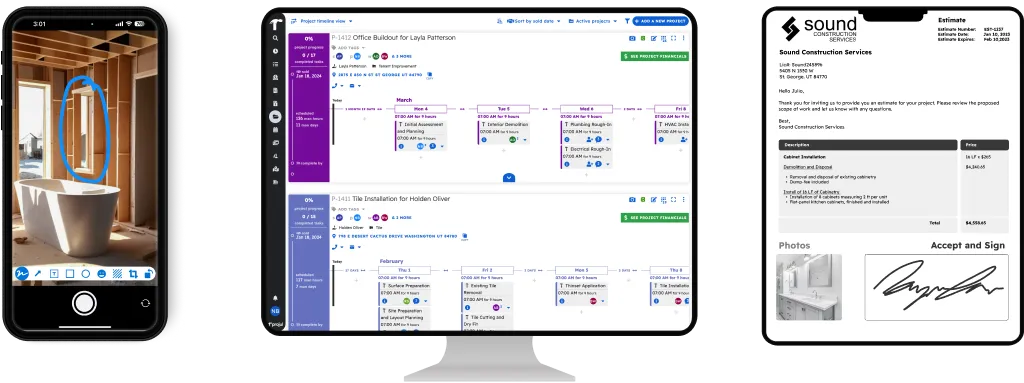
- Impress your clients with professional estimates
- Stay on track with drag and drop scheduler
- It's easy to get paid with card payments direct from invoices
What Is Painting Contractor Software?
Painting contractor software is a business management platform that helps painting companies estimate jobs by square footage, schedule crews across multiple properties, track paint products and color selections, and manage the fast-paced workflow of running several jobs per week.
Projul’s painting contractor software helps painting companies estimate by square footage, schedule crews across jobs, and track color selections from a platform built by contractors who know paint work. Projul offers flat-rate pricing with no per-user fees for construction companies of all sizes.
If you run a painting company, you know the work itself is not the hard part. The hard part is keeping ten jobs moving at once, making sure the right crew shows up at the right house with the right color, and getting invoices out before your cash flow dries up. Painting software like Projul handles the business side so you can focus on putting paint on walls.
Estimating Paint Jobs by Square Footage
A good paint estimate starts with accurate measurements. Interior jobs require wall and ceiling square footage, minus windows and doors. Exterior jobs need siding, trim, soffit, and fascia measurements. And every estimate needs to account for the number of coats, the type of surface, and the condition of the existing finish.
Projul’s estimating tools let painting contractors build detailed bids with separate line items for each phase of work. Break out prep (scraping, patching, caulking, priming) as its own line item. List primer and finish coats separately. Include trim, doors, and ceilings as individual items so the client sees exactly what they are paying for.
Save templates for your most common job types. A standard 3-bedroom interior repaint. A 2,500-square-foot exterior with wood trim. A commercial office refresh. Each template includes your standard labor rates, material quantities, and markup so you are bidding in 15 minutes instead of an hour. Painting contractor software that speeds up your estimating puts more bids on the street, which means more work on the schedule.
Prep Work Estimating: Where Scope Creep Lives
Every painting contractor has lost money on prep work. The exterior bid assumed light scraping and a coat of primer. But when your crew got on ladders, they found three layers of peeling paint, rotted trim, and caulk that crumbled at the touch. Suddenly a one-day prep job is a three-day project and your margin is gone.
Projul helps you estimate prep work as a separate, detailed line item. When you walk a job for the estimate, document the surface condition with photos attached to the project record. Note areas that need heavy scraping, wood repair, or primer. Build your prep hours based on what you actually see, not what you hope the condition will be.
When prep scope does expand on site, create a change order in Projul before the extra work happens. The client approves it digitally. The change order updates your job cost and your invoice automatically. Painting software that handles scope changes in real time prevents the arguments that happen when extra work shows up on the final bill with no prior approval.
Paint Product and Color Selection Tracking
Painting companies deal with product selections on every single job. Which brand? Which sheen? Which color for each room? When a homeowner picks seven different colors for their interior and then changes two of them after your crew already bought the paint, you need a system that tracks every selection and every change.
Projul’s project records let you attach product specifications, color codes, and client selections to each job. When Mrs. Johnson calls to say she changed her mind about the master bedroom color, your office updates the project record and your crew lead sees the change before he opens a can. No more painting a room the wrong color because the change got lost in a text thread.
For commercial jobs, product tracking is even more critical. Property management companies often specify exact products and sheens for tenant improvements. HOAs may require specific exterior colors from an approved palette. Painting contractor software that keeps product specs tied to the project prevents costly mistakes and rework.
Scheduling Paint Crews Across Multiple Jobs
Most painting companies run several active jobs at once. Your interior crew is finishing a residential repaint. Your exterior crew is prepping a two-story colonial. A commercial client needs a conference room done over the weekend. And you have three touch-up callbacks scattered across town.
Projul’s drag-and-drop scheduler shows all your painting crews’ assignments on one board. See who is where, what is finishing today, and where the gaps are. When an exterior job gets pushed by rain, move it in seconds and shift interior work forward to keep everyone productive. Your crew gets notified on the mobile app before they leave the house.
Scheduling Around Weather for Exterior Work
Exterior painting is at the mercy of weather. Most latex paints need temperatures above 50 degrees and dry conditions for proper adhesion. High humidity extends dry times and can cause blistering. Direct sun on a hot day makes the paint flash dry before it levels out.
Projul’s scheduling tools let you plan exterior work around favorable weather windows. When a week of rain rolls in, shift your exterior crews to interior projects with a few taps. When the forecast clears, move them back. Software for painting companies that handles weather pivots quickly keeps your crews productive instead of sitting in the truck waiting for it to stop raining.
Running Multiple Small Jobs Per Day
Not every painting job is a multi-day project. Touch-ups, single room repaints, cabinet refreshes, and small commercial jobs might take two to four hours each. A productive crew can knock out two or three of these in a day if the routing is right.
Projul lets you assign multiple jobs to the same crew on the same day with time blocks for each stop. Your crew sees their full daily route on the mobile app. They check off each job as they complete it, log their time, and move to the next stop. Painting software that handles high-volume, short-duration scheduling keeps your billable hours up and your windshield time down.
Crew Productivity Tracking: Square Feet Per Day
Knowing how many square feet your crew can cover in a day is the foundation of accurate estimating. If you bid 8 hours of labor for a 1,200-square-foot interior and your crew consistently needs 10 hours, you are losing money on every similar job.
Projul’s time tracking ties crew hours to specific projects and tasks. Over time, you build real data on your crew’s production rates. How many square feet of wall can a two-person crew prep and paint in an 8-hour day? How much longer does a dark-to-light color change take compared to a same-color repaint? Painting contractor software that gives you this data makes every future estimate more accurate.
Your production rates become your competitive advantage. When you know exactly how long each type of job takes, you bid with confidence instead of guessing. You stop underbidding because you are working from real numbers, not optimistic hopes.
Interior vs. Exterior Project Management
Interior and exterior painting are different operations with different challenges. Interior work is weather-proof but comes with occupied-home logistics: furniture moving, floor protection, ventilation for fumes, and working around the homeowner’s schedule. Exterior work is weather-dependent but gives your crew more room to move and fewer client interactions during the day.
Projul lets you manage both on the same platform with different task templates for each. Your interior template might include furniture protection, wall prep, primer, two finish coats, trim, and touchup. Your exterior template might include power washing, scraping, caulking, primer, and finish coat with separate sections for siding, trim, and detail work.
Each template flows into your schedule and your job cost tracking. You see profitability on interior versus exterior work separately. If your exterior jobs consistently run over on prep labor, you spot the pattern and adjust your bidding. Painting software that separates these service lines gives you the data to make better business decisions.
Commercial Painting: Tenant Improvements and Property Management
Commercial painting work runs on different timelines and different expectations than residential. Tenant improvements happen fast because every day the space is under construction is a day the landlord is not collecting rent. Property management companies want annual refresh schedules with minimal disruption to tenants. Both require documentation, insurance certificates, and professional communication.
Projul’s CRM tracks commercial clients with their property portfolios, contact history, and past project records. When a property manager calls about refreshing three units, you pull up their history and know what products and colors were used last time. Build the estimate in minutes because your templates already have that client’s specifications.
Schedule commercial jobs for evenings or weekends when the space is empty. Track access requirements, building hours, and tenant notification deadlines as tasks on the project. Painting contractor software that handles commercial workflow keeps you organized enough to earn repeat business from property managers who value reliability.
Lead Paint Compliance: The RRP Rule
Any painting work on homes built before 1978 falls under the EPA’s Renovation, Repair, and Painting (RRP) rule. Your firm must be EPA-certified. Your crew must include a certified renovator. You must follow lead-safe work practices including containment, HEPA vacuuming, and post-job cleaning verification. Violations carry fines up to $37,500 per day.
Projul stores your compliance documentation in the project record. Attach your firm certification, crew certifications, lead test results, containment setup photos, and post-job cleaning verification records to every pre-1978 job. When a building inspector or EPA auditor asks for documentation, you pull it up on your phone in seconds.
VOC Requirements and Product Compliance
Volatile Organic Compound (VOC) regulations vary by state and municipality. Some jurisdictions limit the VOC content of coatings used in interior applications. Commercial jobs, especially in healthcare and education, may require low-VOC or zero-VOC products regardless of local regulations.
Projul lets you track product specifications on every job. When a project requires low-VOC products, note it in the project record and your estimate. Your crew sees the product requirements before they pick up materials. Painting software that keeps compliance requirements visible prevents the expensive mistake of applying the wrong product and having to redo the work.
Time Tracking With GPS for Paint Crews
Labor is the biggest cost in a painting business. If you are still using paper timesheets, you are guessing at your actual labor costs on every job. Guys round up. Start and stop times are approximate. And there is no way to verify anyone was at the job site they claimed.
Projul’s time tracking includes geofencing. Your crew clocks in from the mobile app, and the system verifies they are at the right address. Hours tie directly to the project record and feed into your job costing. When you see that a job you bid at 24 labor hours is already at 20 hours with a day of work left, you know your estimate was tight and you adjust for next time.
Job Costing That Shows Profit on Every Paint Job
Every painting contractor should be able to answer this question at any point during a project: Am I making money on this job?
Projul tracks estimated costs versus actual costs in real time. You see labor hours logged, paint purchased, and any subcontractor costs against your original bid. When a job is trending over budget at the halfway point, you find out now, not when you add up receipts two weeks after the crew left.
Contractors using Projul report a 32% average profit increase. For painting companies, that comes from tighter estimating based on real production data, catching scope creep before it kills your margin, and knowing which job types consistently make money.
Invoicing and Getting Paid Faster
Painting contractors often finish a job and then take a week to send the invoice. That week turns into two. Then the client takes 30 days to pay. Suddenly you are floating six weeks of labor and materials on your credit line.
Projul lets you invoice from the job site the day the work is done. Your crew marks the final task complete. You send the invoice with online payment from your phone before you drive away. The client pays with a card, and the money hits your account in days instead of weeks.
For larger jobs, send deposit invoices before work starts and progress invoices at milestones. Projul integrates with QuickBooks so every invoice and payment syncs automatically. No double entry. No month-end reconciliation scramble. Painting software that tightens your billing cycle improves your cash flow more than almost any other business change you can make.
Mobile App Your Paint Crews Will Actually Use
Your painters are on ladders, not at desks. Projul’s native iOS and Android app was built for the field. Big buttons. Simple navigation. It works with paint-covered fingers and screens smeared with primer.
From the app, your crew can clock in with GPS, view their schedule, see product and color specs for the current job, take progress photos, log materials, and message the office. Everything syncs in real time. When you add a touch-up stop to someone’s afternoon, they see it on their phone. No phone call needed.
Rated 4.9/5 on G2 for ease of use, Projul is the kind of tool your crew adopts without a training session. Most guys are comfortable with it by the end of day one.
Client Communication That Wins Referrals
Painting is a referral-heavy business. A homeowner who had a great experience tells their neighbors. A property manager who got clean documentation and on-time completion gives you the next building. Your communication during the project is what creates that experience.
Projul’s client portal lets your customers view their project schedule, approved estimate, and invoice status. They can sign estimates and pay invoices online. When you update the project timeline because weather pushed the exterior work, they see the change without calling your office. Painting contractor software that keeps your clients informed makes you look organized and professional, which is exactly what drives referrals.
Why Painting Companies Switch to Projul
Most painting contractors come to Projul after outgrowing spreadsheets or getting frustrated with tools that were not built for how painting companies work. The common story: the estimating was too slow, scheduling multiple small jobs was impossible, and there was no way to track product selections by project.
Here is what makes Projul different for painting companies:
- Built by a contractor. Kurt Clayson started Projul after years in the construction industry. Every feature exists because a real contractor needed it.
- Flat-rate pricing. $4,788 per year for your entire company. No per-user fees. Your estimators, crew leads, painters, and office staff all get full access.
- All-in-one platform. CRM, estimating, scheduling, job costing, time tracking, invoicing, and client portal. One login. One place.
- Rated 4.9/5 on G2. For both ease of use and quality of support. Real contractors, real reviews.
- Over 5,000 contractors. From one-crew residential painters to multi-crew commercial operations. The platform scales with you.
Managing Paint Crew Payroll and Labor Costs
Labor is the single biggest line item on every painting job. If you do not have a tight handle on crew hours, your profit disappears fast. A two-person crew that clocks 10 hours on a job you bid at 8 hours just ate your margin on that project. Multiply that across 15 active jobs and you have a serious problem you might not even notice until month-end.
Projul’s time tracking ties every hour your painters log directly to the project they worked on. No paper timesheets. No guessing on Friday afternoon. Your crew clocks in from the mobile app when they arrive at the job site, and GPS verification confirms they are at the right address. When they clock out, those hours feed straight into your job costing report so you see labor spend against your estimate in real time.
For painting companies that pay hourly, accurate time records also protect you from disputes. When a crew member questions their paycheck, you pull up the GPS-verified time log and settle it in seconds. That kind of documentation keeps your team honest and your office out of payroll arguments.
Tracking Labor by Project Phase
Smart painting contractors break their labor tracking into phases. Prep work, primer coats, finish coats, trim, and cleanup each get their own time entries. When you track hours by phase, you learn where your labor really goes. Maybe your crew spends 40% of total project hours on prep work. That tells you to bid prep more aggressively and stop underpricing the hardest part of the job.
Projul lets you create task categories that match your workflow. Set up phases for surface prep, priming, first coat, second coat, trim and detail, and final walkthrough. Your crew logs time against each phase from their phone. Over a few months, you build a dataset that makes every future estimate more accurate.
Overtime and Seasonal Crew Management
Painting is seasonal in most markets. Summer brings a flood of exterior work and you bring on extra painters to handle the volume. Winter slows down and you trim back to your core crew. That cycle makes payroll management tricky.
With Projul, adding seasonal painters costs nothing extra because there are no per-user fees. Your summer crew of 20 painters costs the same as your winter crew of 8. Every painter gets full access to the mobile app, schedule, and project details from day one. When the season ends and those painters move on, you do not waste time removing seats or adjusting your subscription.
Honest Pricing for Painting Contractors
Most painting software charges per user. That model punishes you for growing. Add a second crew? Double your software cost. Bring on seasonal painters for your busy months? Pay for every seat.
Projul starts at $4,788 per year for your entire painting company. No per-user fees. Your estimators, crew leads, painters, and office staff all get full access without inflating the bill. Over 5,000 contractors use Projul to manage their operations, and painting contractors consistently report saving 2+ hours daily on admin work. G2 users rate Projul 4.9/5 for ease of use and 4.9/5 for quality of support.
Painting Guides for Better Job Quality
Surface prep is the difference between a paint job that lasts and one that peels within a year. Our interior painting preparation guide covers patching, priming, and surface assessment so your crews deliver work that holds up.
Managing multiple painting crews across job sites gets complicated fast. Our painting management guide breaks down scheduling, quality control, and production tracking for painting contractors running more than a couple crews.
Color Matching and Brand Specification Tracking
Every painting contractor has been on the wrong end of a color mismatch. The homeowner picked Benjamin Moore Revere Pewter for the living room, but somebody on the crew grabbed a gallon of a similar gray from a different brand. It looked close enough in the can. On the wall, under the room’s lighting, it was clearly off. Now you are buying new paint, repainting the room, and eating three hours of labor because the color spec was buried in a text message nobody scrolled back to find.
Color matching and brand specification tracking is not a nice-to-have for painting companies. It is a daily operational need. Residential repaints might involve five or six different colors across rooms, trim, doors, ceilings, and accent walls. Commercial work gets even more specific. Property management companies hand you a spec sheet with exact Sherwin-Williams numbers for every surface. HOAs require exterior colors from a pre-approved palette with specific sheen levels. Franchise locations need brand-standard colors that match every other location in the chain.
Projul’s project records give you a central place to store every color selection, brand specification, product number, and sheen requirement for each job. When the homeowner picks colors during the consultation, log them in the project record right from your phone. Attach the color chip photos. Note the brand, product line, sheen, and which surface each color applies to. Your crew lead opens the project on the mobile app the morning of the job and sees every specification without calling the office or digging through group texts.
Brand specifications matter more than most painters realize. A client who picks Sherwin-Williams Duration for the exterior is paying for that product’s specific adhesion, coverage, and warranty. If your crew substitutes a cheaper product because the supplier was out of stock, you have a warranty issue and a trust issue. Tracking brand specs on the project record means your purchasing person orders the right product and your crew applies what was quoted.
Color changes happen on almost every residential job. The homeowner approves the colors at the estimate stage, then wants to swap the kitchen color after your crew already bought five gallons. With Projul, update the color spec in the project record, notify your crew through the app, and create a change order for any cost difference. The old and new color selections are both documented, so there is no confusion about what was approved and when.
For painting contractors who work with designers or architects, color schedules can run to multiple pages. Attach the full schedule as a document on the project record. Your crew references it from their phone at the job site instead of carrying a paper copy that gets paint on it and becomes unreadable by day two. Painting contractor software that keeps specs accessible on every crew member’s phone prevents the mistakes that cost you money and reputation.
Interior vs Exterior Crew Scheduling
Running interior and exterior crews off the same schedule sounds simple until weather throws a wrench into your week. Your exterior crew was supposed to spend three days on a colonial repaint, but Tuesday through Thursday is calling for rain. Your interior crew is already booked solid on a 4-bedroom residential job. Now you have an exterior crew with no work and an interior crew that could use an extra hand but was not planned that way.
Most painting companies run into this scheduling collision every week during the busy season. The ones that handle it well keep their billable hours high. The ones that do not have painters sitting in the truck or going home early, which kills morale and margins at the same time.
Projul’s scheduling tools let you manage interior and exterior crews on the same board with different color codes or categories. When a weather delay hits, you see your full crew availability at a glance. Drag the exterior crew to an interior project that could use extra hands, or pull forward an interior job that was scheduled for next week. Your crew gets the schedule change on the mobile app before they leave the house in the morning.
Interior painting has its own scheduling challenges beyond weather. You are working in occupied homes, which means coordinating around the homeowner’s daily routine. They might need the kitchen accessible during dinner time. The nursery has to be done and aired out before the baby comes home. A home office needs to be painted over the weekend when nobody is working. These constraints live as notes on the project in Projul, so whoever is scheduling that crew knows the boundaries.
Exterior work has different crew composition needs. Exterior jobs often require more people for ladder work, spray equipment setup, and ground-level masking. A two-person crew might handle a standard interior repaint, but that same exterior project needs three or four painters to be productive. Projul’s scheduling lets you assign specific headcounts per job so you know exactly how many painters you need on any given day across all your active projects.
The real payoff comes when you track interior versus exterior productivity separately. Projul’s time tracking ties hours to specific projects and project types. After a few months, you know your average labor cost per square foot for interior work versus exterior work. That data feeds back into your estimates and makes every bid more accurate. Painting companies that treat interior and exterior as separate service lines with their own metrics make better pricing decisions than companies that lump everything together.
Lead Paint Abatement Compliance
If your painting company works on homes built before 1978, lead paint compliance is not optional. The EPA’s Renovation, Repair, and Painting (RRP) rule requires your firm to be EPA-certified, your crew to include at least one certified renovator, and your work practices to follow specific containment and cleanup protocols. Fines start at $37,500 per day per violation. One complaint from a neighbor or a failed clearance test can trigger an enforcement action that puts your business at serious financial risk.
The compliance burden goes beyond the work itself. You need to distribute the EPA pamphlet to the homeowner before starting work. You must post warning signs. Containment must cover the ground and extend at least six feet from the work area on exteriors. Interior work requires sealing doorways and HVAC vents with plastic sheeting. All waste including paint chips, dust, and plastic sheeting must be disposed of as lead-contaminated material. And after the work is done, you must perform a cleaning verification using wet wiping and visual inspection protocols.
Most painting contractors know the rules. The problem is documentation. When an inspector or auditor asks for proof of compliance, they want to see your firm certification, your renovator certifications, the signed pre-renovation disclosure, containment setup photos, and post-job cleaning verification records. If those documents are scattered across filing cabinets, email folders, and camera rolls on three different phones, you are going to have a bad day during an audit.
Projul stores all of your compliance documentation on the project record. Before your crew starts work on a pre-1978 home, attach the signed disclosure form, your firm certificate, and the lead renovator’s certification to the project. During the job, your crew takes photos of the containment setup, warning signage, and HEPA vacuum cleanup from the mobile app. Those photos upload directly to the project record with timestamps and GPS coordinates.
After the job, log the cleaning verification results on the project. Note which method you used (wet wiping or dust clearance testing) and the results. If the clearance test fails and requires additional cleaning, document the additional work and the retest results. Your complete compliance record lives on the project forever.
For painting companies that work across multiple states or municipalities, compliance requirements can vary. Some states have their own lead paint programs that add requirements on top of the federal RRP rule. Projul’s project notes let you flag location-specific requirements so your crew follows the right protocol for each jurisdiction. Our asbestos and lead paint management guide covers the documentation requirements in detail and walks through the record-keeping practices that protect your business during an audit.
Commercial Painting Bid Square Footage Tracking
Commercial painting bids live and die on accurate square footage. A 50,000 square foot office building repaint is a different animal than a residential interior. You are measuring corridors, conference rooms, lobbies, restrooms, stairwells, and mechanical rooms, each with different ceiling heights, surface conditions, and access requirements. Miss a stairwell or undercount the corridor footage and your bid is short by thousands of dollars.
The challenge with commercial painting is that the spaces are rarely standard. A conference room might have 9-foot ceilings with one accent wall. The lobby has 14-foot ceilings with two-story windows that require swing staging. The restrooms need moisture-resistant coatings. The back offices are straightforward but there are 40 of them. Each space needs its own square footage calculation, surface assessment, and coating specification.
Projul’s estimating tools let you break commercial bids into zones or areas, each with its own square footage, surface type, number of coats, and product specification. Build the bid room by room or floor by floor. Your total automatically rolls up from the component areas so you can see the full project cost while still tracking each zone independently.
Square footage tracking also matters for production planning on commercial jobs. If you know your crew covers 800 square feet of wall per painter per day on a standard office repaint with two coats, you can calculate your total labor days by dividing the project footage by your production rate. That calculation drives your crew size and your timeline. Undershoot the footage and you undershoot your labor estimate, which means either the job runs over schedule or you pull painters from other jobs to make the deadline.
For property management companies and commercial clients who rebid their painting work on a regular cycle, tracking your square footage data by property creates a historical record that speeds up future bids. When the property manager calls about the annual lobby refresh, you pull up last year’s project in Projul, check the square footage and product specs, update your material pricing, and send the bid in 20 minutes. That speed and professionalism wins repeat commercial work.
Change orders on commercial jobs often involve additional square footage that was not in the original scope. The tenant decided to include the break room. The building owner wants the exterior entrance repainted while your crew is on site. Projul’s change order workflow lets you add the new areas with their square footage, calculate the additional cost, and get approval before the work starts. The change order updates your project cost, your material order, and your invoice automatically. Commercial clients expect this level of documentation, and painting companies that provide it earn repeat business from the property managers who control the biggest accounts. For more on tracking material costs across large commercial projects, check our material tracking guide.
Stop Losing Jobs to Slow Estimates and Sloppy Scheduling
If you are still writing estimates on a legal pad, scheduling with a whiteboard, and sending invoices from a Word template, you are leaving money on the table every week. Every slow estimate is a job that went to the faster bidder. Every scheduling mix-up is a crew sitting idle while you sort out who goes where.
Painting software like Projul tightens up every part of your operation. Bid faster. Schedule smarter. Get paid sooner. Over 5,000 contractors have already made the switch. Your competition is probably one of them.