
Sewer Line Replacement: Trenchless vs Traditional
Sewer line replacement is one of those jobs where picking the wrong method can cost you tens of thousands of dollars in extra work. Whether you are replacing a residential lateral or rehabbing a municipal mainline, the decision between traditional open-cut and trenchless methods comes down to site conditions, pipe condition, and what makes financial sense for the project.
This guide breaks down both approaches so you can make the right call on your next sewer job.
Understanding Sewer Line Failures
Before you can pick a replacement method, you need to understand why sewer lines fail. The failure mode tells you a lot about which repair approach will work.
Common Failure Types
Root intrusion is the number one problem with clay and concrete sewer pipes. Tree roots find their way into pipe joints, grow inside the line, and eventually crack the pipe from the inside out. You will see this on camera as roots hanging from the crown of the pipe, sometimes filling the entire cross-section.
Joint separation happens when the ground shifts, settles, or erodes around the pipe. The joints pull apart, creating gaps where soil and water enter the line. On camera, you will see offset joints where one section of pipe no longer lines up with the next.
Pipe collapse is the most severe failure. The pipe wall has broken down and the surrounding soil has filled the void. You cannot line a collapsed pipe because there is no pipe left to line. This requires either open-cut replacement or pipe bursting.
Bellies and sags occur when sections of pipe settle lower than the surrounding grade. Solids collect in the low spots and the line backs up. Minor bellies can sometimes be addressed with lining, but severe sags usually need excavation to re-establish proper grade.
Corrosion affects cast iron and ductile iron pipes, especially in acidic soil conditions or where hydrogen sulfide gas is present. The pipe wall thins until it perforates or collapses.
Camera Inspection: The Starting Point for Every Job
A sewer camera inspection is not optional. It is the first step on every single sewer replacement project, no exceptions.
What the Camera Tells You
A quality camera inspection gives you the pipe material, interior diameter, the location and condition of every joint, the position and type of every service lateral connection, and the exact nature and location of every defect.
Modern camera systems include a sonde (locating transmitter) built into the camera head. As you push the camera through the line, your locator can mark the surface position and depth of the camera at any point. This data is critical for planning access pits for trenchless work or trench lines for open-cut jobs.
NASSCO PACP Coding
If you are doing municipal or commercial work, you should be coding your inspections to NASSCO PACP (Pipeline Assessment Certification Program) standards. PACP coding assigns standardized defect codes and severity grades to every observation. This gives engineers and owners a consistent, objective assessment of pipe condition.
Even on residential work, using a standardized inspection report makes your proposals more professional and defensible. When a homeowner questions why they need a $15,000 pipe replacement, showing them coded camera footage with labeled defects is a lot more convincing than saying “your pipe is bad.”
Pre and Post-Construction Inspection
Always run the camera before and after the work. The pre-construction run defines the scope. The post-construction run proves the quality of your installation. Keep both recordings on file. If there is ever a warranty claim or a dispute about the quality of work, those recordings are your protection.
Traditional Open-Cut Sewer Replacement
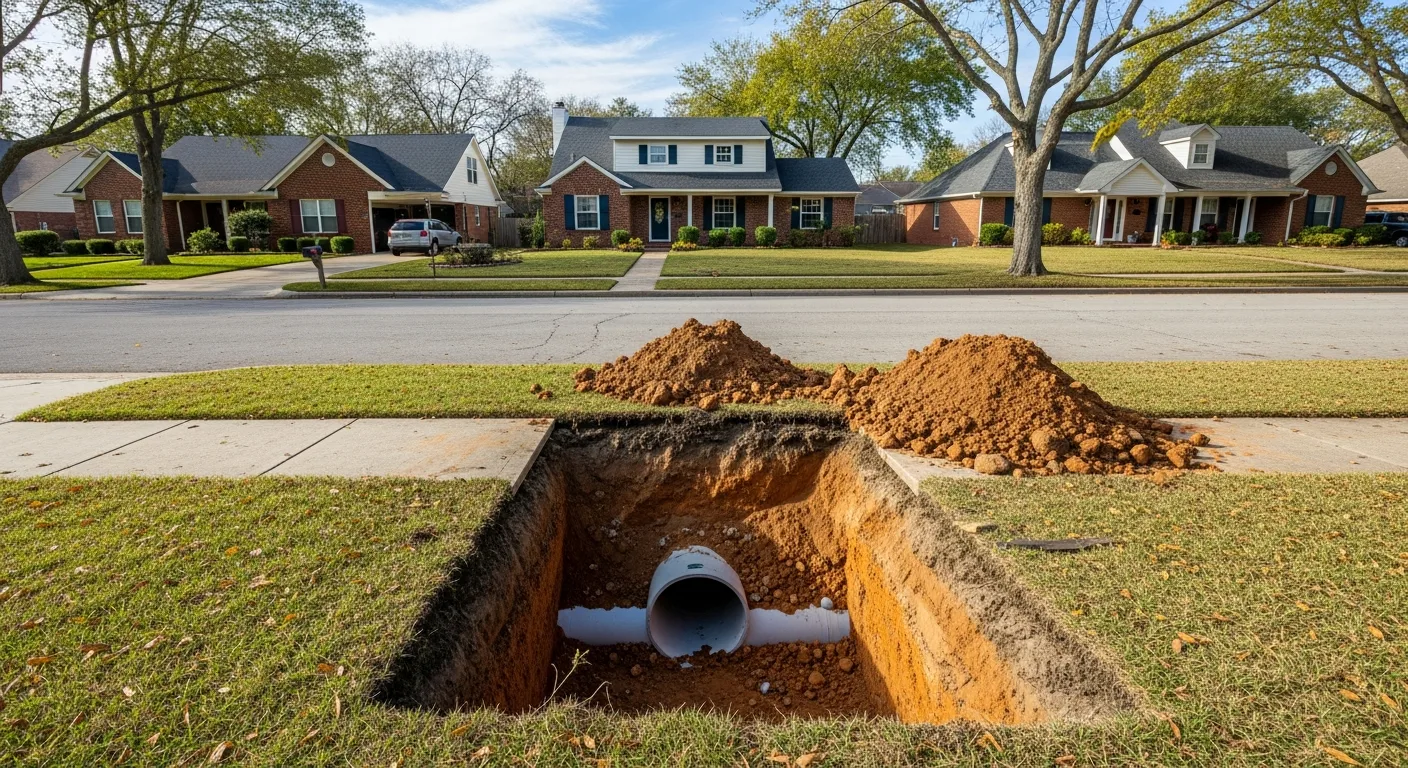
Open-cut replacement is exactly what it sounds like. You dig a trench, remove the old pipe, lay new pipe, backfill, and restore the surface.
When Open-Cut Makes Sense
Open-cut is the right choice when:
- The pipe has completely collapsed and there is nothing left to burst or line
- The pipe has severe bellies that need grade correction
- The line runs through open ground where excavation is easy and surface restoration is simple
- You need to upsize the pipe significantly (going from 4-inch to 6-inch, for example)
- The depth is shallow enough that shoring costs are minimal
- Access for trenchless equipment is limited or impossible
Open-Cut Process
Locate all utilities. Call 811 and get your locate tickets. On residential work, remember that private utilities (irrigation, landscape lighting, invisible fence) are not marked by 811. Use your own locating equipment or hire a private locator.
Excavate the trench. Depending on depth, you may need trench boxes, hydraulic shoring, or sloping. OSHA requires protective systems for any trench 5 feet deep or more. Many sewer lines run 6 to 12 feet deep, so shoring is almost always needed.
Remove the old pipe. Break out and remove the existing pipe in sections. Separate materials for proper disposal. Clay and concrete pipe can often go to a clean fill site. Cast iron may have scrap value.
Prepare the bedding. Lay a minimum 4-inch bed of granular material (pea gravel or crushed stone) under the new pipe. This provides uniform support and prevents point loading on the pipe.
Install new pipe. Lay the new pipe to grade, typically SDR-35 PVC for gravity sewers or SDR-21 for pressure applications. Make connections at both ends and to any service laterals.
Backfill in lifts. Backfill with approved material in 12-inch lifts, compacting each lift to 95% standard Proctor density. Under roads or structures, you may need controlled density fill (flowable fill) instead of compacted backfill.
Restore the surface. Replace whatever you dug through: pavement, sidewalk, landscape, irrigation. This is often the most expensive single line item on an open-cut job.
Open-Cut Challenges
The biggest challenge with open-cut work is surface restoration. Replacing a sewer line that runs under a driveway, through a landscaped yard, or under a street adds significant cost and time to the project. You also have to deal with dewatering if the trench is below the water table, traffic control if you are in the right-of-way, and utility crossings that need to be supported during excavation.
Trenchless Method 1: Pipe Bursting
Pipe bursting replaces the old pipe by pulling a new HDPE pipe through the existing line while simultaneously breaking the old pipe outward into the surrounding soil.
How Pipe Bursting Works
A bursting head (an expander cone) is attached to the front end of the new HDPE pipe. A pulling cable or rod runs from the bursting head, through the existing pipe, to a pulling machine at the other end. The pulling machine draws the bursting head through the old pipe, fracturing it outward, while the new pipe follows directly behind.
You need two access pits: one at each end of the run. These pits are typically 4 feet by 6 feet and need to be deep enough to provide a straight pull through the existing pipe alignment.
Pipe Bursting Advantages
- Minimal surface disruption. You only dig two pits instead of an entire trench.
- Speed. A typical residential lateral can be burst and replaced in a single day.
- Seamless pipe. HDPE pipe is fused together on site, creating a monolithic, joint-free line with zero infiltration points.
- Can upsize. You can typically go one pipe size larger than the existing pipe (4-inch to 6-inch, for example).
- Works in most soil conditions. The displaced pipe fragments push into the surrounding soil without difficulty in most cases.
Pipe Bursting Limitations
- Cannot correct grade problems. The new pipe follows the alignment of the old pipe. If the old pipe has a belly, the new pipe will have the same belly.
- Service lateral reconnection. Every service connection must be excavated and reconnected after the burst. On mainline projects, this can add significant cost.
- Not suitable for severely deteriorated pipe in soft or saturated soil. If the old pipe has disintegrated and the soil has filled the void, there may not be enough remaining pipe to guide the bursting head.
- Limited by bends. Pipe bursting works best on straight runs. Significant bends in the existing line can cause the bursting head to track off-line.
Pipe Bursting Equipment
The basic equipment package includes a hydraulic pulling machine (rated for the pipe size you are bursting), bursting heads in various sizes, HDPE pipe and a butt fusion machine, pulling rods or cables, and a pit shoring system. This is a significant equipment investment, typically $80,000 to $150,000 for a complete setup. Many contractors start by subbing out the bursting work and investing in their own equipment as volume justifies it.
Trenchless Method 2: CIPP Lining
Cured-in-place pipe (CIPP) lining installs a new pipe inside the existing pipe without removing or disturbing the old line at all.
How CIPP Lining Works
A flexible felt or fiberglass tube is saturated with a thermosetting resin (epoxy, polyester, or vinyl ester). The saturated liner is inverted or pulled into the existing pipe, inflated against the pipe wall, and then cured using hot water, steam, or UV light. When the resin hardens, you have a smooth, seamless, structural pipe lining that is essentially a new pipe inside the old one.
CIPP Advantages
- Zero excavation in many cases. If you can access the pipe through an existing cleanout or manhole, you may not need to dig at all.
- Preserves surrounding infrastructure. No disruption to roads, sidewalks, landscapes, or structures above the pipe.
- Excellent for root intrusion repair. The seamless liner eliminates all joint gaps where roots enter.
- Fast cure times. UV-cured liners can be ready for service in hours. Steam and hot water cured liners typically take 4 to 8 hours.
- Minimal diameter reduction. A typical liner reduces the pipe interior diameter by about 6mm, which has negligible effect on flow capacity because the smooth liner surface reduces friction compared to the rough interior of an old clay or concrete pipe.
CIPP Limitations
- Cannot fix collapsed pipes. You need a reasonably intact pipe to serve as the host for the liner. If the pipe has collapsed, lining is not an option.
- Cannot correct grade. Like pipe bursting, the liner follows the existing alignment.
- Lateral reinstatement. Service connections buried under the liner must be reopened using a remote cutting robot after the liner is cured.
- Diameter reduction. While typically negligible, lining reduces the interior diameter. On already-undersized pipes, this can be a concern.
- Temperature sensitivity during installation. Resin pot life and cure times are affected by ambient and groundwater temperatures. Cold weather installations require careful planning.
Quality Control for CIPP
Proper quality control is critical for CIPP work. At minimum, you should verify resin mix ratios and wet-out quality before installation, monitor cure temperatures throughout the cure cycle, measure wall thickness of the finished liner (typically by cutting coupons at the ends), and run a post-installation camera inspection to verify the liner is smooth, fully cured, and free of defects.
On municipal and commercial projects, you may also need to provide test samples (flat plate specimens cured alongside the liner) for independent lab testing of flexural strength and modulus.
Making the Right Choice: Decision Framework
Here is a practical decision framework for choosing between methods:
Choose Traditional Open-Cut When:
- The pipe is completely collapsed
- Grade correction is needed
- The pipe is shallow (under 4 feet) and in open ground
- You need to significantly upsize the pipe
- Access for trenchless equipment is restricted
- Surface restoration costs are low (open field, gravel, etc.)
Choose Pipe Bursting When:
- The pipe is cracked, separated, or root-infested but still has a defined bore
- The line runs under pavement, structures, or landscaping
- You want to upsize by one pipe size
- The run is relatively straight
- Speed is important
Choose CIPP Lining When:
- The pipe is structurally sound but has joint infiltration, root intrusion, or minor cracks
- Zero excavation is the goal
- The pipe runs under critical infrastructure
- You are rehabilitating a long run with multiple service connections
- The project is a municipal or commercial mainline rehab
- The scope involves a wastewater treatment plant or other large-scale treatment facility
Estimating and Bidding Sewer Replacement Work
Accurate estimating on sewer work requires detailed information from the camera inspection. Without it, you are guessing.
Key Cost Factors
Pipe depth is the single biggest cost driver for open-cut work. Deeper pipes mean more excavation, more shoring, more backfill, and higher risk. A 4-foot deep sewer line and a 12-foot deep sewer line are completely different jobs.
Pipe material and condition determine the difficulty of removal (open-cut) or the feasibility of trenchless methods. Cast iron pipe is harder to burst than clay. Collapsed pipe eliminates lining as an option.
Surface conditions drive restoration costs. Replacing a sewer under a concrete driveway costs a lot more than replacing one through a grass yard.
Service lateral connections add cost to every method. Each lateral connection on a mainline burst needs an excavation pit and a reconnection. Each lateral on a lined section needs robotic reinstatement.
Access and staging affect equipment mobilization costs. Trenchless equipment needs room to set up. If the only access is through a narrow side yard, you may need smaller equipment or a different approach entirely.
Using Project Management Software
Sewer replacement projects involve a lot of moving parts: camera inspections, locate tickets, permits, equipment scheduling, material orders, subcontractor coordination, and inspection hold points. Keeping all of this organized in spreadsheets or on paper is a recipe for missed steps and costly delays.
Construction project management software like Projul keeps everything in one place. You can track each phase of the job, attach camera inspection reports and videos to the project file, schedule crews and equipment, manage material orders, and keep a complete record of the work for warranty purposes.
If you are running multiple sewer replacement projects at once, having a system that lets you see the status of every job at a glance is worth its weight in gold. Check out Projul’s pricing or request a demo to see how it fits your operation.
Safety Considerations
Sewer line work comes with specific safety hazards that you need to plan for.
Trench safety is non-negotiable. OSHA fines for trench violations are severe, and the consequences of a trench collapse are fatal. Use appropriate protective systems for every excavation over 5 feet deep.
Confined space entry applies to any work inside manholes or large-diameter pipes. You need a written confined space program, trained entrants and attendants, atmospheric monitoring, and rescue equipment.
Traffic control is required any time you are working in or near the road right-of-way. Follow your local jurisdiction’s traffic control manual and obtain the required permits.
Utility conflicts are always a concern on underground work. Verify the location of gas, electric, water, telecom, and any other utilities before you dig. Potholing (hand digging or vacuum excavation) at crossing points is cheap insurance against a catastrophic utility strike.
Hot work comes into play if you are fusing HDPE pipe. The butt fusion machine operates at temperatures above 400 degrees Fahrenheit. Keep a fire extinguisher nearby and maintain clear zones around the fusion equipment.
Getting Started with Trenchless
If you are currently an open-cut only operation and want to add trenchless capabilities, here is a practical path:
-
Start with camera inspection. Buy or lease a quality sewer camera and start running inspections on every sewer job. This builds your diagnostic skills and helps you identify which jobs are candidates for trenchless.
-
Sub out your first trenchless jobs. Find a reputable trenchless subcontractor in your area and sub them the pipe bursting or lining work. You manage the project, they do the specialty work. This lets you learn the process without a major equipment investment.
-
Invest in equipment when volume supports it. Once you are doing enough trenchless work to justify the equipment, invest in your own setup. Start with pipe bursting, which has a lower entry cost than CIPP lining.
-
Get trained. Both pipe bursting and CIPP lining require specific training. Equipment manufacturers offer training programs, and organizations like NASSCO offer certification courses for CIPP installation and inspection.
-
Market your capabilities. Trenchless methods are a strong selling point, especially for residential customers who do not want their yards torn up. Make sure your website, proposals, and marketing materials highlight your trenchless capabilities.
Permits, Inspections, and Code Requirements
Every sewer line replacement job requires permits, and the inspection process varies by jurisdiction. If you skip this section of the planning or treat it as an afterthought, you are setting yourself up for delays, re-work, and fines.
Typical Permit Requirements
Most municipalities require a plumbing permit for any sewer line replacement, whether residential or commercial. Some jurisdictions also require a separate excavation permit or right-of-way permit if you are working in public easements or under streets. On larger municipal rehab projects, you may be dealing with environmental permits related to bypass pumping and discharge.
The permit application typically requires a site plan showing the location of the existing and proposed sewer line, the depth of the line, the materials to be used, and the connection points. For trenchless work, some jurisdictions have additional requirements or separate permit categories. It pays to call the building department before you bid the job so you know exactly what they want.
Inspection Hold Points
Sewer line installations usually have at least two inspection hold points. The first is a bedding and alignment inspection before backfill on open-cut jobs, or a pre-installation inspection for trenchless work. The second is a final inspection, which often includes a camera run of the completed installation and sometimes an air test or water infiltration test.
On commercial and municipal projects, you may also have compaction testing requirements for backfill, mandrel testing for flexible pipe, and vacuum or pressure testing for force mains.
Do not backfill or restore surfaces until you have passed all required inspections. Re-excavating to show an inspector something you already covered is expensive and makes you look unprofessional.
Code Considerations
The International Plumbing Code (IPC) and Uniform Plumbing Code (UPC) both address sewer pipe materials, minimum grades, cleanout requirements, and connection methods. Your local code may add additional requirements on top of these national codes.
Pay attention to minimum slope requirements. The standard minimum grade for 4-inch residential sewer pipe is 1/8 inch per foot (1% slope). For 6-inch pipe, it is 1/8 inch per foot in most codes, though some jurisdictions allow 1/16 inch per foot for 6-inch and larger. Getting the grade wrong is a callback waiting to happen.
Cleanout spacing is another area where codes vary. The IPC requires a cleanout every 100 feet for pipes 4 inches and smaller, and every 200 feet for larger pipes. Many local codes are stricter. On a long trenchless run, you may need to install intermediate cleanouts, which means additional excavation points.
Working with Inspectors
Build a good relationship with your local inspectors. They are not the enemy. Call ahead to schedule inspections so you are not sitting around waiting. Have your permit posted on site. Have your camera footage ready to show if they ask. If an inspector flags something, fix it without arguing. The inspector who remembers you as the contractor who does clean work and never pushes back on corrections is the inspector who will work with you when you need flexibility on a future job.
Real-World Cost Breakdown: What These Jobs Actually Cost
Pricing sewer line replacement work varies wildly by region, depth, pipe size, and conditions. But here are some ballpark numbers based on real project data that should help you calibrate your estimates.
Residential Lateral Replacement (Typical 50-80 Foot Run)
Open-cut replacement for a residential sewer lateral running 6 to 8 feet deep through a yard with no major obstructions typically runs $8,000 to $15,000 in most markets. That includes excavation, pipe materials (SDR-35 PVC), backfill, compaction, and basic landscape restoration. If the line runs under a driveway or sidewalk, add $2,000 to $5,000 for concrete removal and replacement.
Pipe bursting for the same residential lateral typically runs $6,000 to $12,000. The pipe material cost is higher (HDPE vs PVC), and you need a fusion machine on site, but you save significantly on excavation and restoration. The two access pits are usually the only digging required.
CIPP lining for a residential lateral runs $5,000 to $10,000 if the pipe is structurally sound enough to accept a liner. If you can access through an existing cleanout, the excavation cost drops to nearly zero.
Municipal Mainline Rehabilitation (Per Linear Foot)
Mainline sewer rehab is typically priced per linear foot. Open-cut replacement in the 8-inch to 12-inch range runs $150 to $400 per foot depending on depth, soil conditions, and surface restoration requirements. Pipe bursting runs $80 to $200 per foot. CIPP lining runs $50 to $150 per foot for standard installations.
These per-foot numbers look like trenchless is always cheaper, but remember that service lateral reconnections add $1,500 to $3,000 per lateral on pipe bursting jobs and $800 to $1,500 per lateral for robotic reinstatement on CIPP jobs. On a mainline with laterals every 50 feet, those reconnection costs add up fast.
Hidden Cost Factors That Catch Contractors Off Guard
Bypass pumping is required when you cannot take the line out of service during the work. On active sewer mains, you need to pump flow around the work zone 24 hours a day until the job is done. Bypass pumping can run $2,000 to $10,000 per day depending on flow volume and distance.
Dewatering is needed when the trench or access pits are below the groundwater table. Pump costs, discharge permits, and the time it takes to dewater before you can work are all line items that contractors sometimes underestimate.
Soil disposal becomes a cost factor when the existing backfill material is contaminated. Old gas station sites, industrial properties, and even some residential lots built on fill can have soil contamination that requires special handling and disposal at licensed facilities. Always ask about the property history and consider soil testing on commercial jobs.
Night work and weekend premiums are common on municipal projects where the specifications limit work hours to minimize traffic disruption. If the spec says you can only close lanes between 9 PM and 5 AM, your labor costs just went up 30 to 50 percent.
Tracking these costs across multiple jobs is where most contractors lose visibility. You might know a job was profitable, but can you say exactly where your margins were tighter than expected? Job costing tools built for contractors let you compare estimated vs actual costs in real time, so you can catch problems before they eat your profit.
Common Mistakes That Kill Profit on Sewer Jobs
After talking to hundreds of contractors who do sewer work, the same mistakes come up over and over. Here is what to watch out for.
Bidding Without Enough Information
The biggest profit killer in sewer replacement is bidding a job without a camera inspection. When you bid blind, you are making assumptions about pipe material, depth, condition, and connections. Every one of those assumptions is a potential change order if you guessed wrong, or a loss if you eat the cost to keep the customer happy.
Always include a camera inspection in your bid. If the customer already has camera footage from another contractor, ask to see it. If it is more than a year old, run a new one. Pipe conditions change, especially if there is active root growth.
Underestimating Surface Restoration
On open-cut jobs, the excavation and pipe installation are usually straightforward. It is the surface restoration that surprises contractors. Matching existing concrete finishes, re-establishing landscaping, re-routing irrigation that was cut during excavation, replacing fence sections that were removed for equipment access: all of this costs time and money.
When you are putting together your estimate, walk the entire route and note every surface condition you will need to restore. Take photos. Include every item in your bid. Do not lump it all into a generic “restoration” line item. Break it out so you and the customer both know exactly what is included.
Ignoring Material Lead Times
HDPE pipe, especially in larger diameters, can have lead times of two to four weeks depending on your supplier and the diameter you need. CIPP liner materials are often custom-fabricated for each project and can take one to three weeks to arrive. SDR-35 PVC in standard sizes is usually available off the shelf, but specialty fittings and transition couplings can cause delays.
Order materials as soon as you have a signed contract. Do not wait until the week before you plan to start. A week of idle crew time because pipe has not arrived costs more than a few weeks of material storage.
Skipping the Post-Installation Camera Run
Running a camera after installation is not just good practice. It is your proof that the work was done correctly. It catches installation defects before they become warranty calls. It shows the customer exactly what they paid for. And it creates a baseline record that protects you if someone else damages the line later and tries to blame your work.
Some contractors skip the post-installation camera to save an hour of time. That is a terrible trade. Budget the time for it on every single job.
Poor Documentation Habits
Sewer line work generates a lot of documentation: permits, locate tickets, camera reports, daily logs, inspection reports, compaction test results, as-built drawings. If you are keeping all of this in a truck folder or scattered across email chains and text messages, you are going to lose something important.
A project management platform like Projul lets you attach every document, photo, and video to the project record. When you need to pull up the pre-construction camera footage from a job you did eight months ago, it is right there. When an inspector asks for your compaction test results, you can pull them up on your phone in the field. That kind of organization is not just about looking professional. It saves you real time and real money.
Emerging Trends in Sewer Rehabilitation
The sewer rehabilitation industry continues to evolve, and contractors who stay current with new methods and technologies will have a competitive advantage.
UV-Cured CIPP Lining
UV-cured liners are rapidly gaining market share over traditional hot water and steam cure methods. The advantages are significant: no heat-related shrinkage, faster cure times (minutes instead of hours), no wet-out facility needed on site (liners arrive pre-impregnated and refrigerated), and more consistent quality because the resin system is factory-controlled rather than mixed in the field.
The trade-off is higher material cost and the need for a UV light train, which is a significant equipment investment. But for contractors doing volume CIPP work, UV cure is becoming the standard.
Spray-In-Place Pipe (SIPP)
Spray-in-place lining uses a spinning application head to apply a structural coating (typically polyurea or epoxy) directly to the interior of the existing pipe. It is faster than CIPP for short sections and lateral connections, and it works well for spot repairs where a full liner is not needed.
SIPP is not yet as widely accepted as CIPP for structural rehabilitation, but it is gaining traction for protective linings and partial structural repairs. Keep an eye on this technology, especially for residential lateral work.
Robotic Repair Systems
Robotic systems that can perform spot repairs inside pipes without any excavation are getting more capable and more affordable. These systems can grind out failed joints, apply structural patches, reinstate laterals, and remove obstructions, all controlled by an operator watching a camera feed from the surface.
For contractors who do a lot of sewer maintenance and repair work, a robotic repair system can turn small jobs that would otherwise require an excavation crew into one-truck, one-operator jobs. The return on investment can be substantial.
Digital Project Management and Field Reporting
The days of paper daily reports and hand-drawn as-builts are numbered. More and more project owners and municipalities are requiring digital documentation, including geo-referenced as-built drawings, digital daily reports, and cloud-based document management.
Contractors who already have digital systems in place have a real advantage when bidding work that requires this level of documentation. If you are still running your projects on paper and spreadsheets, it is worth looking at construction management software that can handle the documentation requirements of modern sewer rehabilitation projects. Scheduling tools that keep your crews, equipment, and inspectors coordinated are just as important as the pipe in the ground.
Wrapping Up
Sewer line replacement is a bread-and-butter service for plumbing and utility contractors. Having both traditional and trenchless methods in your toolkit lets you match the right technique to each job, which means better results for your customers and better margins for your business.
The key is always starting with a thorough camera inspection, understanding the condition and alignment of the existing pipe, and choosing the method that fits the specific conditions of that job. There is no single “best” method. There is only the right method for each situation.
Whatever approach you choose, keeping your projects organized and your documentation tight is what separates the contractors who grow from the ones who stay stuck. A good project management system makes that a lot easier. See what Projul can do for your operation.
Frequently Asked Questions
What is trenchless sewer line replacement?
How much does trenchless sewer replacement cost compared to traditional?
When should you use traditional open-cut sewer replacement?
How long does CIPP lining last?
Do you always need a camera inspection before sewer line replacement?
Can you use trenchless methods on clay or cast iron pipes?
What pipe materials are used in trenchless replacement?
How do you manage service laterals during trenchless sewer replacement?
Related Articles
Best Glazier Software in 2026: 6 Options Compared for Glass Contractors
Looking for the best glazier software? We compare six top options for glass contractors, covering features, pricing,...
Read More →
Best Roofing Contractor Software in 2026: 6 Options Compared
Looking for the best roofing contractor software? We compare six top options, including pricing, roofing-specific...
Read More →
Fire Sprinkler System Installation: Wet vs Dry Systems, Pipe Sizing, and Code Requirements
Fire sprinkler systems are one of those building components that nobody thinks about until they are needed. But for...
Read More →