Construction Communication Software - Ditch the Group Texts, Keep Every Update Organized
- Instant updates between office and job site
- Automatically organized and channeled communications
- Easily track and find project photos and messages even years later!
Keep everyone on track with construction communication software that actually works
If you’re running a construction company, you already know the #1 source of problems on any project: communication. Missed messages, unclear instructions, photos stuck on someone’s phone, and crews that don’t have the info they need to do their jobs right.
Projul’s construction communication software fixes that by giving your entire team one place to share updates, photos, files, and messages, all organized by project and task. No more phone tag. No more lost texts. Over 5,000 contractors use Projul to keep their office and field crews in sync every day.
Projul’s construction communication software replaces scattered group texts with project-organized messaging between office and field crews. Photos, updates, and files stay searchable by job for years. Projul offers flat-rate pricing with no per-user fees for construction companies of all sizes.
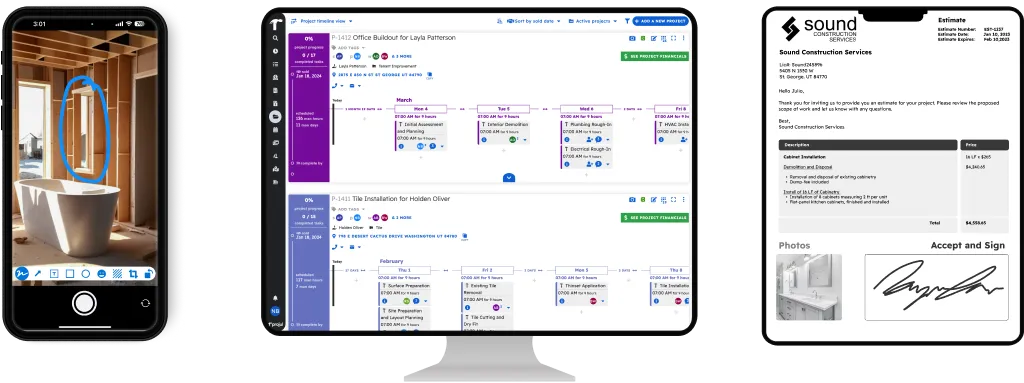
Send updates as easily as updating a task, sending a text, or using talk-to-text. Field workers can snap pictures right in messages to eliminate confusion, and even mark up photos for additional clarity.
- Send messages from the mobile app in seconds
- Easy to use, simple messaging your crew will actually adopt
- Get notified when new messages arrive
Why Group Texts Don’t Work for Construction
Every contractor has tried it. You start a group text for each job, and within a week it’s a disaster. Messages get buried. Someone adds their buddy by accident. Half your crew mutes the thread because it blows up their phone at 6 AM. And good luck finding that one photo from three weeks ago.
Group texts fail for contractor team communication because they weren’t designed for it. There’s no way to organize messages by project. No way to search for a specific update. No way to keep client communication separate from crew communication. And when a project wraps up, all that info disappears into a text thread nobody will ever scroll through again.
The bigger problem? Important details get lost. A sub asks a question about the scope, and the answer gets buried under 47 messages about lunch plans and schedule changes. That missed answer turns into a mistake, and that mistake costs you money.
Construction communication software like Projul solves this by giving every project its own dedicated channel. Messages, photos, and files are tied to the job they belong to. Your crew gets project-specific updates without the noise. And everything is searchable, even years later.
What Real Job Site Communication Looks Like
Real contractor team communication isn’t about fancy features. It’s about getting the right information to the right person at the right time, without 14 phone calls and a game of telephone.
Here’s what that looks like with Projul:
Your foreman spots a problem on site. He opens Projul on his phone, snaps a photo, marks it up to highlight the issue, and sends it with a quick note. The project manager sees it instantly. No phone calls needed.
A client asks about project status. Instead of calling you (while you’re on another job site), they log into the client portal and see exactly where things stand. Photos, updates, and timeline, all in one place.
You need to send a change order. The messaging and communications tools let you send it directly through Projul, tied to the project. The client reviews it, approves it, and everything is documented. No he-said-she-said later.
A schedule change happens. Mobile notifications push the update to every crew member who needs to know. They don’t have to check a text thread or call the office. The info comes to them.
That’s what construction communication software should do. Not add another app to check, but replace the chaos with something that actually works on a job site.
Never Lose a Message Again
Projul automatically tags and channels every message, photo, and follow-up to the right project and task. Over 5,000 contractors use Projul to keep communications organized and easy to find, even years later.
No more scrolling through days of texts or digging through group chats. Everything lives where it belongs in Projul.
- Automatically created channels built into each project
- Eliminate the need to scroll through days worth of texts
- No need to create endless group chats for every job
Think about how much time you spend just looking for information. Searching your texts for that one photo a sub sent. Scrolling through emails trying to find the change order approval. Calling three people to figure out what happened on a job last Tuesday.
Projul’s search pulls up any message, photo, or file by project in seconds. Two years from now, if a warranty issue comes up, you can find the exact conversation and photos from that phase of the build. Try doing that with a group text.
Easily Track Project Photos and Messages
Projul eliminates the need for separate messaging and photo storage tools. Everything lives inside the project. With unlimited photo storage and no per-user fees, your whole crew can upload and access project photos and messages without extra cost.
Add steps, notes, images, markup, or files to tasks so details are never missed and expectations stay clear for everyone on the project.
- Channeled messages organized on the project level
- Unlimited photo storage for all your project photos
- Quickly send and receive updates to and from every job site
Most construction communication software charges per user, which means you either pay a fortune or leave half your crew without access. Projul’s flat-rate pricing means everyone on the team can communicate through the platform. Your subs, your office staff, your foremen. Everyone.
Let Automation Handle the Follow-Ups
You shouldn’t have to manually remind every client about every appointment and every payment. Pair your project communications with automated client reminders so clients get appointment confirmations and payment nudges without you sending a single email.
Add mobile notifications and your field crew stays in the loop the moment anything changes. Schedule shifts, new task assignments, messages from clients. It all hits their phone automatically.
Common Communication Mistakes That Cost Contractors Money
After working with thousands of construction teams, certain communication failures come up again and again. Here are the ones that hurt the most and how to avoid them.
Relying on verbal instructions for scope changes. A homeowner asks your lead carpenter to move a wall outlet six inches to the left. He says sure and does it. Nobody writes it down. Three weeks later, the homeowner says they never asked for that and refuses to pay the change order. Without a written record tied to the project, you eat the cost. Always document scope changes in writing through your project management tool, not just a conversation on site.
Not looping in subs on schedule changes. You push a framing inspection back two days but forget to tell the electrician. He shows up ready to rough in and there’s nothing to wire yet. That’s a wasted trip he may bill you for, and it throws off every trade behind him. Use project-level notifications so every sub on the job gets schedule updates automatically.
Keeping project info in one person’s head. If your project manager is the only person who knows the details of a job, you have a single point of failure. When they’re sick, on vacation, or leave the company, nobody knows what’s going on. Centralized communication tied to the project means anyone on the team can pick up where someone left off.
Mixing personal and work communication channels. When project updates live in the same text thread as weekend plans and fantasy football talk, critical messages get buried. Dedicated project channels in Projul keep work communication separate from everything else. Your crew gets project info without the noise, and nothing important gets lost in the scroll.
Failing to document daily progress. Even on smooth projects, keeping a daily record of what happened protects you. Use daily logs alongside your communication tools to create a timeline of every project. If a dispute comes up months later, you’ll have the messages, photos, and notes from every single day.
The contractors who avoid these mistakes aren’t doing anything complicated. They’re just using a system that keeps communication organized and searchable instead of scattered across phones, texts, and memory. Tools like scheduling and lead management tie into your communication workflow so nothing falls through the cracks from first contact to final walkthrough.
Photos and Docs That Stay With the Project
All your project photos and files live right alongside your messages. Connect with photos and document management to keep everything organized by job. Need to reference a conversation or photo from last year? Projul’s powerful search pulls it up in seconds.
Your project documentation becomes your protection. When a client disputes a change order, you pull up the photos and messages from that exact conversation. When an insurance claim comes up, you’ve got every photo documented with timestamps. It’s not just communication. It’s your paper trail.
The Communication Problem Every Contractor Knows
You’ve been there. It’s 7 AM and you’re trying to piece together what happened on a job yesterday. You check your texts - nothing useful, just a thread that went sideways talking about where to grab lunch. You call your foreman. Voicemail. You check your email and find a client question from two days ago that nobody answered. There’s a sticky note on your desk that says “call Dave about the drywall” but you don’t remember which Dave or which job.
This is how most contractors operate, and it’s costing you more than you realize.
Construction communication is broken because it happens in too many places at once. Your office manager sends emails. Your foremen send texts. Your subs call and leave voicemails. Your clients message you on Facebook, email, and text - sometimes all three about the same question. Somewhere in your truck there’s a napkin with measurements scribbled on it from a site visit last week.
None of it is connected. None of it is organized. And none of it is tied to the actual project it belongs to.
The Real Cost of Scattered Communication
Think about the last time a miscommunication cost you money. Maybe a sub showed up on the wrong day because the schedule change was communicated via text - and he didn’t see it because he was in a dead zone. Maybe a client approved a change order verbally, but when the invoice came, they suddenly didn’t remember agreeing to it. Maybe you lost a full day of productivity because your crew didn’t have the updated specs and built something that had to be torn out.
These aren’t rare events. They happen every week on job sites across the country. A study by the Project Management Institute found that poor communication is the primary cause of project failure one-third of the time. For contractors, “project failure” translates directly into lost profit, blown timelines, and damaged reputations.
And here’s the part nobody talks about: when project communication lives on someone’s personal phone, it belongs to that person - not your company. When your best project manager leaves, every text thread, every photo, every conversation about every job they managed walks out the door with them. You’re left with nothing. No history. No context. No way to look up what was discussed on a project six months ago.
That’s not just inconvenient. That’s a business risk.
The Sticky Note Problem
Every contractor has a system. The problem is, it’s usually held together with sticky notes, memory, and good intentions.
You’ve got a folder in your truck with printed plans that are two revisions old. Your office has a whiteboard with the schedule - but nobody updated it since Tuesday. Your project manager keeps everything in his head, and when you ask him about the Johnson project, he pulls out his phone and scrolls through 200 text messages to find the answer.
This “system” works - until it doesn’t. And it usually stops working at the worst possible time. During a busy season when you’re running six jobs at once. When a key employee calls in sick. When a client threatens legal action and you need to produce documentation of every conversation you’ve had about their project.
The truth is, scattered communication doesn’t just slow you down day to day. It makes your entire business fragile. You can’t scale a company that runs on one person’s memory and a pile of text threads. You need a system where every message, every photo, every update is automatically tied to the project it belongs to - and accessible to anyone on your team who needs it.
That’s exactly what Projul was built to do. Not as an afterthought or an add-on, but as the core of how your construction business communicates.
When Communication Lives in Silos, Everyone Loses
Here’s a scenario that plays out constantly: Your office staff books a job through the CRM. They email the details to the project manager. The PM texts the foreman a summary. The foreman tells the crew verbally on the job site. By the time the actual scope reaches the guys doing the work, it’s been through four rounds of telephone.
Now multiply that by every active project in your company. Every schedule change, every material update, every client request goes through this same broken chain. And at each step, information gets lost, changed, or forgotten.
The worst part? When something goes wrong, nobody can figure out where the breakdown happened. Was it the email that didn’t get read? The text that got buried? The verbal instruction that was misunderstood? You spend more time investigating the communication failure than fixing the actual problem.
Contractors who move to a centralized communication system - where every conversation is tied to a specific project and visible to everyone who needs it - don’t just communicate better. They eliminate entire categories of problems that used to eat up hours every week.
How Projul Keeps Every Conversation Tied to the Job
The fundamental problem with using texts, emails, and phone calls for construction communication is that none of those tools know anything about your projects. A text message doesn’t know it’s about the Smith remodel. An email doesn’t automatically file itself under the right job. A voicemail just sits in your phone until you remember to do something about it.
Projul flips that around. Every message, every photo, every update is attached to a specific project from the moment it’s created. You don’t have to organize anything - it’s done for you.
Messages That Belong to the Project, Not a Phone
When your foreman opens Projul and sends a message about the Henderson job, that message lives on the Henderson project. Forever. It doesn’t live on his phone. It doesn’t disappear when he upgrades to a new device. It doesn’t walk out the door if he takes a job with another company.
This is a fundamental shift in how your business handles information. Instead of project knowledge being scattered across dozens of personal devices, it’s all in one place. Your entire team sees the same conversation. New team members can get up to speed on a project by reading the thread instead of asking fifteen questions.
And it’s not just messages. Photos taken on site are automatically tied to the project. Documents uploaded are filed where they belong. When you use photos and document management, every image and file becomes part of the permanent project record, not just another photo lost in someone’s camera roll.
Searchable History That Actually Works
Here’s a question: can you pull up the conversation you had about the Thompson project’s bathroom tile six months ago? If your communication lives in text threads, the answer is almost certainly no. You’d have to remember who you were texting, scroll through hundreds of messages, and hope you find it before you give up.
With Projul’s powerful search, you type “Thompson” and “tile” and you’ve got every message, photo, and document related to that topic in seconds. Six months from now. Two years from now. It doesn’t matter.
This isn’t a nice-to-have feature. It’s the difference between winning and losing a dispute. When a client says “nobody told me about the change order,” you pull up the exact message thread with timestamps. When an insurance adjuster asks for documentation, you produce the complete photo history of the project. When your accountant needs to verify a billing adjustment, you show them the conversation that led to it.
Searchable project history turns your communication into a business asset instead of a liability.
Everyone Sees the Same Thread
One of the biggest sources of confusion on construction projects is when different people have different information. Your PM tells the client one thing. Your foreman tells the sub something slightly different. The office quotes a number that doesn’t match what was discussed on site.
When all communication lives on the project in Projul, everyone sees the same thread. There’s no “he said, she said” because the conversation is right there in black and white. Your PM, your foreman, your office staff, and even your client (through the portal) are all looking at the same information.
This kind of transparency doesn’t just prevent mistakes - it builds trust. Your team trusts each other because nobody is working with outdated info. Your clients trust you because they can see exactly what’s happening. And you can trust your team because you have complete visibility into every project without micromanaging.
Photos and Documents in Context
A photo of a cracked foundation is useful. A photo of a cracked foundation attached to the right project, tagged to the right phase, with a note from your foreman explaining what he found - that’s powerful.
Projul keeps your photos and documents in the context where they matter. When someone uploads a photo on a project, it doesn’t just go into a generic photo library. It’s tied to the conversation, the task, and the project. You can see exactly when it was taken, who uploaded it, and what was said about it.
This contextual organization is what separates project management software from a filing cabinet. A filing cabinet stores things. Projul connects them. Every photo, every document, every message is part of a larger story about that project - and you can follow that story from start to finish without ever losing the thread.
Client Communication That Builds Trust
You know the phone call. It comes in at 3 PM on a Tuesday while you’re standing on a roof. “Hey, just checking in on the project. When do you think you guys will be starting the next phase?” You’ve gotten that call a hundred times. Different clients, same question.
It’s not that your clients are being difficult. They’re spending tens of thousands of dollars - sometimes hundreds of thousands - and they want to know what’s happening. That’s completely reasonable. The problem is that every time a client has to pick up the phone and call you for a status update, it means your communication system isn’t doing its job.
Automated Updates That Keep Clients Informed
Projul’s customer portal gives your clients a window into their project without requiring a single phone call from either side. When you update a project status, your client can see it. When you move to the next phase, they know. When a schedule change happens, they’re informed automatically.
Think about what this does for your day. Instead of fielding five or six “just checking in” calls, you spend that time actually running your business. Your clients are happier because they feel informed. You’re happier because your phone isn’t ringing off the hook. And your relationship with the client improves because they see you as organized and professional - not because you told them you were, but because they can see it with their own eyes.
Automated updates aren’t about removing the personal touch from your client relationships. They’re about handling the routine communication automatically so you can save the personal conversations for when they actually matter - design decisions, change orders, milestones worth celebrating.
Progress Photos They Can Actually See
Here’s what used to happen: your foreman takes 20 photos on site. They live on his phone. A week later, the client asks for progress photos. You ask your foreman to send them. He scrolls through his camera roll, finds half of them mixed in with pictures of his kids and his truck, and texts them to you. You forward them to the client. The client asks which photo is which because there’s no context.
With Projul, progress photos are uploaded to the project as they’re taken. Your clients can view them through the customer portal - organized, timestamped, and attached to the right phase of the project. They don’t need to call you. They don’t need to wait for someone to compile and send photos. They log in and see exactly what’s happening on their project.
This does something important for your business that goes beyond convenience. It builds trust. When a client can see daily progress photos, they feel connected to the project. They see the work being done. They understand why certain phases take time. And when it comes time to pay an invoice, they’ve already seen the work - there are no surprises.
Professional Estimates and Invoices That Reflect Your Brand
Communication isn’t just messages and updates. Every estimate you send, every invoice you create - those are communication touchpoints with your clients. And if they look like they were thrown together in a spreadsheet, that’s the message you’re sending about your business.
Projul’s branding customization lets you put your logo, your colors, and your professional identity on every client-facing document. Your estimates look polished. Your invoices look professional. Your change orders are clear and well-organized.
This matters more than most contractors realize. When a homeowner is comparing three estimates, the one that looks clean and professional gets taken more seriously - even if the price is higher. When an invoice arrives with your branding and a clear breakdown of work completed, it gets paid faster because the client feels confident they’re working with a real business.
Your brand is a communication tool. Make sure it’s saying the right things.
Reducing the “Did You Get My Message?” Problem
Every contractor has clients who send the same question through three different channels just to make sure someone sees it. They email your office, text your cell, and call your foreman. Not because they’re annoying - because they’ve been burned before by contractors who didn’t respond.
When you give clients a single, reliable way to communicate with your team through Projul’s portal, you train them to use one channel. They send a message, they see it was received, and they get a response. No more triple-messaging. No more “did you get my message?” follow-ups.
This isn’t just better for you - it’s better for the client. They have one place to go for everything related to their project. Messages, photos, documents, invoices, schedule updates. It’s all there. They feel organized, informed, and taken care of. And that feeling is what turns a one-time client into a referral source.
Internal Team Communication: Office to Field and Back
The gap between your office and your field crews is where most communication breaks down. Your office has all the project details, the specs, the schedules, the client requests. Your field crews have the boots-on-the-ground reality of what’s actually happening on site. Getting those two worlds to talk to each other efficiently is the difference between a smooth operation and daily chaos.
Notifications That Actually Reach the Field
Your crew isn’t sitting at a desk checking email. They’re on ladders, running saws, and covered in drywall dust. If your communication system relies on people checking in, it’s going to fail in the field.
Projul’s mobile notifications push updates directly to your crew’s phones. Schedule changes, new task assignments, messages from the office or client - it all comes through as a notification. Your guys don’t have to remember to check the app. The info comes to them.
And because Projul’s mobile app was built specifically for construction, it works the way your crew actually works. Big buttons. Simple interface. Works on data or WiFi. You don’t need to be tech-savvy to use it. If your crew can send a text, they can use Projul.
This is critical for adoption. The best communication tool in the world is useless if your crew won’t use it. Projul is built to be so simple that even your most tech-resistant guys will pick it up within a day or two - especially once they realize it means fewer phone calls interrupting their work.
Task Assignments With Context
Telling someone “go fix the thing at the Johnson job” is how mistakes happen. Which thing? Where at the Johnson job? What tools do they need? What did the client say about it?
When you assign tasks in Projul, you can attach all the context your crew needs. Photos showing the issue. Notes explaining what the client wants. Documents with specs or plans. Links to related tasks. Everything they need to do the job right, right there on the task.
This eliminates the back-and-forth. Instead of your crew calling the office three times to clarify what they’re supposed to do, they open the task and everything is there. The marked-up photo showing exactly where the problem is. The note from the PM explaining the priority. The client’s exact words about what they want changed.
Context turns a vague instruction into a clear action item. And clear action items get done right the first time, which means fewer callbacks, fewer mistakes, and more profit on every job.
Daily Logs That Capture What Actually Happened
At the end of every day, a lot happens on your job sites that never gets recorded. Which crews were there, what work was completed, what problems came up, what decisions were made. If nobody writes it down, it’s gone. And six months from now, when a question comes up about that project, you’re relying on memory.
Projul’s daily logs give your crews a quick, simple way to record what happened on site each day. A few notes, a couple of photos, and you’ve got a daily record that becomes incredibly valuable over time.
Daily logs serve multiple purposes. They’re your documentation if a dispute comes up. They’re your reference when planning similar projects in the future. They’re your way of tracking productivity across crews. And they’re your proof of work when a client questions what was accomplished during a specific week.
The key is making daily logging so easy that it actually happens. Projul’s mobile interface makes it a 60-second task. Your crew lead snaps a photo or two, types a quick note, and the day is documented. No forms to fill out. No reports to write. Just a quick update that takes less time than a phone call.
Bridging the Office-Field Gap
The biggest communication challenge in construction isn’t technology - it’s the physical distance between the people who manage the business and the people who do the work. Your office staff is scheduling, invoicing, and managing clients. Your field crews are building, fixing, and solving problems. These two groups operate in completely different environments, on completely different schedules, with completely different priorities.
Projul bridges that gap by putting everyone on the same platform. When your office updates a schedule, the field crew sees it immediately. When your field crew reports a problem, the office can respond in real time. When a client asks a question, whoever has the answer can respond - whether they’re at a desk or on a roof.
This real-time connection between office and field does something that phone calls and texts can’t: it creates a continuous flow of information. Not bursts of communication between long silences, but an ongoing thread that everyone contributes to throughout the day. Your office knows what’s happening in the field. Your field knows what the office needs. And nobody has to make a phone call to get basic information.
The result is a company that operates like a single team instead of two separate groups trying to coordinate across a gap. Jobs run smoother. Problems get solved faster. And you spend less time playing middleman between your office and your crews.
How to Set Up Job Site Communication That Sticks
The biggest challenge with any construction communication tool isn’t the software. It’s getting your crew to actually use it. Here are practical steps that work for real construction teams.
Start with your foremen, not everyone at once. Roll out project messaging to your lead guys first. Let them get comfortable with it for a week or two. When the rest of the crew sees the foremen using it naturally, adoption happens faster than if you announce a company-wide change on a Monday morning.
Make it the only place for project updates. If you keep answering project questions over text while also having Projul, your crew will default to texting because it’s what they know. Set the expectation clearly: project questions and updates go through Projul. Personal stuff stays on your phone. The transition is uncomfortable for about two weeks, then it becomes habit.
Use the photo markup feature from day one. Nothing gets a crew to adopt new software faster than a feature that solves an actual daily pain point. Marked-up photos save time explaining problems, showing progress, and documenting issues. Once your guys realize they can circle a problem area and send it in five seconds instead of making a phone call and trying to describe it verbally, they’re sold.
Set a daily check-in routine. Have each crew lead post a quick end-of-day update with one or two photos on their active project. This takes 60 seconds and gives your office complete visibility into every job without a single phone call. It also builds a daily record you can reference if questions come up later.
Connect communication to your money trail. When estimates and change orders live in the same system as your messaging, approvals happen faster. A client question about a line item turns into a two-message exchange instead of three phone calls. And when invoicing ties to the same project thread, your office staff can reference the exact conversation that led to a billing adjustment.
Track crew hours alongside project updates. When your time tracking and communication live in the same platform, you can cross-reference what happened on a job with who was there and for how long. This is especially useful when a client questions labor charges or when you need to review productivity on a specific phase.
Use your communication data to improve your CRM follow-ups. When all your client interactions live in one searchable system, you can see patterns. Which clients respond fastest to certain types of messages? Which projects had the most communication issues? That data helps you refine how you manage client relationships from the first estimate through final walkthrough.
For more strategies on keeping your field and office teams aligned, read our guide on how to improve construction site communication.