Commercial Contractors Software. Built by construction pros with honest pricing.
Managing commercial construction projects should be profitable, not frustrating. Projul's Commercial Edition, rated 9.8 out of 10 on G2, helps you optimize operations from bids to closeout with precision, clarity, and efficiency. What Projul helps you do:
- Win more contracts with professional, fast-moving proposals
- convert accepted bids into scheduled tasks
- Bill at every stage: deposit, progress, change orders, and final. Without missing a beat
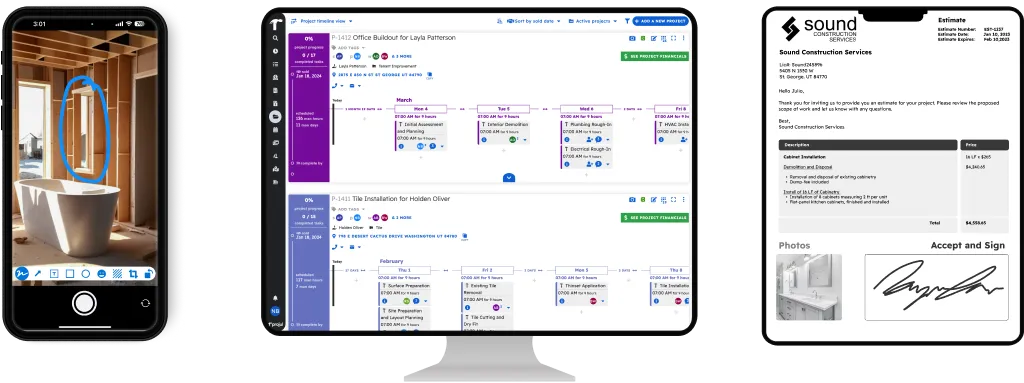
What Is Commercial Construction Software?
Commercial construction software is a platform built to help contractors manage the full lifecycle of commercial projects, from competitive bidding and multi-phase scheduling through AIA billing, retainage tracking, and closeout. It connects your office, field crews, subs, and stakeholders so nothing slips through the cracks on complex builds.
Projul’s commercial construction software helps contractors manage multi-phase scheduling, AIA billing, and subcontractor coordination from one platform designed by a contractor who ran commercial jobs. Projul offers flat-rate pricing with no per-user fees for construction companies of all sizes. Commercial work is a different animal than residential. The projects are bigger. The timelines are longer. The billing is more complex. And the number of people who need to stay coordinated on any given job can stretch into the dozens. You need software that was built for this level of complexity, not a residential tool with a few extra fields bolted on.
Projul is commercial construction software designed by a contractor who ran commercial jobs and got tired of duct-taping spreadsheets together. Over 5,000 contractors use Projul to manage their operations, and commercial contractors rely on it to keep multi-phase projects on track and profitable.
Multi-Phase Project Management for Commercial Builds
Commercial projects don’t follow a straight line. A ground-up office build might have sitework, foundation, structural steel, exterior envelope, MEP rough-in, interior finishes, and punch list phases, each with their own schedule, budget, and sub crews. Managing all of that in a single flat task list is a recipe for missed deadlines and blown budgets.
Projul lets you break commercial projects into distinct phases. Each phase gets its own schedule, task list, budget, and sub assignments. When the structural phase wraps, the interior rough-in phase activates with everything your team needs to keep moving. Your project managers see the big picture across all phases while your supers focus on the tasks in front of them.
This phased approach mirrors how commercial construction actually works. Your commercial project management software should match reality, not force you to bend your workflow around the tool.
Gantt Charts and Scheduling Views That Make Sense
On a commercial job with 40 or 50 tasks spanning six months, you need more than a calendar view. Projul offers seven schedule views including Gantt charts that show task dependencies, durations, and critical path items at a glance. Drag and drop to adjust timelines when a phase runs long or a sub gets ahead of schedule.
Your entire scheduling board updates in real time across the mobile app, so every superintendent and crew lead sees the current plan without calling the office.
Competitive Bidding and Bid Package Management
Commercial contractors live and die by their bids. You might have five or ten proposals out at any given time, each with different scopes, bid deadlines, and GC requirements. Losing track of a single bid package means losing the job.
Projul’s estimating and pipeline tools let you build detailed bid packages with line items for labor, materials, equipment, subs, and overhead. Save assemblies for work you bid repeatedly, like tenant improvement buildouts or parking structure repairs, so you can turn around proposals fast.
Track every bid through your sales pipeline. See which proposals are pending, which need follow-up, and which are about to close. When a GC needs a revised number by end of day, you pull up the original estimate, adjust the line items, and send it out in minutes instead of rebuilding from scratch.
Commercial contractor software should make your bid process faster and more consistent. Projul does both, which is why contractors report winning more work after switching to the platform. For a deeper dive into the bidding process, read our guide on how to bid on commercial construction projects.
AIA Billing: G702 and G703 Format Support
If you do commercial work, you know AIA billing. Owners, architects, and general contractors expect to see progress billing in the G702/G703 format. That means billing by percentage complete on each schedule of values line item, with columns for previous billing, current billing, retainage, and balance to finish.
Projul’s invoicing tools let you bill by completed percentage on each line item, matching the format commercial stakeholders expect. Build your schedule of values at project start, then update completion percentages each billing cycle. The math flows automatically so your pay applications go out clean and on time.
No more rebuilding AIA pay apps in Excel every month. No more formula errors that hold up payment for weeks. Your commercial construction software handles the billing format so you can focus on the work.
Why AIA Billing Matters for Cash Flow
Commercial billing cycles are long. You might submit a pay application on the 25th, wait for architect review, get approval on the 10th of the next month, and see payment 30 days after that. If your pay app has errors or missing documentation, that timeline stretches even further.
Clean, accurate AIA billing through Projul means fewer rejections and faster approvals. When your cash flow depends on getting paid every 45 to 60 days, shaving a week off the approval cycle makes a real difference to your bottom line.
Retainage Tracking That Protects Your Cash Flow
Retainage is a fact of life on commercial projects. Owners typically hold back 5% to 10% of each progress payment until substantial completion. On a $2 million project, that’s $100,000 to $200,000 sitting in someone else’s account while you pay your subs and suppliers out of pocket.
Projul tracks retainage amounts at the project level so you always know exactly how much is held back across every active job. See your total retainage exposure in one view. Know when retainage releases are coming so you can plan your cash flow around them.
This visibility is critical for commercial contractors who juggle multiple projects at different stages. Without it, you’re guessing at your true receivables and making financial decisions with incomplete data.
RFI Management: Keep Projects Moving
Requests for information are constant on commercial jobs. Your crew hits a conflict between the structural drawings and the MEP layout. The architect specified a material that’s on a 16-week lead time. The owner wants to add a conference room that wasn’t in the original scope.
Every RFI that sits unanswered is a potential delay. And on commercial projects, delays cost real money in extended general conditions, idle crews, and downstream schedule impacts.
Projul’s project communication tools keep RFIs tied to the specific project and phase where they belong. Log the question, attach the relevant drawing or photo, and route it to the right person. Track response times so you have documentation when delays become disputes. Your team sees the full RFI thread in context, not buried in an email chain from three weeks ago.
Submittal Tracking Across Dozens of Subs
On a commercial project, you might have 30 or 40 subcontractors, each responsible for submitting product data, shop drawings, and samples for architect review. Managing that paper trail through email and spreadsheets is where things fall apart. A missed submittal holds up procurement. A late approval delays an entire trade.
Projul helps you track submittals as part of your project workflow. Assign submittal responsibilities to each sub, set deadlines, and monitor status across the entire project. When the mechanical sub’s equipment submittal is three days overdue, you see it on your dashboard instead of finding out when the equipment doesn’t show up on site.
For software for commercial contractors, submittal management isn’t optional. It’s a core requirement that separates tools built for commercial work from those designed for residential.
Punch Lists and Project Closeout
The last 5% of a commercial project takes 50% of the effort. Punch lists, final inspections, commissioning, as-built documentation, and close-out packages all need to happen before you collect your final payment and retainage release.
Projul’s task management lets you build detailed punch lists with photos, assign items to specific subs, and track completion in real time from the field. Your superintendent walks the job with the architect, logs deficiencies on their phone with photos, and assigns corrections to the responsible sub. That sub gets notified immediately and marks items complete as they’re addressed.
Clean closeout means faster final payment. And on commercial projects where retainage release can be six figures, getting through punch list quickly has a direct impact on your cash flow.
Prevailing Wage Compliance and Documentation
If you work on public commercial projects, prevailing wage compliance is non-negotiable. You need to track hours by worker and wage classification, submit certified payroll reports, and maintain documentation that survives an audit.
Projul’s time tracking captures hours by worker, project, and task with GPS verification confirming your crews were on the correct job site. Export time data grouped by classification to build your certified payroll reports. When an auditor asks for proof that your electricians were paid the correct rate on a specific project during a specific week, you pull the report in minutes instead of digging through filing cabinets.
The cost of getting prevailing wage wrong is steep: back pay, penalties, and potential debarment from future public work. Commercial contractor software with solid time tracking and reporting gives you the documentation backbone you need to stay compliant. If you are pursuing public work, our guide on how to bid on government construction contracts walks through the full process from registration to proposal submission.
Bonding Requirements and Financial Visibility
Commercial projects often require performance and payment bonds. Your bonding company wants to see that you’re financially healthy and operationally organized. They look at your work in progress, your backlog, your receivables, and how you manage job costs.
Projul’s job costing and project tracking give you the data your surety needs. Pull reports showing estimated vs. actual costs across every active project. Show your backlog of contracted work. Demonstrate that you have systems in place to catch cost overruns early and keep projects profitable.
Contractors with clean, organized project data get better bonding capacity and rates. Your commercial construction software is part of your financial story, and a messy operation signals risk to your surety.
Multi-Site Coordination for Commercial Contractors
Commercial contractors often run projects across multiple locations simultaneously. A retail chain buildout might mean five stores in different cities, all on overlapping timelines with the same spec package but different site conditions and local sub crews.
Projul’s multi-project dashboard shows every active job with its current status, schedule position, and budget health. Move crews between sites when one location gets ahead of schedule. Compare progress across locations to spot which sites need attention. Your superintendents at each location update their project from the field app, and the home office sees everything in real time.
This kind of visibility is what separates commercial project management software from tools designed for one-job-at-a-time operations. When you’re running five or ten or twenty jobs simultaneously, you need a command center, not a task list.
Owner, Architect, and GC Communication
Commercial construction involves more stakeholders than residential work. On any given project, you’re communicating with the owner, the architect, the engineer, the GC (or your own subs if you’re the GC), inspectors, and sometimes the owner’s representative. Everyone needs different information at different times.
Projul keeps project communication organized so the right people see the right updates. Your internal team discusses scheduling and cost issues in one thread. Project updates for stakeholders go through another channel. Nothing gets crossed, and sensitive cost data stays internal.
When disputes arise, and they always do on commercial work, having organized communication records tied to specific projects and dates protects your position. You can show exactly what was communicated, when, and to whom.
Pain Points Projul Solves for Commercial Contractors
Complex Billing Cycles
Commercial billing isn’t “send an invoice, get paid.” It’s schedule of values, progress percentages, retainage calculations, architect review, owner approval, and then maybe you get a check in 45 days. One error sends the whole thing back to the start. Projul automates the math and keeps your billing organized so pay applications go out clean the first time.
Retainage Cash Flow Gaps
When 10% of every payment is held back across eight active projects, your retainage exposure adds up fast. Projul gives you a clear view of retainage held, expected release dates, and total exposure so you can plan your cash flow instead of guessing.
Managing Submittals Across Dozens of Subs
Tracking 40 submittals through email is a full-time job. And when one goes missing, procurement stalls and your schedule slips. Projul centralizes submittal tracking so you see every item’s status without digging through your inbox.
Prevailing Wage Documentation
Public commercial work demands certified payroll and audit-ready records. Paper timesheets and manual tracking create liability. Projul’s GPS-verified time tracking gives you the data foundation for compliant reporting.
Longer Project Timelines
A 12-month commercial project has more opportunities for things to go wrong than a 3-week residential job. Budget drift, scope creep, and schedule slippage compound over time. Projul’s real-time job costing and schedule tracking catch problems at week three, not month nine.
Larger Crew Coordination
When you have 60 workers from 15 different subs on a job site, coordination is everything. One trade showing up out of sequence wastes a full day for multiple crews. Projul’s scheduling board sequences every trade and notifies everyone automatically when the plan changes.
Commercial job sites often involve aerial lifts and boom lifts for facade work, steel erection, and MEP rough-in at height. Our aerial lift and boom lift safety guide covers OSHA requirements, operator training, and fall protection best practices for commercial projects.
Keep Your Supers Connected From the Field
Your superintendents live on commercial job sites, not behind desks. Projul’s native iOS and Android app gives them full access to schedules, daily logs, and time tracking from their phone. Clock crews in with geofencing, update task progress, snap photos, and pull up project documents on the spot without waiting for someone at the office to send a file.
When a sub delay shifts the schedule, your super sees it in real time and keeps the project moving. That kind of field connectivity is what makes commercial construction software actually useful, not just another system your team ignores.
Job Costing That Catches Problems Early
On commercial projects with six- or seven-figure budgets, a 5% cost overrun means real money. The difference between catching it at week three versus month six could be the difference between a profitable project and a loss.
Projul tracks estimated versus actual costs on every project in real time. See which line items are trending over budget. Compare labor hours against your original estimate. Pull job cost reports by phase, by trade, or by cost code to find exactly where the bleed is happening.
Contractors using Projul report a 32% average increase in profitability. That number comes from catching overruns early, tightening change order documentation, and keeping schedules on track so general conditions don’t eat your margin.
Why Commercial Contractors Choose Projul
Most commercial construction software was designed by tech companies and then sold to contractors. You feel it in every click. Workflows that don’t match how a real commercial project moves. Features built for software demos, not job sites.
Projul was built by Kurt Clayson, a contractor who ran his own construction company and got tired of tools that didn’t fit. Every feature exists because a real contractor needed it on a real project.
Here’s what sets Projul apart for commercial contractors:
- Built by a contractor. Not a tech startup. Not a consulting firm. A guy who ran crews, managed subs, and submitted pay applications.
- Flat-rate pricing. $4,788 per year for your entire company. No per-user fees. Your estimators, PMs, superintendents, office staff, and subs all get full access.
- All-in-one platform. CRM, estimating, scheduling, job costing, time tracking, invoicing, and client portal. One login covers the full project lifecycle.
- Rated 9.8 on G2. For both ease of use and quality of support. That rating comes from real contractors, not paid reviewers.
- Over 5,000 contractors. From specialty subs to large commercial GCs. The platform scales with your operation.
Honest Pricing for Commercial Contractors
Most software for commercial contractors charges per user. That pricing model punishes you for giving your team the access they need. Add a superintendent? More money. Give your estimator access? More money. Let your subs see their schedule? Way more money.
Projul starts at $4,788 per year for your entire commercial company. No per-user fees. Your estimators, project managers, crew leads, and office staff all get full access without inflating the bill. Over 5,000 contractors use Projul to manage their operations, and commercial contractors consistently report saving 2+ hours daily on admin work. G2 users rate Projul 9.8 for ease of use and 9.8 for quality of support.
Multi-Phase Scheduling That Mirrors How Commercial Projects Actually Move
Commercial projects do not follow a neat, linear path from start to finish. A 50,000-square-foot office buildout might have sitework and foundation running simultaneously in different areas of the site. Interior rough-in starts on the first floor while structural steel is still going up on the third. The architect issues a bulletin that changes the lobby layout, which affects flooring, electrical, and millwork on a section you thought was locked in.
Most scheduling tools force you into a single timeline view that treats the project as one long sequence. That works fine for a bathroom remodel. It falls apart on a commercial job where you have 15 trades working in 4 different zones on overlapping timelines.
Projul’s scheduling tools let you build zone-based schedules within each project phase. Break the building into zones, like floors, wings, or areas, and schedule each zone independently while maintaining dependencies between them. Your drywall crew finishes Zone A on the second floor, which triggers taping and finishing in Zone A while drywall starts in Zone B. The flooring sub sees their Zone A start date activate as soon as the drywall team marks their tasks complete.
This approach mirrors the way experienced commercial superintendents actually think about scheduling. They do not think in terms of one giant task list. They think in zones, phases, and trade flow. When your scheduling software matches that mental model, your supers actually use it instead of keeping a separate plan in their head or on a legal pad.
The payoff shows up in reduced idle time. On a commercial project with 30 to 40 workers on site daily, every day of wasted trade overlap or out-of-sequence work costs $3,000 to $8,000 in labor alone. Over a 12-month project, even a 5% reduction in scheduling waste saves $15,000 to $30,000. Projul’s Gantt view makes these dependencies visible so your PM catches the conflict before it hits the field.
Your project managers also benefit from zone-based reporting. Instead of asking “how is the project going” and getting a vague answer, they can drill into each zone and see exactly which tasks are complete, which are in progress, and which are blocked. A PM managing three commercial projects simultaneously can check zone status across all of them in minutes instead of spending an hour on the phone with each superintendent every morning.
Zone-based scheduling also helps when the owner or architect issues mid-project changes. If a design bulletin affects the lobby but not the office floors, you adjust the lobby zone schedule without touching the rest of the building. Your trades working on unaffected floors keep moving. On a traditional single-timeline schedule, a lobby change ripples through the entire project and creates confusion about which tasks are still valid. Projul’s phased approach contains the disruption to the zone where it belongs, keeping the rest of your project on track.
Compliance and Safety Documentation That Survives an Audit
Commercial job sites face a level of regulatory scrutiny that residential projects rarely encounter. OSHA inspections. Fire marshal walkthroughs. Environmental compliance reviews. ADA accessibility checks. Building department inspections at every major milestone. Each one requires documentation that proves you did the right thing at the right time, not just that the work looks correct.
The problem is that most commercial contractors store this documentation across five different systems: safety training records in a filing cabinet, daily logs in a notebook, inspection reports in email, toolbox talk sign-in sheets in a binder, and incident reports on a form that gets faxed to the insurance company. When an OSHA inspector asks to see your fall protection training records for the ironworkers on your project last month, you spend two hours digging through paper.
Projul centralizes your project documentation in one place. Daily logs, photos, inspection records, and task completion notes all live in the project record. When your superintendent conducts a morning safety briefing, they log it in the app with a photo of the sign-in sheet. When the fire marshal walks the site and notes a deficiency, your super creates a task to correct it, assigns it to the responsible sub, and documents the correction with a photo.
This documentation approach is not just about passing inspections. It protects you in liability situations. If a worker is injured on your site and the plaintiff’s attorney claims you did not maintain safe conditions, your Projul project record shows daily safety briefings with sign-in photos, documented hazard corrections, and time-stamped GPS records proving which workers were on site and when. That level of documentation changes the entire trajectory of a liability claim.
For commercial contractors working on public projects, compliance documentation is even more critical. Prevailing wage audits, DBE participation tracking, and certified payroll submissions all require organized records that go back months or years. Building that documentation habit into your daily workflow through Projul means you are always audit-ready, not scrambling to reconstruct records after the auditor calls.
Training documentation is another area where commercial contractors often fall short. OSHA requires records of worker training for specific hazards present on each job site. Confined space entry, fall protection, scaffolding competent person, and forklift operation all require documented training that you must produce on demand during an inspection. Projul’s project records give you a central place to attach training certificates and link them to specific workers and projects so you never have to dig through a filing cabinet during an OSHA visit.
Environmental compliance adds another layer on many commercial projects. Stormwater pollution prevention plans (SWPPPs), dust control measures, and hazardous material abatement documentation all need to be maintained and accessible. Projul’s document management keeps these plans attached to the project record where your superintendent can reference them from the field. When the environmental inspector asks to see your SWPPP and your last three inspection logs, your super pulls them up on their phone instead of calling the office. For more on safety requirements, read our construction safety software guide.
GC and Sub Payment Applications Without the Spreadsheet Gymnastics
Payment applications on commercial projects are nothing like sending an invoice on a residential job. As a subcontractor, you submit a pay app to the GC with your completed percentages, the GC reviews it against their records, and then the GC includes your work in their pay app to the owner. The owner’s architect reviews the full application, and 30 to 45 days later, the GC gets paid and passes your portion through. Miss a billing deadline by one day and you wait another full month for your money.
As a GC, the process is even more involved. You collect pay apps from every sub on the project, verify their completion percentages against field observations, compile everything into your G702/G703 schedule of values, add your own general conditions and fee, and submit the whole package to the architect. One error in one sub’s numbers can delay the entire pay app.
Projul’s progress billing tools let you track completion percentages by line item on your schedule of values. Update percentages from the field based on actual work in place. When your superintendent confirms that 75% of the electrical rough-in is complete, that percentage flows into your billing. No more end-of-month scramble to walk the entire project and estimate percentages from memory.
For subcontractors using Projul, the billing cycle becomes predictable. You know your submission deadline. You track your own completion percentages throughout the month. When billing day arrives, your pay app is already 90% done because you have been updating progress as the work happened, not trying to reconstruct a month of work in one afternoon.
The cash flow impact is significant. A $3 million commercial project with monthly billing means each pay app could be $200,000 to $400,000. Getting that pay app rejected and resubmitted costs you an additional 30 days of cash flow delay. At even a modest cost of capital, that delay costs real money. Clean, accurate pay applications through Projul keep your cash flowing on schedule.
Documentation is the other half of the payment application process. Most owners and architects require backup documentation with each pay app: daily logs showing work progress, photos of completed work, and lien waivers from subs who were paid on the previous cycle. Projul’s daily logs and photo documentation feed directly into your billing workflow. When the architect asks for proof that the mechanical rough-in is 80% complete, you attach the daily log entries and photos from the past month. That documentation speeds up approval and reduces the back-and-forth that delays payment. For a deeper look at how retainage affects your bottom line, read our complete guide to construction retainage.
Lien waiver management is another piece of the commercial billing puzzle. Before many owners release payment, they require conditional and unconditional lien waivers from every sub and supplier on the project. Tracking which waivers have been collected and which are outstanding is tedious but essential. Projul helps you stay on top of waiver collection so a missing waiver from one sub does not hold up payment for your entire pay app. For more on protecting your lien rights, read our lien waivers guide.
Retainage Tracking Across Your Entire Portfolio
Retainage is the silent cash flow killer for commercial contractors. On every progress payment, the owner holds back 5% to 10% until the project reaches substantial completion. That sounds manageable on one project. But when you are running five or eight commercial jobs simultaneously, your total retainage exposure can reach $500,000 or more. That is half a million dollars you have earned, paid your subs and suppliers for, and cannot access until each project closes out.
The challenge is visibility. Most commercial contractors track retainage on a per-project basis, usually in a spreadsheet that someone updates monthly if they remember. What they do not track is their total retainage exposure across the entire company at any given moment. They do not know that $127,000 releases next month when the hospital wing reaches substantial completion, or that $84,000 has been held for over a year on a project where the owner is dragging their feet on final punch list items.
Projul tracks retainage at the project level and gives you portfolio-wide visibility. See your total retainage held across every active project in one view. Sort by expected release date so you know which chunks of cash are coming back and when. Flag projects where retainage release is overdue so you can follow up with the owner or GC before the money becomes a dispute.
This visibility changes how you manage your cash flow. Instead of taking on a line of credit to cover the gap between retainage held and bills due, you plan around your expected retainage releases. You know that $200,000 comes back in Q2 across three projects, which covers the equipment deposit on your next job. You know that $90,000 is stuck on a project with an unresolved punch list, which means you need to push your super to close out those items so the retainage releases.
For subcontractors, retainage tracking is even more critical because you are at the end of the payment chain. The owner releases retainage to the GC, and then the GC is supposed to pass your portion through. If you are not tracking what is owed to you and when, you can lose tens of thousands of dollars simply because nobody followed up. Projul’s project-level retainage records give you the documentation to hold GCs accountable for timely retainage release. Combined with lien rights tracking, you have the tools to protect every dollar you have earned.
Some commercial contracts allow for retainage reduction after the project reaches 50% completion. If your contract includes this provision, Projul helps you track when you cross that threshold so you can formally request the reduction from the owner. On a $2 million project, reducing retainage from 10% to 5% at the halfway point releases $50,000 back to you immediately. That is real money that can fund your next mobilization instead of sitting in escrow.
Retainage also affects your bonding capacity. Your surety company looks at your work-in-progress report, which includes retainage receivable as an asset. But retainage that has been held for over 12 months starts to look less like an asset and more like a collection problem. Keeping retainage current by actively managing closeout and punch list completion, tracked through Projul’s task management, keeps your financial statements clean and your bonding capacity strong. For more on managing cash flow timing across your commercial portfolio, read our cash flow management guide.
Stop Managing Commercial Projects With Spreadsheets
If you’re still running commercial jobs with spreadsheets for cost tracking, email chains for submittals, and Excel templates for AIA billing, you already know it’s not working. Details fall through the cracks. Pay applications go out with errors. Subs show up out of sequence. And you spend your evenings catching up on admin instead of running your business.
Commercial construction software like Projul brings all of that into one platform. Your bids, schedules, budgets, submittals, billing, and communication all live in the same place. Your field team and office stay connected in real time. And you get the visibility you need to keep every project profitable from groundbreaking to closeout.
Over 5,000 contractors have already made the switch. They’re spending less time on admin, catching budget problems earlier, and getting paid faster. Your competition is probably one of them.