Contractor Management Software. Built by construction pros with honest pricing.
Stop paying per-user fees that punish growth. Projul gives your entire team CRM, estimating, scheduling, job costing, time tracking, and invoicing in one platform for a flat monthly rate. Over 5,000 contractors run their operations through Projul and report a 32% average profit increase.
- It's easy to manage your tasks, from creation through to completion.
- Keep on top of your schedule with various useful views.
- Track where your workers are now, and where they've been.
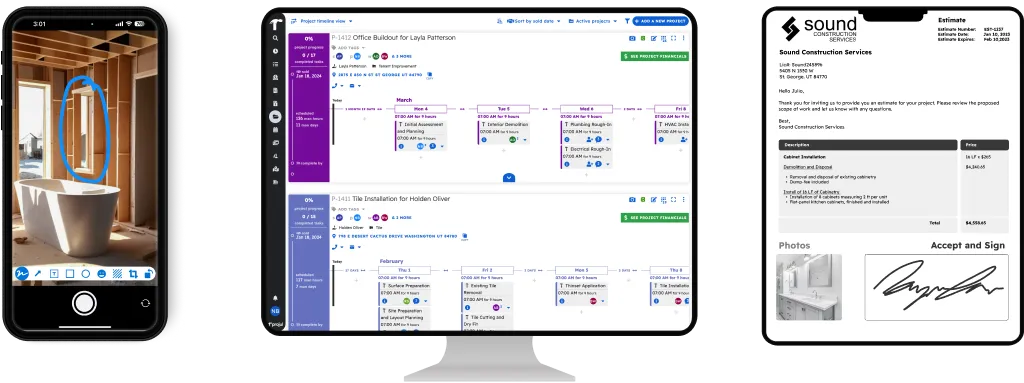
What Is Contractor Management Software?
Contractor management software is a platform that helps contracting businesses manage their entire operation from first lead through final payment. It connects estimating, scheduling, job costing, time tracking, invoicing, and client communication in one system so nothing gets lost between the office and the field.
Projul’s contractor management software connects estimating, scheduling, job costing, and invoicing in one platform so contractors stop juggling disconnected tools. Built by a contractor for contractors. Projul offers flat-rate pricing with no per-user fees for construction companies of all sizes. If you run a contracting business, you spend half your time on the work itself and the other half running the business. Chasing leads. Writing estimates. Scheduling crews. Tracking costs. Sending invoices. Following up on payments. Contractor management software exists to handle all of that in one place so you can focus on the work that actually makes you money.
Projul was built by a contractor who lived these exact problems. That is why over 5,000 contractors across every trade trust it to run their daily operations.
One Platform for Your Entire Contracting Business
Running a contracting business means wearing a dozen hats before lunch. You are the salesperson, the estimator, the project manager, the HR department, and the bookkeeper. Most contractors cobble together a stack of disconnected tools: a spreadsheet for estimates, a calendar app for scheduling, text threads for crew coordination, and a separate program for invoicing.
That patchwork approach works until it does not. And it usually stops working around the time you hit five or six active projects. Details start falling through the cracks. You forget to invoice a change order. A crew shows up at the wrong job. Your spreadsheet formula breaks and you send a bid that is $3,000 too low.
Projul puts your leads, estimates, schedules, job costs, time tracking, and invoicing in one connected contractor management software platform. When your estimator prices a job, that estimate converts into a scheduled project with one click. The line items become your job cost budget. Your crew sees the schedule on their phone. Your office tracks progress in real time.
That connected workflow is what separates real contractor software from a collection of apps that happen to be on the same computer.
The Project Lifecycle: From Lead to Final Payment
Every contracting project follows the same basic lifecycle, regardless of trade. A lead comes in. You write an estimate. The client says yes. You schedule the work. Your crew builds it. You track costs along the way. You invoice the client. They pay. You make money (hopefully).
Contractor management software should handle every stage of that lifecycle without forcing you to re-enter data or switch between tools. Here is how Projul handles each phase:
Lead Pipeline and CRM
Your leads are the lifeblood of your business. Lose track of one and you lose the revenue it would have generated. Projul’s lead pipeline tracks every prospect from first contact through signed contract. See which leads need follow-up, which estimates are pending, and which ones went cold. Over time, you learn your close rate and can forecast revenue based on your pipeline.
Estimating That Converts to Scheduled Work
Your estimate is your first impression and your profit blueprint. Projul’s estimating tools let you build detailed bids with line items, quantities, and markup. Save templates for the types of work you do most so you are not building estimates from scratch every time.
When the client says yes, that estimate converts directly into a scheduled project. The line items become your budget. No re-entering data. No copy-paste errors. That single conversion saves contractors hours every week and eliminates the mistakes that eat into margins.
Contractor software that treats estimating and project management as separate activities forces you to do double work. Projul does not.
Scheduling That Adapts to Reality
Every contractor knows the plan changes. Weather kills a day. A material shipment runs late. A sub does not show. Your schedule needs to flex without creating chaos.
Projul’s drag-and-drop scheduler lets you move tasks, reassign crews, and shift timelines with a few taps. Seven schedule views, including Gantt charts and calendar views, give you the visibility to keep every project moving. Your crew sees schedule changes instantly on the mobile app.
For contractors running multiple crews across multiple jobs, the scheduling board shows all assignments on one screen. Drag a crew from one job to another. See the gaps. Fill them. Your field team gets notified automatically.
Job Costing in Real Time
Here is a question every contractor should be able to answer at any moment: Am I making money on this project right now?
If you cannot answer that without spending an hour in a spreadsheet, your system is broken. Contractor management software should track estimated costs versus actual costs on every project as the work happens. Your labor hours feed in from time tracking. Your material costs come from purchase records. At any point during the project, you see whether you are on budget or heading for a loss.
Projul gives you that visibility. Contractors using Projul report a 32% average profit increase because they catch cost overruns at week two, not at the final invoice.
Invoicing That Gets You Paid
Slow invoicing is slow money. In contracting, cash flow determines whether you survive or thrive. If you wait until the end of a project to send an invoice, you are financing your client’s project with your own cash.
Projul lets you invoice throughout the project. Send deposit invoices before work starts. Bill for completed phases as you go. Add change orders to the invoice with one click. Your clients can pay online directly from the invoice, which means faster payments with less chasing.
Change orders get documented inside the project record. The scope, the approval, and the cost update flow through to your budget and invoice automatically. No more eating costs from verbal agreements that never got written down.
Crew Management Without the Phone Tree
Your crews are your most valuable and most expensive resource. Knowing where they are, what they are working on, and how many hours they are logging against each project is critical to your profitability.
Projul’s geo-fenced time tracking clocks crews in automatically when they arrive at the job site. No more paper timesheets filled out from memory on Friday. No more buddy punching. The system verifies your crew is at the right location, logs their hours against the right project, and feeds that data directly into your job costing reports.
From the office, you see who is on which project, how many hours they have logged today, and whether any job site is short-staffed. That visibility lets you make smart decisions about crew allocation instead of playing phone tag every morning.
Contractor management software should make crew management simple. Projul does it with GPS verification, automatic job assignment, and real-time updates that keep your office and field on the same page.
Client Communication That Builds Your Reputation
Your clients want to know what is happening with their project. They do not want to call you every other day to ask. And you do not want to take those calls while you are trying to run your business.
Projul’s client portal gives customers visibility into their project without giving them access to your internal notes. They see the schedule, approve estimates, sign change orders, and pay invoices. All in one place. All without a phone call.
This level of transparency sets you apart from every other contractor who communicates through sporadic texts and unreturned voicemails. When a homeowner can log in and see that their project starts Monday, they stop calling you on Friday to ask.
For contractors, client communication is not just about being nice. It is about reducing disputes, earning referrals, and protecting your reputation. Software for contractors should make this easy, and Projul does.
Financial Tracking That Keeps You Profitable
Most contractors know whether they are busy. Fewer know whether they are profitable. There is a big difference.
Projul’s financial tools give you a clear picture of your business health. See your revenue by month, your margins by project, your outstanding invoices, and your cash position. When you integrate with QuickBooks, your invoices and payments sync automatically so your books stay accurate without double entry.
Job costing reports show you which project types make the most money, which crews are the most productive, and which clients are the most profitable. Over time, that data helps you make better decisions about which work to bid on, how to price it, and who to assign.
Contractor software that only handles scheduling or only handles invoicing gives you a partial picture. Projul gives you the whole thing.
Mobile Access for Contractors in the Field
Contracting happens on job sites, not in offices. Any contractor management software that requires a desktop computer is missing the point.
Projul’s native iOS and Android app was designed for the field first. Big buttons. Simple navigation. It works on a dusty phone with one bar of signal. Your crew can:
- Clock in with GPS verification at the job site
- View their schedule and task assignments
- Update task status as work gets completed
- Take progress photos and attach them to the project
- Log materials delivered and used
- Send messages to the office or other crew members
Everything syncs in real time. When a crew lead marks a task complete, the office sees it immediately. When the office updates the schedule, the crew sees the change on their phone. That real-time connection is what makes Projul more than just a mobile app. It is a connected field management tool.
Rated 4.9/5 on G2 for ease of use, Projul’s mobile app is designed so your crew picks it up by lunch on day one. No training sessions needed.
Choosing the Right Contractor Software for Your Trade
Not every contractor management software fits every company. Here is what to consider based on your situation:
If you are a small contractor (1 to 10 employees): You need something simple that does not take a week to learn. Look for flat-rate pricing so you are not paying per seat as you grow. You probably need estimating, scheduling, invoicing, and a mobile app. Skip the tools with 200 features you will never use.
If you are a mid-size company (10 to 50 employees): You need real job costing, not just invoicing. You need scheduling that handles multiple crews across multiple jobs. And you need your estimating and accounting systems to talk to each other. Integration with QuickBooks becomes important at this level.
If you are running a larger operation (50+ employees): You need a platform that handles hundreds of active projects without slowing down. You need permission controls so crew leads see their schedule but not your profit margins. You need reporting that shows business health across every division.
Regardless of size: Avoid contractor software that charges per user. That pricing model punishes growth. Hiring a new PM should not mean another $50 per month on your software bill. Projul’s flat rate means adding your 50th employee costs the same as your 5th.
QuickBooks Integration Eliminates Double Entry
Double-entering data into your accounting software wastes time and creates errors. Projul integrates with QuickBooks Online so your invoices, payments, and customer records sync automatically.
When you send an invoice in Projul, it shows up in QuickBooks. When the client pays, both systems update. Your bookkeeper does not need to re-enter anything, and your financial data stays accurate without extra work.
For contractors who run their own books, this integration saves hours every week. For contractors who have a bookkeeper, it means fewer questions and cleaner records.
Why Contractors Switch to Projul
Most contractors come to Projul after trying one or two other platforms. The story is usually the same. The last tool was too expensive, too complicated, or too disconnected from how contracting actually works.
Here is what makes Projul different:
- Built by a contractor. Kurt Clayson started Projul after years of running his own construction company. Every feature exists because a real contractor needed it.
- Flat-rate pricing. $4,788 per year for your entire company. No per-user fees. Everyone gets full access.
- All-in-one platform. CRM, estimating, scheduling, job costing, time tracking, invoicing, and client portal. One login.
- Rated 4.9/5 on G2. For both ease of use and quality of support. That is contractors voting with their reviews.
- Over 5,000 contractors. From one-truck operations to companies with 200+ employees. The platform scales with you.
Scaling Your Contracting Business Without Scaling Your Software Costs
Growth should not mean higher software bills every month. But that is exactly what happens with per-user pricing. You hire a project manager - add a seat. Bring on a crew lead - add a seat. Your estimator needs access - add a seat. By the time your whole team is in the system, your software cost has tripled.
Projul uses flat-rate pricing because that is how contractor software should work. Your Core plan runs $4,788 per year. Core+ is $7,188 per year. Pro is $14,388 per year. Every plan covers your entire company with no per-user fees. Hire your 50th employee and your software cost stays the same as it was with your 5th.
That pricing model matters most during growth phases. When you are adding crews, taking on bigger projects, and bringing in seasonal workers, the last thing you need is a software bill that grows faster than your revenue. Projul removes that friction so you can scale your team without doing math on whether each new hire justifies another software seat.
What You Get at Each Pricing Tier
Every Projul plan includes the core tools contractors need: CRM and lead pipeline, estimating with templates, drag-and-drop scheduling, job costing, time tracking with GPS, invoicing with online payment, and the mobile app. Higher tiers add advanced features like custom reporting, multiple pipelines, and priority support.
The important thing is that no plan limits how many people can use it. Your estimators, PMs, crew leads, office staff, and field workers all get full access at every tier. That means your entire operation runs on one connected platform from day one, not a stripped-down version that forces half your team to work outside the system.
Comparing Projul to Per-User Contractor Software
Run the numbers on any per-user platform with a team of 15 people. At $50 per user per month, you are paying $9,000 per year just for seats. Projul’s Core plan gives your entire company full access for $4,788 per year. That is a $4,200 annual savings, and the gap gets wider every time you hire.
For contractors evaluating contractor management software, pricing model matters as much as features. A tool with every feature in the world does not help if half your team cannot access it because the per-user cost is too high.
Honest Pricing for Contractors
Most contractor management software charges per user. That pricing model punishes growth. Hire a new PM? More money. Add an estimator? More money. Give your crew leads access? Way more money.
Projul starts at $4,788 per year for your entire company. No per-user fees. Your estimators, PMs, crew leads, office staff, and field workers all get full access without inflating the bill. Over 5,000 contractors use Projul to manage their operations, and contractors consistently report saving 2+ hours daily on admin work.
G2 users rate Projul 4.9/5 for ease of use and 4.9/5 for quality of support. That is not a marketing claim. That is real feedback from real contractors.
How to Evaluate Contractor Management Software Before You Buy
Picking the wrong software wastes months of setup time and frustrates your team. Here is a practical checklist contractors should run through before committing to any platform.
Run your actual workflow through the demo. Do not just watch a sales rep click through slides. Bring a real estimate from a recent project and ask them to show you how it becomes a scheduled job, generates a budget, and turns into an invoice. If that workflow takes more than a few clicks, the tool is going to slow you down in the field.
Ask about data migration. If you are moving from spreadsheets, another platform, or even paper files, find out what the onboarding team will help you import. Client lists, estimate templates, and open project data should all transfer over. Projul’s onboarding team handles this so you are not starting from scratch.
Check mobile app reviews independently. Do not rely on the vendor’s website. Search the App Store and Google Play for the app name and read what actual field workers say. If the reviews mention crashes, slow load times, or confusing navigation, your crew will not use it regardless of what the sales team promises. Projul’s mobile app is rated highly by field crews specifically for its simple interface.
Test with your least technical crew member. The real test of any contractor software is whether your most tech-resistant foreman can figure it out in an afternoon. If they cannot clock in, view their schedule, and update a task without calling the office, the software fails the field test.
Verify QuickBooks sync is two-way and real-time. Some platforms advertise QuickBooks integration but only push data one direction or batch-sync once a day. Ask specifically whether invoices, payments, and customer records flow both ways. Projul’s QuickBooks integration syncs in real time so your bookkeeper always has current data.
Calculate total cost with your actual team size. Per-user pricing looks affordable when you demo with three people. Run the math with every person who needs access: estimators, PMs, office staff, crew leads, and field workers. A platform at $50 per user with 20 people costs $12,000 per year. Projul’s flat rate covers everyone for $4,788 per year.
Scaling From 5 to 50 Employees Without Losing Control
Growing a contracting business is exciting until it breaks your systems. What worked with a crew of five falls apart at fifteen. By the time you hit thirty or forty employees, every process that relied on memory, phone calls, or “the way we have always done it” becomes a bottleneck that slows down the entire operation.
The first thing that breaks is communication. When you had five guys, everyone heard the plan at the morning meeting. Now you have four crews on four different job sites and an office with two people trying to keep everything coordinated. Your lead carpenter on the north side job has a question about the spec. Your crew on the south side needs materials delivered. Your newest hire showed up at the wrong address. These problems multiply every time you add people, and they all land on the same two or three people in your office.
The second thing that breaks is scheduling. A whiteboard worked when you had two active jobs. A shared calendar worked when you had five. But at fifteen or twenty simultaneous projects, you need a scheduling system that shows every crew assignment across every job on one screen, lets you move people around without making six phone calls, and notifies everyone automatically when something changes. Projul’s scheduling tools handle exactly this. Drag a crew from one project to another, and both the field and the office see the update immediately.
Job costing is the third casualty of growth. When you were small, you could eyeball whether a project was making money. At scale, you have too many moving parts to track in your head. Labor costs are spread across multiple crews and projects. Material purchases get charged to the wrong job. Change orders happen in the field and never make it into the budget. Projul’s budgeting tools track estimated versus actual costs on every project in real time, so you catch overruns at week two instead of month four.
Hiring gets harder too. Finding good field workers is already the biggest challenge in construction. When you are growing fast, you need people who can be productive on day one, not people who need three weeks of hand-holding before they can work independently. Your contractor management software should make it easy for new hires to see their schedule, clock in, update tasks, and communicate with the office from their phone. If the learning curve is too steep, your new employees spend their first week confused and your experienced people spend their time babysitting instead of building.
The contractors who scale successfully share a common trait. They invest in systems before they need them. By the time you are drowning in scheduling conflicts and missed change orders, you have already lost money. Set up your contractor management software when things are still manageable, get your processes dialed in, and then grow into the system instead of scrambling to build one while everything is on fire.
Our construction company scaling guide covers the operational, financial, and hiring decisions that separate companies that grow profitably from companies that grow themselves into bankruptcy.
Closing the Office-to-Field Communication Gap
The biggest source of waste in any contracting company is the gap between what the office knows and what the field knows. Your estimator priced the job with specific materials. Your crew bought something different because they did not have the spec. Your PM changed the schedule on Tuesday. Your foreman did not find out until Thursday. The client approved a change order over email. Nobody told the crew, and now there is a dispute about scope.
This gap is not a technology problem. It is a workflow problem. But technology is the only realistic fix when your teams are spread across multiple job sites and cannot all sit in the same room.
The old solution was phone calls. Your PM calls the foreman every morning with the day’s updates. The foreman calls the office when something goes wrong. The office calls the client. The client calls the PM. Everyone is on the phone, nobody is building, and half the information gets lost or garbled along the way.
Projul’s construction communication tools put project-level messaging inside the platform where the work is being tracked. When your PM posts an update about a material change, everyone assigned to that project sees it. When your foreman snaps a photo of a problem on site, it is attached to the project record with context, not floating in a text thread that five other people cannot find.
The difference between a text thread and project-based communication is accountability. Text messages disappear into a scroll of unrelated conversations. Project messages in Projul are tied to the job, timestamped, and visible to anyone on the team who needs the information. When there is a dispute about what was communicated and when, the record is right there.
Mobile notifications keep your field team informed without requiring them to check the app constantly. When a schedule change affects their project, they get a push notification. When the office uploads a revised plan, the foreman knows immediately. When a material delivery is confirmed, the crew lead sees it before the truck arrives.
Our construction office-to-field communication guide breaks down the most common communication failures in contracting businesses and gives you a framework for fixing them. The team communication guide covers how to set up communication norms that your crew will actually follow, including when to call, when to message, and when to just handle it.
The contracting companies that waste the least money are not the ones with the best carpenters. They are the ones where the office and the field are always working from the same information. Contractor management software that connects those two worlds is not a nice-to-have. It is the difference between a tight operation and one that leaks money through miscommunication every single day.
Multi-Location Branch Management
Running one office is hard enough. Running two or three branches in different cities introduces a whole new set of problems that most contractor management software does not address. Your crews are spread across locations. Your estimators are quoting jobs in different markets with different pricing. Your PMs are managing projects you cannot drive to in twenty minutes. And your financial picture gets blurry when revenue and costs are split across multiple profit centers.
The first challenge is consistency. Every branch develops its own habits. The Phoenix office writes estimates one way. The Tucson office does it differently. Your crews in one location use time tracking religiously. The other location is still doing paper timesheets. Without a single system that enforces the same workflows everywhere, your branches drift apart until you are essentially running two different companies under one name.
Projul gives every branch the same platform with the same tools. Your estimate templates are shared, so a kitchen remodel bid in Phoenix looks the same as one in Tucson. Your scheduling workflow is identical, so you can pull up any project from any location and know exactly what you are looking at. Time tracking with GPS works the same everywhere, so labor data is consistent across every branch.
The second challenge is resource sharing. Your Tucson branch has a slow week. Your Phoenix branch just won three new contracts and needs more bodies. Without visibility across locations, your Tucson PM does not know Phoenix needs help, and Phoenix starts subcontracting work that your own crew could have handled. Projul’s scheduling board shows every crew across every location, so you can spot opportunities to share resources before you hire outside help.
Financial oversight across branches requires real-time data, not monthly reports that arrive three weeks late. Projul’s job costing tools show you estimated versus actual costs on every project in every location. You do not have to wait for your branch manager to compile a spreadsheet. Log in, filter by location, and see which projects are on track and which ones need attention. When your QuickBooks integration syncs invoices and payments from every branch, your accountant has a clean consolidated view without manual data entry from three different offices.
The third challenge is management oversight. When you cannot physically visit every job site, you depend on your systems to tell you what is happening. Projul’s project dashboard gives you status updates from every active project across all locations. Which jobs are on schedule? Which ones are over budget? Which branch is hitting its revenue targets? You get those answers from your phone without driving three hours.
For contractors thinking about opening a second location, plan your systems first. Get your contractor management software set up and working at your first location before you open the second. That way, your new branch inherits proven workflows instead of inventing their own. The cost of fixing bad habits across two offices is double the cost of getting it right from the start.
Onboarding New Field Users Quickly
Your contractor management software is only as good as the people who use it. And in construction, “the people who use it” includes field workers who may not be comfortable with technology, who are busy with physically demanding work all day, and who will abandon any app that takes more than a few minutes to figure out.
The onboarding problem is real. You spend weeks evaluating software, setting up your projects, and training your office team. Then you roll it out to the field and half your crew ignores it. They keep filling out paper timesheets. They call the office instead of checking the app. They “forget” to update task status. Within a month, your office is running one system and your field is running another, and you have gained nothing.
The fix starts with picking software that was built for the field, not adapted for it. Projul’s mobile app was designed around how construction crews actually work. Big buttons. Simple navigation. The three things your crew needs most, clock in, view schedule, and update tasks, are right on the main screen. No menus to dig through. No tiny text on a dusty phone. Your newest hire should be able to clock in and find their schedule within five minutes of downloading the app.
Start with the basics. On day one, show new field users three things: how to clock in with GPS verification, how to check their schedule, and how to mark a task as complete. That is it. Do not try to train them on estimating, job costing, or document management. Those are office functions. Your field crew needs to know three buttons, and they need to see those buttons work on their own phone before they leave the first-day meeting.
The second week, add one more function. Show them how to take progress photos and attach them to the project. This is where the app starts saving them time, because now the office stops calling to ask for photo updates. The photos are already in the system, tied to the right project, with a timestamp. Your crew starts to see the app as something that makes their life easier, not something the boss is forcing them to use.
Our construction onboarding guide covers the full onboarding process for new hires, from paperwork through first-week training. The client onboarding guide handles the customer side of the equation, but the principles of gradual introduction and early wins apply to field staff too.
The contractors who get the highest adoption rates from their field teams share a common approach. They start simple. They show the value before they add complexity. And they pick software that respects the fact that their crew is on a job site, not sitting at a desk. Projul’s 4.9/5 G2 rating for ease of use comes specifically from field workers and office staff who found the platform simple enough to use without formal training sessions.
If your current contractor management software has low field adoption, the problem might not be your crew. It might be the software. A tool that requires a training manual to clock in is a tool your crew will never use consistently. Switch to something built for the job site and watch adoption jump within the first week.
Stop Running Your Business From a Spreadsheet
If you are still managing your contracting business with spreadsheets, whiteboards, and group texts, you already know it is not working. You are losing time on estimates that take too long. You are losing money on jobs where costs sneak past your budget. You are losing clients who go with the contractor that looked more professional.
Contractor management software like Projul is not about adding technology for its own sake. It is about running a tighter operation so you can take on more work, protect your margins, and actually leave the office at a reasonable hour.
Over 5,000 contractors have already made the switch. They are spending less time on admin, catching budget problems earlier, and getting paid faster. Your competition is probably one of them.