Excavation & Grading Software. Built by construction pros with honest pricing.
You cannot break ground until 811 locates clear, and you cannot grade when the site is a mud pit. Projul helps excavation and grading contractors sequence their jobs around utility locates, weather windows, and equipment availability so crews dig instead of sit. Over 5,000 contractors trust Projul to keep their operations moving.
- Track 811 locate requests, clearance dates, and utility mark-outs per job site
- Schedule excavator, dozer, and compactor moves across multiple active sites
- Estimate cut and fill, trenching, backfill, and finish grade work with reusable templates
- Log soil conditions, compaction test results, and benchmark elevations on the project record
- Reschedule weather-delayed grading work without losing track of your full backlog
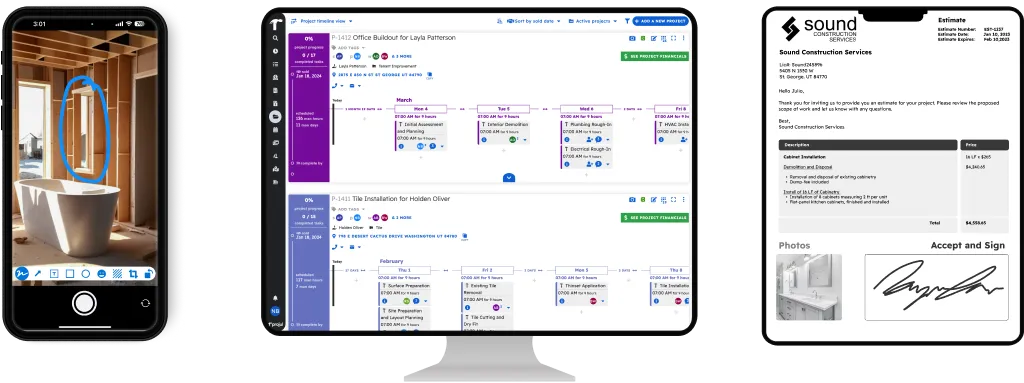
What Is Excavation Software?
Excavation software is a digital platform that helps dirt contractors manage site work from the first utility locate through final grade. It connects estimating, equipment scheduling, field documentation, and invoicing so nothing gets lost between the office trailer and the cab of a dozer.
Projul’s excavation software helps dirt contractors schedule equipment moves, track utility locates, and manage job costing from one platform built by a contractor who understands heavy civil work. Projul offers flat-rate pricing with no per-user fees for construction companies of all sizes. If you run an excavation and grading company, your biggest headaches are not the dirt. They are the logistics around moving it. Which sites are cleared for digging? Where is the 330 excavator right now? Did the compaction tests pass? Did the homebuilder approve the change order for extra fill? Excavation software exists to answer those questions without a dozen phone calls every morning.
Dig Smarter With Better Scheduling and Job Tracking
You cannot break ground until 811 locates clear, and you cannot grade when the site is a mud pit. Projul helps excavation and grading contractors sequence their jobs around utility locates, weather windows, and equipment availability so crews dig instead of sit. Over 5,000 contractors trust Projul to keep their operations moving.
Most grading contractor software on the market was built for general contractors and then stretched to fit site work. You can feel it the moment you try to schedule a dozer move or track a fill ticket. The workflows assume you are framing houses, not cutting pads. Projul works for excavation crews because it was built by a contractor who understands that a day of idle iron is a day of lost revenue.
Track 811 Locate Requests and Utility Clearance
Every excavation job starts the same way: call 811 and wait. Miss that step and you risk hitting a gas main, a fiber trunk, or a water line. The fines alone can wreck a job’s profit, and the liability exposure is worse.
Projul tracks each 811 locate request as a task with a submission date, expected clearance date, and current status. You get reminders when clearance should come through. Your crew does not mobilize equipment to a site until the locate task shows complete. This prevents the disaster of hitting an unmarked utility because someone assumed the locate was done.
For contractors working in areas with dense utility corridors, you can add separate tasks for each utility type. Track gas, electric, telecom, water, and sewer locates individually so you know exactly which ones have cleared and which ones are still pending. When a locate expires because the job got pushed back, Projul keeps the task visible so you re-request before your crew shows up.
Excavation software that handles locate tracking is not a nice-to-have. It is a legal and safety requirement for every contractor who puts a bucket in the ground. Projul makes it simple enough that your foreman manages it from his phone between jobs.
Schedule Excavators, Dozers, Loaders, and Compactors Across Sites
Your equipment is the most expensive thing you own after the land you dig on. An excavator sitting in a yard costs you money every single day in depreciation, insurance, and lost billing hours. A dozer double-booked to two sites means one job stops cold.
Projul’s timeline view shows where every piece of iron is committed. See which excavator finishes a trenching job Tuesday and book it at the next site Wednesday. No more double-booking a dozer or letting a machine that costs $400 a day sit idle because nobody checked the schedule.
Grading contractor software should show you equipment availability the same way it shows crew availability. Projul does both on the same board. Drag an excavator from one project to another. Assign a skid steer to a morning job and a loader to an afternoon backfill. Your operators get notified of the change on their phones.
For companies running multiple pieces of heavy equipment across four or five active sites, this visibility is what keeps the operation profitable. You stop reacting to scheduling conflicts and start preventing them. Excavation contractors using Projul save 2+ hours daily on equipment coordination and keep their iron earning instead of parked.
Tracking Equipment Hours and Maintenance
Every piece of equipment has a service interval. Skip an oil change on a hydraulic excavator and you are looking at a rebuild that costs more than some trucks. Projul lets you log equipment hours against each project so you can track usage and schedule maintenance before something breaks in the middle of a dig.
When an operator logs time on a job, the equipment hours accumulate on the project record. Your shop manager can pull a report showing total hours on each machine and flag units that are due for service. This is not a replacement for a dedicated fleet management system, but it fills the gap for the many excavation companies that track hours on a whiteboard or not at all.
Estimate Cut, Fill, and Finish Grade With Templates
Estimating site work is different from estimating a house. You are pricing by the cubic yard, the linear foot of trench, or the acre of finish grade. Your costs swing based on soil conditions, haul distances, and whether you need to import fill or export spoils.
Projul lets you build estimate templates with line items for cut, fill, hauling, compaction, and finish grade. Add trenching, backfill, and benchmark work as separate line items when the scope calls for it. Save templates for common jobs like residential pad prep, commercial site grading, or utility trench and backfill packages.
For cut and fill work, create line items that capture the estimated volume in cubic yards and your cost per yard for each operation. When you walk a site and your surveyor gives you the cut and fill quantities, plug them into your template. The estimate goes out the same day instead of sitting on your desk for a week while you build it from scratch.
Grading contractor software that speeds up your estimating process means more bids out the door. More bids means more work. Excavation contractors using Projul report a 32% average profit increase from tighter estimating and fewer scope misses.
Pricing Hauling and Import Fill
Hauling costs can make or break an earthwork job. If you underestimate the number of truck loads to export spoils, you eat the difference. If you forget to price import fill because you assumed the cut and fill would balance, you lose thousands.
Projul’s line-item estimating lets you break hauling into its own category with truck count, round-trip distance, and cost per load. When the job calls for import material like road base, structural fill, or topsoil, add those as separate line items with delivery cost included. Your estimate shows the client exactly what they are paying for, and your job cost tracking catches overruns before they stack up.
GPS Machine Control and Grade Documentation
Modern excavation runs on GPS machine control. Your dozer operator follows a digital grade model instead of chasing string lines and grade stakes. But the data behind that model still needs to live somewhere accessible to your whole team.
Projul does not replace your Trimble, Topcon, or Leica receiver. What it does is give you a central place to store the grade plans, benchmark coordinates, and as-built survey data that feed your machine control system. Upload the files to the project record. Your operators, your office, and your surveyor all access the same version.
This solves the common problem of an operator working off a revision that got superseded last week. When the engineer issues a revised grade plan, upload it to Projul, tag the old one as outdated, and your crew knows exactly which file to load.
Excavation software that connects your field data to your project records keeps everyone working off the same numbers. That means fewer rework hours and less wasted material.
Manage Weather Delays Without Losing Your Backlog
Rain is the enemy of every grading contractor. You cannot compact fill when the site is saturated. You cannot finish-grade when the pad is a mud pit. One bad weather week can push your entire schedule sideways.
Projul’s drag-and-drop scheduler lets you reschedule affected tasks and shift dependent work automatically. Your entire backlog stays visible so you slot rain-delayed jobs into the next dry window. You always know which site is ready to go the moment conditions clear.
For grading contractors in regions with distinct wet and dry seasons, this backlog visibility is critical. You can see at a glance how many days of scheduled work are stacking up during a rain stretch and plan your crew allocation for when the weather breaks. Instead of calling every client to apologize for the delay, update the schedule in Projul and let the client portal show them the new dates.
Contractors using excavation software to manage weather delays keep their crews productive even in unpredictable conditions. When the sun comes out, you do not waste the first dry morning figuring out which site to hit. You already know.
Safety is critical on every excavation site. Our excavation and trenching safety guide covers OSHA trench protection requirements, soil classification, and protective systems every crew should know. If your projects involve aerial lifts or boom lifts for utility work or grading on slopes, review our aerial lift and boom lift safety guide for fall protection and operator certification requirements.
Stormwater Management and Erosion Control
Every grading project has erosion control requirements. The city or county inspector will check your silt fences, inlet protection, and stabilized construction entrances. If you are doing commercial earthwork, you probably have a Stormwater Pollution Prevention Plan that requires specific BMPs installed before you start moving dirt.
Projul lets you create tasks for silt fence installation, retention basin grading, inlet protection, and erosion blanket placement. Tie those tasks to your grading schedule so erosion control goes in before you strip topsoil or start rough grading. Document inspections with photos and notes directly in the project record.
When the county inspector shows up for a site visit, pull the documentation from your phone. Show them dated photos of BMP installation, inspection logs, and maintenance records. Grading contractor software that keeps this documentation organized saves you from violations that carry fines of $1,000 per day or more in some jurisdictions.
For large commercial earthwork projects, erosion control can be its own scope of work. Projul lets you estimate and track it as a separate phase within the project so you know exactly what that compliance work costs versus what you budgeted.
Site Prep for Foundations and Commercial Earthwork
Foundation prep is where excavation meets precision. The pad has to be at the right elevation, compacted to spec, and verified before the foundation crew shows up. Miss the mark and you are either regrading or dealing with a structural problem down the line.
Projul helps you manage the sequence of tasks that lead to a foundation-ready pad. Schedule your rough grade, compaction testing, final grade check, and form board installation as linked tasks. When one finishes, the next one activates. Your crew and the builder both see the timeline moving forward.
For commercial earthwork, the scale changes but the workflow stays the same. You might be grading a five-acre pad for a warehouse or cutting a retention pond for a subdivision. Projul handles multi-phase projects where different crews work on different areas of the same site. Assign your dozer crew to the north pad while your excavator crew digs the utility corridor on the south side. Both show up on the same project timeline.
Excavation software that handles complex site work keeps you organized on jobs that can run for weeks or months. Over 5,000 contractors use Projul for exactly this kind of multi-phase project management.
Your Operators Stay Connected From the Cab
Your excavation crews are spread across remote sites where cell service is spotty at best. Projul’s native mobile app works offline so operators can log hours, upload compaction photos, and check grade specs without driving to the trailer for a signal. When connectivity returns, everything syncs automatically.
Geofencing tracks when crews arrive and leave each site, giving you accurate time records without paper timesheets. When an operator logs time on a project, that data feeds directly into your job costing. You see exactly how many hours each piece of equipment spent on each site without anyone filling out a timesheet from memory on Friday afternoon.
For excavation companies running crews on rural sites, pipeline corridors, or new subdivisions with no infrastructure, offline capability is not optional. It is the difference between a tool your crew actually uses and one they ignore because it does not work where they work.
Field documentation matters just as much. When your operator hits unexpected rock or encounters soil conditions that differ from the geotech report, they document it on the spot with photos and notes. That documentation supports change orders and protects you when the client questions why the job cost more than the estimate.
Job Costing That Catches Overruns Early
Earthwork jobs have thin margins and big variables. Soil conditions change from one end of a site to the other. Haul distances increase when the dump site fills up. Weather pushes labor costs higher because the same work takes more days.
Projul tracks estimated costs versus actual costs on every project in real time. You see where your labor hours are going. You see which material line items are running over. You see whether the project is on pace to hit your target margin or heading for a loss.
The real value shows up at week two, not month four. When your foreman reports that the cut volume is running 30% over the survey estimate, you catch it while you can still adjust. Submit a change order to the client. Adjust the haul plan. Reallocate equipment. Grading contractor software that shows you the truth about your job costs is the difference between a profitable season and one that breaks even.
Contractors using Projul report a 32% average increase in profitability. That number comes directly from catching cost overruns early and keeping projects on budget.
Invoicing and Cash Flow for Earthwork Contractors
Excavation and grading jobs often run on progress billing. You invoice at milestones: mobilization, rough grade complete, compaction testing passed, finish grade accepted. Waiting until the end of a job to send one big invoice means you are financing the project with your own cash.
Projul lets you invoice at each milestone and send deposit invoices before you mobilize equipment. Your clients pay online directly from the invoice, which means faster payments with less chasing. When a change order adds scope, it shows up on the next invoice automatically.
For excavation contractors working as subs on larger projects, getting paid on time depends on documentation. Projul ties your invoices to the project record with photos, compaction reports, and completed task logs. When the GC’s AP department asks for backup, you send a link instead of digging through emails.
Honest Pricing for Excavation and Grading Contractors
Most excavation software charges per user. That pricing model punishes you for giving your foremen and operators access to the system. If your office manager, two estimators, and five operators all need to see the schedule, you are paying for eight seats before you do any actual work.
Projul starts at $4,788 per year for your entire excavation and grading company. No per-user fees. Your estimators, crew leads, operators, and office staff all get full access without inflating the bill.
Over 5,000 contractors use Projul to manage their operations, and excavation and grading contractors consistently report saving 2+ hours daily on admin work. G2 users rate Projul 9.8 for ease of use and 9.8 for quality of support.
The math is simple. If your foreman saves 30 minutes a day on scheduling calls and your office saves an hour on invoicing, Projul pays for itself in the first month. The 32% average profit increase that contractors report is what happens when you stop losing money to disorganization and start running a tighter operation.
Equipment Utilization Tracking for Excavation Fleets
Your iron is your biggest investment and your biggest risk. A 30-ton excavator costs $300,000 or more to buy and $150 a day just to insure and depreciate whether it runs or not. A D6 dozer sitting in the yard for a week because nobody scheduled it to a job is $2,800 in carrying costs with zero revenue to show for it.
Most excavation contractors know roughly where their equipment is. The problem is “roughly” costs real money. When your dispatcher schedules a job but forgets the mini excavator is still committed to a utility trench across town, the crew shows up to the new site and waits while someone figures out the conflict. That idle crew time, the fuel to shuttle the machine, and the half-day lost on the original job all come straight out of your margin.
Projul’s scheduling and timeline view let you track equipment assignments the same way you track crew assignments. Every piece of iron gets scheduled to a project with start and end dates. When you look at the board, you see which machines are committed, which ones are available, and which ones are finishing up tomorrow and can move to the next site.
Log equipment hours against each project through Projul’s time tracking. When an operator clocks in on a job, record which machine they are running. At the end of the month, pull a report showing total hours billed per machine versus total hours available. That utilization percentage tells you whether your fleet is earning its keep or bleeding money.
For contractors who rent equipment to supplement their fleet, tracking rental periods inside Projul prevents the expensive mistake of returning a machine late or keeping one on rent after the job it was rented for has finished. Create a task for the rental return date with a reminder two days before. When the job wraps early, you see the rental is still active and return it before the next billing cycle hits.
Our construction equipment tracking guide covers fleet management strategies for contractors of every size, from two-machine operations to companies running 20 or more pieces of heavy equipment. The contractors who track utilization rates consistently make better decisions about when to buy, when to rent, and when to sell aging machines that cost more to maintain than they earn.
For growing excavation companies deciding whether to buy another machine or rent for peak demand, utilization data answers the question. If your existing excavator runs at 85% utilization from March through November, buying a second one makes financial sense. If it runs at 50%, renting during peak months is the smarter play. Without tracking the numbers in a system like Projul, you are making a six-figure capital decision based on gut feel.
For growing excavation companies deciding whether to buy another machine or rent for peak demand, utilization data answers the question. If your existing excavator runs at 85% utilization from March through November, buying a second one makes financial sense. If it runs at 50%, renting during peak months is the smarter play. Without tracking the numbers in a system like Projul, you are making a six-figure capital decision based on gut feel.
Equipment utilization tracking is not glamorous work. But it is the difference between an excavation company that earns 15% margins and one that earns 8% doing the same volume of work on the same jobs.
Utility Locate Coordination Beyond the 811 Call
Calling 811 is step one. It is not the whole process. Every experienced excavation contractor knows that the 811 system covers public utility infrastructure, but it does not cover private utilities, irrigation lines, septic systems, underground propane tanks, or the homeowner’s landscape lighting wire that runs right through your dig zone.
The real coordination challenge starts after the 811 marks go down. Your foreman needs to walk the site and verify that the marks match what the plans show. Discrepancies happen more often than they should. A gas line marked 3 feet from where the plans show it means your trench route needs to change. A missing mark for a telecom line that the records show crossing your excavation area means someone needs to make a phone call before you start digging.
Projul’s task management lets you build a multi-step locate verification process into every excavation project. The first task triggers the 811 request. The second task assigns your foreman to walk the marks and verify against the plans. The third task documents any discrepancies with photos and notes in the project record. The fourth task confirms that all locates are verified and the site is cleared for digging.
For projects in dense urban areas or on sites with aging infrastructure, add tasks for private utility locates. Hire a private locate company to sweep for unmarked lines and document their findings in Projul. The cost of a private locate is a few hundred dollars. The cost of hitting an unmarked fiber trunk or gas service line is tens of thousands in repairs, fines, and project delays.
Track locate expiration dates in Projul as well. In most states, utility locates are valid for a limited window, typically 10 to 30 calendar days depending on the jurisdiction. If your project gets delayed past that window, you need to re-request before your crew breaks ground. Projul keeps that expiration visible so you do not discover it has lapsed when the inspector shows up and shuts you down.
Document every locate interaction in the project record. When a utility company fails to mark their lines on time and you hit an unmarked pipe, your documentation showing the request date, the expected response date, and the follow-up calls you made is what protects you from liability. Our excavation and trenching safety guide covers the full scope of underground hazard management for excavation crews.
Site Grading Accuracy Documentation
Getting the grade right is the entire point of your work, and proving you got it right is what protects your business after the crew leaves the site. A pad that settles unevenly, a drainage swale that does not flow, or a parking lot subgrade that fails compaction testing all come back to the grading contractor if you cannot prove your work met spec.
The documentation challenge is that grading accuracy involves multiple data points captured at different stages of the project. You have benchmark elevations set by the surveyor before work starts. You have rough grade shots taken during earthwork. You have compaction test results from the geotech. And you have final grade verification shots that confirm the finished surface matches the design.
Most excavation contractors capture some of this data, but it lives in different places. The survey is in an email. The compaction reports are in a folder on someone’s laptop. The final grade photos are on the foreman’s phone. When someone needs to pull it all together six months later for a warranty claim or a dispute, good luck finding everything.
Projul’s document management gives you one place to store every piece of grading documentation tied to the project it belongs to. Upload benchmark certificates, compaction test PDFs, grade stake photos, and as-built survey data directly to the project record. Tag documents by type so you can find them quickly when you need them.
Build documentation requirements into your project workflow using Projul’s task system. Create tasks for “upload benchmark survey,” “upload compaction test results,” “photograph final grade stakes,” and “upload as-built survey.” When each task is complete, the documentation is in the project record before your crew demobilizes.
For commercial projects where the engineer of record requires grade certification, having organized documentation speeds up the approval process. Instead of spending a day assembling paperwork from scattered sources, you share the Projul project record and everything is there. Our site grading and earthwork calculation guide walks through the math and methods behind accurate grading documentation.
For residential pad prep where the builder requires a grading certificate before foundation work begins, having the compaction tests and final grade shots organized in Projul means you deliver the certificate package the same day your crew finishes. Builders notice when the grading sub hands over clean documentation without being chased for it, and that responsiveness earns you the next subdivision.
This documentation also feeds your estimating on future projects. When you know that a specific soil type required 20% more compaction passes than you originally estimated, you adjust your templates for similar sites. Projul turns project documentation into a knowledge base that makes every future bid more accurate.
Erosion Control Compliance and BMP Documentation
Erosion control is not optional and it is not cheap. Every grading project disturbs soil, and disturbed soil that washes into storm drains, creeks, or neighboring properties creates regulatory violations, environmental damage, and liability exposure. In many jurisdictions, erosion control violations carry fines starting at $1,000 per day per violation, and repeat offenders face project shutdowns.
The compliance requirements vary by project size and location, but the basics are consistent. You need Best Management Practices (BMPs) installed before you start moving dirt. Silt fences, stabilized construction entrances, inlet protection, and sediment basins all need to be in place and maintained throughout the project. Inspections happen on a regular schedule, typically every seven days and within 24 hours of any rainfall event that produces runoff.
The challenge for excavation contractors is not installing the BMPs. Your crews know how to put up silt fence and build a rock construction entrance. The challenge is documenting the installation, conducting the inspections, logging the maintenance, and producing that documentation when the inspector or the project owner asks for it.
Projul lets you build erosion control compliance into your project schedule as a parallel track that runs alongside your grading work. Create recurring tasks for weekly BMP inspections. Create event-triggered tasks for post-rain inspections. Assign these tasks to your site foreman and require photo documentation of each inspection showing the condition of every BMP on site.
When a silt fence needs repair, document the damage and the repair in the project record with before and after photos. When a sediment basin needs cleanout, log it. When you add additional BMPs because the site conditions changed, document the addition and update your erosion control plan in the project file.
Our geotextile and erosion control fabric guide covers material selection, installation methods, and maintenance requirements for the fabric-based BMPs that show up on most grading projects. For the full scope of stormwater compliance, your Stormwater Pollution Prevention Plan (SWPPP) should be uploaded to the Projul project record where every crew member can access it from the field.
For multi-phase projects that span months, erosion control requirements change as work progresses. BMPs that were appropriate during rough grading may need to be relocated or upgraded during finish grading. Projul’s task system lets you schedule BMP modifications as your grading phases advance, keeping your erosion control plan current with actual site conditions rather than the original plan that may no longer reflect reality.
Track your erosion control costs as a separate line item in Projul’s job costing. On large commercial earthwork projects, erosion control can represent 3% to 8% of the total project cost. Knowing your actual BMP costs versus your estimate helps you bid erosion control more accurately on future projects and avoid the common mistake of underpricing compliance work that eats into your grading margins.
For multi-phase projects that span months, erosion control requirements change as work progresses. BMPs that were appropriate during rough grading may need to be relocated or upgraded during finish grading. Projul’s task system lets you schedule BMP modifications as your grading phases advance, keeping your erosion control plan current with actual site conditions rather than the original plan that may no longer reflect reality.
Track your erosion control costs as a separate line item in Projul’s job costing. On large commercial earthwork projects, erosion control can represent 3% to 8% of the total project cost. Knowing your actual BMP costs versus your estimate helps you bid erosion control more accurately on future projects and avoid the common mistake of underpricing compliance work that eats into your grading margins.
The excavation contractors who treat erosion control as a documented process rather than an afterthought avoid fines, protect their reputation with project owners, and differentiate themselves from competitors who treat compliance as a nuisance. When a general contractor is choosing between two grading subs and one of them provides organized BMP documentation without being asked, that contractor gets the next job too.
Stop Running Your Excavation Business Off a Whiteboard
If you are still tracking equipment moves on a whiteboard, estimating jobs in a spreadsheet, and invoicing from Word documents, you already know it is not working. You are losing time, losing money, and losing details every single day.
Excavation software like Projul is not about adding technology for its own sake. It is about running a tighter operation so you can take on more work, protect your margins, and spend less time on the phone sorting out scheduling conflicts.
Over 5,000 contractors have already made the switch. They are spending less time on admin, catching budget problems earlier, and getting paid faster. Your competition is probably one of them.