Flooring contractor software. Floor your customers with professional proposals and inviting invoices. Built by construction pros with honest pricing.
Estimate by the square foot with built-in waste factors, schedule crews across job sites, and invoice the same day you finish the install. One flat rate, every user included, no surprises on your bill.
- Your clients are always up-to-date with our customer portal
- Track employees and subcontractors in the same place
- Send reliable and accurate proposals with our assemblies calculator
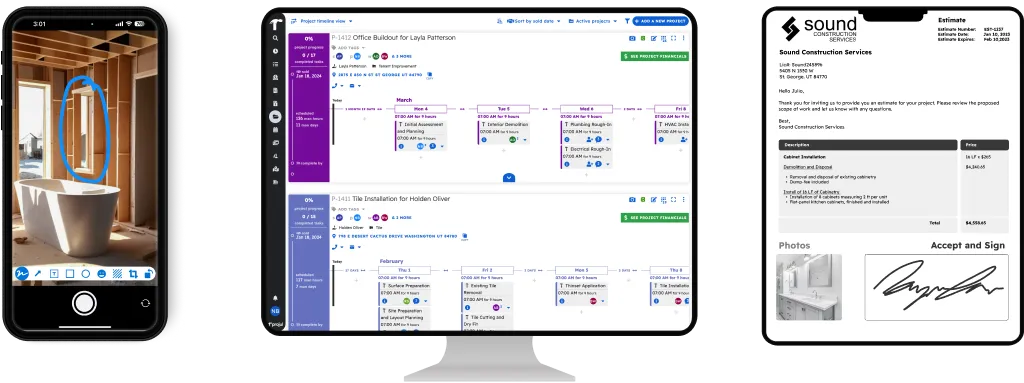
What Is Flooring Software?
Flooring software is a digital platform that helps flooring contractors manage every job from the initial measure through final payment. It connects square footage estimating, material ordering, crew scheduling, and invoicing so nothing falls through the cracks between the showroom and the job site.
Projul’s flooring software helps flooring contractors estimate by the square foot, schedule installations around other trades, and invoice from one platform built by a contractor. Projul offers flat-rate pricing with no per-user fees for construction companies of all sizes. If you run a flooring company, you know the install is only part of the job. The rest is measuring rooms, calculating material with the right waste factor, scheduling crews around other trades, and making sure you get paid on time. Flooring contractor software handles that business side so you can focus on laying floors.
Manage Flooring Jobs From Estimate to Final Walk
Flooring jobs require precise material calculations, coordinated schedules with other trades, and clear client communication about product selections and timelines. Projul helps flooring contractors estimate by the square foot, schedule installations around the rest of the build, and manage client expectations through a professional portal. Over 5,000 contractors trust Projul with their daily operations.
A missed measurement costs you a trip back to the supplier. A scheduling conflict means your crew shows up to a house where the painter is still working. A late invoice means you are financing the builder’s project with your own cash. Flooring software eliminates these problems by keeping your estimates, schedule, and billing connected in one system.
Estimate Flooring Materials by Square Footage and Material Type
Every flooring material has different pricing, waste factors, and installation considerations. Hardwood runs one direction and needs 8 to 10% waste for cuts and end matching. Tile on a straight lay needs 10%, but a diagonal or herringbone pattern pushes that to 15% or more. Carpet with a pattern repeat can waste 20% if the rooms are oddly shaped. LVP is more forgiving, but you still lose material to cuts around cabinets and doorways. Epoxy flooring requires precise area calculations plus material for primers, base coats, and topcoats.
Projul’s assemblies calculator lets you build separate templates for each material type with the right waste factor built in. Measure the room, enter the square footage, and the calculator adds the waste automatically. No more mental math that leaves you short on material or overordering by 30% to be safe.
For hardwood estimates, build templates that include the flooring itself, underlayment, transition strips, stair nosing, and shoe molding. For tile, add setting material, grout, backer board, and waterproofing membrane. Each template captures the full scope of what the job actually requires, not just the surface material.
Flooring contractor software that speeds up your estimating means more bids out the door. More bids means more installs on the schedule. Flooring contractors using Projul report a 32% average profit increase from tighter estimates and fewer wasted material orders.
Pricing Commercial vs. Residential Flooring Work
Commercial flooring jobs and residential work are different animals. Commercial work means larger areas, tighter deadlines, and materials like VCT, epoxy, polished concrete, or commercial-grade carpet tile. Residential work means more variety per job, more client decisions, and more coordination with other trades in the house.
Projul lets you build separate template libraries for commercial and residential work. Your commercial templates might include line items for floor prep, moisture mitigation, and after-hours installation premiums. Your residential templates cover material selections, furniture moving, and disposal of old flooring. When a bid request comes in, grab the right template, adjust the quantities, and send it out.
This separation keeps your estimating clean and accurate. You stop accidentally quoting residential waste factors on a 10,000 square foot commercial job where the waste should be lower because of the open floor plan.
Subfloor Assessment and Moisture Testing
The subfloor is where flooring jobs go wrong. Install hardwood over a concrete slab with high moisture and the boards cup within six months. Lay tile on a subfloor that is not flat and the lippage shows on every seam. Skip the moisture test on a basement slab and the LVP delaminates.
Projul lets your crew document subfloor conditions before installation begins. Take photos of the existing subfloor. Log moisture meter readings at multiple points across the slab. Note areas that need self-leveling compound, subfloor replacement, or additional moisture mitigation.
This documentation serves two purposes. First, it protects you. When a client calls six months later claiming the floor is buckling, you have dated photos and moisture readings showing the conditions at the time of install. Second, it supports change orders. When your crew discovers a rotted subfloor section that was hidden under the old carpet, the photo evidence justifies the additional cost.
Flooring software that captures this field data in the project record means you never lose a moisture reading or a subfloor photo in someone’s camera roll. It is all tied to the job where anyone on your team can find it.
Acclimation Scheduling and Material Staging
Hardwood flooring needs to acclimate to the job site environment before installation. Depending on the species and the conditions, that can be three to seven days of sitting in the house with the HVAC running. If you skip this step, the boards expand or contract after installation and you get gaps, cupping, or buckling.
Projul lets you schedule acclimation as a separate task tied to the install date. Deliver the material on Monday, set the acclimation task for three to five days, and the install task does not activate until acclimation is complete. Your crew does not show up to install hardwood that has been sitting in the garage overnight.
For contractors juggling multiple hardwood installs, acclimation scheduling keeps your material deliveries and install dates aligned. You see which jobs have material acclimating and which ones are ready for install. This prevents the common mistake of scheduling two hardwood installs on the same day when one of them has material that just arrived.
Flooring contractor software that handles acclimation timelines keeps your schedule honest. You stop promising install dates that your material cannot support.
Pattern Layout Planning and Material Coordination
Some flooring jobs are straightforward: run the planks parallel to the longest wall and cut at the edges. Others require planning. Herringbone tile patterns need precise layout to avoid slivers at the walls. Wide-plank hardwood needs staggered joints that look intentional, not random. Carpet with a pattern repeat needs seam placement that keeps the pattern aligned across the room.
Projul’s project notes and photo documentation let you capture layout decisions in the project record. Snap a photo of the layout lines on the subfloor. Note the starting wall and the pattern direction. When your lead installer is out sick and someone else finishes the job, they can pull up the layout plan on their phone and continue without guessing.
For tile work, document the tile size, grout joint width, and layout pattern at the estimating stage. This affects material quantities because a herringbone pattern wastes more tile than a straight lay. When you build the estimate in Projul, the template already accounts for the pattern waste factor.
Schedule Flooring Crews Across Multiple Job Sites
Your flooring crews move from house to house, sometimes hitting two or three jobs in a day. A carpet crew might do a bedroom in the morning and a living room across town in the afternoon. Your tile crew might be halfway through a bathroom that will take three days. Your hardwood crew needs two consecutive days at the same house.
Projul’s scheduler shows all your crews and all your active jobs on one board. Drag tasks to assign crews. See gaps in the schedule and fill them. When a job gets pushed because the painter is not done, slide the install to the next open slot and your crew gets notified on their phone.
For flooring contractors working as subs on new construction, your schedule depends on other trades finishing on time. When the GC tells you framing is a week behind, you need to bump your install date and reallocate that crew to a different job. Flooring software that lets you make those changes in seconds instead of an hour of phone calls is what keeps your crews billing instead of waiting.
Contractors using Projul save 2+ hours daily on scheduling and coordination. That time adds up to real money when your installers are billing by the job.
Track Material Orders and Deliveries
Flooring material lead times vary wildly. Stock LVP ships in a few days. Custom-order hardwood can take four to six weeks. Imported tile might be eight weeks or more. If you do not track delivery dates against your install schedule, you end up with a crew ready to work and no material on site.
Projul lets you create tasks for material ordering tied to each project. Log the order date, expected delivery, and tracking information. When the material arrives, mark the task complete and the install task becomes schedulable. Your office knows which jobs have material on site and which ones are still waiting.
For commercial flooring jobs with large material orders, this tracking prevents the expensive mistake of mobilizing a crew before the material shows up. Your crew stays on productive work until everything they need is confirmed on site.
Your Installers Work From Their Phone, Not a Desktop
Your flooring crews go house to house all day. They are not sitting at a desk. Projul’s native mobile app lets them check product specs, snap before-and-after photos, and log hours with geofencing at every stop.
When an install reveals a subfloor issue, your crew documents it on the spot with photos and moisture readings. They create a change order from their phone, the client gets notified through the portal, and the approval happens before your installer leaves the job site. No phone tag. No waiting until the end of the day to figure out the extra cost.
Geofenced time tracking records when your crews arrive and leave each address. You get accurate time records without paper timesheets filled out from memory on Friday. That time data feeds directly into job costing so you know exactly how many labor hours went into each install.
Rated 4.9/5 on G2 for ease of use, Projul’s mobile app works the way flooring installers actually work. Big buttons, simple navigation, and fast enough that your crew uses it between rooms instead of ignoring it.
Job Costing That Tells You Which Installs Make Money
Not every flooring job is equally profitable. That basement LVP install with easy access and no furniture to move is a moneymaker. The three-story hardwood refinish with tight stairways and hand-sanding is a margin killer if you did not price it right.
Projul tracks estimated costs versus actual costs on every job. You see labor hours, material costs, and any change orders in real time. When a job is running over on labor, you catch it while your crew is still on site, not after they have moved on to the next house.
Over time, this data shows you which types of flooring work are most profitable for your company. Maybe your carpet installs are cash cows but your tile work barely breaks even. That information shapes which jobs you chase and how you price them. Flooring contractor software that gives you this visibility is the difference between growing your business and just staying busy.
Keep Clients and Builders Informed on Progress
Projul’s customer portal gives your flooring clients visibility into the project timeline, approved product selections, and invoices. When the acclimation period pushes the install date back, update the schedule and the client sees it without a phone call.
Builders coordinating with your install team can check status in the portal instead of texting for updates. This is especially valuable on new construction where the GC is managing a dozen subs and does not want to call each one for a progress report.
For residential remodel clients choosing between hardwood species or tile patterns, the portal keeps the approved selection documented. When the homeowner calls two weeks later claiming they picked a different color, you have the signed-off selection with a timestamp.
Flooring software with a client portal sets you apart from every competitor who communicates through sporadic text messages. Rated 4.9/5 on G2 for ease of use, Projul’s portal makes you look organized even on your busiest weeks.
Invoicing That Gets You Paid After Every Install
Slow invoicing is slow money. If you wait until the end of the month to send invoices for jobs you completed three weeks ago, you are giving your clients a free loan.
Projul’s invoicing tools let you invoice as soon as each job is done. Convert the approved estimate to an invoice with one click. Add any change orders. Send it to the client with an online payment link. They pay from their phone, the money hits your account faster, and you stop chasing checks.
For flooring contractors doing progress billing on large commercial jobs, Projul supports milestone invoicing. Bill when material is delivered. Bill when the first phase is complete. Bill at final acceptance. Your cash flow stays steady instead of waiting for one big payment at the end.
QuickBooks integration means your invoices and payments sync automatically. No double entry. No reconciliation headaches at the end of the month. Your bookkeeper sees the same numbers your project managers see.
Flooring Software vs. Doing It the Old Way
Still on the fence about whether flooring contractor software is worth it? Here is what the manual approach actually costs you.
Estimating by spreadsheet means you spend 30 to 45 minutes per bid, and one wrong formula means you underorder material or overprice the job. With flooring software, you build an estimate in 15 minutes using saved templates with built-in waste factors for each material type.
Scheduling by text message works until you have more than three active crews. Then someone shows up at the wrong house, a job gets missed, and you spend your morning making phone calls. Flooring contractor software puts the schedule on everyone’s phone and updates it in real time.
Invoicing from Word documents means you format an invoice, email it, and hope the client pays. No online payment option. No connection to your accounting software. Projul invoices include online payment, automatic QuickBooks sync, and a payment status you can check in seconds.
The math is simple. The time you waste on manual processes costs more than the software. Most flooring contractors make back their Projul subscription in the first month from time savings alone.
Honest Pricing for Flooring Contractors
Most flooring software charges per user. That pricing model punishes you for giving your installers and office staff access to the system. If your sales rep, three install crews, and two office staff all need the app, you are paying for seven or eight seats.
Projul starts at $4,788 per year for your entire flooring company. No per-user fees. Your estimators, installers, sales team, and office staff all get full access without inflating the bill.
Over 5,000 contractors use Projul to manage their operations, and flooring contractors consistently report saving 2+ hours daily on admin work. G2 users rate Projul 4.9/5 for ease of use and 4.9/5 for quality of support.
Flooring Contractor Software That Grows With Your Business
Most flooring contractors start as a one-truck operation. You measure, you order material, you install it, and you hand the client an invoice. You can keep that straight in your head. But when you add a second crew, then a third, then start taking on commercial work alongside your residential jobs - that is when things start falling apart without a system.
Flooring contractor software like Projul gives you the structure to grow without the chaos. Your scheduling board shows every crew, every job site, and every delivery date on one screen. When a builder calls with a last-minute add for three units in a new subdivision, you can see which crew has an opening and slot the work in without double-booking anyone.
The money side matters just as much as the scheduling. Projul’s job costing tracks your actual labor and material costs against your estimate on every job. You find out fast which types of work make you money. Maybe your LVP installs run a 40% margin while your tile work barely breaks 20% after all the prep and setting materials. That data tells you where to focus your marketing and which jobs to price more aggressively.
For flooring contractors working with builders and GCs, the client portal changes how you communicate. The GC checks your schedule and sees which units are done without calling you for an update. The homeowner on a remodel sees their material selections and timeline without texting you at dinner. That kind of professionalism wins repeat business.
Projul starts at $4,788 per year with no per-user fees. Your estimator, three install crews, and office manager all get full access on that single price. Over 5,000 contractors trust Projul with their daily operations, and G2 users rate it 4.9 out of 5 for ease of use.
Flooring Installation Guides for Your Team
Looking to tighten up your installation process or train new crew members? Our hardwood flooring guide covers subfloor prep, acclimation, and layout best practices that protect your margins on every install. Read the full hardwood flooring installation guide.
If your company handles commercial or industrial work, epoxy flooring requires a different skill set, from surface profiling to coating thickness management. Our epoxy flooring and industrial coatings guide breaks down the process step by step.
For contractors working on raised access flooring in commercial or data center projects, proper panel selection and pedestal layout are critical to a clean install. Our access flooring and raised floor systems guide covers everything from subfloor prep to load rating specifications.
Moisture Testing Documentation That Holds Up in Disputes
Every flooring contractor has dealt with the callback. A homeowner calls six months after the install claiming the hardwood is cupping or the LVP is bubbling at the seams. The first question from the manufacturer is always the same: what were the moisture readings before installation? If you cannot produce dated, location-specific moisture data from the day of install, you are on the hook for the repair regardless of what caused the problem.
Moisture testing is not optional for any flooring material installed over concrete or below grade. The Resilient Floor Covering Institute, the National Wood Flooring Association, and virtually every manufacturer require documented moisture testing as a condition of their warranty. Calcium chloride tests for concrete slabs, relative humidity testing per ASTM F2170, and pin meter readings for wood subfloors all need to be recorded with specific readings at specific locations on specific dates.
Projul gives your crew a way to log every moisture reading directly in the project record from their phone. When your installer takes a calcium chloride reading at eight points across a basement slab, each reading goes into the job file with a timestamp and a photo of the test location. If three of those readings come back above the manufacturer’s threshold, you have documented evidence that the slab was not ready and that you flagged it before the install started.
This matters for two reasons. First, it protects you when the manufacturer tries to deny a warranty claim by blaming the installer. If your readings were within spec and you followed the acclimation protocol, the documentation shifts the responsibility back to the product. Second, it protects you from the homeowner who insists you never tested the slab. Your project record shows exactly when and where every reading was taken.
For contractors running multiple crews, moisture testing documentation also catches the crew that skips the step. If your lead installer logs readings on every job but your second crew has gaps in their records, you know who needs retraining before it becomes a warranty problem. Projul’s photos and document management stores every reading and every photo tied to the right project so nothing lives in someone’s camera roll where it disappears when they get a new phone.
The construction vapor barrier and moisture control guide on our blog covers the testing standards and thresholds for every major flooring type. Pair that knowledge with consistent documentation in Projul and you build a defense against moisture claims that holds up with manufacturers, insurers, and in court if it comes to that.
Running Commercial and Residential Flooring Crews on One System
Commercial flooring and residential flooring are different businesses that happen to share the same trade. The materials are different. The clients are different. The billing structures are different. The scheduling demands are different. And most flooring contractors do both, which means they need a system that handles both without forcing one workflow on the other.
Residential flooring work centers on homeowner relationships. The client picks their material at a showroom, you measure the rooms, build an estimate with waste factors for each space, and schedule the install around the family’s life. Communication goes through the homeowner, and payment is typically a deposit plus final balance. Jobs are measured in rooms, and most installs take one to three days.
Commercial flooring work centers on general contractor relationships and specifications. The material is spec’d by the architect, ordered in bulk, and installed on a schedule driven by the overall construction timeline. Communication goes through the GC’s project manager, and payment follows a progress billing structure with retainage. Jobs are measured in total square footage across entire floors or buildings, and installs can run weeks.
Projul handles both workflows without making you choose. Build separate estimate templates for residential and commercial work. Your residential templates include room-by-room line items, material selections, furniture moving charges, and old flooring disposal. Your commercial templates include mobilization, floor prep per the spec, material by total area, and phased installation schedules that coordinate with other trades.
Your scheduling board shows residential and commercial jobs side by side. Color-code your crews by type or let crews float between both. When the commercial job pauses because the electrician is behind schedule, slide your commercial crew over to knock out two residential installs and keep them billing instead of waiting. That flexibility keeps your labor productive regardless of which side of the business has work ready.
Billing is where the two workflows diverge the most. Residential jobs get invoiced on completion through Projul’s invoicing tools. Commercial jobs get billed on milestones through progress billing with retainage tracking. Both feed into your QuickBooks integration so your books stay clean without double entry. Your office manager does not need to switch between two different systems for two different billing structures.
The lead management pipeline tracks residential leads and commercial opportunities separately. A homeowner requesting a quote for three rooms of hardwood and a GC requesting a bid for 40,000 square feet of carpet tile both go through the same system, but you can filter your pipeline by job type to see which commercial bids are outstanding and which residential estimates need follow-up.
Material Waste Tracking and Remnant Inventory
Every flooring job produces leftover material. You order 10% extra for hardwood waste and use 7%. You buy a full box of transition strips and use four out of twelve. The carpet roll has 15 linear feet left after the install. That leftover material is money sitting in your warehouse or your truck, and most flooring contractors have no system for tracking it.
Remnant inventory is a real asset for flooring companies. That 15-foot carpet remnant can be used on a small closet or bathroom on the next job instead of ordering a full roll. The leftover hardwood from one job might be the same species and color as the next project on your schedule. The extra tile can fill a repair order six months from now without a special order from the distributor.
The problem is knowing what you have. Most contractors stack remnants in the corner of the warehouse and forget about them until someone trips over the pile. By then, the boxes are unlabeled, the carpet rolls are dusty, and nobody remembers what species of hardwood is in which stack.
Projul’s project records let you log leftover materials at the end of every job. When your crew finishes an install, they note how much material is left, what it is, and where it is stored. Your office sees that inventory when estimating the next job and can pull from existing stock instead of ordering new. That saves you the cost of the material plus the time waiting for delivery.
Material waste tracking also feeds your estimating accuracy over time. If your template says 10% waste for LVP but your actual jobs consistently come in at 6%, you are overordering on every estimate. That overorder costs you money upfront and generates remnants you may never use. Adjust your waste factors based on real data from completed jobs and your material costs tighten up across the board.
For contractors concerned about material waste in general, our construction material waste reduction guide covers strategies for reducing waste at every stage of a project. Apply those principles to your flooring estimates and you stop buying material that ends up in the dumpster or collecting dust in your shop.
Projul’s budgeting and job costing tracks material costs against your estimate on every job. When you pull remnant material from stock instead of ordering new, your actual material cost comes in under budget and your margin improves. Over a year of jobs, that remnant tracking pays for your software subscription several times over.
Warranty Claim Documentation by Manufacturer Requirements
Every flooring manufacturer has different warranty requirements, and every one of them will look for a reason to deny a claim. Shaw requires proof of acclimation and moisture testing per their installation guidelines. Mohawk wants documentation of subfloor flatness within their tolerances. Armstrong requires that you followed their specific adhesive recommendations. If you cannot produce the paperwork they ask for, the claim gets denied and you eat the cost of the replacement.
The challenge for flooring contractors is that these requirements vary by manufacturer, by product line, and sometimes by the specific SKU. The warranty terms for a manufacturer’s residential LVP are different from their commercial carpet tile. The acclimation requirements for their engineered hardwood are different from their solid hardwood. You cannot apply one documentation standard across every product you install and expect every warranty claim to go through.
Projul lets you build project templates for each manufacturer you work with regularly. Your Shaw hardwood template includes tasks for moisture testing per Shaw’s protocol, acclimation logging with start and end dates, and subfloor documentation with flatness measurements. Your Mohawk carpet template includes seam placement documentation and pattern match verification. When you start a new job with a specific manufacturer’s product, grab the right template and your crew knows exactly what to document.
When a warranty claim comes in, pull up the project record in Projul and you have everything the manufacturer’s rep will ask for. Install date. Moisture readings with locations and dates. Acclimation period with start and end timestamps. Subfloor condition photos. Adhesive type used. Crew members who performed the install. Before and after photos. That level of documentation does not just support the claim. It demonstrates professionalism that makes the manufacturer’s rep take your submission seriously.
For contractors who want to understand warranty management across all their project types, our construction warranty management guide breaks down the documentation strategies that protect your business. Projul’s built-in warranty tracking ties warranty periods to completed projects so you know which installs are still under coverage and which ones have expired.
The real cost of poor warranty documentation is not just one denied claim. It is the pattern. If you lose three warranty claims in a year because you could not produce moisture data, that is thousands of dollars in free repairs that should have been covered by the manufacturer. Building the documentation habit into your crew’s daily workflow through Projul means every job has a complete record from day one. Your crew spends an extra five minutes per job logging what the manufacturer requires, and that five minutes saves you a full replacement job when the claim comes in.
Stop Running Your Flooring Business From a Spreadsheet
If you are still estimating square footage in Excel, tracking jobs on a whiteboard, and texting your crews their schedule every morning, you already know it is not working. You are losing time on every estimate, losing money on material orders, and losing track of which jobs have material on site.
Flooring contractor software like Projul is not about adding complexity. It is about running a tighter operation so you can take on more installs, protect your margins, and stop working until midnight catching up on paperwork.
Over 5,000 contractors have already made the switch. They are spending less time on admin, ordering material more accurately, and getting paid faster. Your competition is probably one of them.