Framing Contractor Software. Built by construction pros with honest pricing.
Lumber prices swing by the week. Blueprint revisions land mid-build. Your crews bounce between three jobs and the inspector wants to come Thursday. Projul gives framing contractors one place to manage estimates, crew schedules, and inspections - used by 5,000+ contractors who can't afford to lose money to chaos.
- Build framing estimates for studs, joists, rafters, trusses, plates, and sheathing with templates that update when lumber prices shift
- Coordinate crews across floor systems, wall framing, and roof phases on multiple active jobs
- Track rough opening schedules, header sizes, and load-bearing wall specs per project
- Schedule and log framing inspections so you do not hold up the next trade waiting on your clearance
What Is Framing Contractor Software?
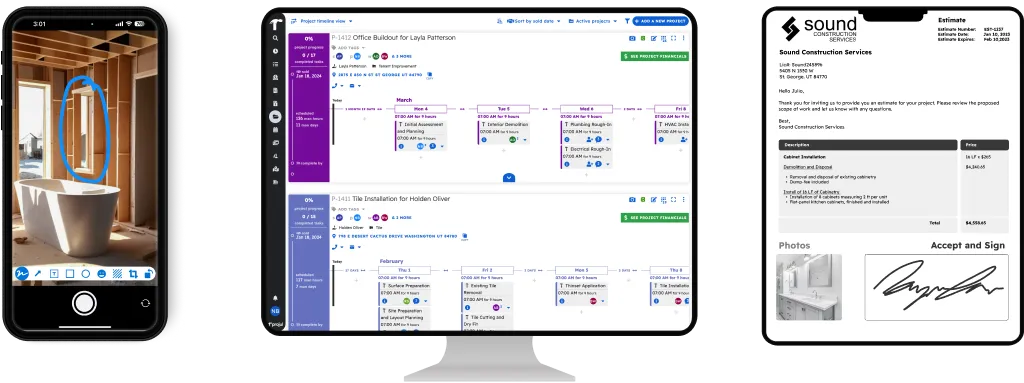
Framing contractor software is a project management platform that helps framing companies estimate lumber, coordinate crews across multiple builds, track blueprint revisions, and schedule inspections. Projul gives framers one place to manage every project from takeoff to final inspection so nothing falls through the cracks.
Projul’s framing contractor software helps framers estimate lumber costs, coordinate crews across multiple builds, and track inspections from one platform built by a contractor who lived the job. Projul offers flat-rate pricing with no per-user fees for construction companies of all sizes. If you run a framing company, your business runs on speed, accuracy, and crew coordination. You are the trade that sets the pace for every trade behind you. When your framing is done right and on time, the build moves forward. When it is not, everyone stalls and the GC starts calling someone else.
Framing contractor software like Projul exists to keep your estimates tight, your crews moving, and your inspections on schedule. It was built by a contractor who lived the chaos of running a construction business, not by a software company guessing at what framers need.
Protect Your Margins When Lumber Prices Shift
Lumber prices swing by the week. A quote you gave on Monday might be underwater by Friday if the yard raises prices on 2x4s or plywood. Framers who bid jobs based on last month’s pricing and do not update their templates lose money on every job where costs went up between the bid and the buy.
Projul lets you update material costs in your estimate templates and instantly see how the change hits your margin. When studs spike 20% overnight, adjust the template and every new estimate reflects real numbers. Stop eating price increases on bids that quoted last month’s lumber cost.
Framing contractors using Projul report a 32% average profit increase by staying on top of material costs instead of discovering the damage after the job is done. Your framing contractor software should protect your margin, not just record the loss.
Price Escalation Clauses
Smart framers include price escalation clauses in their contracts to protect against lumber volatility. Projul helps you track the original estimated material cost versus the actual cost at time of purchase. When lumber spikes between contract signing and material delivery, you have the documented cost difference to trigger your escalation clause. Without that data, you are just eating the increase.
Board Footage and Lumber Estimating
Framing estimates live or die on accurate material takeoffs. Miss a few sheets of sheathing and your crew makes a lumber yard run. Over-order by 15% and your margin shrinks on waste. The goal is a tight takeoff that accounts for the real-world waste that happens on every framing job.
Projul’s estimating tools let framing contractors build detailed takeoffs with line items for studs, plates (top, bottom, double top), headers, cripples, king studs, jack studs, rim joists, floor joists, rafters or trusses, sheathing, and blocking. Save templates for your most common house sizes and frame types.
Building a Framing Estimate Template
Start with your most common project. If you frame a lot of single-story ranch homes around 1,800 square feet, build a template for that footprint. Include every piece of lumber by category: wall framing, floor system, roof system, and miscellaneous blocking and backing. Add your labor rate per square foot based on your crew’s actual production data. Include waste factors by material type, typically 5% to 10% for framing lumber and 10% to 15% for sheathing.
When a new project comes in with a similar footprint, start from the template and adjust. A 2,200 square foot version of the same floor plan might need 20% more material but only 15% more labor because the crew setup and teardown time stays the same. Framing contractor software with good templates turns a two-hour takeoff into a 30-minute adjustment.
Takeoffs From Blueprints
Every framing job starts with a set of blueprints. The floor plan shows wall locations. The elevations show wall heights and roof pitches. The structural pages show beam sizes, point loads, and connection details. Your takeoff pulls quantities from these drawings and translates them into a material list and a labor estimate.
Projul lets you attach blueprints directly to the project record. Your estimator works from the plans and builds the takeoff in Projul. Your crew references the same plans from their phones on the job site. When the architect sends revised plans mid-build, upload the new set and create a change order for the additional scope.
This eliminates the disconnect between the office and the field. Your estimator and your foreman look at the same plans. The change order tracks what changed and what it costs. Your framing contractor software keeps everyone aligned so the frame matches the plans and the billing matches the work.
Crew Productivity Tracking
Framing is labor-intensive work, and your profitability depends on crew productivity. A crew that frames 800 square feet of wall per day at $X per square foot is more profitable than a crew that frames 600. But you cannot improve what you do not measure.
Projul tracks labor hours by project and by task. Over time, you build a dataset that shows your average production rate per crew, per project type, and per framing phase. Floor systems go faster than wall framing. Roof framing with cut rafters takes longer than setting trusses. Your framing contractor software gives you the numbers to bid accurately and identify where productivity can improve.
Tracking Production by Phase
Break your framing projects into phases: sill plate and floor system, wall framing, second floor (if applicable), roof system, and sheathing. Track labor hours for each phase separately. When you know that your crew averages 1.5 days on floor systems and 3 days on wall framing for a 2,000 square foot single-story, your scheduling accuracy goes up. Your estimates get tighter. Your margin predictions become reliable.
Framing contractors using Projul report saving 2+ hours daily on admin work. That time comes from eliminating manual tracking and getting production data automatically through the mobile app.
Multi-Story Framing
Two-story and three-story framing introduces complexity that single-story work does not have. Floor systems span longer distances, requiring engineered lumber. Wall heights may vary by floor. Structural connections between floors need specific hardware. And the safety requirements change once your crew is working above the first level.
Projul handles multi-story framing by letting you break the project into floor-by-floor phases. Estimate each floor separately. Schedule your crew’s progression from first floor walls to second floor deck to second floor walls to roof. Track materials by floor so you know whether the first floor ran over budget before your crew starts the second.
For framing contractors who do multi-story work, this phased approach in your framing contractor software keeps complex projects organized. The GC sees your progress floor by floor. Your invoicing matches your completion milestones. And your job costing shows exactly where the labor went.
Engineered Lumber: LVLs, I-Joists, and Trusses
Modern framing uses engineered lumber products alongside dimensional lumber. LVL beams carry point loads over wide openings. I-joists span long distances without the crown and bow issues of dimensional floor joists. Manufactured trusses replace stick-built rafters with pre-engineered components that install faster and carry more consistent loads.
Projul tracks engineered lumber as separate line items on your project with delivery dates and supplier information. LVL beams and I-joists often have lead times of one to three weeks. Trusses can take three to six weeks from order to delivery. Missing a delivery date means your crew cannot start the floor system or set the roof, and every day of delay costs you money.
Your framing contractor software needs to keep your engineered lumber orders synchronized with your project schedule. Projul does this by tying delivery dates to project tasks. When the truss delivery shifts, the roof framing task shifts with it, and your crew knows before they show up.
Truss Layouts and Shop Drawings
Truss manufacturers provide shop drawings that show layout, bracing requirements, and bearing points. Attach these drawings to the project record in Projul so your crew accesses them from the job site. No more running back to the truck for a rolled-up set of truss drawings. The foreman pulls them up on his phone and verifies bearing points before the crane sets the first truss.
Inspection Scheduling and Documentation
Framing inspection is the gate between your work and every trade that follows. Plumbers, electricians, HVAC, and insulation all wait for framing inspection to clear before they can start. A failed inspection or a delayed inspection call holds up the entire build.
Projul lets you schedule inspections as tasks on the project timeline with reminders for your foreman and the office. Log pass or fail results and any required corrections. The GC and the next trade see that framing inspection cleared, so there is no gap between your work and the mechanicals showing up.
Common Framing Inspection Items
Inspectors check wall straightness, proper nailing schedules, header sizes, hold-down and strap placement, sheathing nailing patterns, fire blocking, and floor system connections. Projul lets you build an inspection prep checklist for your foreman to run through before calling for inspection. Catching a missing hold-down before the inspector arrives saves the callback and the schedule delay.
Keep all inspection documentation on the job record. Framing contractor software that maintains a clean inspection history builds trust with builders and gives you leverage when a GC claims your work caused a delay.
Weather Protection for Framing Projects
Framing is outdoor work, and weather is your biggest uncontrollable variable. Rain soaks lumber, causing swelling and potential mold growth. Snow and ice create safety hazards on elevated platforms. Wind makes wall raising dangerous and can knock unsecured walls over.
Projul’s scheduler lets you push framing tasks when weather hits. Move the crew to a different job that has interior work or covered conditions available. Shift the timeline and notify the GC instantly through the platform. Your framing contractor software should help you minimize weather losses, not just record them after the fact.
For framing projects that sit exposed between phases, document the weather protection measures you take. Photos of tarps over floor systems, house wrap installation, and temporary weather barriers all go on the job record. When a builder questions moisture staining on the subfloor, your documentation shows what you did to protect the structure.
Commercial vs. Residential Framing
Commercial framing and residential framing require different skills, different materials, and different project management approaches. Residential framing typically involves wood-frame construction with standard dimensional lumber and engineered products. Commercial framing might involve steel studs, heavy timber, or hybrid systems.
Projul manages both from one platform. For residential work, you coordinate with small builders on tight schedules. For commercial projects, you interface with GCs, multiple subcontractors, and longer project timelines. Your framing contractor software adapts to the project type without forcing you into a single workflow.
Commercial work often involves larger crews, stricter safety documentation, and more detailed reporting requirements. Projul handles crew tracking, safety documentation uploads, and progress reporting for commercial framers who need to satisfy GC reporting requirements. Track man-hours, production rates, and safety incidents per project.
Residential framing moves faster and involves more direct relationships with builders. The builder calls, you bid, you frame, you get paid. Projul keeps that cycle tight with fast estimating, simple scheduling, and quick invoicing.
Handle Blueprint Revisions Without Losing Money
Blueprint revisions are a fact of framing life. The architect changes a window size. The homeowner adds a door. The engineer redesigns a load path. Every revision means additional work, and every piece of additional work needs to be billed.
Projul tracks change orders inside the project record. Upload the revised plans, document the scope change, get approval from the GC, and bill for the extra work. Your original estimate stays intact as the baseline, and the change orders show exactly what was added and what it costs.
Framing contractor software that handles revisions cleanly means you stop doing free work. Every added header, every moved wall, and every new rough opening gets documented and invoiced. Over 5,000 contractors use Projul to make sure they get paid for every piece of work they perform.
Your Framing Crews Run the Job From Their Phone
Your framers are up on walls and roof systems all day, not sitting near a computer. Projul’s native mobile app lets them pull up truss layouts, check rough opening specs, upload progress photos, and log hours with geofencing right from the deck.
Geofencing tracks when each crew arrives and leaves the site, so your time records stay accurate without anyone stopping to fill out a sheet. When your foreman needs to check a header size or verify a hold-down location, the specs are on his phone instead of rolled up in the truck.
The app works on job sites with poor cell coverage. Your crew picks it up fast because the interface was built for construction workers, not accountants. That is why G2 users rate Projul 9.8 for ease of use.
Job Costing That Tells You the Truth
Every framing project has a target margin, and lumber volatility makes it hard to predict. Without real-time job costing, you guess. With Projul, you know.
Track estimated costs versus actual costs on every project. See whether your lumber bill matched your takeoff. Check whether labor hours came in where you expected or whether that two-story framing job took an extra day. Framing contractor software with live job costing turns your business from a guessing game into a data-driven operation.
Contractors using Projul report a 32% average increase in profitability. That number comes from catching cost overruns early, billing for every change order, and keeping crews productive.
Framing Guides for Your Team
Metal stud framing is increasingly common on commercial and multi-family projects. Our metal stud framing guide covers gauge selection, track layout, and bracing methods that meet structural and fire-rating requirements.
For contractors working on custom homes, barns, or heavy timber structures, our timber framing and post-and-beam guide breaks down joinery techniques, wood species selection, and connection hardware that deliver both structural integrity and visual appeal.
Lumber Waste and Material Takeoff Accuracy
Every framing contractor has walked a job site after the frame is up and counted the cutoffs piled by the dumpster. Some waste is unavoidable. Studs get cut for cripples and trimmers. Sheathing gets trimmed around openings. But the difference between 5% waste and 15% waste on a $40,000 lumber package is $4,000 straight off your margin. That is money you already spent but got zero value from.
The root of most lumber waste is inaccurate takeoffs. Over-ordering is the easy fix for uncertainty. If you are not sure whether you need 280 or 310 studs, you order 330 and figure the extra will get used somewhere. Multiply that padding across plates, headers, joists, and sheathing and you are buying 10% to 15% more material than the job actually needs. On a year with 30 framing jobs, that adds up to tens of thousands in waste.
Projul’s estimating tools help you build takeoffs that match reality. Start with your template for the project type and adjust quantities based on the actual plans. Track your estimated quantities against actual usage on completed jobs. After ten projects, you have real data showing whether your stud counts run high or low, whether your sheathing estimates account for waste at openings correctly, and whether your plate calculations match what your crew actually installs.
The feedback loop is what matters. Most framing contractors estimate, build, and never compare the two. Projul closes that loop by tracking material costs per project through job costing. When you see that your last five ranch homes used 8% less sheathing than estimated, you tighten the next estimate. When your two-story jobs consistently run 5% over on floor joist material, you adjust the template.
Reducing waste is not just about ordering less lumber. It is about ordering the right lumber. A takeoff that specifies the correct lengths reduces cuts and waste. If your walls are 9 feet and you order 10-foot studs, every stud generates a 1-foot cutoff. Order pre-cut 9-foot studs (or 104-5/8 inch studs for standard 9-foot walls) and the waste drops to almost nothing. Projul’s line-item detail lets you specify lengths in your estimate so your lumber order matches your framing plan, not a generic material list.
Talk to any framing contractor running 20 or more jobs a year and they will tell you: the money is in the details. A tight takeoff, accurate ordering, and waste tracking per job turn lumber from your biggest expense into your most controllable one.
Multi-Story Framing Crew Coordination
Framing a two-story or three-story building is a different animal than single-story work. The crew size is often larger, the safety requirements increase once you are above the first floor, and the sequencing between floors creates dependencies that do not exist on a ranch home. Getting crew coordination wrong on a multi-story frame means idle workers, missed deadlines, and margin erosion.
A typical two-story residential frame might involve a crew of six to eight. Two workers build and stand walls on the first floor while two others cut and stage materials. Once first-floor walls are up, plumbed, lined, and braced, the floor system crew sets second-floor joists and decking. Then the wall crew moves upstairs and repeats the process. The roof system follows. Each transition between floors is a handoff point where the crew either moves smoothly or stalls.
Projul’s scheduling tools let you break multi-story framing into floor-by-floor phases with specific crew assignments and target dates. Your foreman sees the plan on his phone each morning: first-floor walls today and tomorrow, second-floor deck on Wednesday, second-floor walls Thursday and Friday. When the first floor takes an extra day because of a complex layout or a load-bearing wall revision, the downstream phases shift and the GC gets notified through Projul.
Material staging is another coordination challenge on multi-story projects. You cannot have second-floor lumber delivered and stacked on the ground when first-floor walls are still going up. The delivery blocks access and creates safety hazards. Projul ties your material delivery schedule to your project phases so lumber for each floor arrives when the crew is ready for it, not before.
For commercial multi-story framing with crews of 12 to 20, the coordination multiplies. You might have wall crews, floor system crews, and a crane operator all working different parts of the building simultaneously. Projul’s crew tracking through geo-fenced time tracking shows who is on site, which phase they are working, and how their hours compare to the estimate. Your project manager sees the real picture without walking every floor.
The GC on a multi-story project expects tight scheduling and clear communication. When your framing phase is one of 15 trades on a commercial build, falling behind by two days can push the entire project schedule. Projul gives you the tools to plan the work, track the progress, and communicate the timeline so your reputation with builders stays solid.
Rough Inspection Scheduling and First-Pass Success
A failed framing inspection costs more than the correction itself. It costs you the re-inspection wait time, the schedule delay for every trade behind you, and sometimes the GC’s confidence in your company. In competitive markets, builders remember which framing contractors pass inspection on the first call and which ones need callbacks.
The most common framing inspection failures come from a short list of items: missing or incorrect hold-downs, wrong nailing patterns on sheathing, missing fire blocking, incorrect header sizes, improper stud spacing at bearing points, and missing or incorrect strapping. Every one of these items is checkable before you call for inspection. The problem is that most crews finish framing, call it done, and schedule the inspector without a final walk-through.
Projul lets you build a pre-inspection checklist specific to your jurisdiction’s code requirements. Your foreman runs through the checklist on his phone before calling for inspection. Hold-downs installed and torqued? Check. Sheathing nailing at 4-inch on edges and 12-inch in the field? Check. Fire blocking at floor lines and above dropped soffits? Check. Simpson hardware at every engineered connection? Check. Each item gets checked off with a timestamp in the project record.
Schedule the inspection in Projul as a task on the project timeline with a reminder for both your foreman and your office. When the inspector passes the frame, log the result and the inspection card number. When the inspector notes corrections, create follow-up tasks assigned to specific crew members with due dates. The correction, re-inspection, and clearance all get tracked in one place.
Framing contractors who use a pre-inspection checklist pass on the first call 90% or more of the time. Without one, the first-pass rate drops to 60% to 70%. On a busy schedule with inspectors booking three to five days out, a failed inspection can push your timeline by a full week. That week costs you crew productivity on other jobs and damages your relationship with the builder.
Building strong relationships with your local inspectors also pays dividends. When an inspector knows your company produces clean frames with proper documentation, they trust your work and the inspection goes faster. A framing contractor with a 95% first-pass rate earns a reputation that makes every future inspection smoother. That reputation starts with consistent quality and consistent documentation, both of which Projul supports.
For framing contractors working across multiple jurisdictions, code requirements can vary. One county might require hurricane clips on every rafter while the adjacent city does not. One municipality might enforce a specific nailing schedule for shear walls that differs from the state code. Build jurisdiction-specific checklists in Projul so your crews know exactly what each inspector expects. The five minutes spent checking the list before calling for inspection saves days of re-inspection delays.
Track your first-pass inspection rate in Projul over time. If your rate is below 85%, the checklist needs updating or your crews need training on the items they miss most often. Projul’s reporting tools show you which inspection items fail most frequently so you can target your quality control where it matters.
Framing-to-Drywall Handoff Tracking
The transition from framing to the trades that follow, especially drywall, is one of the most common friction points in residential construction. Your frame is done, but the HVAC crew still needs to run ductwork. The electrician has not pulled wires through the top plates. The plumber needs to move a vent stack. Until every rough-in trade finishes and rough-in inspection passes, the drywall crew cannot start. And every day of delay between your frame completion and drywall start is a day the GC blames someone.
The problem for framing contractors is that this gap often gets blamed on your work even when it is not your fault. The GC says framing held things up, but really the electrician was two days late. Or the plumber failed rough-in inspection and needs a correction that requires opening up a wall your crew already framed. Without clear documentation of when you finished and when you handed off, the blame lands on you by default.
Projul helps you document the framing-to-drywall handoff with clear completion dates and inspection records. When your frame passes inspection, log the date, the inspector’s name, and the result in the project record. Take completion photos showing the frame ready for mechanicals. This creates a documented handoff point that proves when your work was done and available for the next trade.
For framing contractors who also coordinate with the GC on sub scheduling, Projul’s scheduling board shows where your framing completion fits in the overall build timeline. If you finish framing on Tuesday but the HVAC crew is not scheduled until the following Monday, that five-day gap is visible to everyone. The GC can pull the HVAC crew forward, and your schedule shows that framing was not the bottleneck.
Track your average framing-to-drywall gap across projects. If the gap consistently runs seven to ten days when it should be three to four, the issue is downstream scheduling, not your framing speed. Present that data to your builders and you shift the conversation from “framing is slow” to “the rough-in trades need tighter coordination.” That kind of data-driven conversation protects your reputation and helps the builder improve their overall schedule.
The other handoff issue is punch items. The drywall crew starts hanging and discovers a bowed stud, a missing backing board for a towel bar, or a rough opening that is a half-inch too narrow. These callbacks pull your crew off their current job to fix issues on a completed one. Projul tracks punch items by project so you can see which jobs generated callbacks, what the issues were, and how much time they cost you. Over time, that data helps you reduce callbacks by catching the common issues before you leave the site.
Managing Material Deliveries Across Multiple Active Jobs
A framing company running five to eight active jobs has lumber deliveries coming every week. Miss a delivery and your crew stands around. Accept a delivery at the wrong time and the lumber sits in the rain or blocks site access for other trades. Coordinating deliveries across multiple jobs is one of those back-office tasks that quietly eats your time and occasionally blows up your schedule.
Projul ties material deliveries to project phases so you see when each job needs lumber and when the delivery is scheduled to arrive. Your office coordinator sets up the delivery date as a task on the project timeline. Your foreman gets a reminder the day before so the site is ready: access is clear, the drop zone is prepped, and someone is there to verify the load matches the order.
Lumber yard mistakes happen more often than anyone likes to admit. You order 200 2x6x16 and the truck shows up with 200 2x6x14. Your crew does not catch it until they start cutting joists and every board is two feet short. Now you are waiting for a correction delivery while your crew sits idle. Projul’s project record lets your foreman verify the delivery against the material list on his phone right at the truck. Catch the error before the driver leaves and the replacement comes on the next run instead of two days later.
For framing contractors who buy from multiple suppliers, different lumber yards for dimensional stock, a truss manufacturer for roof systems, and an engineered lumber supplier for LVLs and I-joists, coordinating three or four deliveries per project adds complexity. Projul tracks each supplier’s delivery as a separate task tied to the project phase that needs the material. When the truss delivery pushes back a week, your roof framing phase shifts automatically and your crew gets reassigned to a different job for those days.
Delivery coordination also affects your cash flow. Most lumber yards offer terms, but those terms have deadlines. A $35,000 lumber delivery on 30-day terms needs to be paid before the next month’s deliveries start stacking up. Projul’s invoicing tools help you bill the GC for completed phases so the money comes in before the material bills come due. Keeping that cycle tight is the difference between a framing company that grows and one that is always chasing cash.
Track your delivery accuracy rate over time. If your lumber yard is shorting or mis-shipping more than 5% of deliveries, that data gives you the standing to negotiate better service or switch suppliers. Your framing contractor software should give you visibility into every part of your supply chain, not just the work on the wall.
Honest Pricing for Framing Contractors
Projul starts at $4,788 per year for your entire framing company. No per-user fees. Your estimators, crew leads, foremen, office staff, and laborers all get full access without inflating the bill.
Most framing contractor software charges per user. That model punishes framers who run large crews. A 15-person framing company paying $50 per user per month spends $9,000 a year just on software seats. Projul covers everyone for $4,788. The math is simple.
Over 5,000 contractors use Projul to manage their operations, and framing contractors consistently report saving 2+ hours daily on admin work. G2 users rate Projul 9.8 for ease of use and 9.8 for quality of support.