
Best Remodeling Contractor Software (2026): 7 Compared
Remodeling is its own business. You’re working in someone’s home, the scope changes every time the client walks through, and a few undocumented change orders can wipe out the margin on a kitchen. Software built for big commercial projects or for service calls rarely fits.
This guide compares seven platforms remodelers actually use. We make Projul, so it’s first on the list, but we’ve tried to be straight about where each of the others is the better choice.
What Remodelers Need From Software
Before comparing tools, here’s what matters most for a remodeling company:
- Change orders the client signs. Every “while you’re in there” request should be priced, approved and added to the budget before the work starts.
- Selections and allowances. Tile, fixtures and finishes tracked against the allowance, with the client’s approval on record.
- A client portal. Homeowners living in the middle of the job want to see what’s next without texting you at 9 PM.
- Scheduling across several jobs. Remodelers juggle more projects at once than most builders, and the same plumber or tile setter shows up on three jobs a week.
- Fast estimating. Templates for your common jobs, so a bathroom estimate takes minutes, not an evening.
- Job costing while the job is running. Knowing your margin at rough-in, not three months after the final payment.
The 7 Best Software Options for Remodeling Contractors
1. Projul: Best All-in-One for Small and Mid-Size Remodelers
Projul covers the whole remodeling workflow in one platform: lead tracking and CRM, estimates and change orders with e-signatures, client selections, a client portal, scheduling and job costing.
Why remodelers choose it:
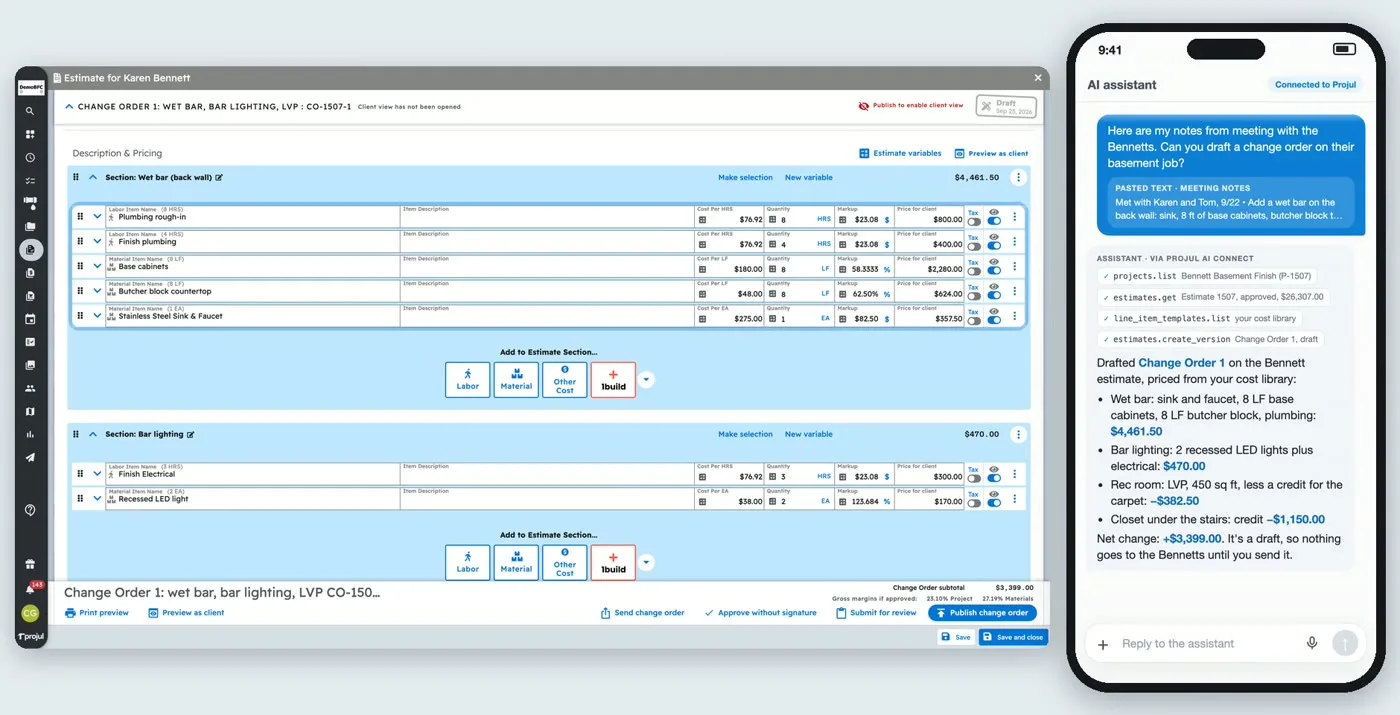
- Change orders are created from the original estimate, signed on the client’s phone, and added to the budget automatically
- Flat-rate pricing with no per-user fees, so adding a project manager or lead carpenter doesn’t raise your bill
- Native iOS and Android apps, with a full Spanish version for field crews
- Projul AI Connect on the Pro plan lets ChatGPT or Claude draft change orders from your site-visit notes
Where another tool may fit better: very large design-build firms that need deep 3D design tools, or teams that only want estimating.
Pricing: published at projul.com/pricing, from $2,388 per year, with monthly or annual billing.
2. Buildertrend: Best for Larger Design-Build Remodelers
Buildertrend is one of the most established residential construction platforms. Its selections, client portal and scheduling are deep, which suits larger design-build remodelers with dedicated office staff.
Watch for: reviewers often mention a learning curve, and Buildertrend quotes pricing based on your annual construction volume rather than publishing it. In Capterra’s September 2026 analysis, Buildertrend averaged 4.11 out of 5 across 45 recent reviews (source).
See our Buildertrend alternatives guide and Projul vs Buildertrend.
3. JobTread: Best for Detailed Budgets and Estimating
JobTread is known for strong estimating and budget-versus-actual tracking, and reviewers praise its support. It topped Capterra’s September 2026 construction management list at 4.87 out of 5 across 46 recent reviews (source). JobTread prices per internal user, with customer and vendor users free.
Watch for: scheduling is more basic than dedicated project management tools. See Projul vs JobTread.
4. Houzz Pro: Best for Remodelers Who Get Leads From Houzz
Houzz Pro pairs project management with the Houzz marketplace, 3D floor plans and mood boards. If a meaningful share of your leads come from Houzz, the marketplace exposure is the main draw.
Watch for: job costing and field tools are lighter than construction-focused platforms, and Houzz Pro’s customer support scored lowest of the nine tools in Capterra’s September 2026 analysis. See Houzz Pro alternatives.
5. Buildxact: Best for Estimating-Led Residential Work
Buildxact focuses on estimating and quoting for residential builders and remodelers, with takeoffs and supplier price files. It’s a fit for companies whose biggest bottleneck is getting accurate estimates out.
Watch for: project management and field features are thinner than all-in-one platforms. See Buildxact alternatives.
6. BuildBook: Best for Simple Client-Facing Project Tracking
BuildBook, now part of Housecall Pro, is designed for small remodelers and custom builders who want a clean client experience without a heavy setup.
Watch for: growing companies often outgrow its job costing and scheduling. See BuildBook alternatives.
7. Contractor Foreman: Best Low-Cost Feature Breadth
Contractor Foreman packs a wide feature set into low-cost plans and scored well on value in Capterra’s September 2026 analysis (4.56 out of 5 across 196 recent reviews).
Watch for: reviewers mention bugs and a busy interface. See Projul vs Contractor Foreman.
How to Choose
Match the tool to how your company actually runs:
- Small to mid-size remodelers running several jobs at once: you want everything connected, from lead to final invoice, without per-user fees as you hire. Start with Projul.
- Larger design-build firms with office staff: Buildertrend’s depth may be worth the learning curve and higher cost.
- Estimating is the bottleneck: look at JobTread or Buildxact, and check how far their project management goes.
- Most leads come from Houzz: Houzz Pro, and plan to pair or replace it as job costing needs grow.
Whatever you pick, test it with a real recent job: build the estimate, add two change orders, and check the margin at the end. If that’s painful in the demo, it will be painful every day.
Want to see how it works for a remodel? Book a Projul demo and bring a recent kitchen or bath estimate.
Frequently Asked Questions
What is the best software for a small remodeling company?
What features do remodeling contractors need in software?
Do remodelers need different software than home builders?
How much does remodeling contractor software cost?
Related Articles
Which Construction Software Works With ChatGPT and Claude? (2026)
ChatGPT and Claude can now work inside some construction software, not just answer questions about it. Here is which...
Read More →
5 Best Fieldwire Alternatives for Contractors in 2026
Fieldwire is solid for field management, but it won't run your whole business. If you need more than task tracking and...
Read More →
4 Best JobTread Alternatives for Contractors in 2026
JobTread does estimating and budgeting well. But it isn't the right fit for every contractor. Here are 4 alternatives...
Read More →