Construction Scheduling Software - Save 2+ Hours Daily With Drag-and-Drop Scheduling
Projul's drag-and-drop scheduling keeps your projects on track, contractors save 2+ hours daily.
- Managing and scheduling tasks is quick and simple
- Adjust your schedule on the fly, so you're always up to date
- Mobile app makes it easy for your team to see their schedule, and log their time
Why Whiteboards and Spreadsheets Don’t Scale
Let’s be honest. Every contractor starts with some version of the same system: a whiteboard in the office, a spreadsheet on someone’s laptop, or a notebook in the truck. And for one or two jobs, it works fine.
Projul’s construction scheduling software offers drag-and-drop Gantt charts, mobile crew access, and real-time schedule updates that keep every job site on track. Built by a contractor, rated 4.9 out of 5 on G2. Projul offers flat-rate pricing with no per-user fees for construction companies of all sizes.
But then you grow. Three active projects. Five. Ten. Suddenly you’ve got 15 crew members, four subs, and a whiteboard that hasn’t been updated since last Thursday. Your lead carpenter calls to ask what he’s doing tomorrow, and you have to dig through a spreadsheet that three people have edited with conflicting information.
Here’s what actually breaks down:
Your field crew can’t see the schedule. If the schedule lives on a whiteboard or a desktop spreadsheet, the only people who can see it are the people in the office. Everyone else is calling, texting, or just guessing.
Changes don’t reach people in time. You move a task from Tuesday to Thursday. But your sub already showed up on Tuesday because nobody told him. Now he’s billing you for a wasted trip, and your Thursday is double-booked.
You can’t see the big picture. When you’re managing multiple projects on spreadsheets, it’s nearly impossible to see which crews are overloaded, which projects are falling behind, and where you have capacity. You’re reacting to problems instead of preventing them.
There’s no record of what happened. A client says the project is behind schedule. You’re pretty sure it’s because they took three weeks to pick their countertops. But you can’t prove it because your scheduling history lives in erased whiteboard ink.
Construction scheduling software fixes all of this. Your schedule lives in one place, updates in real time, sends automatic notifications when things change, and gives you the data to back up every decision.
What Good Construction Scheduling Software Does
Not every scheduling tool is worth your time. Some are overbuilt enterprise tools that take months to set up. Others are too simple and fall apart once you have more than a few active projects. Here’s what the best contractor scheduling software actually does well.
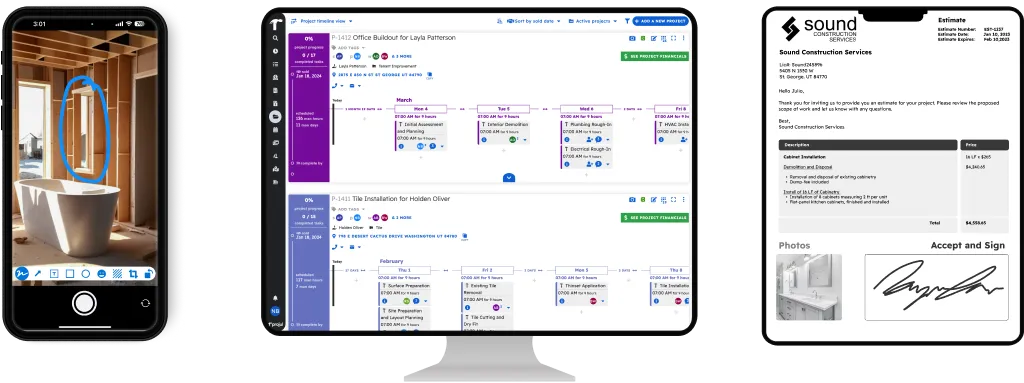
Drag-and-drop scheduling. You should be able to build and adjust your schedule as fast as you think. Drag a task to a new date. Drop a crew member onto an assignment. If it takes more than a few clicks, the tool is too slow for the field.
Multiple schedule views. Different people need to see the schedule differently. Your project manager needs a Gantt chart to see task dependencies and the critical path. Your field foreman needs a simple daily task list. Your office manager needs a calendar view to coordinate subs. Good construction project scheduling software gives you all of these views.
Mobile access that actually works. This is non-negotiable. Your crew is on job sites, not at desks. If the mobile app is clunky, slow, or hard to read, your team won’t use it. And scheduling software that your field workers don’t use is just an expensive whiteboard.
Template and cloning features. If you build similar projects, you shouldn’t have to create the schedule from scratch every time. Clone a previous project’s schedule, pick a start date, and the software sets the tasks and dates automatically. Contractors save hours per project this way.
Automatic notifications. When a task changes, the affected crew members should know immediately. Not when someone remembers to send a group text. Mobile notifications that fire automatically when the schedule updates are what keep your team in sync.
Time tracking integration. Scheduling tells people what to do. Time tracking tells you what actually happened. When those two are connected, you can compare planned vs. actual hours for every task and spot problems before they wreck your budget.
AI-powered improvements. AI is starting to change how contractors plan and adjust schedules. In Projul, that’s Projul AI Connect on the Pro plan: ask ChatGPT, Claude, or another AI assistant to shift the schedule when materials or subs run late, set up repeating inspection tasks, or check the week ahead for double bookings. See our guide to construction AI tools for contractors for what else is available now.
Connection to the rest of your workflow. Your schedule doesn’t exist in isolation. It affects your estimates, your budgets, your invoices, and your client expectations. The best construction scheduling software connects to all of these so you’re not managing your business in five different apps.
Stay in Complete Control by Creating and Assigning Tasks
Projul converts your estimates into tasks in just a couple of clicks, so you skip the manual data entry and get your project started faster. Over 5,000 contractors use Projul to create daily task lists and keep everyone focused on what needs to get done.
You can add locations to tasks for better clarity, and you can see real-time progress reports. This gives you a clear picture of how your team is performing and whether the project is tracking to the schedule.
Need help picking the right platform? Our project management software for construction guide compares the top options side by side.
Projul’s project management features make construction scheduling simple for you and your team. Complete transparency across projects with real-time progress, quick and easy task creation for your field workers, and everything managed in the same place you build your schedule.
How Projul Scheduling Works in the Field
Here’s what a typical day looks like for a contractor using Projul’s construction scheduling software.
Morning. Your lead carpenter opens the Projul app on his phone, checks today’s tasks, taps the location icon to map his route, and he’s on his way. No phone calls to the office. No confusion about which site to go to.
Mid-morning. You realize the electrician can’t come until Thursday, so you drag his tasks on the schedule. Projul automatically notifies the affected crew members. The plumber who was waiting on the electrical rough-in knows immediately that his start date shifted.
Lunch. You check the heat-mapped schedule view and spot that one crew is overloaded next week while another has light days. You rebalance a few tasks with drag and drop. It takes two minutes.
Afternoon. Your client asks for a project update. You pull up the Gantt view and show them exactly where things stand, what’s done, what’s in progress, and what’s coming next. There’s no guessing. It’s all right there.
End of day. Your crew logs their time from the app. You can see who was on site, how long they worked, and which tasks they completed. Tomorrow’s schedule is already set.
That’s contractor scheduling done right. Not complicated, not overwhelming. Just a clear picture of who’s doing what, where, and when.
Build Your Schedule Fast with Drag and Drop
Projul’s drag-and-drop scheduler makes it quick to build out your project schedule. Contractors save 2+ hours daily on scheduling and admin tasks with Projul’s templates, cloning, and automation.
View your schedule with 7 different schedule views. Advanced filtering lets you look at only the information you need, whether that’s one crew, one project, or one week.
Work on similar projects? Clone a project schedule and apply it to new projects instantly. Pick a start date and Projul sets the tasks and schedules automatically. The heat-mapped schedule view shows you at a glance who is overloaded and who needs more work.
Stay Connected With Your Field Workers
Projul’s mobile app puts scheduling, tasks, photos, and documents in your crew’s pocket. Rated 4.9 out of 5 on G2 for ease of use, it’s simple enough that your field workers will actually use it.
They can log their time from the job site, meaning your data is always up to date. No more collecting paper timesheets on Friday afternoon and spending an hour entering them into a spreadsheet.
All of Projul’s scheduling features work on mobile. Crew members can check tasks, upload photos, add notes, and communicate with the office without leaving the job site. Available on iOS and Android.
Know Who’s on Site and When They Arrived
Pair your schedule with geo-fenced time tracking so you know your crew is clocking in at the right job site. No more guessing who showed up where. The system verifies location automatically, so you get accurate time data without micromanaging.
Handle Weather Delays Without the Chaos
Rain, snow, and extreme heat don’t care about your schedule. When weather shuts down a job site for two days, you need to shift everything forward without calling every sub and crew member individually.
With Projul’s project sliding feature, you select the affected tasks and slide the entire schedule forward by the number of lost days. Every downstream task adjusts automatically, and every affected team member gets notified on their phone. What used to take an hour of phone calls and calendar updates takes about 30 seconds.
You can also flag tasks as weather-sensitive so you know which parts of the schedule are at risk when a storm rolls in. Plan around exterior work, concrete pours, and roofing days with a clear view of what’s exposed.
Coordinate Subcontractors Without the Back and Forth
Subcontractor scheduling is one of the biggest headaches in construction. Subs have their own schedules, their own crews, and their own priorities. If you’re coordinating via phone calls and text threads, things fall through the cracks.
Projul gives your subs visibility into the tasks that affect them without exposing your entire project schedule. When you move a task that a sub depends on, they get notified right away. No more “I didn’t know the framing wasn’t done yet” surprises that cost you a day and a rebooking fee.
You can assign tasks directly to subcontractor contacts, set task dependencies so subs can see when their window opens, and track whether they’ve acknowledged the schedule. It turns subcontractor coordination from a daily fire drill into something you manage in minutes.
Keep the Whole Project Moving
Your schedule is just one piece of the puzzle. Project management ties your tasks, timelines, and team together in one view. Use to-dos and daily logs to track what actually got done each day. And when a delay hits, project sliding lets you shift every downstream task with a single click instead of rebuilding the schedule from scratch.
When your schedule, time tracking, and project management all live in one system, you stop wasting time switching between apps and start spending it on the work that actually matters: building.
Why Contractors Choose Projul for Scheduling
There are a lot of construction scheduling software options out there. Some are bare-bones calendar apps that fall apart once you have more than a few projects. Others are enterprise tools built for billion-dollar GCs that take months to set up and cost a fortune.
Projul sits in the sweet spot. It’s powerful enough to handle complex multi-project schedules for general contractors and residential contractors with dozens of crew members and subs, but simple enough that your team actually uses it. Rated 4.9 out of 5 on G2 for ease of use, Projul was built by a contractor who understood that the best scheduling software in the world is worthless if your crew won’t open it.
Here’s what sets Projul apart:
No per-user pricing. Most construction scheduling tools charge per user. That gets expensive fast when you have field workers, office staff, and subs who all need access. Projul gives you flat-rate pricing so your whole team can use it without you watching the bill grow every time you hire someone.
Everything is connected. Your schedule ties into your estimates, time tracking, invoicing, and project management. Move a task on the schedule, and the rest of your project data stays in sync. You’re not reconciling information across five different tools.
It works on job sites. The mobile app is fast, simple, and built for people wearing gloves and squinting at a screen in direct sunlight. Your crew checks tasks, logs time, uploads photos, and moves on with their day.
You’re up and running fast. Projul doesn’t require a six-month implementation with a dedicated consultant. Most contractors are scheduling their first project within a day of signing up. Clone a template, set a start date, and go.
Over 5,000 contractors trust Projul to manage their schedules every day. If you’re still juggling spreadsheets and whiteboards, or paying too much for software your crew refuses to use, it’s time to try something built for the way you actually work.
How to Schedule a Construction Project in Projul
If you’re new to Projul or thinking about making the switch, here’s exactly how scheduling a construction project works from start to finish. No theory, no fluff. Just the steps.
Step 1: Create your project. From the Projul dashboard, create a new project and fill in the basics: client name, project address, start date, and expected duration. This takes about 30 seconds. If you’ve built a similar project before, you can clone an existing project to skip ahead with a schedule already in place.
Step 2: Pull tasks from your estimate. If you’ve already built an estimate in Projul, you can convert line items into scheduled tasks with a couple of clicks. Your estimate for framing, electrical, plumbing, drywall, and paint becomes a task list with no retyping. This is where most contractors save the first chunk of time. Instead of building the schedule from scratch, you’re working from the scope you already defined.
Step 3: Set dates on the Gantt chart. Open the interactive Gantt view and drag each task to its start and end date. You can see the full project timeline laid out visually. If a task takes three days, drag the edge to size it. If framing starts Monday and runs through Wednesday, that’s exactly what the chart shows. Everything is drag and drop, so you’re not typing dates into cells or clicking through calendar popups.
Step 4: Assign crews and subs. Click on any task and assign it to a crew member, a crew, or a subcontractor. You can assign multiple people to the same task if the job requires it. Assigned team members see that task on their phone in the Projul mobile app. Subs see only the tasks assigned to them, not your full project schedule.
Step 5: Set dependencies between tasks. Some tasks can’t start until others finish. Drywall can’t go up until framing passes inspection. Paint can’t start until drywall is done. In Projul, you link tasks together so the schedule reflects reality. If a predecessor task slips, the dependent tasks shift automatically. You don’t have to hunt through the schedule to figure out what else is affected.
Step 6: Send notifications. Once your schedule is set, Projul sends notifications to everyone with assigned tasks. When you make changes later, affected team members get updated automatically. You don’t need to send group texts or make a round of phone calls. The schedule is the single source of truth, and everyone stays connected to it.
That’s the full workflow. Most contractors set up their first project schedule in under 30 minutes. After a couple of projects, it takes even less time because you’re cloning templates and reusing task structures you’ve already built.
Gantt Charts vs. Spreadsheets for Construction Scheduling
Most contractors start scheduling in a spreadsheet. It’s familiar, it’s free, and it works when you have one or two projects. But at some point, the spreadsheet becomes the problem instead of the solution. Here’s why.
Spreadsheets don’t show you the timeline visually. A list of tasks with start dates and end dates in columns is not the same as seeing those tasks laid out on a timeline. A Gantt chart shows you the shape of your project at a glance. You can see overlapping tasks, gaps in the schedule, and how long each phase takes without scanning rows of data and doing mental math.
Spreadsheets can’t track dependencies. In a spreadsheet, if the foundation pour gets delayed by a week, you have to manually find every downstream task and push it back. Miss one, and you’ve got a sub showing up to a job site that isn’t ready. In Projul, dependencies are built into the schedule. Move one task and the linked tasks adjust with it.
Spreadsheets don’t notify anyone. You update a date in cell D14. Who knows about it? Nobody, unless you remember to text them. With Projul, schedule changes trigger automatic notifications to the people affected. Your drywall crew doesn’t need to check a spreadsheet. They get a push notification on their phone when their start date moves.
Spreadsheets break when multiple people edit them. You’ve probably experienced this. Two people editing the same spreadsheet, overwriting each other’s changes, or working from a stale copy saved to their desktop. Projul is cloud-based and designed for multiple users. Everyone sees the current schedule, not the version someone emailed last Tuesday.
Rescheduling in a spreadsheet is manual and slow. A rain delay pushes your exterior work back two days. In a spreadsheet, you’re updating dozens of cells, checking formulas, and hoping you didn’t miss anything. In Projul, you select the affected tasks and use project sliding to shift everything forward at once. It takes seconds, not an hour.
Spreadsheets don’t connect to anything else. Your schedule should tie into your estimates, time tracking, and project management tools. In a spreadsheet, you’re copying data between files and hoping nothing falls out of sync. In Projul, everything lives in one system.
The bottom line: spreadsheets work until they don’t. If you’re spending more time updating your spreadsheet than actually managing your projects, you’ve outgrown it.
What Happens When a Project Slips
Every contractor deals with schedule slips. A material shipment is late. An inspection gets pushed back. A sub cancels. The question isn’t whether it will happen. It’s how fast you can adjust without creating a chain reaction of missed dates and wasted trips.
Here’s what usually happens with a spreadsheet or whiteboard: One task slips, and you start making phone calls. You call the framing crew to let them know the foundation isn’t ready. Then you call the electrician because framing just moved. Then the drywall sub because electrical shifted. Then the painter. By the time you’ve worked through the chain, you’ve spent an hour on the phone and you’re not confident you caught everyone.
In Projul, the process is different. When a task slips, you drag it to the new date. If that task has dependencies, the downstream tasks shift automatically. Every person assigned to an affected task gets a notification on their phone with the updated schedule. The whole cascade that used to take an hour of phone calls happens in about 30 seconds.
For bigger delays, like a week of rain or a permit holdup, project sliding lets you push an entire section of the schedule forward by a set number of days. Select the tasks, pick the number of days, and slide. Every date updates. Every person gets notified. Every dependency stays intact.
This matters more than most contractors realize. The cost of a schedule slip isn’t just the lost day. It’s the sub who showed up to a site that wasn’t ready and bills you anyway. It’s the crew that sat idle because they didn’t know the schedule changed. It’s the client who calls angry because nobody told them the timeline moved. Projul’s automatic notifications and dependency tracking remove most of that fallout by keeping everyone informed the moment something changes.
You can also look back at the schedule history to see what changed and when. If a client claims the project is behind because of your crew, you have a record showing the actual cause of each delay. That kind of documentation protects your reputation and your bottom line.
Scheduling for Subs and Crews
Subcontractor no-shows and miscommunication cost contractors thousands of dollars every year. A sub shows up on the wrong day because they missed a text. A crew drives to the wrong site because yesterday’s schedule changed overnight. These aren’t rare events. For most contractors managing multiple projects, they happen weekly.
Projul fixes this by giving subs and crew members direct access to their own schedule through the mobile app. Here’s how it works:
Subs see only their tasks. When you assign tasks to a subcontractor in Projul, they can view their scheduled dates, task details, and job site location. They don’t see your full project schedule, your budget, or your other subs’ assignments. You control exactly what they see.
Automatic notifications when dates change. If you move a sub’s task to a different day, they get a push notification right away. No more “I sent you a text last week, did you see it?” conversations. The notification comes from the system, and you can see whether they’ve viewed the updated schedule.
Crew members check their phone, not the office whiteboard. Your field workers open the Projul app in the morning and see exactly what they’re doing, where they’re going, and what tasks are assigned to them. If you make a mid-day change, the update shows up on their phone immediately.
Reduce double-booking and scheduling conflicts. The heat-mapped schedule view shows you when a crew or sub is overbooked. If you accidentally schedule the same electrician on two job sites for the same morning, you’ll see the conflict before it causes a problem. In a spreadsheet, you’d only find out when one of the sites calls to ask where the electrician is.
Task dependencies keep subs informed about their actual start window. A sub doesn’t just see “Tuesday” on their schedule. They can see that their task depends on the framing inspection passing first. If framing runs late, the sub’s task automatically shifts and they’re notified. This kind of visibility reduces friction between you and your subs because everyone has the same information.
The result is fewer no-shows, fewer wasted trips, and fewer angry phone calls. Your subs and crews trust the schedule because it’s always current, and you spend less time playing phone tag to confirm dates.
Why Flat-Rate Pricing Matters for Scheduling Software
Most construction scheduling software charges per user per month. That pricing model creates a problem that gets worse as your company grows.
Think about who needs to see your schedule. It’s not just the project manager and the owner. It’s your lead carpenters, your foremen, your office coordinator, your subs, and every crew member who needs to know where they’re going tomorrow. On a busy week, that could be 20, 30, or 50 people who need schedule access.
At $30 to $50 per user per month (which is common for construction scheduling tools), adding your entire field crew to the system gets expensive fast. A 20-person team at $40 per user is $800 a month just for scheduling. So what happens? You limit who gets access. Only the office sees the full schedule. Field workers get a printed sheet or a group text. And now you’re right back to the communication problems you were trying to solve.
Projul uses flat-rate pricing. You pay one price, and everyone on your team gets access. Add your entire crew, all your subs, and your office staff without watching the bill go up. When you hire two new carpenters next month, just add them. When a sub needs to see their schedule, give them access. No seat counting, no access tiers, no “do we really need this person on the system?” conversations.
This changes how you use the software. When there’s no penalty for adding users, you actually give everyone access. And when everyone has access, the schedule works the way it’s supposed to. Your lead carpenter checks his own tasks instead of calling the office. Your sub sees the updated timeline instead of relying on a text from last week. Your office coordinator stops fielding “what am I doing today?” calls because the answer is on everyone’s phone.
Per-user pricing makes sense for software where only a few people need access. But scheduling is the one tool in construction that literally everyone on the project needs to see. Paying per seat for that is like charging per employee to look at the job site whiteboard. It doesn’t make sense, and it leads to worse outcomes because people get locked out of the information they need to do their jobs.
With Projul, your whole team is on the schedule. That’s how it should be.
Looking for more guidance on running projects efficiently? Our guide on construction project management for growing companies covers how to scale without losing control. If you’re earlier in your journey, construction project management for small contractors breaks down what matters most when resources are tight. And for a side-by-side look at the tools available, check out our project management software for construction comparison.