General Contractor Software. Built by construction pros with honest pricing.
When executed well, general contracting work is both satisfying and highly profitable. If it's not, delays, miscommunication, and unexpected costs can eat into your margins. Projul helps you stay organized with 26+ features, ensuring every job flows smoothly with better general contractor management software. Our lead pipeline helps you even before your project kicks off!
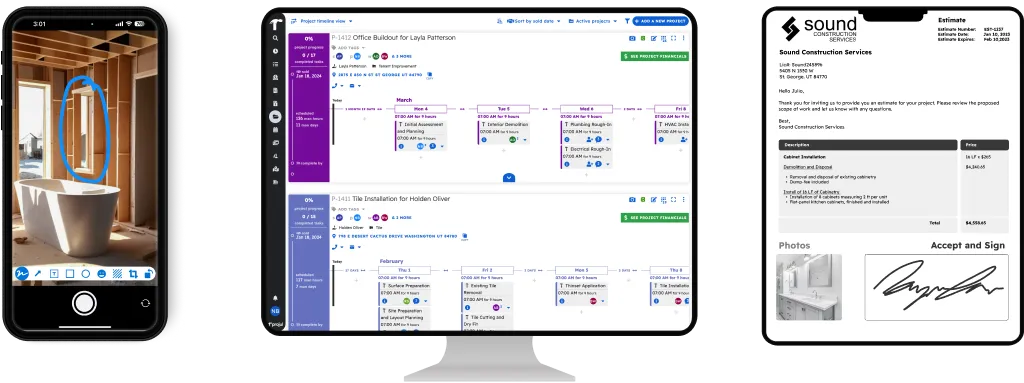
- Impress your prospects using our detailed lead pipeline management
- Send estimates, and convert them into scheduled tasks when the project starts
- Invoice throughout the project, including change orders
What Is General Contractor Software?
General contractor software is a platform that helps GCs manage every part of their business, from bids and subcontractor coordination to scheduling, job costing, change orders, and invoicing, all in one place so nothing falls through the cracks across multiple trades and job sites.
Projul’s general contractor software helps GCs coordinate subcontractors, track job costs across multiple projects, and manage change orders from one platform built by a former general contractor. Projul offers flat-rate pricing with no per-user fees for construction companies of all sizes. If you run a general contracting company, you already know the hardest part of the job isn’t the construction itself. It’s keeping 10 or more subcontractors on schedule, tracking costs across multiple active projects, and making sure every change order gets documented before someone forgets. General contractor software exists to handle that coordination so you can focus on building.
The difference between a profitable GC and one that’s barely scraping by often comes down to organization. The contractors making money have systems. The ones losing money have spreadsheets, group texts, and a whiteboard that hasn’t been updated since last Tuesday.
Built by a GC, for GCs
Projul was built by Kurt Clayson, a former general contractor who got tired of software that was either overpriced, too complicated, or built by people who had never stepped onto a job site. Every feature in Projul exists because a real GC needed it. Over 5,000 contractors, both GCs and specialty trades, now run their businesses through the platform, from first lead to final invoice.
Most general contractor software on the market was designed by tech companies and sold to contractors. You can feel it when you use those tools. The workflows don’t match how a real project moves. Features are either missing or buried three menus deep. And the pricing always involves per-user fees that punish you for growing your team.
Projul started on a job site, not in a conference room. That difference shows up in every screen.
The GC’s Biggest Problem: Coordinating Everyone
Here’s the reality of running a general contracting company. On any given job, you might have a concrete crew, framer, plumber, electrician, HVAC tech, insulation crew, drywall team, painter, tile setter, and finish carpenter all needing to show up in the right order, at the right time, without stepping on each other.
Now multiply that across five or ten active projects.
That coordination problem is what separates general contracting from specialty trade work. A plumber worries about plumbing. A GC worries about everything and everyone. And when one sub falls behind on one job, it creates a domino effect across your entire schedule.
This is exactly why software for general contractors needs to do more than basic scheduling. It needs to show you every sub across every project on one screen, let you shift timelines without making phone calls, and keep your subs informed automatically.
Why Spreadsheets Break Down for GCs
A spreadsheet might work when you have two active jobs and four subs. But the moment you’re running seven projects with 15 different subcontractors, the spreadsheet becomes a liability. Formulas break. Someone overwrites a cell. You can’t see conflicts between projects. And there’s no way for your subs to see their own schedule without you texting it to them every week.
General contracting software like Projul replaces that mess with a single dashboard where every project, every sub, and every deadline lives in one place. When something changes, everyone who needs to know finds out immediately.
Subcontractor Management That Actually Works
Managing subs is the core of general contracting. Your ability to keep subs scheduled, informed, and accountable determines whether projects finish on time and on budget.
Projul gives you a scheduling board that shows every subcontractor’s assignment across all your active projects. Drag a trade from one day to another, and the sub sees the change on their phone right away. Sequence your rough-in, drywall, and finish work so nobody shows up before their turn. When your framing crew wraps early, bump the next trade forward without spending an hour on the phone.
GCs using Projul save 2+ hours daily on sub coordination alone. That’s time you’re not spending on Monday morning phone calls confirming who’s going where this week.
Tracking Who’s Responsible for What
On a busy job site, accountability gets fuzzy fast. Who was supposed to handle the fire blocking? Did the electrician pull the permit, or was that on us? Is the tile sub bringing their own materials or are we supplying them?
Projul ties every task to a specific person or crew. When something doesn’t get done, there’s no finger-pointing about who was supposed to handle it. The assignment is right there in the system with a name, a date, and a status.
Bid Management for General Contractors
GCs don’t just estimate their own work. They collect bids from subs, assemble scopes, add their markup, and present a complete package to the client. That process is messy when you’re doing it through email chains and phone calls.
Projul’s estimating tools let you build detailed bids with line items, quantities, and markup. Save templates for your most common project types so you’re not rebuilding estimates from scratch. A kitchen remodel estimate that took you 45 minutes in a spreadsheet takes 15 in Projul.
When the client says yes, that estimate converts directly into a scheduled project. Line items become your job cost budget. No re-entering data. No copy-paste errors. The work flows forward.
Win More Bids With Professional Estimates
Your estimate is your first impression. A clean, itemized bid from Projul tells the homeowner or developer that you’re organized and professional. A sloppy PDF cobbled together in Word tells them to call the next GC on their list.
Contractors who use estimate templates in Projul report cutting their estimating time in half. More bids out the door means more work coming in. If you handle garage door installations, grab our free garage door estimate templates for ready-to-use bid formats.
Project Coordination Across Multiple Job Sites
Running one project well is a challenge. Running five or ten simultaneously is where most GCs hit a wall. You need to know the status of every job, every day, without driving to every site.
Projul’s project dashboard answers your biggest questions in seconds. Which jobs are on schedule? Which ones are over budget? What needs your attention right now? You see all your active projects with their schedules, budget status, and next action items on one screen.
When your PM marks a task complete on their phone, your office sees it immediately. When a material delivery comes up short, it gets logged in the app and the project record updates in real time. You stop being reactive and start catching problems while they’re still small.
Real-Time Visibility Changes How You Run Your Business
Most GCs find out about problems days after they happen. The drywall sub didn’t show on Wednesday, and you don’t hear about it until Friday’s progress meeting. By then, you’ve lost two days.
With general contractor software that updates in real time, you know about the missed day on Wednesday. You make a call, adjust the schedule, and keep the project moving. That kind of responsiveness is the difference between a project that finishes on time and one that drags for weeks.
Scheduling Across Multiple Trades
Every GC knows the plan changes. Weather kills a day. A material shipment runs late. The plumber doesn’t show. Your schedule has to adapt without creating chaos across every other trade on the job.
Projul’s drag-and-drop scheduler lets you move tasks, reassign crews, and shift timelines with a few taps. Seven schedule views, including Gantt charts and calendar layouts, give you the flexibility to see your projects however works best for you.
Your subs see schedule changes on the mobile app right away. No more morning group texts sorting out who goes where. No more driving to a site to find out the work got pushed back.
Sequencing Trades Without Conflicts
The order matters in construction. You can’t hang drywall before the rough-in inspection. You can’t paint before drywall mud dries. You can’t install cabinets before the floor is level.
Projul lets you set task dependencies so trades are sequenced correctly. When one phase runs long, dependent tasks shift automatically. Your electrician doesn’t show up expecting to do trim-out while the painter is still working. That kind of scheduling intelligence is what separates real GC software from a basic calendar app.
Change Order Management
Change orders are a fact of life in general contracting. The client wants to upgrade the countertops. The architect revises the spec. The inspector requires additional blocking. Every one of those changes affects your budget and your schedule.
The problem most GCs face is documentation. The client asks for a change on site. Your super says “sure, we can do that.” Nobody writes it down. Two months later, you’re eating the cost because there’s no record of the approval.
Projul tracks change orders inside the project record. Document the scope, get the client’s approval through the platform, and the change order automatically updates your job cost budget and your invoice. No more lost money from verbal agreements that nobody can prove.
Protecting Your Margins on Every Change
A single undocumented change order can cost you thousands. On a large project with dozens of changes, that adds up to the difference between a profitable job and a loss.
General contractor software should make change orders easy to create, easy to approve, and impossible to forget. Projul does exactly that, and your client gets a clean record of every change they approved.
Job Costing That Shows You the Truth
Here’s a question every GC should be able to answer at any moment: Am I making money on this project right now?
If answering that question requires an hour in a spreadsheet, your job costing system is failing you. And “I’ll figure it out when the job’s done” is how contractors lose money on projects they thought were profitable.
Projul tracks estimated costs versus actual costs on every project in real time. You see where your labor dollars are going. You see which material line items are running over. You see whether the project is on pace to hit your target margin or heading for trouble.
Catch Overruns While You Can Still Fix Them
The value of job costing isn’t the report you run after the project closes. It’s the alert at week three that labor is running 20% over your estimate. That’s when you can still adjust: reassign tasks, talk to the crew, tighten up the plan.
GCs using Projul report a 32% average increase in profitability. That number comes from catching cost overruns early and keeping projects on budget. By the time most contractors discover a budget problem, the money is already gone.
Lien Waivers and Documentation
General contractors carry the risk on every project. If a sub doesn’t pay their supplier, the supplier can put a lien on the property, and the GC gets dragged into it. Tracking lien waivers from every sub on every project is tedious but critical.
Projul keeps project documentation organized and tied to the right job. Store lien waivers, contracts, permits, inspection reports, and photos in the project record so everything is findable when you need it. Six months after a project closes, you can pull up the lien waiver from your drywall sub in ten seconds instead of digging through a filing cabinet.
Reducing Your Risk on Every Job
Good documentation protects you from disputes, lien claims, and warranty callbacks. When everything lives in one system tied to the project, you always have the records to back up your position. General contracting software that doesn’t handle documentation is leaving you exposed.
Client Communication That Builds Trust
Your clients want to know what’s happening with their project. They don’t want to call you every other day asking for updates. And honestly, you don’t want to take those calls when you’re in the middle of coordinating subs on three other jobs.
Projul’s client portal gives your customers visibility into their project status without giving them access to your internal notes or margins. They can see the schedule, approve estimates, sign change orders, and pay invoices, all in one place.
This level of transparency sets you apart from every other GC who communicates through sporadic phone calls and texts. When a homeowner can log in and see that framing starts Monday, they stop calling you on Friday to ask.
Professional Communication Wins Referrals
General contractors live and die by referrals. A client who felt informed and respected throughout the project tells their neighbors. A client who felt ignored or confused tells them too, just a different story.
Software for general contractors should make client communication automatic, not something you have to remember to do. Projul handles that so your reputation builds with every project.
Run Your GC Business From the Truck
Your supers and PMs need schedules, change orders, and time tracking from the field, not the office. Projul’s native iOS and Android app gives them the full platform on their phone, with geofencing to verify crew locations across every job site.
Pull up a sub’s schedule, approve a change order, or clock your crew in without touching a laptop. The app works on a dusty phone with one bar of signal. Your team picks it up fast because it was designed for the field first, not adapted from a desktop tool.
Time Tracking With GPS Verification
Paper timesheets filled out from memory at the end of the week are never accurate. Guys round up. Nobody verifies which site they were actually on. And the data doesn’t connect to your job costs.
Projul’s time tracking includes geofencing. Your crew clocks in from the mobile app, and the system confirms they’re at the correct job site. Those hours feed directly into your job costing, so you know exactly where the labor went. Real general contractor software connects time tracking to budgets automatically.
Invoicing That Gets You Paid Faster
Cash flow is the lifeblood of every GC operation. If you’re waiting until project completion to send an invoice, you’re financing your client’s project with your own money, and your subs still expect to get paid on time.
Projul lets you invoice throughout the project. Send deposit invoices before work starts. Bill for completed phases as you go. Add change orders to the invoice with one click. Your clients can pay online directly from the invoice, which means faster payments and less chasing.
QuickBooks Integration
Double-entering financial data into your accounting software wastes time and creates errors. Projul integrates with QuickBooks Online so your invoices, payments, and customer records sync automatically. When you send an invoice in Projul, it shows up in QuickBooks. When the client pays, both systems update. Your bookkeeper stays happy and your books stay accurate.
Why GCs Switch to Projul
Most general contractors come to Projul after trying one or two other platforms. The story is almost always the same: the last tool was too expensive per user, too complicated for the field team, or missing features that GCs specifically need.
Here’s what makes Projul different:
- Built by a general contractor. Kurt Clayson started Projul after running his own GC business. Every feature exists because a real contractor needed it.
- Flat-rate pricing. $4,788 per year for your entire company. No per-user fees. Your estimators, PMs, field supers, office staff, and subs all get full access.
- All-in-one platform. CRM, estimating, scheduling, job costing, time tracking, invoicing, change orders, and client portal. One login. One system.
- Rated 9.8 on G2. For ease of use and quality of support. That rating comes from contractors who use it every day.
- Over 5,000 contractors. From one-truck operations to companies with 200+ employees. The platform grows with you.
General Contractor Software vs. Doing It the Old Way
Still wondering whether general contractor software is worth the investment? Here’s what the manual approach actually costs you.
Scheduling by group text: Works until you have more than three active jobs. Then messages get buried, subs miss updates, and you spend your morning on the phone sorting out who goes where. GC software puts the schedule on everyone’s phone and updates it automatically.
Job costing after the fact: You finish a project, add up the receipts, and discover you lost money. That information doesn’t help on a job that’s already closed. Real-time job costing warns you at week two, not month four.
Change orders on napkins: The client approved it verbally. Your super did the work. Nobody documented the scope or the cost. Now you can’t bill for it. General contracting software creates a paper trail that protects your margins.
Invoicing from Word documents: You format an invoice, email it, and hope the client pays. No online payment. No automatic reminders. No connection to your accounting system. Projul invoices include online payment, QuickBooks sync, and payment status you can check in three seconds.
The math is straightforward. The time and money you lose to manual processes costs more than the software. Most GCs make back their Projul subscription in the first month from time savings alone.
Keeping Every Document in One Place
General contractors deal with more paperwork than any other trade. Permits, contracts, lien waivers, insurance certificates, inspection reports, architect drawings, sub agreements, and change order approvals pile up on every project. When those documents live in email threads, filing cabinets, and random folders on someone’s desktop, things get lost. And lost documents cost you money.
Projul’s document management ties every file to the right project. When your super needs the building permit, it is right there on the project record. When the owner asks for proof of insurance from your electrical sub, you pull it up in seconds. When a dispute arises about a change order three months after the project closes, you have the signed approval with a timestamp.
Photo Documentation That Protects You
Photos are your best defense against disputes, warranty claims, and he-said-she-said arguments about what was done and when. Projul’s mobile app lets your field team snap photos throughout the project and attach them to the right job automatically. Before and after shots, progress photos, inspection documentation, and punch list items all live in the project record with dates and timestamps.
When a homeowner calls six months later claiming the tile was cracked before your crew left, you pull up the final walk-through photos showing clean, undamaged work. That kind of documentation saves you thousands in avoided callbacks and disputes.
Sub Documentation and Compliance
On larger GC projects, you need insurance certificates, W-9s, and signed sub agreements from every trade on the job. Keeping track of which subs have current documentation and which ones are expired is a headache that grows with every project.
Projul lets you store sub documentation at the company level so it carries across projects. When your plumber’s insurance certificate expires, you catch it before they show up on the next job. When the GC above you on a commercial project asks for documentation on every sub, you pull it from one place instead of making a dozen phone calls.
Your lead pipeline and scheduling board work alongside document management to give you a complete picture of every project. From the first bid through the final payment, nothing falls through the cracks because everything lives in one system that your whole team can access from the office or the field.
Specialty GC Resources
General contractors managing energy-efficient builds should understand blower door testing requirements. Our blower door testing guide explains the process, code requirements, and how to coordinate air sealing with your insulation and HVAC subs. For GCs taking on parking structure projects, our parking garage design and building guide covers structural considerations, waterproofing, and phased construction planning.
Multi-Trade Scheduling Across 10+ Subcontractors
Most scheduling tools were built for companies that run one or two crews. General contractors do not have that luxury. On a typical residential build, you might have concrete, framing, plumbing, electrical, HVAC, insulation, drywall, paint, tile, and finish carpentry all needing to hit the job in a specific order. On a commercial project, double that number. Managing 10 or more subs across multiple active jobs is the single hardest operational challenge a GC faces, and it is where most scheduling systems fall apart.
The problem starts with visibility. When your schedule lives in a spreadsheet or a shared calendar, you can see dates but you cannot see conflicts. Your plumber is booked on two jobs the same week. Your framing crew finished early on one project but nobody moved them to the next one. Your drywall sub showed up before the rough-in inspection passed. These conflicts cost you days, and days cost you thousands.
Projul’s scheduling board shows every sub across every active project on one screen. You see who is assigned where, what is coming up next, and where the gaps are. When your concrete crew wraps a day early, drag the framing start date forward and every sub downstream gets notified automatically. No phone tree. No group text that three people miss.
The real power shows up when you are running seven or eight projects at once. Your HVAC sub works on Project A Monday through Wednesday and Project B Thursday and Friday. Your electrician is on Project C all week but needs to do a service call at Project D on Tuesday afternoon. Projul handles that level of complexity without turning your schedule into a tangled mess.
Task dependencies keep trades in the right order. You cannot start drywall until the rough-in passes inspection. You cannot paint until the drywall is finished and mudded. Set those dependencies once and the schedule enforces them automatically. When one trade runs behind, everything downstream shifts without you having to manually update 15 calendar entries.
For GCs who manage specialty trade subs alongside their own crews, time tracking with GPS confirms that everyone showed up where they were supposed to. Your field super does not have to drive to four sites every morning to verify coverage. The app handles verification while they focus on the work that needs their attention.
The contractors who grow past a million in revenue are almost always the ones who figured out multi-trade scheduling. It is not about working harder. It is about knowing where everyone is, what they are doing, and what comes next, every single day, across every project.
Lien Waiver Collection and Tracking
Every general contractor knows the risk. You pay your sub. Your sub does not pay their supplier. The supplier files a mechanics lien against the property. Now the property owner is looking at you, and your reputation takes the hit even though you did everything right on your end. Lien waivers exist to break that chain, but collecting them from every sub on every project is one of the most tedious parts of running a GC business.
On a typical residential project with 12 subs, that is 12 conditional waivers at each payment milestone and 12 unconditional waivers at final payment. On a commercial job with 25 subs, the paperwork multiplies fast. Miss one waiver from one sub, and you are exposed to a claim that could tie up the property and delay your final payment from the owner.
The old way of handling this is painful. You email every sub asking for their waiver. Half of them respond. You follow up with the other half. Two of them send the wrong form. One sends a waiver for the wrong project. By the time you have collected everything, your project manager has spent half a day on what should be a simple administrative task.
Projul’s document management system lets you store lien waivers tied directly to the project and the sub who submitted them. When your drywall contractor sends their conditional waiver after the first progress payment, it goes into the project file under their name. When you need to verify that every sub has submitted their waiver before you release final payment, the checklist is right there.
For GCs who work on projects requiring progress billing, lien waiver tracking becomes even more important. Each draw request to the owner or lender typically requires proof that all subs have been paid and have submitted waivers for the previous period. Having those documents organized by project and by payment period saves you from scrambling every time a draw is due.
Our construction lien waiver guide breaks down the different waiver types, when to collect each one, and common mistakes GCs make with lien management. If you are not currently tracking waivers on every project, start now. One missed waiver on one project can cost more than your entire annual software bill. The lien management guide covers the broader picture of protecting your company from lien-related risk across all your active projects.
The contractors who stay in business for decades are the ones who treat documentation as seriously as they treat the construction itself. Lien waivers are not glamorous, but they are the paperwork that keeps your business protected.
Owner-Builder vs. GC Workflow Differences
Not every project that lands in your pipeline fits the same workflow. When a homeowner pulls their own permit and acts as their own general contractor (the “owner-builder” model), the relationship between you and the client changes completely. Understanding that difference matters because it affects how you estimate, how you schedule, and how much risk you carry.
On a standard GC project, you control the timeline. You hire the subs. You sequence the trades. You pull the permits. You schedule inspections. The homeowner writes checks and makes design decisions, but you run the show. Your estimating tools and scheduling workflow are built around that level of control, and the margin you charge reflects the coordination work you are doing.
On an owner-builder project, the homeowner is technically the GC. They may hire you for a specific scope (framing, for example) while they coordinate the other trades themselves. Or they might ask you to “help manage” the project without giving you full authority over the schedule. This is where things get messy. You are doing GC-level coordination without GC-level control, and if the project goes sideways, you still get blamed.
The pricing model needs to change for owner-builder work. When you are not controlling the full schedule, you cannot guarantee timelines. Your estimate should reflect that. Build in contingency for delays caused by other trades you do not control. Price your scope as a standalone deliverable, not as part of a coordinated build sequence. Projul’s estimate templates let you create separate templates for GC projects and owner-builder projects so you are quoting the right scope with the right assumptions every time.
Scheduling also works differently. On a GC project, you set task dependencies and the schedule enforces the order. On an owner-builder job, your scope might depend on work being completed by trades you did not hire and cannot control. Build buffer time into your schedule for owner-builder projects. If the homeowner’s electrician runs two weeks behind, your drywall schedule needs room to absorb that delay without blowing up your commitments on other projects.
Communication expectations are higher with owner-builders because they are more involved in the day-to-day decisions. Projul’s client portal helps here by giving the homeowner visibility into your scope and schedule without requiring constant phone calls. They can check progress, approve changes, and see what is coming up next. That reduces the “just checking in” calls that eat into your productive hours.
The biggest risk with owner-builder projects is liability. If you are coordinating trades without a GC contract, make sure your agreements are clear about what you are and are not responsible for. Document everything. Use Projul’s document management to store contracts, scope agreements, and any written communication about responsibilities. When a dispute comes up six months later, you need that paper trail.
Some GCs avoid owner-builder projects entirely. Others treat them as a separate revenue stream with different pricing and different expectations. Either approach works as long as you are intentional about how you handle them.
Punch List and Closeout Documentation
The last 5% of a project takes 50% of the effort. Every GC has lived this reality. The major construction is done, the client is excited to move in, and then the punch list appears. A door that does not latch right. A paint touch-up in the master bedroom. A cabinet knob that was never installed. Caulk missing at the backsplash. Individually, these items take minutes. Collectively, they can drag your closeout process for weeks if you do not have a system.
The problem with most punch list processes is that they start on paper and end in chaos. The client walks the project with your super and points out 30 items. Your super writes them on a legal pad. Half the items are legit. A few are outside the scope of the contract. Two of them require a sub to come back. The list gets transcribed into an email, sent to three people, and then nobody tracks what actually got completed.
Projul turns that mess into a tracked workflow. Create punch list items inside the project record with descriptions, photos, and assigned responsibility. If the paint touch-up is on your crew, assign it to your painter. If the cabinet hardware was the homeowner’s responsibility, document that in the notes. Every item has a status, an assignee, and a completion record.
For items that require a sub to return, Projul’s scheduling tools let you slot the callback into the sub’s calendar without a phone call. Your drywall sub sees they have a two-hour patch job at 123 Main Street on Thursday. They show up, fix the issue, mark it done in the app, and you see the update from the office. No follow-up call needed.
Photo documentation during closeout protects you from callbacks after the client moves in. Before you hand over the keys, walk the finished project and photograph every room, every fixture, and every surface. Those photos live in Projul’s document management tied to the project record. When the homeowner calls three months later claiming a scratch on the hardwood was there when you left, you pull up the closeout photos and settle it in seconds.
Our construction closeout guide walks through the full closeout process from final inspections to warranty documentation. The punch list best practices guide covers how to run an efficient walk-through that catches everything the first time. And for GCs who want a deeper look at the walk-through itself, the punch list walkthrough tips guide breaks down the room-by-room approach that experienced supers use to avoid second and third walks.
Closeout documentation goes beyond the punch list. Final inspection reports, certificates of occupancy, warranty information for installed equipment, as-built drawings, and maintenance manuals all need to be compiled and delivered to the client. GCs who hand over a clean closeout package with everything organized earn referrals. GCs who disappear after the last payment and leave the client chasing paperwork do not.
The construction project closeout checklist gives you a template to follow on every project so nothing gets missed. Load it as a task template in Projul and your closeout process becomes repeatable across every job, every time.
Honest Pricing for General Contractors
Most general contractor software charges per user. That model punishes you every time you grow. Hire a new PM? More money. Add a field super? More money. Give your subs access to their schedule? Way more money.
Projul starts at $4,788 per year for your entire general contracting company. No per-user fees. Your estimators, crew leads, PMs, office staff, and field workers all get full access without inflating the bill.
Over 5,000 contractors use Projul to run their operations, and general contractors consistently report saving 2+ hours daily on admin work. G2 users rate Projul 9.8 for ease of use and 9.8 for quality of support.