
Pharmaceutical Cleanroom Construction Guide
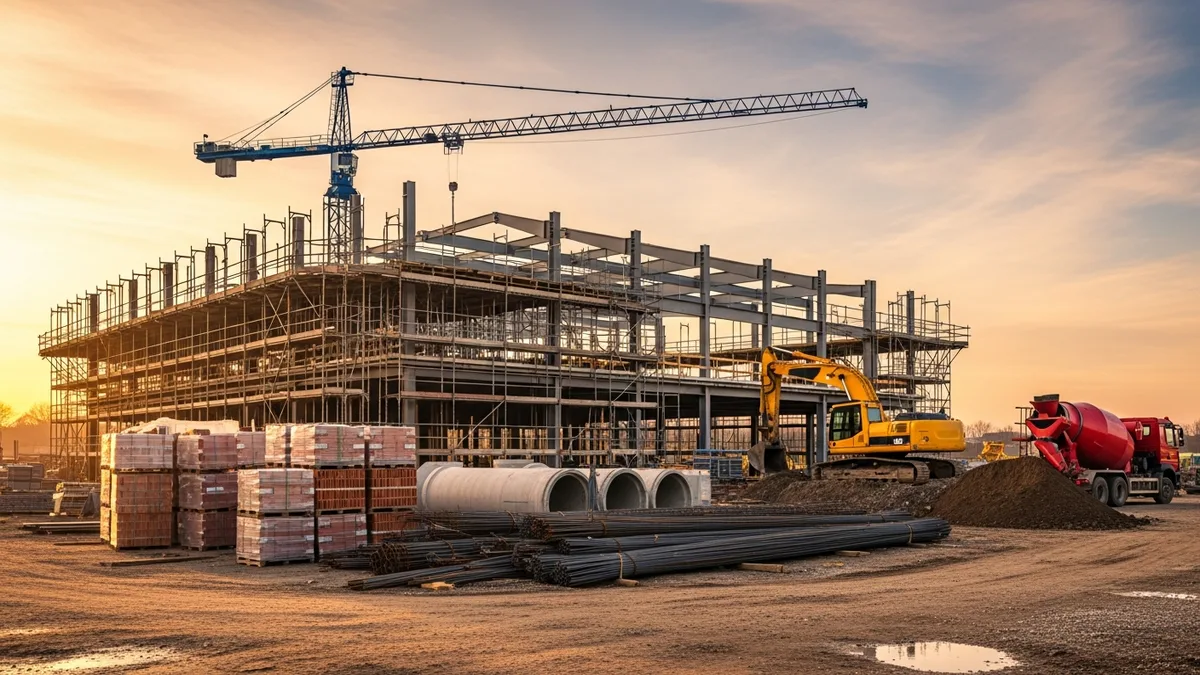
Building cleanrooms and pharmaceutical facilities is one of the most demanding specialties in construction. You are not just putting up walls and running ductwork. You are creating spaces where the air itself is a controlled material, where a single particle in the wrong place can ruin a million-dollar batch of medication, and where every surface, seal, and joint gets tested before anyone in a bunny suit sets foot inside.
If your crew has worked on commercial builds or even data center projects, you have some of the foundational skills. But cleanroom and pharma work layers on strict regulatory requirements, extreme precision in mechanical systems, and a validation process that can feel like building the facility twice: once in the physical world and once in documentation.
This guide breaks down what contractors need to know about air classification, HEPA filtration, gowning rooms, material flow, validation and commissioning, and managing these projects from preconstruction through turnover.
Understanding ISO Air Classifications and What They Mean for Your Build
The backbone of every cleanroom project is its air classification. The ISO 14644-1 standard defines cleanliness levels from ISO 1 (the cleanest, used in semiconductor fabrication) down to ISO 9 (roughly equivalent to a typical indoor space). Pharmaceutical facilities most commonly call for ISO 5 through ISO 8, and the classification you are building to dictates almost every decision on the project.
Here is what contractors need to understand about the most common pharmaceutical classifications:
ISO 8 (Class 100,000 under the old Federal Standard 209E): This is the entry point for most controlled environments. You will see ISO 8 in packaging areas, some manufacturing support spaces, and controlled corridors. Air changes per hour typically fall in the 20 to 40 range. HEPA coverage might be 15 to 25 percent of the ceiling. Wall and ceiling systems still need to be flush, cleanable, and sealed, but the tolerances are more forgiving than higher classifications.
ISO 7 (Class 10,000): A step up that you will find in many active pharmaceutical ingredient (API) processing areas and sterile manufacturing support zones. Air changes per hour jump to 60 to 90. HEPA coverage increases to 30 to 50 percent of the ceiling area. Gowning requirements get stricter, and you will start seeing airlocks between spaces.
ISO 6 (Class 1,000): Less common as an entire room classification in pharma, but you will encounter it. The mechanical systems get substantially larger and more complex at this level.
ISO 5 (Class 100): The standard for aseptic fill areas and critical processing zones. This is where construction gets genuinely difficult. You need unidirectional (laminar) airflow, HEPA coverage approaching 80 to 100 percent of the ceiling, and construction tolerances that leave no room for error. Every penetration, every joint, every surface finish becomes a potential failure point during testing.
From a construction standpoint, each step up in classification roughly doubles or triples the mechanical system complexity and cost. An ISO 8 room might need a 20-ton air handling unit. The same footprint at ISO 5 could require 80 to 100 tons of air handling capacity. Your structural engineer needs to know about this early, because the weight of ductwork, air handlers, and the reinforced ceiling grid system adds serious load to the building.
The classification also drives your preconstruction planning. Procurement lead times for HEPA filter housings, pharmaceutical-grade wall panels, and specialized air handling units can stretch to 16 to 24 weeks. If you are waiting on these items, your schedule is dead in the water.
HEPA Filtration Systems: The Heart of Every Cleanroom
HEPA (High Efficiency Particulate Air) filters are the single most important component in a cleanroom. A true HEPA filter captures 99.97 percent of particles at 0.3 microns. ULPA (Ultra Low Penetration Air) filters push that to 99.999 percent at 0.12 microns and show up in ISO 5 and cleaner environments.
Filter Housing and Ceiling Systems
The way you install HEPA filters matters as much as the filters themselves. There are two primary approaches:
Ducted HEPA installations use individual filter housings connected to supply ductwork. Each filter gets its own sealed connection. This is common in ISO 7 and ISO 8 applications where HEPA coverage is partial.
Fan filter units (FFUs) are self-contained modules with their own motor and HEPA filter. They sit in a T-bar grid ceiling system and provide uniform coverage. FFUs are the standard approach for ISO 5 environments where you need wall-to-wall filtration. They also give you redundancy, since losing one FFU out of a hundred is not catastrophic.
Gel-seal vs. knife-edge vs. fluid-seal housings each have their place. Gel-seal systems use a continuous bead of gel around the filter frame to create a leak-free seal. They are the standard in pharmaceutical work because they eliminate the gasket compression variables that can cause leaks in mechanical clamping systems.
What Contractors Get Wrong
The most common mistake I see on cleanroom jobs is treating HEPA installation like standard ductwork. It is not. Every filter housing needs to be leak-tested individually after installation, typically using a photometer and DOP (Dispersed Oil Particulate) or PAO (Poly-Alpha Olefin) aerosol. A single pinhole leak in a gel seal will fail the room during commissioning.
Your sheet metal crew needs training on cleanroom ductwork standards. Interior surfaces of supply ductwork must be smooth, sealed at all joints, and free of fiberglass liner or exposed insulation. Many specs call for welded stainless steel ductwork in critical areas. The HVAC coordination on these projects is significantly more complex than standard commercial work.
Pressure Cascades
Cleanrooms maintain pressure differentials between adjacent spaces. In pharmaceutical work, you typically see 0.03 to 0.05 inches of water gauge (7.5 to 12.5 Pascals) between each classification level. The cleanest space is at the highest pressure, so air always flows from clean to less clean when a door opens.
In containment applications (handling potent compounds or biological agents), this flips. The containment space is at negative pressure, so nothing escapes. Some facilities need both simultaneously, with positive pressure at the product level and negative pressure at the containment level. The mechanical design for these dual-pressure systems is genuinely complex, and the controls work to maintain stable differentials adds substantial cost.
Building automation systems for cleanroom HVAC need to be fast and precise. A door opening for five seconds in an ISO 5 suite can blow the pressure cascade for the entire wing if the controls do not compensate quickly enough.
Gowning Rooms and Personnel Flow Design
If the HVAC system is the lungs of a cleanroom, the gowning room is the front door. And like any front door, it can let in things you do not want.
Gowning rooms serve as transition zones where personnel shed their street contamination and suit up in progressively cleaner garments as they move toward higher-classification spaces. A properly designed gowning sequence for an ISO 5 aseptic area typically includes:
Pre-gown area (unclassified or ISO 8): Personnel remove outer clothing, jewelry, and personal items. They wash hands and put on dedicated shoes or shoe covers, a hair cover, and a first-layer smock.
Gowning room (ISO 7 or ISO 8): This is where the full bunny suit goes on. Sterile coveralls, boots, double gloves, hood, face mask, and goggles for aseptic operations. The room itself needs a step-over bench or demarcation line separating the “dirty” side from the “clean” side.
Airlock or air shower (transition to ISO 5): A small pressurized space with interlocking doors. Both doors cannot be open simultaneously. Some designs include air showers that blast personnel with filtered air to remove loose particles from the gown surface.
Construction Considerations
From a builder’s perspective, gowning rooms eat up more space than clients initially expect. A properly designed gowning suite for a 20-person operation can easily require 400 to 600 square feet. The room needs HEPA-filtered supply air, smooth and cleanable wall and floor finishes, dedicated lighting with flush-mounted sealed fixtures, and hand wash stations with hands-free operation.
The bench or step-over barrier is a critical design element. It forces personnel to sit, lift their feet over the barrier, and set them down on the clean side, which prevents contamination from shoe soles crossing into the classified area. Some designs use a one-way pass-through from dirty to clean side, which simplifies traffic flow but requires more corridor space.
Every gowning room needs a quality control plan for finishes. The walls and ceilings are typically pharmaceutical-grade panels with flush joints sealed with silicone. Floors are usually sheet vinyl or epoxy with an integral cove base running six inches up the wall. No sharp corners, no exposed fasteners, no ledges where particles can accumulate.
Door hardware matters too. Lever handles get replaced with push plates or automated sliding doors. Anything that personnel touch frequently needs to be cleanable, non-shedding, and resistant to the sanitizing agents used in the facility (which often include hydrogen peroxide vapor, isopropyl alcohol, or peracetic acid).
Material Flow, Airlocks, and Contamination Control
Personnel are one contamination vector. Materials are another. Pharmaceutical facility design separates these flows to minimize cross-contamination risk.
Material Airlocks
Curious what other contractors think? Check out Projul reviews from real users.
Raw materials, components, and packaging enter the classified space through material airlocks (MALs). These are small, sealed rooms with interlocking doors on each side. The material gets placed in the airlock from the unclassified side, the door closes, and after a purge cycle (where the airlock flushes with HEPA-filtered air), the classified-side door opens and staff in gowns bring the material in.
Larger facilities use pass-through chambers for small items and full-room airlocks with roll-up doors for pallet-sized deliveries. The airlock needs to be large enough for the biggest item that will pass through it, plus enough clearance for personnel to stage materials and perform wipe-downs.
Unidirectional Flow
Good pharma facility design moves materials in one direction: raw materials enter at one end, and finished product exits at the other. This prevents raw and finished goods from crossing paths and reduces contamination risk. The construction implication is that the facility layout needs to be finalized early and changes to room adjacencies late in design will cascade through every system.
This is where your scheduling and sequencing becomes critical. Wall panel systems need to go in before ceiling grids. Ceiling grids need to be level and sealed before HEPA housings get installed. Mechanical penetrations through classified walls need fire-rated, sealed pass-throughs that maintain the room’s pressure boundary. If your framing crew punches a hole in the wrong location, patching it to cleanroom standards is a serious headache.
Waste Flow
Waste streams get their own exit paths. Contaminated waste from production areas cannot travel back through clean corridors. Dedicated waste airlocks, or at minimum, designated waste holding areas within each classified zone, are standard. The construction scope often includes specialized flooring with trench drains in washdown areas and sealed waste chute penetrations.
Surface Finishes and Material Selection
Every surface in a classified space needs to meet specific requirements:
- Non-porous and non-shedding (no exposed concrete, no painted drywall, no acoustic ceiling tile)
- Resistant to cleaning and sanitizing agents
- Smooth, with minimal joints and no crevices where microbes can hide
- Electrostatically dissipative in some applications (to prevent static charge from attracting particles)
Common wall systems include powder-coated steel panels with tongue-and-groove joints sealed with pharmaceutical-grade silicone, fiberglass reinforced plastic (FRP) panels, and in some high-end applications, welded stainless steel. Ceilings use walkable or non-walkable panel systems rated for the HEPA filter weight. Floors are typically poured epoxy, polyurethane, or sheet vinyl welded at seams.
Validation and Commissioning: Building It Twice on Paper
Here is where pharmaceutical construction diverges most sharply from every other type of building. In standard commercial work, you build it, punch it, and hand it over. In pharma, you build it, document every single step, then prove it works through a formal qualification process. This process is called validation, and it is driven by FDA regulations (21 CFR Parts 210 and 211), EU GMP Annex 1, and the facility owner’s quality system.
The Qualification Phases
Design Qualification (DQ): Happens before construction. Confirms that the facility design meets the owner’s User Requirement Specification (URS) and complies with all applicable regulations. As a contractor, you may be asked to review and sign off on DQ documents related to your scope.
Installation Qualification (IQ): Performed during and immediately after construction. Verifies that every system and component is installed per the approved design documents. This means comparing as-built conditions against P&IDs, equipment submittals, and specification sections. Your submittal management process needs to be airtight, because IQ auditors will trace every piece of equipment back to its approved submittal.
IQ documentation includes calibration certificates for instruments, material certificates for ductwork and piping, weld inspection reports for stainless steel systems, and installation checklists signed by the installer and verified by quality assurance.
Operational Qualification (OQ): Tests that systems operate correctly across their full range. For HVAC, this means verifying airflow velocities, air change rates, pressure differentials, temperature and humidity control, and HEPA filter integrity at every operating condition (occupied and unoccupied, doors open and closed, different production scenarios).
Performance Qualification (PQ): The final step. Demonstrates that the cleanroom maintains its classification under actual (or simulated) production conditions over a sustained period, typically three consecutive successful runs. Particle counts, microbial monitoring, and environmental data logging all happen during PQ.
What This Means for Contractors
Validation adds 20 to 30 percent to the project timeline and can add 10 to 15 percent to the cost. But it is not optional. Without completed IQ/OQ/PQ documentation, the facility cannot receive FDA approval to operate.
From a practical standpoint, this means:
- Every piece of installed equipment needs a unique tag that matches the design documents
- Your field team needs to maintain installation logs, photographs, and checklists that go beyond standard daily reporting
- Material substitutions require formal change control, not just a field directive
- Punchlist items in a cleanroom can delay the entire validation schedule, so your punch list process needs extra rigor
- Third-party commissioning agents will be on site for weeks or months, and they need access, power, and cooperation from your team
The documentation burden is real. A mid-size pharmaceutical cleanroom project can generate 10,000 to 50,000 pages of qualification documentation. If your team is not set up to produce, organize, and retrieve this volume of paperwork, you will struggle.
Project Management Strategies for Cleanroom and Pharma Builds
Managing a cleanroom project requires all the standard construction management skills, turned up several notches. Here is what separates successful cleanroom contractors from the ones who lose money and credibility on these jobs.
Start Procurement Early
Lead times for cleanroom components are long. Pharmaceutical-grade wall and ceiling panel systems, HEPA filter housings, cleanroom doors and windows, and specialized flooring all have lead times of 12 to 24 weeks. Fan filter units from major manufacturers can take 16 to 20 weeks. If you are not issuing purchase orders during design development, you are already behind.
Build the Commissioning Schedule Into Your Construction Schedule
Do not treat commissioning as something that happens after construction. The commissioning agent will need access to completed zones while construction continues in adjacent areas. This means your schedule needs to account for phased completion, temporary pressurization barriers, and coordination between your finishing trades and the commissioning team.
Map commissioning milestones into your project schedule from day one. If the commissioning agent needs a finished and sealed room to start air balancing by week 40, your ceiling panels, HEPA installations, and wall sealing need to be complete by week 38, which means your rough-in and overhead mechanical need to wrap by week 32. Work backward from the commissioning dates, not forward from the construction start.
Control Contamination During Construction
This sounds obvious, but it trips up contractors constantly. You cannot build a cleanroom in a dirty environment and expect it to test clean. Late-stage construction activities need to follow clean construction protocols:
- Temporary HEPA filtration in completed or near-complete classified spaces
- Wipe-downs of all surfaces before ceiling closure
- Removal of all cardboard, wood, and fibrous materials from classified areas
- Personnel wearing booties and hair covers in pre-finished zones
- Positive pressure maintained in completed areas relative to adjacent construction zones
Some owners require a formal Clean Construction Protocol (CCP) document as part of the contract. Even if they do not, having one protects you during commissioning. When the particle counts come back high and everyone is looking for someone to blame, your CCP logs show that you ran a clean site.
Invest in Your Documentation System
A standard filing system will not cut it on pharma work. You need a document control system that tracks revisions, maintains approval chains, and can produce any document on demand during an audit. Digital systems are the standard now, and having your team trained on the system before mobilization saves weeks of headaches later.
Your document control process should include version-controlled drawings, traceable RFIs, formal change orders with quality impact assessments, and a turnover package structure that matches the owner’s validation file requirements.
Budget for the Learning Curve
If this is your first cleanroom project, be honest about the learning curve. Your mechanical crews will take longer on their first cleanroom ductwork installation. Your panel installation team will need time to figure out the tolerance requirements. Your project engineer will spend twice as long on documentation as they would on a standard commercial job.
Build this learning curve into your estimate and your schedule. The alternative is blowing your budget and falling behind, which is a much more expensive lesson.
Want to put this into practice? Book a demo with Projul and see the difference.
Cleanroom and pharmaceutical facility construction rewards contractors who plan thoroughly, document obsessively, and respect the precision these environments demand. The work is challenging, but the margins on successful cleanroom projects reflect that challenge. Contractors who build a reputation for delivering validated, compliant facilities on schedule will find steady demand in a sector that continues to grow.
Frequently Asked Questions
What is the difference between ISO 5 and ISO 8 cleanrooms?
How much does it cost to build a pharmaceutical cleanroom?
What is IQ/OQ/PQ in cleanroom commissioning?
How long does it take to build a pharmaceutical cleanroom?
What HVAC requirements do cleanrooms have?
Related Articles

Construction Bridge Building and Repair: A Contractor's Field Guide
Bridge construction and repair demand a different level of coordination than most commercial or residential projects....
Read More →
Soil Nail Walls vs. MSE Retaining Structures: A Contractor's Field Guide
Soil nail walls and MSE retaining structures both hold back earth, but they work in completely different ways. This...
Read More →
Construction Data Center & Server Room Build-Out Guide
Data center build-outs are some of the most demanding projects in commercial construction. Every system has to work...
Read More →