
Wastewater Treatment Plant Construction Guide
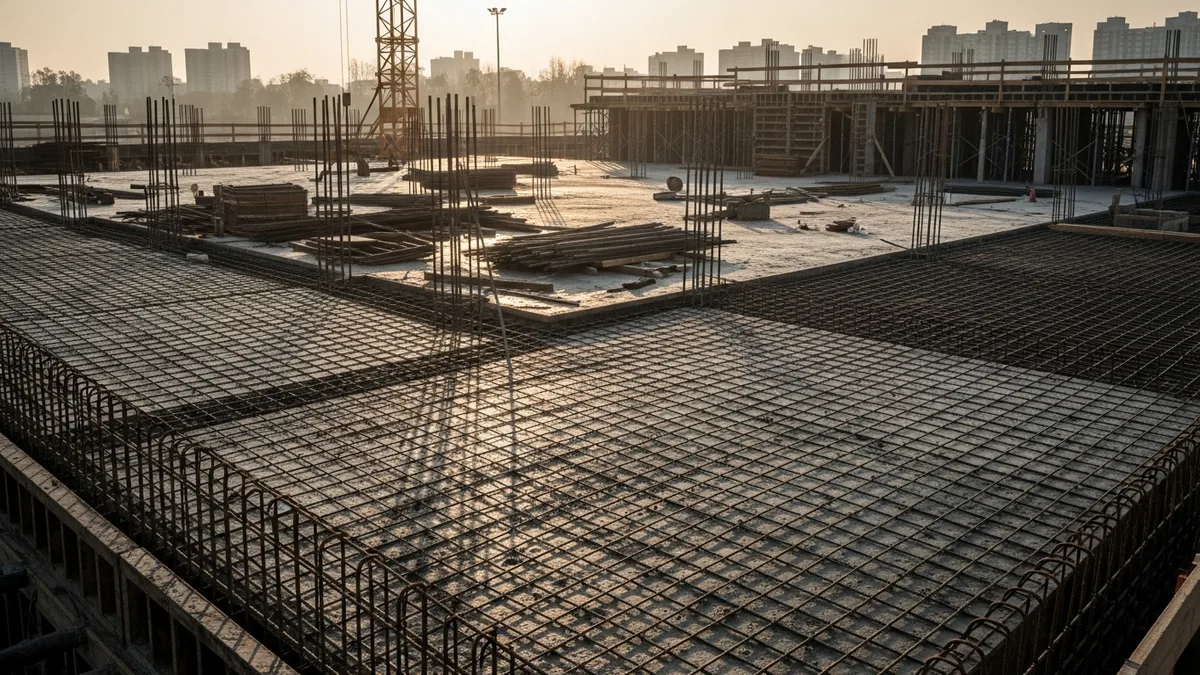
Building a wastewater treatment plant is one of those jobs that separates the generalists from the specialists. You are not just pouring concrete and hanging pipe. You are constructing a living, breathing industrial facility that has to treat millions of gallons of sewage every single day, meet discharge permits down to parts per billion, and keep running for 50 years with minimal downtime. The tolerances are tight, the coordination is relentless, and the consequences of getting it wrong include regulatory fines, environmental damage, and public health risks.
Whether you are a general contractor looking at your first water and wastewater bid, or a seasoned civil builder who wants a refresher on the moving parts, this guide covers what actually goes into building one of these plants from the ground up.
Concrete Tankage: The Bones of the Plant
The concrete work on a wastewater treatment plant is unlike anything you will see in commercial building construction. We are talking about massive reinforced concrete structures designed to hold water permanently, resist chemical attack, and last half a century without leaking. Aeration basins, clarifiers, equalization tanks, digesters, and chlorine contact chambers all demand specific concrete mix designs, placement techniques, and curing protocols.
Most treatment plant specs call for concrete with compressive strengths between 4,000 and 6,000 PSI, with water-to-cement ratios below 0.40 to keep permeability low. You will almost always see requirements for sulfate-resistant cement because hydrogen sulfide in wastewater breaks down standard Portland cement over time. Fly ash, silica fume, and slag cement are common supplementary materials that reduce porosity and improve chemical resistance.
Wall pours on large rectangular tanks might be 30 to 40 feet tall and several hundred feet long. Monolithic pours are preferred to minimize cold joints, which means you could be placing 500 to 1,000 cubic yards in a single pour that runs through the night. Concrete pumps, multiple batch plants, and detailed pour sequencing are not optional. They are survival tools.
Waterstops at every construction joint are non-negotiable. PVC or rubber waterstops get embedded in the concrete at every horizontal and vertical joint to prevent water migration. If a waterstop gets displaced during a pour, you have a leak path that is extremely expensive to fix after the fact. Good formwork crews know this and treat waterstop placement like sacred ground.
Post-pour, thermal control matters. Thick walls and slabs generate heat during hydration, and if the temperature differential between the core and surface exceeds about 35 degrees Fahrenheit, you get thermal cracking. Insulating blankets, temperature monitoring with embedded thermocouples, and sometimes cooling pipes within the concrete are all part of the thermal management plan.
Leak testing is the moment of truth. After curing, every tank gets filled with water and monitored for a set period, typically 24 to 72 hours. Any measurable drop in water level means you have a leak, and you are not moving forward until it is fixed. Injection grouting, crystalline waterproofing coatings, and in some cases, cutting out and replacing sections of concrete are all on the table when leaks show up. Getting concrete right the first time is always cheaper. For more on getting concrete work dialed in, check out our concrete basics guide and our concrete formwork best practices.
Process Piping: The Circulatory System
If concrete is the skeleton of a treatment plant, process piping is the circulatory system. Wastewater, return activated sludge, waste sludge, chemical feeds, disinfection lines, plant water, air headers, and effluent discharge lines all run through a web of piping that connects every process unit in the facility.
Pipe materials vary by service. Ductile iron and HDPE handle raw wastewater and sludge. PVC and FRP (fiberglass reinforced plastic) work for chemical feed lines and non-pressure drainage. Stainless steel shows up in chemical rooms and where corrosion resistance is critical. Large diameter piping, think 36 to 72 inches for main influent and effluent lines, is usually ductile iron or prestressed concrete cylinder pipe (PCCP) for buried runs.
The tricky part is that wastewater piping is not like plumbing in a building. You are dealing with abrasive solids, corrosive gases in the headspace above the water, wide temperature swings in chemical feed areas, and pressures that range from gravity flow to 150 PSI on force mains. Every joint, fitting, and valve has to be right for the specific service it sees.
Valve coordination alone can eat weeks of schedule time. A large treatment plant might have 500 to 1,000 valves, including butterfly valves, plug valves, check valves, gate valves, knife gate valves, and pressure-reducing valves. Each one has a specific function in the process, and the operations team will want to confirm that every valve is accessible, properly oriented, and operable before they accept the plant.
Pipe supports, thrust blocks, and expansion joints need careful engineering. Buried piping runs through soil that moves seasonally. Above-grade piping in pipe galleries and equipment rooms deals with thermal expansion. Large diameter pipes create massive thrust loads at bends and tees that need concrete thrust blocks or restrained joints to keep everything in place.
Hydrostatic testing of process piping is another checkpoint that can make or break your schedule. Every pressure pipe run gets tested to 1.5 times its working pressure and held for a specified duration. Leaks mean cutting out joints, replacing gaskets, and retesting. Plan time for this and do not treat it as an afterthought. Our mechanical piping guide goes deeper on the specifics of process piping coordination.
Electrical and SCADA: The Nervous System
A modern wastewater treatment plant is essentially an industrial facility running on electricity and data. The electrical scope on a mid-size plant can easily be 25 to 30 percent of the total project cost. We are talking about medium-voltage switchgear, motor control centers, variable frequency drives, transformers, emergency generators, uninterruptible power supplies, and thousands of feet of conduit and cable tray.
Power distribution starts at the utility service entrance, typically 12.47kV or 4.16kV for larger plants, stepping down through transformers to 480V for motors and further down to 208/120V for lighting and controls. Redundancy is baked into the design. Most plants have dual utility feeds or an on-site generator sized to run the entire facility during a power outage. Wastewater does not stop flowing when the lights go out, so the plant cannot stop treating it.
Variable frequency drives (VFDs) are everywhere in modern treatment plants. Blowers, pumps, mixers, and chemical feed systems all run on VFDs that allow operators to adjust speeds based on flow conditions. Installing VFDs means dealing with harmonic distortion, proper cable shielding, and heat dissipation in electrical rooms. The VFD vendor’s installation requirements are gospel, and ignoring them leads to premature failures and warranty disputes.
SCADA is where the plant comes to life electronically. Programmable logic controllers (PLCs) in local panels throughout the plant collect data from instruments and control equipment based on programmed logic. Flow meters, level sensors, dissolved oxygen probes, pH analyzers, turbidity meters, and pressure transmitters all feed data back to the PLCs, which relay it to the central SCADA system in the control room.
The SCADA scope includes the hardware (PLCs, network switches, fiber optic cabling, operator workstations, large-screen displays) and the software (the human-machine interface or HMI that operators use daily). SCADA integration is almost always a specialty subcontractor, and they need access to every other trade’s equipment to wire up instruments, calibrate sensors, and test control loops.
Commissioning the electrical and SCADA systems is a multi-week process that involves point-to-point wiring checks, instrument calibration, loop testing (verifying every sensor reads correctly on the SCADA screen), motor bump tests, and functional performance testing of automated sequences. This work has to happen in a logical order because you cannot test a pump control sequence until the pump is installed, wired, and the suction and discharge piping is complete. For more on managing electrical scope on construction projects, take a look at our electrical rough-in guide.
Odor Control: Keeping the Neighbors Happy
Wastewater smells. That is not a surprise to anyone, but what might surprise you is how much engineering and construction effort goes into containing and treating odorous air at a treatment plant. Hydrogen sulfide is the primary culprit, and it is not just unpleasant. It is toxic at higher concentrations and corrodes concrete and metals.
Odor control starts with covering or enclosing the process units that generate the worst smells: headworks (where raw sewage enters the plant), primary clarifiers, sludge handling areas, and sometimes aeration basins. Covers can be flat aluminum or FRP panels, or they can be domed structures over circular tanks. Each covered area has ductwork that pulls foul air out under slight negative pressure and routes it to an odor control system.
The three main treatment technologies are chemical scrubbers, biological scrubbers (biofilters), and activated carbon adsorption. Chemical scrubbers use caustic soda and sodium hypochlorite to neutralize hydrogen sulfide in a packed tower. Biofilters pass foul air through a bed of organic media where bacteria consume the odorous compounds. Carbon systems adsorb odors onto granular activated carbon in a vessel.
From a construction standpoint, odor control systems involve FRP ductwork, FRP scrubber vessels, chemical storage tanks with secondary containment, chemical metering pumps, blowers, and a lot of specialty coatings on concrete and metal surfaces that contact corrosive gases. The ductwork runs can be extensive, sometimes spanning the entire length of the plant, and they need to maintain negative pressure to keep odors from escaping.
Sealing is everything. A cover that leaks air means odor escapes untreated. Access hatches, pipe penetrations through covers, and joints in ductwork all need gasketing and careful fitup. During construction, temporary sealing measures might be needed if you are building adjacent to an active plant.
Testing the odor control system involves air sampling at the property boundary and at specific points within the plant. Many projects have odor emission limits written into the permit, and failing to meet them means the plant cannot pass its operational readiness review. This is not a system where “close enough” works.
Managing the Complexity: Scheduling, Coordination, and Phasing
Wastewater treatment plant construction is project management at its most demanding. You are juggling civil, structural, mechanical, electrical, instrumentation, HVAC, and specialty trades across a site that often has an existing plant running right next to your construction zone. The existing plant cannot shut down, period. Sewage flows 24 hours a day, 365 days a year, and the community depends on continuous treatment.
Thousands of contractors have made the switch. See what they have to say.
Phased construction is the standard approach. You build new facilities while the old ones keep running, then cut over flows from old to new in carefully planned switchovers that might happen during low-flow periods at 2:00 AM on a Sunday. Each phase has its own set of tie-in points where new piping connects to existing systems, and every tie-in is a potential disruption to plant operations if it goes sideways.
Long-lead equipment procurement is a scheduling reality that can make or break the project. Large pumps, blowers, generators, SCADA panels, and specialty items like membrane bioreactor systems or UV disinfection units can have lead times of 6 to 12 months or longer. If you do not get purchase orders placed early in the project, you will be staring at empty equipment pads while the rest of the plant sits finished around them.
Coordination meetings are not a luxury. Weekly meetings with all major trades present are the bare minimum. On larger projects, daily pull planning sessions using lean construction principles keep work moving and conflicts visible before they become problems. Our pre-construction planning guide covers how to set up coordination protocols that actually work on complex jobs.
Document control is another area where treatment plant projects separate the organized from the overwhelmed. Submittals, RFIs, shop drawings, O&M manuals, as-built drawings, and commissioning records add up to thousands of documents over the life of the project. Missing a submittal deadline on a long-lead item can cascade through the schedule for months. A solid document control system is not optional on these projects.
Quality control requires full-time attention. Concrete testing, welding inspection, pipe joint testing, electrical testing, and coating inspection all need qualified inspectors and a paper trail that satisfies the owner, the engineer, and the regulatory agency. Third-party testing labs, certified welding inspectors, and specialty coating inspectors are standard members of the project team.
The budget exposure on wastewater projects is significant. Change orders from differing site conditions (high groundwater, contaminated soil, unexpected existing utilities) are common. Having solid change order management processes protects your margins and keeps the project on track financially.
Commissioning and Startup: Bringing the Plant to Life
Commissioning a wastewater treatment plant is not like punching out a commercial building. You are testing an integrated industrial system where every component depends on others to function correctly. The commissioning process typically spans several months and follows a structured sequence from individual component testing through full system performance.
The sequence generally goes like this: pre-functional checks (verifying installation completeness), individual equipment testing (running each pump, blower, or mixer independently), system-level testing (running connected groups of equipment together), and finally, performance testing with actual wastewater flowing through the system.
During startup, process engineers work alongside operators to establish the biological treatment process. Activated sludge systems need time to grow the right population of microorganisms that break down organic matter. Seeding the system with sludge from another plant speeds this up, but it still takes weeks to months to develop a stable, well-settling biomass. During this period, effluent quality may not meet permit limits, and the regulatory agency usually grants a startup period where temporary discharge limits apply.
Training plant operators is a contractual requirement on most wastewater projects. The contractor and equipment vendors provide hands-on training covering every system in the facility. Operations and maintenance manuals fill shelves of binders, and the SCADA system needs to be fully documented with control narratives that explain every automated sequence.
Substantial completion on a wastewater project is not just about finishing construction. It means the plant is treating wastewater to permit standards, operators are trained, all documentation is submitted, and the facility is ready for continuous operation. The warranty period typically starts at substantial completion, and the contractor remains on the hook for warranty callbacks on every piece of equipment and every system for at least one year.
Closeout documentation on treatment plant projects is extensive. As-built drawings, O&M manuals, spare parts lists, warranty certificates, training records, commissioning reports, and regulatory compliance documentation all need to be compiled and delivered. Our closeout documentation guide covers how to stay ahead of the paperwork instead of drowning in it at the end.
Wrapping Up
Wastewater treatment plant construction sits at the intersection of civil, mechanical, electrical, and process engineering. It demands precision in concrete work, expertise in process piping, deep knowledge of electrical and controls systems, and careful attention to odor control and environmental compliance. The projects are long, complex, and unforgiving of mistakes.
But they are also some of the most rewarding work in construction. When you build a treatment plant, you are building infrastructure that protects public health and the environment for generations. Every gallon of clean effluent that flows out of your plant is proof that the concrete held, the pipes sealed, the controls worked, and the team delivered.
Ready to see how Projul can work for your crew? Schedule a free demo and we will walk you through it.
For contractors managing these kinds of complex projects, having the right project management tools makes a real difference. Tracking schedules, coordinating trades, managing documents, and keeping budgets in line across an 18 to 36 month build requires more than spreadsheets and sticky notes. That is exactly the kind of work Projul was built to support.
Frequently Asked Questions
How long does it take to build a wastewater treatment plant?
What types of concrete are used in wastewater treatment plant construction?
What is SCADA and why is it important for wastewater treatment plants?
How do contractors manage odor control during wastewater plant construction?
What are the biggest risks in wastewater treatment plant construction?
Related Articles
Construction Bridge Building and Repair: A Contractor's Field Guide
Bridge construction and repair demand a different level of coordination than most commercial or residential projects....
Read More →
Soil Nail Walls vs. MSE Retaining Structures: A Contractor's Field Guide
Soil nail walls and MSE retaining structures both hold back earth, but they work in completely different ways. This...
Read More →
Construction Data Center & Server Room Build-Out Guide
Data center build-outs are some of the most demanding projects in commercial construction. Every system has to work...
Read More →