
Free Kitchen Remodel Estimate Template (2026 Costs + Line Items)
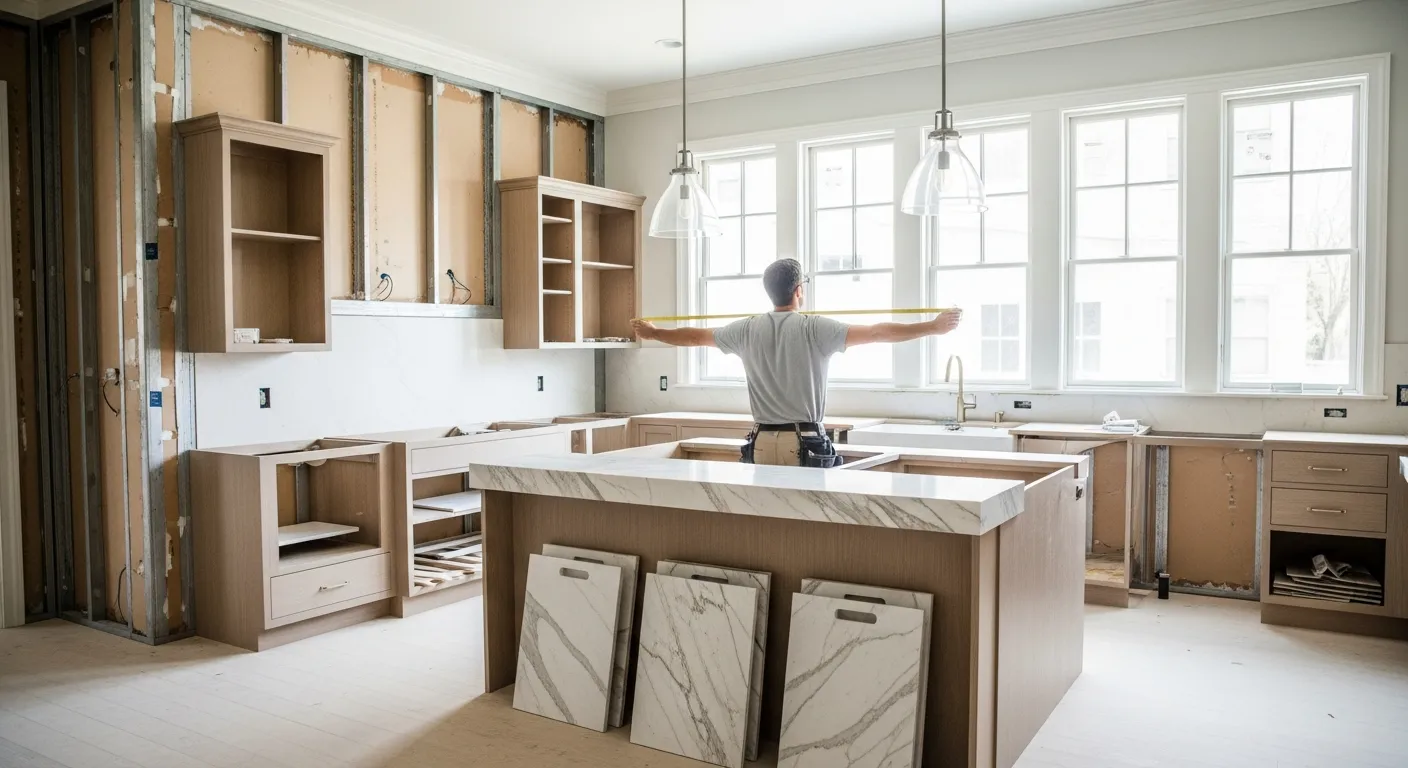
TL;DR: Kitchen remodels in 2026 run $15,000 to $30,000 for a cosmetic refresh, $30,000 to $75,000 for a mid-range remodel, and $75,000 to $150,000+ for a full gut renovation. The biggest cost drivers are cabinets ($5K to $25K), countertops ($2K to $8K), and labor ($50 to $85/hr). A good estimate template keeps every line item visible so nothing slips through the cracks. Download our free kitchen estimate templates and start sending accurate bids today.
Need a kitchen remodel estimate template you can download and use right now? You are in the right place. Below you will find free templates in PDF and Excel formats, plus a full breakdown of 2026 kitchen remodeling costs so you can price every job with confidence.
Over 5,000 contractors use Projul to cut estimating time in half. In this guide, we cover the key line items every kitchen estimate needs, walk through real 2026 cost ranges by category, and show you exactly how to fill out your template step by step.
Get Your Free Kitchen Estimate Template
Download Projul’s free construction estimate templates - built by contractors, ready to customize. Create professional estimates in minutes and win more jobs.
Why Every Contractor Needs a Kitchen Remodel Estimate Template
If you have ever sat down to write a kitchen remodel estimate from scratch, you know how tedious the process is. You pull out your notepad or open a blank spreadsheet. You start listing out demo work. Then cabinets. Then countertops. Then you remember you forgot plumbing rough-in costs. You go back and add those. Then you realize you did not account for the electrician. Before you know it, two hours have passed and you are still working on a single estimate.
A kitchen estimate template fixes that entire cycle. Instead of starting from zero, you start with a pre-built framework that already includes the most common kitchen remodel line items. You adjust quantities, plug in your local rates, and the estimate is ready to send. What used to take a full morning now takes 30 to 45 minutes.
The consistency factor matters too. When every estimate follows the same format, you stop forgetting line items. That stray plumbing cost or the permit fee you always overlook? It is already in the template, waiting for you to fill in the number. That consistency protects your margins across every single project.
Projul carries a 4.9/5 G2 rating for its ease of use, and our kitchen remodel estimate templates were created by industry experts with years of experience. These templates include all the essential parts of a kitchen remodeling cost estimate - labor costs, material costs, permit fees, equipment rentals, and other project-related expenses.
2026 Kitchen Remodel Cost Ranges by Category
Before you fill out any kitchen estimate template, you need to know what things actually cost in 2026. The table below gives you realistic price ranges for each major line item. These numbers reflect national averages - your local market may be higher or lower depending on labor rates and material availability.
| Category | Low End | High End | Notes |
|---|---|---|---|
| Cabinets | $5,000 | $25,000 | Stock vs. semi-custom vs. custom; includes hardware |
| Countertops | $2,000 | $8,000 | Laminate to quartz/granite; includes fabrication and install |
| Flooring | $1,500 | $5,000 | LVP, tile, or hardwood; includes underlayment and waste factor |
| Plumbing | $2,000 | $6,000 | Higher if relocating sink or adding fixtures |
| Electrical | $1,500 | $4,000 | New circuits, lighting, panel upgrades if needed |
| Appliances | $3,000 | $15,000 | Budget to premium; includes installation fees |
| Labor | $3,000 | $12,000 | General contractor labor for project coordination |
| Permits | $200 | $1,000 | Building, electrical, and plumbing permits vary by city |
| Demolition | $500 | $2,000 | Includes disposal fees and dumpster rental |
| Backsplash | $800 | $3,000 | Subway tile to natural stone; includes grout and accent pieces |
| Painting | $500 | $2,000 | Walls, ceiling, trim; moisture-resistant paint recommended |
| Lighting | $300 | $2,000 | Recessed, pendant, under-cabinet; includes fixtures and install |
Total range for a mid-range kitchen remodel in 2026: $20,300 to $85,000
These numbers are useful as a starting point, but always adjust for your local market. A kitchen remodel in San Francisco will cost very different from one in rural Texas. The key is having every category listed in your template so nothing falls through the cracks.
For more on building accurate estimates quickly, check out our guide on 5 steps to create estimates faster.
2026 Kitchen Remodel Costs by Scope
Not every kitchen remodel is the same size job. A homeowner who wants new countertops and a fresh coat of paint is a completely different project than someone who wants to tear their kitchen down to the studs and start over. Here is how costs break down by scope in 2026.
Minor Refresh: $15,000 to $30,000
This is the “make it look new without tearing anything out” tier. You are keeping the existing layout and most of the infrastructure. The typical scope includes:
- Refacing or painting existing cabinets and adding new hardware
- New countertops (laminate or mid-grade quartz)
- Fresh paint on walls and ceiling
- Updated light fixtures
- New faucet and sink (using existing plumbing lines)
- New backsplash over existing substrate
A minor refresh is the fastest turnaround, usually 4 to 6 weeks. You do not need to pull permits in most cases unless you are adding electrical. The profit margins on these projects can be solid because the labor hours are predictable and there are fewer surprises behind the walls.
Mid-Range Remodel: $30,000 to $75,000
This is where most kitchen remodels land. The homeowner wants a noticeably different kitchen but is not changing the footprint. The typical scope includes everything in the minor refresh, plus:
- New stock or semi-custom cabinets with full installation
- Higher-end countertops (quartz or granite)
- New flooring throughout the kitchen (LVP, tile, or hardwood)
- Electrical work for additional outlets, under-cabinet lighting, or pendant lights
- Plumbing updates for new sink location or upgraded fixtures
- New appliance package (mid-range brands)
- Dumpster rental and full demo of existing materials
A mid-range remodel typically runs 8 to 10 weeks. You will need building permits and likely separate electrical and plumbing permits. Budget tracking matters here because there are enough moving parts that costs can creep if you are not watching. Projul’s budgeting tools help you track actual spending against your estimate in real time so you catch overruns before they eat your margin.
Full Gut Renovation: $75,000 to $150,000+
This is the “tear it all out and start fresh” tier. Everything goes, down to the studs. The typical scope includes:
- Complete demolition of existing kitchen
- New layout with possible wall removal or relocation
- Custom or high-end semi-custom cabinets
- Premium countertops (natural stone, waterfall edges)
- All new plumbing rough-in and fixtures
- Full electrical rewire with dedicated circuits for appliances
- New subfloor and premium flooring
- High-end appliance package
- Custom lighting plan with dimming controls
- Structural work if removing load-bearing walls
Full gut renovations run 12 to 16 weeks minimum, and custom cabinets alone can add 6 to 8 weeks of lead time. These projects require detailed scheduling and constant communication with clients. Every week the project runs over schedule costs you money in labor and damages your reputation.
At this tier, your estimate needs to be extremely detailed. Missing a $2,000 line item on a $15,000 project hurts. Missing a $2,000 line item on a $100,000 project might not break you, but stack up five or six misses and you have given away $10,000 to $12,000 in profit.
Cost Breakdown by Component
Let’s go deeper on what each major component actually costs in 2026 and what drives the price up or down.
Cabinets: $5,000 to $25,000
Cabinets are almost always the biggest single line item. Stock cabinets from a big box store run $75 to $150 per linear foot installed. Semi-custom cabinets jump to $150 to $400 per linear foot. Full custom cabinets from a local shop can hit $500 to $1,200 per linear foot.
The hidden costs with cabinets are fillers, crown molding, end panels, and lazy susans or pull-out organizers. A client who picks a $10,000 cabinet package can easily add $2,000 to $3,000 in accessories and trim pieces. Make sure your estimate template has separate line items for cabinet accessories so you are not eating those costs.
Countertops: $2,000 to $8,000
Laminate countertops run $10 to $25 per square foot installed. Butcher block is $40 to $70. Quartz and granite run $50 to $120 per square foot including fabrication and installation. Premium natural stone like marble can go even higher.
Watch out for sink cutouts ($150 to $300 each), edge profiles ($10 to $30 per linear foot upgrade), and seam placement. A kitchen with an L-shaped counter will have at least one seam, and the fabricator charges for each one. Always measure twice and order once because countertop mistakes are expensive to fix.
Flooring: $1,500 to $5,000
LVP (luxury vinyl plank) is the most popular kitchen flooring right now at $3 to $7 per square foot installed. Tile runs $8 to $15 per square foot. Hardwood is $8 to $20 per square foot depending on species and grade.
Do not forget the waste factor. Always order 10% extra for cuts and mistakes. If you are running the flooring under the toe kicks of new cabinets (which you should if the cabinets are not installed yet), you need to account for that additional square footage. Include underlayment and transition strips as separate line items.
Plumbing: $2,000 to $8,000
If the sink stays in the same spot and you are just swapping fixtures, plumbing might only be $1,500 to $2,500. But the moment a client says “I want to move the sink to the island,” your plumbing costs can triple. Running new supply lines and drain lines through a slab or crawl space is a full day of work for a plumber.
Other plumbing items that add up: pot fillers ($300 to $800 for the fixture alone), ice maker lines for the fridge, dishwasher hookups, and garbage disposal installation. List each one separately in your estimate so clients see where the money goes.
Electrical: $1,500 to $4,000
Kitchen electrical codes have gotten stricter. Most kitchens now need dedicated 20-amp circuits for the fridge, dishwasher, garbage disposal, and microwave. If you are adding an island with outlets, that is another circuit run plus the cost of cutting into the floor.
Under-cabinet lighting, pendant lights, and recessed lighting all need their own wiring runs. If the existing panel is full (common in homes built before 2000), you are looking at a $1,500 to $3,000 panel upgrade on top of everything else. This is one of the most commonly underestimated categories in kitchen remodels, so pad your numbers here.
Appliances: $3,000 to $15,000
Budget appliance packages (fridge, range, dishwasher, microwave) start around $3,000. Mid-range packages run $5,000 to $8,000. Premium brands like Wolf, Sub-Zero, or Thermador can blow past $15,000 for the package.
Include installation fees as a separate line item. Gas ranges need a gas line hookup ($150 to $300). Built-in microwaves need trim kits. Counter-depth fridges sometimes need cabinet modifications. These small costs add up fast when you are not tracking them.
Labor: $50 to $85 per Hour
General labor rates for kitchen remodels run $50 to $85 per hour depending on your market. Specialty trades like electricians and plumbers typically charge $75 to $125 per hour. Tile installers run $60 to $100 per hour.
Track labor hours carefully. Projul’s time tracking tools let your crew clock in and out from their phones using the mobile app, so you know exactly how many hours each phase of the project actually took. That data is gold for future estimates because it tells you whether your labor estimates are accurate or need adjusting.
How to Price Kitchen Remodels for Profit
Knowing what things cost is only half the equation. The other half is pricing the job so you actually make money. Here is how experienced remodeling contractors price kitchen jobs for profit.
Material vs. Labor Split
On a typical kitchen remodel, the material-to-labor split runs about 40/60. That means for every $100,000 kitchen remodel, roughly $40,000 goes to materials and $60,000 goes to labor (including your crew, subcontractors, and your own time on-site). Some projects skew more toward materials if the client picks premium cabinets or appliances. Others skew more toward labor if there is a lot of custom work or structural changes.
Understanding your split matters because it affects your markup strategy. Materials have a smaller margin but are more predictable. Labor is where most of your profit comes from, but it is also where cost overruns happen. Track both categories separately in your estimates using a tool like Projul’s budgeting feature so you can see where your money is actually going.
Markup Strategies
Most remodeling contractors mark up materials 15% to 25% and labor 30% to 50%. Your total markup needs to cover your overhead (office rent, insurance, trucks, software, marketing) and your desired profit margin.
A simple way to think about it: if your overhead rate is 18% and you want a 12% net profit, your total markup needs to be at least 30%. That means a $50,000 job at cost needs to bid at $65,000 to hit your target. If you are bidding at $55,000 to “stay competitive,” you are working for 10% margin and one surprise eats your entire profit.
Do not compete on price alone. Compete on professionalism, speed, and accuracy. A clean estimate sent the same day with a detailed scope of work wins more jobs than the cheapest bid sent a week later. Projul’s estimate and change order tools help you send polished estimates fast, and e-signatures let clients approve on the spot from their phone.
Contingency: 15% to 20%
Build a 15% to 20% contingency into every kitchen remodel estimate. Not 10%. Kitchen remodels have more unknowns than most contractors want to admit. Once you open up walls, you find water damage, outdated wiring, plumbing that does not meet current code, or subfloor rot. If you priced the job with a 10% contingency and the surprises hit 15%, that extra 5% comes out of your pocket.
Present the contingency as a separate line item on the estimate. Be upfront with the client about why it exists. Most homeowners understand that older homes have surprises, and they appreciate a contractor who plans for them instead of hitting them with change orders every other week.
Handling Change Orders Mid-Project
Change orders are unavoidable on kitchen remodels. The client visits a showroom and falls in love with a countertop that costs $3,000 more than what they originally picked. Or they decide to add a pot filler while the plumber is already on site.
Have a clear change order process before the project starts. Projul’s change order system lets you create, price, and get approval on changes right from the job site. The client signs off on their phone, the change is documented, and your budget updates automatically. No arguments at the end of the project about what was or was not included.
For more on managing change orders, check out our free construction change order templates.
How to Use This Kitchen Remodel Estimate Template
Follow these eight steps to turn a blank kitchen estimate template into a professional bid your clients can trust.
Step 1: Gather project details. Before you open the template, walk the kitchen with the homeowner. Measure the space, note the existing layout, and discuss what they want to change. Take photos of everything - cabinets, countertops, flooring, appliances, and any problem areas. The more details you collect upfront, the fewer surprises you will face later.
Step 2: Pick the right template tier. Not every kitchen remodel is the same scope. Use a basic template for cosmetic refreshes (paint, hardware, countertops). Use a mid-range template for partial remodels (cabinets, countertops, flooring, backsplash). Use a full template for gut renovations where everything gets ripped out and replaced. Starting with the right tier saves you from adding or removing dozens of line items.
Step 3: Fill in demolition and removal costs. Start at the beginning of the project timeline. How much demo work is needed? Account for tearing out cabinets, countertops, flooring, backsplash, and appliances. Include dumpster rental and disposal fees. In older homes, add time for potential lead paint or asbestos testing.
Step 4: Enter material costs for each category. Work through the template line by line. Enter costs for cabinets, countertops, flooring, backsplash, paint, lighting fixtures, and hardware. Use current supplier pricing - not last year’s numbers. If you are unsure on a material cost, call your supplier for a quick quote before sending the estimate.
Step 5: Add labor costs per trade. Break labor out by trade - plumber, electrician, tile installer, painter, and general labor. Use your actual crew rates or sub-contractor quotes. Do not guess on labor hours. If a tile backsplash takes your crew 8 hours and you estimate 4, that mistake comes straight out of your profit. For a deeper look at mortar selection and installation methods, see our tile setting and thin-set guide.
Step 6: Include permits and inspection fees. Check with your local building department for current permit costs. Most kitchen remodels need at least a building permit. If you are moving plumbing or electrical, you will likely need separate permits for each. Add these as their own line items so the client sees them clearly.
Step 7: Add your markup and contingency. Apply your standard markup percentage to cover overhead and profit. Then add a 10-15% contingency line item. Once demo starts and you open up walls, surprises are almost guaranteed - rotted subfloor, outdated wiring, water damage, or mold. The contingency protects both you and your client.
Step 8: Review, format, and send. Read through the entire estimate one more time. Make sure every line item has a dollar amount. Check that your totals add up. Add your company logo, contact info, and payment terms. Then send it to the client while the project details are still fresh in their mind. The faster you send a professional estimate, the more likely you are to win the job.
What Every Kitchen Remodel Estimate Should Include
A solid kitchen remodel estimate needs to account for every phase of the project. Missing even one category can mean eating costs you did not plan for. Here is a breakdown of the major sections your kitchen estimate template should cover:
Demolition and Removal: This includes tearing out existing cabinets, countertops, flooring, backsplash, and appliances. You also need to account for disposal fees and dumpster rentals. Demo work is often underestimated because it seems simple, but hauling out old materials, dealing with unexpected issues behind walls, and proper disposal all take time and money.
Cabinets: Cabinets are usually the single biggest line item in a kitchen remodel. Your kitchen cabinet estimate template section should break out cabinet costs by type (stock, semi-custom, or custom), installation labor, and any modifications needed to fit the space. Include hardware costs separately so the client can see exactly what they are paying for.
Countertops: Whether the client wants laminate, granite, quartz, or butcher block, your estimate needs material cost per square foot, fabrication fees, and installation labor. Do not forget to account for sink cutouts and edge profiles, which often carry additional charges.
Plumbing: Plumbing costs vary dramatically depending on whether the client is keeping the existing layout or moving the sink, dishwasher, or adding a pot filler. Your template should have line items for rough-in work, fixture installation, and any pipe relocation.
Electrical: Similar to plumbing, electrical work ranges from simple outlet additions to full rewiring. Include line items for new circuits, lighting installation, under-cabinet lighting, and any panel upgrades required by code.
Flooring: Tile, hardwood, vinyl, or LVP all carry different material and installation costs. Your template should account for square footage, underlayment, transitions, and waste factor (typically 10% extra).
Backsplash: Subway tile, mosaic, natural stone, or painted. Include material, installation, grout, and any accent pieces.
Appliances: While some clients purchase their own appliances, many expect the contractor to handle procurement and installation. Your template should include appliance costs and installation fees as separate line items so the client understands both components.
Paint and Finish Work: Walls, ceiling, trim, and touch-up painting. This is easy to underestimate, especially in kitchens where you need moisture-resistant paint and multiple coats.
Permits and Inspections: Most kitchen remodels require at least a building permit, and many also require separate electrical and plumbing permits. Include these fees in your template so they do not come as a surprise.
Contingency: A 10-15% contingency line is standard practice for kitchen remodels. Once demo starts and you open up walls, surprises are almost guaranteed. Rotted subfloor, outdated wiring, water damage, or mold are all common discoveries. Having a contingency built into the estimate protects both you and your client.
Save Time and Money with a Kitchen Estimate Template
Projul’s estimate templates save contractors 1-2 hours per estimate on average. Projul offers no per-user fees, so your whole estimating team benefits. If you are creating even just 5 estimates per week, that can add up to a whole day’s worth of work… every week! By using a kitchen estimate template, you can feel like you have an 8-day work week. Why start from scratch and waste your valuable time when you can use Projul’s pre-built framework to match your project requirements? Plus, Projul’s templates are customizable, so you can add your own branding and style to make it uniquely yours.
The financial impact of faster estimating goes beyond just saving time. The faster you send estimates, the more likely you are to win the job. Homeowners shopping for a kitchen remodel contractor typically reach out to three or four companies. The first contractor to send a professional, detailed estimate has a significant advantage. If you are taking three days to put together your bid while a competitor sends theirs the same afternoon, you are already behind.
Speed also means volume. If you can produce estimates twice as fast, you can bid on twice as many projects. Even if your close rate stays the same, you are winning more jobs simply because you are putting more bids out there. For remodeling contractors, estimating speed is one of the biggest controllable factors in revenue growth.
Projul’s template system lets you save multiple templates for different project types. You might have one for a basic kitchen refresh (paint, hardware, countertops), another for a mid-range remodel (cabinets, countertops, flooring, backsplash), and another for a full gut renovation. When a lead comes in, you pick the closest template and customize from there. The heavy lifting is already done.
For a deeper look at managing your remodeling business, check out our remodeling contractor software guide.
Cook Up Accurate Kitchen Remodeling Cost Estimates
Estimating labor costs, material costs, and other project-related expenses blindly leads to profit leaks. Contractors using Projul report a 32% profit increase from more accurate estimates. With Projul’s templates, you can create estimates that are accurate and reliable, keeping your project on budget. Often, construction companies using pen and paper for their estimates do not know the final cost breakdown until after they are drowning in material receipts. By using a kitchen remodel estimate template, you set your kitchen remodeling project up for success, leading to better profits.
Accuracy in kitchen remodel estimates comes down to three things: knowing your costs, accounting for every scope item, and building in appropriate margins. Templates help with all three.
Knowing your costs means having accurate, up-to-date pricing for materials and labor in your market. Lumber prices, cabinet costs, and countertop pricing all fluctuate. A good template makes it easy to update these numbers as prices change, so every estimate reflects current reality rather than last year’s pricing.
Accounting for every scope item is where templates really shine. It is easy to forget the small stuff when you are writing an estimate from memory. Trim pieces. Drawer pulls. Appliance hookups. Disposal fees. These items might only be $50 or $100 each, but when you miss ten of them on a single project, that is $500 to $1,000 off your bottom line. Multiply that across a year of projects, and you are talking about serious money.
Building in appropriate margins means understanding your overhead and profit goals. Your template should include your markup percentage so every estimate automatically includes your target margin. If your overhead rate is 15% and your target profit is 10%, those numbers should be baked into the template so you never accidentally bid a job at cost.
Customize Your Kitchen Remodel Estimate Template for Any Project
No two kitchen remodeling projects are the same, but they can be close. Projul’s 26+ features include flexible template customization that lets you present a unique estimate in minutes. Even if all the costs are not 100% the same, starting with a kitchen remodeling estimate template and customizing the details of the job allows you to present a unique estimate as quickly as 1,2,3! Projul’s kitchen remodeling estimate templates are flexible and fully customizable, designed to fit your needs. You can easily add or modify line items, adjust quantities, and input labor rates and material costs to match your project’s unique requirements.
The beauty of customizable templates is that they grow with your business. When you first start using them, you might have a single general template. As you complete more kitchen remodels, you will notice patterns. Maybe 70% of your projects include a specific scope of work. You can create a template that reflects that common scope, so your most frequent estimate type is ready to go with minimal adjustments.
You can also create client-facing templates that match your brand. Projul’s branding and customization tools let you add your logo, colors, contact information, and terms and conditions directly into every template. When a homeowner receives your estimate, it looks professional and polished. That presentation matters more than most contractors realize. A clean, well-organized estimate signals that you run a professional operation, which builds confidence in your ability to deliver the project.
Projul’s selections feature takes customization a step further by letting you present multiple options within a single estimate. Instead of sending three separate estimates for different cabinet tiers, you include all three options in one document. The client picks what they want, and the estimate updates automatically. It saves you time and gives the client a better experience.
Win More Jobs with Kitchen Remodel Proposal Templates
A well-crafted proposal showcases your expertise and attention to detail. Over 5,000 contractors use Projul’s customizable proposal templates to win more bids. Projul costs just $4,788/year, and one extra closed deal covers that investment many times over.
Read real contractor reviews and see why Projul carries a 4.9/5 on G2.
Winning kitchen remodel jobs is not just about having the lowest price. Homeowners are making a major investment in their home, and they want to feel confident in the contractor they choose. A detailed, professional proposal builds that confidence in ways that a handwritten estimate on a legal pad simply cannot.
Your proposal is your first impression. It tells the client whether you are organized, thorough, and professional before they ever see your work on a job site. When your proposal clearly breaks down every phase of the project, explains what is included, and sets expectations for timeline and payment, the client feels comfortable moving forward.
Projul’s proposal templates also make it easy to include project timelines, payment schedules, and terms and conditions. These details matter because they set expectations upfront and reduce the chance of misunderstandings later. When a client knows exactly when each phase will be completed and when each payment is due, there is less friction throughout the project.
The follow-up process matters just as much as the proposal itself. Projul’s CRM and lead management tools help you track which proposals have been sent, which clients have viewed them, and which ones need a follow-up call. That visibility into your pipeline helps you close more jobs and keeps potential revenue from slipping through the cracks.
Common Kitchen Remodel Pricing Mistakes to Avoid
Even experienced contractors make pricing mistakes on kitchen remodels. Here are the most common ones and how a good kitchen estimate template helps you avoid them:
Underestimating demo time. Tearing out an old kitchen always takes longer than you think, especially in older homes where you might encounter lead paint, asbestos tiles, or outdated electrical. Build a generous time allowance into your demo line item.
Forgetting about lead times. Custom cabinets can take 6-8 weeks to arrive. Specialty countertops might need 3-4 weeks for fabrication. If you do not account for these lead times in your project timeline, your crew will be sitting idle waiting on materials while you still pay their wages.
Not accounting for scope creep. Kitchen remodels are notorious for scope creep. “While you are in there, can you also…” is a phrase every remodeling contractor has heard a hundred times. Your estimate should include clear language about what is and is not included, and your change order process should be ready to capture any additions.
Ignoring overhead costs. Your estimate should not just cover materials and labor. It needs to account for your truck, your insurance, your office expenses, your software, and every other cost of doing business. Templates with built-in markup percentages help you consistently cover overhead without having to recalculate it on every bid.
Pricing too low to win the job. It is tempting to cut your margins to beat the competition, but winning a job at a loss is worse than not winning it at all. Accurate templates help you know your true costs so you can price competitively without going below your profit floor.
Forgetting demo and haul-away costs. Demo is not free. A full kitchen tear-out generates a surprising amount of debris. Dumpster rental runs $350 to $600, and if you need multiple loads, that number doubles. Add labor for the crew to rip everything out, sort materials, and haul debris to the dumpster. On older homes, you may also need asbestos or lead paint testing before demo begins ($200 to $500). If these costs are not in your template, they come straight out of your margin.
Underestimating electrical for islands. Adding an island with outlets, pendant lighting, and an under-counter microwave or cooktop means running circuits through the floor. In a slab-on-grade home, that means cutting concrete, which is a $1,000 to $2,000 add just for the floor work. Your electrician still needs to wire everything and tie it back to the panel. Many contractors estimate island electrical at a few hundred dollars when the real cost is $1,500 to $3,000.
Not accounting for permit fees. Permits are not optional on most kitchen remodels, and they are not cheap. Building permits run $200 to $500 in most cities. Separate electrical and plumbing permits add another $100 to $300 each. Some cities also charge plan review fees. Total permit costs can easily hit $600 to $1,000 on a mid-range kitchen remodel. If you did not include them in the estimate, you either eat the cost or surprise the client with an unexpected add-on.
Missing backsplash behind appliances. Here is one that catches a lot of contractors: the client picks a beautiful tile backsplash, and you price it for the visible wall area. Then the appliances go in and you realize there is a gap behind the range or next to the fridge where the old backsplash was torn out but the new one was never installed. Now you need to order more tile, bring the installer back, and eat the cost. Always measure the full backsplash area including behind appliances, not just the visible sections.
Skipping the budget template. An estimate tells you what you plan to spend. A budget template tells you what you are actually spending as the project moves forward. Without both, you are flying blind. Pair your estimate template with Projul’s budgeting tools to track costs in real time and catch overruns before they become profit killers.
For more guidance on running a profitable construction business, make sure your estimating process is dialed in.
Wrap Up
Projul’s free kitchen remodeling estimate templates save you time, effort, and headaches while keeping your estimates accurate. With a 4.9/5 G2 rating and 2+ hours saved daily, Projul helps remodeling contractors close more deals faster. With Projul, you can remodel with confidence, knowing that your estimates are reliable and your process is dialed in.
The bottom line is simple. Kitchen remodel estimates do not have to be painful. When you pair accurate estimates with fast invoicing, you get paid faster and keep cash flow healthy. With the right templates, the right tools, and a consistent process, you can turn estimating from a time-consuming chore into a competitive advantage. Every estimate you send faster, more accurately, and more professionally than your competition is another step toward growing your remodeling business. You can also check out our guide on bathroom remodel estimates for templates tailored to bathroom projects.
Every minute you spend building estimates from scratch is a minute you could be spending on the job site, meeting with clients, or growing your business. Templates do not cut corners. They cut waste. They make sure every estimate is thorough, consistent, and professional. And for remodeling contractors competing in a market where homeowners have plenty of choices, that kind of professionalism is what separates the contractors who are booked out for months from the ones scrambling for their next project.
Get Started with Projul Today
Projul is trusted by 5,000+ contractors and rated 4.9 out of 5 on G2.
See how Projul makes this easy. Schedule a free demo to get started.
Get Your Free Kitchen Estimate Template
Download Projul’s free construction estimate templates - built by contractors, for contractors. Create professional estimates in minutes and win more jobs.
DISCLAIMERWe make no warranty of accuracy, timeliness, and completeness of the information presented on this website. Posts are subject to change without notice and cannot be considered financial advice.
Frequently Asked Questions
What is Projul and how can it help with my kitchen remodels?
How do I create cost estimates for a kitchen renovation?
What itemized costs are included in a kitchen remodel budget template?
How long does a kitchen remodel take from start to finish?
Do I need permits for a kitchen remodel?
Should I use time and materials or fixed price for kitchen remodel estimates?
Related Articles

How Construction Teams Use AI to Cut Admin Time
Most contractors lose a full day every week to paperwork. AI now handles the repetitive admin work that used to eat...
Read More →
Concrete Tilt-Up Construction: A Contractor's Complete Field Guide
Tilt-up construction accounts for roughly 15 percent of all industrial and commercial buildings in North America. This...
Read More →
How to Implement Construction Software Without Losing Your Mind
Most construction software rollouts fail. Not because the software is bad, but because the rollout was rushed. Here are...
Read More →